- Brilliant Traces
- Up Review
- Langston Hughes
- Up Preview
- Awake and Sing!
- The Blue Room
- The Good Doctor
- Arsenic and Old Lace
- Mary Gould
- The Comedy of Errors
- Charleston Theatre Overview 2006
- Village Playhouse
- Little City Musical Theater
- Mark Twain
- Mark Mixson
- High Drama in Osage County
- Harvard Sailing Team review
- Monkey: Journey to the West
- Desdemona review
- This War is Live Spoleto review
- A Devil Inside review
- Desdemona preview
- This War is Live preview
- Cloud Tectonics preview 1
- Cloud Tectonics preview 2
- A Devil Inside preview
- Flora preview
- Lobby Hero preview
- The Tragedian preview
- Under the Lights preview
- Bill Patton
- Marc Bamuthi Joseph
- Company
- Taming of the Shrew
- The Philadelphia Story
- Once Upon a Mattress
- Eurydice
- Neely Bruce
- Hansel and Gretel canceled
- Colder Than Here
- This War is Live by Jeff Messer
- Toys in the Attic
- Songs for a New World
- Nice Day for a WASP Wedding
- A Thurber Carnival
- Butterflies Are Free
- Best Music in a So-So Musical
- Best Black Comedy
- Best Imaginary Set
- Best Oh Shit! Moment
- Dead Man’s Cell Phone review
- The Subject Was Roses
- Twelfth Night
- Dead Man’s Cell Phone preview
- Balanchine
- The Altruists Review
- The Altruists Preview
- Tail Wagger Productions
- Health Nuts
- Romance
Brilliant Traces aims to be a real pressure-cooker of a play
by Nick Smith October 7, 2009
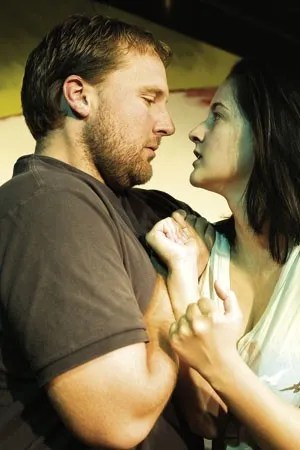
Brilliant Traces is many things. It’s a stunningly taut drama, a showcase for two experienced actors who are willing to take risks, and a brave combination of extended metaphor and elegiac imagery. Just don’t call it a comedy.
Because it’s being staged at Theatre 99, home of The Have Nots!, director Greg Tavares expects the audience to come in ready to laugh. “For the first five or 10 minutes, things will be taken as funny,” he says. “The tension in the room will come from the audience, not the stage.” A few laughs will help to ease that tension, but Tavares is adamant that the show is dark and challenging for the actors.
He adds, “It’s a great theater person’s action piece.”
The actors have plenty of time over the play’s 90-minute length to develop their characters, but they don’t get much of a breather. After a few blackouts to create the sensation of passing time, Tavares says that “the lights go up and they don’t go down until the end of the fucking show.”
Written by Cindy Lou Johnson, Brilliant Traces tells the story of Henry Harry, a man who has sworn off personal relationships to live hermit-like in an Alaskan cabin. And sleep a lot. His seclusion is interrupted by the surprise arrival of Rosannah DeLuce, a runaway bride brought in by a blizzard. Like Henry, she wants to escape her responsibilities and get as far away from her loved ones as possible.
Johnson has created these two misfits to enable her to write about those times in our adult lives when we want to run away from home, the demands of family life, and the crushing familiarity of the world around us. Henry feels that people are too unpredictable, continually sabotaging his search for a peaceful life. Rosannah finds her friends and relatives too cloying and ultimately harmful. It’s not much of a common bond for the two characters to share, but it might just be the start of a strong new connection.
Johnson’s play has been around since the late ’80s. When Tavares saw Brilliant Traces for the first time at Columbia’s Trustus Theatre, it stunned him. “It was very dramatic, full of tension,” he says.
Several years later he played Henry in a Charleston version of the show. Now The Have Nots! co-founder is directing a play that, he says, “has stood the test of time.
“It had no great stars to launch it, no Broadway run, but it still gets produced because of the merit of the script,” he says.
To bring Rosannah DeLuce to life, Tavares chose 23-year-old CofC graduate Eleanor Hollingsworth, who will be moving to Chicago after the run. “I wanted to do a project with her before she left,” says Tavares, “because she brings a smoldering tension to everything she does. She’s properly trained but wildly experimental. She’ll go anywhere and do anything you ask her to do.”
Hollingsworth will be joined by Lee Lewis as Henry. Lewis is well known to Theatre 99 audiences from his work in the comedy groups Doppelganger and Moral Fixation, but he’s a fine dramatic actor as well. Chops or not, the director’s sure that this production will put Lewis and Hollingsworth through their paces.
“These are two giant roles that are not like the actors themselves,” Tavares says. “The characters’ nature are incredibly flawed and unadjusted. There are things in life they haven’t healed from that they want to avoid. They don’t want to look at the things that hurt them.”
In real life, Lewis is a psychiatrist at MUSC and the practical opposite of wandering Henry Harry. Tavares occasionally has to remind him how screwed up Henry really is. And Hollingsworth is the kind of worldly woman who’ll look you in eye and tell you what she means. Rosannah feels like she’s floating above the ground, never centered or content.
“It’s a crazy, hard job, but for me, if I don’t believe them I don’t care,” Tavares concludes. “The big payoff will be if I believe them. If that happens, then we’ll be blown away.”
Expect a dark, intense drama with some comedic moments and a pair of neurotic characters snowed into a cabin with potentially explosive results. But don’t expect to relax. If all goes to plan, Tavares hopes that this pressure-cooker play will have audience members gritting their teeth and hanging onto the edge of their seats from beginning to end.
“It’s a very tense thing you’re watching,” he laughs. “You’ll be paying to get stressed.”
PURE’s Up rises above its source material
by Nick Smith October 7, 2009
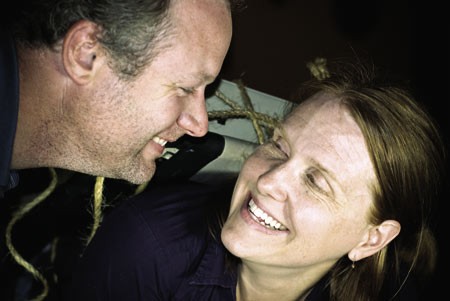
Sometimes a theater company can lift the quality of a play beyond its source material, adding nuances where none have been written, fleshing out two-dimensional characters with strong, vivid performances. But normally, actors are too respectful of a script — no matter what its quality — to truly improve it.
Bridget Carpenter’s Up is slim on plot, heavy on metaphor, and lacking in conflict. Since it’s supposed to deal with the tiffs, tensions, and disappointments of domestic life, lack of conflict is a definite downer. Thankfully, PURE Theatre uses colorful visuals, natural acting, and a light touch to raise the entertainment quotient. Not all of it flies, but there are enough magic moments in this production to make it worth seeing.
Director Sharon Graci uses a few strong, affecting colors to set the tone of the play. The backdrop, stage, and drapes are all sky blue. Shelves are mounted on the back wall, holding red cups and other crockery. A table and chairs are enough to indicate a kitchen area. This is where the Griffin family gathers, their wishes unfulfilled, their household roles about to be shaken up completely.
Helen Griffin is the main wage earner of the family, a postal worker who once took pride in her work. Now she’s marking the years left till she retires. Walter is her stay-at-home husband, an inventor who cares more about his gadgets than his bank balance. The pressure is starting to show, as he hasn’t produced a newsworthy device in 16 years — and that was a one-off, a lawn chair carried aloft by helium balloons.
Mikey is their awkward 15-year-old son who hates high school and has no friends until he meets Maria, a pregnant teen with a forthright view on everything. Mikey is introduced to Maria’s Aunt Chris, who has a barely legal office supply business. Mikey starts selling equipment for her and earning some serious wages.
As the brave Helen, Cristy Landis has an essential role in the play. She’s the ever-dependable lynchpin of the family, the working stiff funding her husband’s dream work. By the time we meet her, she’s losing her patience, so Landis is tasked with balancing commitment with increased irritation.
R.W. Smith is a great everyman, portraying Walter as an amiable dreamer who wants to please his wife without conforming to the traditional stereotype of hubby-as-breadwinner. When his mind starts to disintegrate, Smith is believable, sympathetic, and unpredictable.
Some of the most memorable scenes in the play are between Smith and Rodney Lee Rogers, who embodies Walter’s heroic fantasy, French tightrope walker Philippe Petit. The Frenchman fuels Walter’s unorthodoxy with bon mots like “a bird does not need a wallet.” Like Petit, Rogers makes his art look effortless, exuding confidence and playfulness that’s perfect for the character.
The younger actors aren’t quite as relaxed, but Jon Raz van Pinxteren does a good job of playing a more assured Mikey in the second act of the play, when he’s become a successful seller for Aunt Chris. His boss is a fun character, whether she’s reading tarot cards, boot scootin’ to “Folsom Prison Blues,” or bumming around in her nightgown. Tara Denton is careful not to exaggerate Chris’ traits, giving a louche, unpretentious performance.
As Maria, Carly Sumner Ridgeway has one of the toughest jobs in the show. On several occasions her character reminds us that she’s pregnant when the evidence is as plain as the bump on her belly. In one scene she recites French words relating to flight and descent. In another unsubtle moment, she tells us that being in love made her feel floaty. Still, Ridgeway does well with what she has.
In effect the playwright is walking her own high wire, balancing between an insightful look at the human condition and cheesy flying motifs. But she never falls, and the PURE pros stabilize the play when it wobbles.
Graci continues to incorporate strong, emotionally powerful visuals right up to the end. Hers is the best balancing act of all — she stays true to the text without falling for its cloud-hopping metaphors. The results are — dare we say it? — uplifting.
THEATRE Half-Baked Ham
by Nick Smith October 4, 2006
Langston Hughes’s Little Ham
Art Forms & Theatre Concepts
Running through Oct. 10, 2006
Dock Street Theatre
It’s Harlem, 1936, with the Depression hammering businesses and ruthless gangster Louie “The Nail” Mahoney hitting them even harder. But that doesn’t stop the characters of Little Ham from dancing.
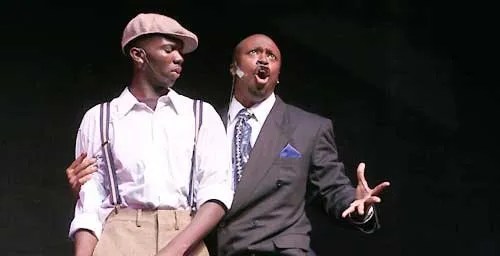
Art Forms and Theatre Concepts’ MOJA production opens with the cast dancing in a row in front of a black curtain, each defined by his costume and the way he moves. Although they all follow the same basic dance steps, they bring their own personalities to the pattern. There’s Hamlet “Ham” Hitchcock Jones (Antwan Crawford), sleeves and pants legs rolled up to make him look gawky; Jimmy (Warnell Berry Jr.), mincing around as befits his flamboyantly gay character; and a street cop (Patrick Dugan), beating time with his baton. Louie (Delvin L. Williams) struts past them all, inspecting his would-be victims. It’s a slick way to introduce the characters, and one of the few highlights of the first act.
Much of the action takes place in Lucille’s shoeshine place, where Ham works and dreams of finding his fortune and a “Sunday woman” to spend it on. Lucille’s husband Leroy enjoys giving Ham a hard time, but the young hero can’t really be blamed for not getting much work done — all of the characters visit the place to gossip or to gamble.
Louie wants some of Lucille’s action — and a share of every other business in town. He even wants to run a protection racket on Tiny Lee’s beauty parlor (another inventive set from designer Tripp Storm). Once Louie recruits Ham as a hoodlum-in-training, that creates a dilemma for the title character — he loves Tiny. But how can he help her if he’s riddled with holes by Louie’s growling associate, Rushmore?
This is a fairy-tale version of Harlem, and Ham’s got more than a touch of Cinderella about him, going from rags to riches at the wave of a crooked wand. He even gets to the ball — the Hello Club Ball, where he has choreographer Alisha Simmons to help him out, drawing on original 1930s dances to keep him in step. While the few fight scenes in Little Ham seem poorly staged and actors occasionally block each other from view, the dancing’s a strong point.
As Ham, Crawford is like Chris Rock with acting chops, handling the singing and comedy well. Lisa Robinson’s Tiny Lee matches his talents, and she’s only hampered by an overly restrictive costume. Warnell Berry Jr. does what he can with his contritely campy character, whose too-short solo hints at great talent. Similarly, Jimmy’s friend Sugar Lou Bird (Lea S. Anderson) does what she can with her role as the gangster’s moll with a heart of gold.
Not everyone in the cast can sing. Williams creates a memorably vain and menacing bad guy, but has particular trouble hitting his low notes. Larchmont (played by Zorba Breshers) and Clarence (Nicholas James) are also off-key, and Opal (Juanita B. Green) can’t be heard over the live five-piece band.
Compared to Gilliard’s previous musicals and despite the best efforts of the cast, the first act of Ham seems disappointingly flat, failing to fully engage the audience. The whole show feels under-rehearsed. A little extra work on the songs, sets, and storytelling would have helped immensely. The gospel-styled “Angels” wakes the audience up at the top of Act Two, which moves a lot faster and has stronger songs than the first half. It’s as if the cast realizes it has to boost its efforts and sing together to assist the weaker vocalists. Like their characters, they achieve goals in unison that they couldn’t hope to alone.
PURE Theatre tackles the serious and the fanciful in Up
by Nick Smith September 30, 2009
Maybe it’s the result of the media constantly telling people they just aren’t good enough — that they need to learn a new language, lose those love handles, bedazzle the hell out of that old blue-jean jacket. For whatever reason, some people simply feel like they aren’t doing enough with their lives. They want more. They want to further their careers, strike it rich, grab the big brass ring. They want to move up in the world.
Playwright Bridget Carpenter’s Up mines this desire and the dissatisfaction that can accompany it. All the characters in the play feel a deep need to rise above their station in life.
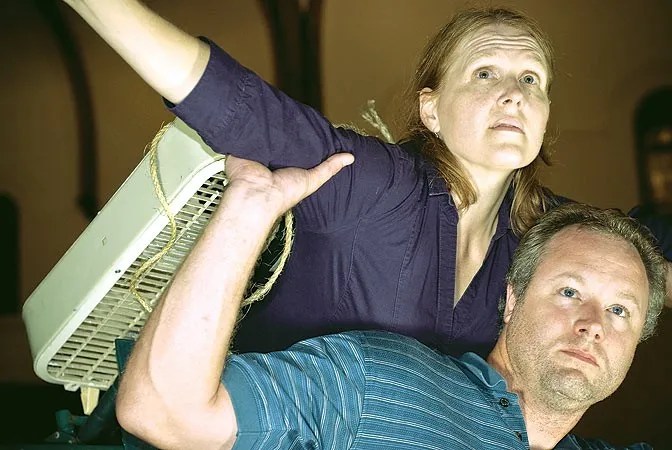
Frustrated inventor Walter Griffin (R. W. Smith) wants to recapture the magic moment when he made his lawn chair fly 16,000 feet up in the air 16 years ago, gaining a brief moment of fame. His wife Helen (Cristy Landis), a mail carrier, wants him to be more practical. Their son Mikey (Jon Raz Van Pinxteren) wants wealth and success.
While Walter spends his time planning his next flight, Helen brings home the bacon, needling her husband to earn some dough. Mikey meets pregnant teen Maria (Carly Sumner Ridgeway), a young lady so precocious that she belongs in a Diablo Cody movie. Despite his wife’s niggles, Walter continues to dream, fantasizing visits from tightrope walker Philippe Petit (Rodney Lee Rogers), a name that should be familiar to viewers of the documentary Man on a Wire.
“The scenes with Philippe Petit are very theatrical,” says director Sharon Graci, PURE Theatre co-founder and artistic director. “Most of Bridget Carpenter’s writing is clean. The dialogue is not at all heightened.” In other words, the characters talk like real people instead of poetical creatures of the stage. “It’s not heavy drama,” she adds. “There’s an essence of magic to it, with Walter really wanting to fly.”
Like the recent Pixar movie Up, this play is inspired by truck driver Larry Walters’ 1982 lift-off via helium balloons. He was stuck sky-high for 14 hours before he descended and got caught on power lines (local artists Bob Snead and Seth Gadsden have tried similar experiments with varying results).
Before her stint as a writer/producer on the television series Friday Night Lights, Carpenter took Walters’ much-publicized adventure and developed it as a play with a traditional, linear structure and a solid, universally recognizable conflict — the struggle between the dreamer and the realist. She saw the play as a chance to examine marriage in its idealized and truthful forms.
Don’t expect any high-wire acts or soaring effects in PURE’s version of the show. There’s no way for the company to hang lights in Lance Hall, let alone lift a lawn chair into the air. There are no smoke and mirrors to distract the audience from the acting on stage. PURE can’t create dramatic transitions through lighting — they have to do it with their performances. “There’s nowhere to hide whatsoever in our theater,” says Graci. “There is no fallback. We have to overcome the limitations of our space in creative ways. It’s not easy, but we get down to the business of what the script’s about. It provides a good opportunity to really look at characters and relationships.”
The cast makes the most of Lance Hall’s meager space. “We do use every bit of stage,” Graci explains. “We’ve broken up the action so that it takes part in different parts of theater.”
The key to making Up work is to clarify Walter’s character. Is he an obsessive nut, a Walter Mitty fantasist, or a suburban hero? Whatever PURE decides to do with him, there’s plenty of scope here for intimate scenes, narrative surprises, and instants that will resonate with the audience.
“The characters find themselves investigating their circumstances and the aftermath of their actions,” says Graci. “The ways they relate is a common theme. That’s where we find similarities in our own behavior.”
Although this is a serious play, its subject matter is lighter and more fanciful than some of PURE’s past work. After all, the focal point of the story is a lawn chair that can fly thanks to the help of lots and lots of balloons.
With that in mind, is this the heralding of a new, fluffier side to the theater company?
“Cheering people up is great,” Graci responds, “but it’s not our driving force. We’re more interested in raising the bar consistently.”
It seems that Walter Griffin isn’t the only one with high-flying ambitions. And there’s nothing wrong — or nutty — about that.
Awake and Sing! is an old-fashioned affair
by Nick Smith September 23, 2009
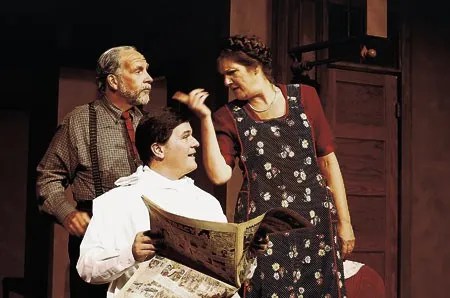
A heart-rending ensemble drama by a great American playwright may seem like a guaranteed winner for a theater company like Village Playhouse, but time has not been altogether kind to Clifford Odets, mainly because his plots and characters have been aped and homaged half to death over the past 75 years.
In 1935’s Awake and Sing!, a domineering Jewish mother called Bessie Berger treads her size 10s all over the men in her family. Her husband Myron is punch-drunk from her jabs and jibes. Grandpa Jacob reminds them of the sacrifices it took to get them to America. Impressionable young Ralph seeks direction in life. Uncle Morty is a loud mouthed fat ‘n’ happy capitalist. And Hennie is a promiscuous ingénue. They live in a Bronx tenement, their luxuries dwindling as the Great Depression commences. The proto-social realist storyline borders on soap opera territory at times — one character even says he has “one life to live.” What once was novel is now cliché. Anything new and fresh must come from the characters and the actors who play them. Fortunately, for every line of dialogue that rings familiar, there’s another that reminds us of Odets’ brilliance.
Ryan Ahlert really holds the show together as Moe Axelrod, and it’s a delight when he’s on stage. As a cynical wheeler-dealer with a soft center, he’s the perfect hero for a beleaguered age. Moe’s affection for Hennie allows Ahlert to show a deeper dramatic side as well.
He’s joined by a well-cast group of actors who will be familiar to regular Playhouse patrons. Josh Wilhoit makes an effectively boorish Morty, with hair as slick as his patter. Like Ahlert, he brightens the stage when he’s present, and while we would have liked to see him show more sides to the character, he plays an effectively likeable rogue. Jeff Jordan gives the most natural performance as Myron, the straight man of the play. He doesn’t have any big speeches — Myron just wants a quiet life — but he helps add realism to the slices of home life.
Playing a part beyond his years, Nat Jones creates a multifaceted, ultimately vulnerable version of Jacob. His thick Eastern European accent makes him hard to hear a couple of times, but for the most part, he is soulful and easy to identify with.
The younger members of the cast, Rebecca L. Anderson (Hennie), Jake Hennessy (Sam), and Eric Brown (Ralph) all acquit themselves well. Anderson makes sure that her selfish character remains sympathetic. Hennessy is equally likeable in his role as a put-upon husband. Brown is careful not to get too emotional too quickly, building slowly to Ralph’s epiphany at the end of the play.
The Playhouse stage just isn’t big enough to contain Kathy Summer, who plays Bessie. Summer has taken the Jewish-mother shrug, arms stretched wide, palms upwards, to the extreme. Every other line is punctuated by this gesture — and she has a lot of lines. Summer gives a strong, crowd-pleasing performance, but her over-the-top mannerisms are incredibly distracting. Her appearance would be a lot more powerful if she held back those hands.
It’s always a marvel to see how set designer Keely Enright and set constructor David Reinwald fit so much into their small space. This time, though, their set looks too expansive. Apart from a couple of small upstage rooms, the Berger apartment looks positively spacious. It doesn’t give off that sense of a cramped working-class tenement. However, the period furniture and props are spot-on and a brown color scheme is complemented by Reinwald’s subdued lighting, suggesting that we’re looking at a guileless sepia world of yore.
Director Enright has taken an old-fashioned play with a heart-on-its-sleeve message about helping your fellow man, and she’s made it funny, poignant, and compelling. And if you can see past the clichés, you’ll recognize shades of your own family in the Bergers as they kvetch around the dining table.
The folks in Theatre /verv/’s Blue Room are feeling very randy
by Nick Smith September 16, 2009
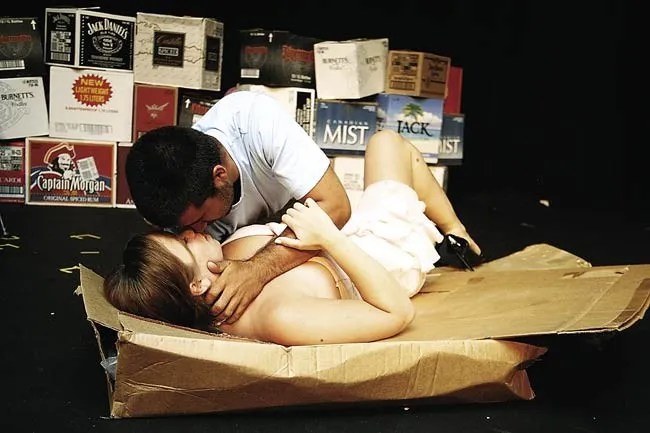
Nicole Kidman’s naked buttocks are not enough, you would think, to launch a Broadway show. But in 1998 they did just that. Kidman was the star attraction of The Blue Room, playing five different characters. Critics concurred that the play, a British adaptation of 1900’s Der Reigen, was average at best. Yet audiences still flocked to catch an all-too-brief glimpse of Kidman’s buns, making the production a hot and heavy hit.
Hanahan-based production company Theatre /verv/ doesn’t have Nicole or a Broadway budget (or any budget for that matter), so they’re left with the text, a series of 10 intimate scenes that explore sexual desire, infidelity, and the way relationships are different depending on the age gap. In each scene there’s a couple, then one of the pair joins another partner for the next scene, linking disparate narratives and settings. The result is disjointed; short, anemic scenes knock boots with longer, deeper philosophical ones. The vignettes develop the characters as much as they can within the space of five or 10 minutes, and we do get to know them quite well. But there isn’t much room left for a story — it’s boy meets girl, then the girl meets another boy, then he meets a girl and so on for an hour and a half.
Director and company founder J.C. Conway has taken great pains to spice up the action, creating some involving drama that’s as fast-paced as the talkative text allows. Half of the scenes are videotaped and projected on a screen; the other half are staged.
By alternating screened and live pieces, Conway shows the actors’ strengths and weaknesses. Actors Ben Meelan (the Cab Driver) and Justinh Avery (the Student) are more comfortable on stage. Others, like Jelena Zerega (the Married Woman) and Jesse Budi (the Aristocrat) are particularly photogenic and come across best on film. It’s a real challenge for the actors to make an impact in both media while maintaining a continuity of character from one scene to the next. For the most part, the cast meets that challenge.
Video director Mark Gorman makes the most of his format so that it’s not just a gimmick. He uses lots of close-ups and hand-held camera moves, telling the story in ways that a live performance cannot. He doesn’t use much artificial light, suggesting a dark demimonde of sex-hungry strangers. Sadly, that means we can’t always see the actors’ eyes or faces, the key to creating an emotional connection with them. In other moments, porn movie dialogue that might have worked on stage sounds silly on camera. “It’s so hot,” says the Student, willing an au pair to strip for him. “My bra hurts,” says a model before she whips it off in her scene.
This version of The Blue Room has a lot going for it — capable performances, some subtle lighting, a restrained use of incidental music, and a cheery minimalism necessitated by the lack of coin. As with previous /verv/ shows, it highlights some talented, young actors; Katie Holland, Tishala Martinal, and Boogie Dabney are particularly memorable in their roles. But the production suffers from a detrimental devotion to the text. Playwright permitting, Conway and Gorman should not be afraid to tighten the scenes and adapt the British dialogue to fit their American cast. Around here, shagging means something completely different.
THEATRE Playing Doctor
by Nick Smith September 13, 2006
The Good Doctor
Village Repertory Co.
Running through Sept. 24, 2006
Village Playhouse
Life can be stressful for a playwright. Once a work is complete, producers, directors, and actors have a chance to interpret it as they see fit. Every new production has an even chance of becoming a polished gem or a dog’s dinner.
Neil Simon, creator of the Village Playhouse’s latest, would be pleased to know that they’ve scrubbed up The Good Doctor to make an appealing gewgaw; after all, he admitted that his 1973 comedy was little more than a string of sketches — a vaudeville show linked by a convivial narrator.
Simon brings his New Yorker sensibilities to the world of Russian literature, channeling the work of Anton Chekhov like a wild-eyed Coney Island medium. The narrator is Chekhov as a young humorist, fretting over the short stories that may become his legacy. Simon uses Chekhov’s character to share the trials of writing with the audience, from the agony of mental blocks to the ecstasy of finding an inspired idea.
The Good Doctor is a simple show, and the set and lighting are correspondingly modest, tailored to its 19th-century setting. The costumes impressively evoke Chekhovian society, from its ragged hawkers to its white-gloved higher echelons.
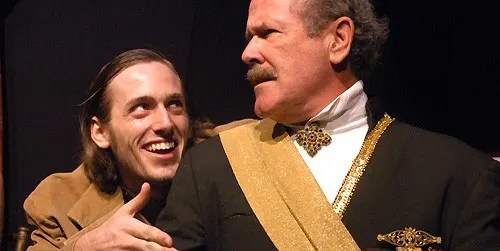
As emcee Chekhov, Brad Leon maintains an easygoing flow from one scene to the next. He deftly slips into other personae, sometimes before our eyes. He portrays a Great Seducer of Other Men’s Wives like a fey Regency England dandy, as silky smooth as his jaunty top hat. His overeager apprentice dentist character is imbued with the energy and high-pitched squeals of Elmo from Sesame Street.
Jake Hennessy contrasts this with a Topol-type voice in his role as a Sexton who’s reluctant to have his tooth pulled. Hennessy gives us a range of amusing characters and vocal impressions that help to differentiate between his characters. He plays a Jimmy Durante-styled lowlife and a couple of simpering subordinates, scraping his way around a set that sometimes seems too small for him.
There’s more contrast in the upper crust appearances of Steve Fordham, often acting as a straight man ignorant of the antics around him. But he excels in a silly scene at the show’s climax, heaving a mightily bandaged foot around as he unsuccessfully fends off a money-grubbing client with equally mighty buttocks.
With a lot of padding and grimacing, Maggie Jo Saylor gets the most laughs as the money-grubber. She’s joined in an earlier scene by Paulette Todd, who delivers the most distinctive characterizations through the play; high-school talent Ally Bing completes the cast, most notably appearing as a young governess and a phlegmatic actress.
As Chekhov points out to the audience, the misfortune of other people is a source of great amusement. The Good Doctor gives plenty of spins on such pain, physical and emotional, and it’s funny stuff. The show’s a good test of the actors’ comedic mettle, and they aren’t found wanting.
But it seems that, notwithstanding their modesty, Simon and Chekhov were aiming for something higher in the interpretation of their texts, aware that the best comedy is leavened with strong pathos. Director George Younts is celebrated for knowing exactly what he wants, and he gets it in this production. It’s a cheery play with a little bit of food for thought, but nothing that the audience can’t digest in a hurry. Through all the screaming and the slapstick, though, serious dramatic moments are not exploited to their full potential, and the actors don’t seize these opportunities to show how versatile they really are. Lonely or unfulfilled characters stay sketchy, and what should be an electrifying moment — an excerpt from Three Sisters — fails to create a buzz. That qualifies this Doctor as a first-aid fix of fun rather than a major operation.
THEATRE Lace Relations
by Nick Smith September 13, 2006
Arsenic and Old Lace
Footlight Players
Running through Sept. 23, 2006
Footlight Theatre
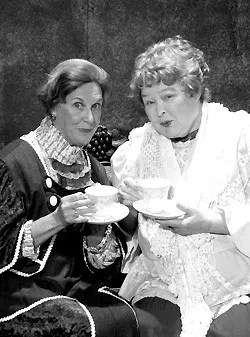
Hello there! Come on in and have a cup of tea, won’t you dearie? I do so like having visitors. You see, I live here with my sister Martha and our nephew Teddy — don’t mind Teddy, he just thinks he’s President Roosevelt — and it helps to have a fresh body in here once in a while to liven up the place.
You’ve arrived in time for some splendid news. Those community theatre darlings, the Footlight Players, are staging our story to launch their 75th season. I find that “bully,” as Teddy would say, because although their production has some flaws, it still hits enough comedic notes to make it a worthwhile evening at the theatre.
My sister is reminding me to point out that we personally abhor anything to do with the theatre, and are very concerned that our nephew Mortimer is a dramatic critic. But the babyfaced Adam Miles plays him with such innocence and energy that he makes an imperfect character seem rather nice. Adam is a good actor with a strong voice that counterpoints his cherubic appearance. The sight of him kissing his fiancée Elaine still makes us giggle, though.
Mortimer’s much sweeter than Jonathan, the black sheep of the family. He fancies himself as some kind of criminal, affording playwright Joseph Kesselring with precious opportunities to make fun of gangsters and “old dark house” movie clichés. Jonathan is portrayed by another accomplished actor, Mike Ferrer, who’s saddled with some disappointing makeup. Mike manages to be menacing despite his panda eyes, giving some of the most natural reactions in the play. He’s obviously a Methodist.
Mortimer and Jonathan both discover our secret, and for some reason they make a big fuss about it. What’s wrong with burying a few bodies in the cellar, for Heaven’s sake? Before we know it, our house is as busy as Piccadilly Circus, with police coming in and out, cheerfully ignoring the cadavers we have hidden in the window seat. Mortimer’s attempts to keep us out of prison provide the play’s main farcical thrust, with ample opportunities for local actors to make solid appearances in supporting roles.
Best among these are Fred Hutter as Dr. Herman Einstein, who makes a great foil for Ferrer; Lawrence Thomas Taylor, perfect in a bit as one of our would-be victims — er, I mean lodgers; and Daniel Lesesne as a handsome young police officer. Arsenic uses a mix of set-in-their-ways Footlight veterans (like E. Karl Bunch and Hal H. Truesdale) and wide-eyed starlets (Christy Coleman and Erin Allison Mansour, frightfully awkward in her role as Elaine). Cornerstones of the cast are a likeable Nat Jones as Teddy, Samille Basler as Martha, and Jan Moore, in my role, as Abigail. Although it’s sometimes hard to distinguish between the voices of the two actresses, they imbue their caricatured parts with the right amount of dignity amidst the dottiness.
Director Bill Stewart uses this play to demonstrate what the Players are capable of: depicting colorful characters and equally brash and effective costumes in a long-winded farce, with jokes as fresh as our first kill. The atmospheric lighting doesn’t draw too much attention to itself, and the purple-patterned set (a replica of the set used in Footlight’s original 1942 production) successfully suggests our adorable three-story house.
The Players use the same set to present a ten minute “curtain warmer” called i am drinking the goddamn sun, a concise, narrative-led original comedy written by New Yorker Brian PJ Cronin that pokes fun at New York critics in a smart and well-written manner. Although I did not approve of its use of a certain four-letter word that is rarely heard in this theatre, I think that Mortimer would give it a killer review.
South of Broadway wants to schedule a playdate with you
by Nick Smith September 2, 2009
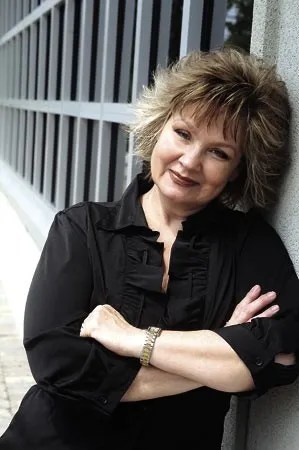
In the spruced up North Charleston neighborhood known as Park Circle, a theater’s getting a face lift. The South of Broadway Theater Co. has been on East Montague Avenue for several years now, so it’s about time its proscenium got primped.
In the main auditorium, a floor that was once scuffed and gray is now a solid black. A storage room has been converted into another teaching and performance space; the walls have been painted black. “It looks beautiful,” says owner Mary Gould, who’s in a bright mood despite the dark dabs of color. “We had so much traffic through the place last year, it needed to get freshened and cleaned up.”
Gould is preparing for the second annual Playfest, a month-long shout-out to pioneering playwrights and their original ideas. One of those writers is Matt Hampton, South of Broadway’s dramaturge and playwright in residence, who led the call for submissions this year. “There’s something for everybody,” he says. “We didn’t want to hit one tone.”
The six plays are all full-length, a departure from last year’s mixed bag of one- and two-act plays. But they won’t be full productions. Actors will perform with scripts in hand, furnishings and props will be minimal, and sets will be practically nonexistent.
“Traditionally, the rehearsal period for staged readings is two weeks,” says Hampton. That’s a much shorter commitment for the actors and directors than a four- or six-week rehearsal time for complete plays.
“This way, you can do a lot more product more quickly than you can if you’re committing to full productions,” adds Gould. “Within the theater industry, a new tenet is being suggested to companies — produce, produce, produce. Instead of backing off, do more as fast as you can.”
More shows mean more ticket sales, and more opportunities for new writers and actors to get in front of audiences. “The plays are raw but immediate,” Gould says. “We’ve become so spoiled with Broadway production values. It’s really hard for regional theater to put on something that’s technologically wowing.” The Playfest has no bells or whistles to distract from the text and its interpretation.
There’s plenty of room for that in Burning the Saint, Hampton’s contribution to the fest. He cryptically pitches it as a classical tragedy along the lines of Shakespeare’s Julius Caesar, updated for the modern age and reset in an urban dystopia. Saint will cap the festival on Sept. 27.
The other five plays cover religion, politics, comedy, and realism, often with a strong female perspective. The festival kicks off with Like Heaven by Elaine Romero. Two sisters in Independence, Kan., have their lives shaken up by the arrival of Sapphire, a wild Californian, in this comedy of clashing cultures. That’s followed on Sept. 12 by Geography, a drama by New Yorker Anne Phelan. A pair of former Hungarian freedom fighters make a video documentary about atrocities in Eastern Europe for the United Nations. By revisiting their hellish past, they hope to deal with it by integrating with the American media.
Sept. 13’s Not Then, Not Now by Michael Kramer is the story of a 50-something theater producer who meets an ex-lover and tries to stoke the flames of love again. On the following Saturday, Kristen Palmer’s Local Story is another play about a mystery woman who upsets the status quo of a small town. This time the males of a country community are bonded by their shared interest in the woman.
Marilyn MacCrackin’s The Brethren will be performed on Sept. 26. It’s about a Texas cult corrupted by a young woman who has had a glimpse of the real world and wants to bring her sect partners into the 21st Century, leading to an ideological war between newfound thought processes and close-knit traditionalism.
Actors include three Equity members (Gould, Kristen Kos, and Mark Gorman) and other familiar local faces such as Rodney Lee Rogers and JC Conway. As with last year, the neighborhood will be involved with other events and performances; these include spoken word performances by Marcus Amaker, Play Slams for teens, and a party on Sept. 4.
“People are now willing to come to North Charleston,” says Gould. “So we’re hoping for a better turn out than last year.” She estimates that 2008’s opening and closing shows enticed 30-40 people into the theater. “There isn’t another play festival in Charleston. It’s a niche that I was prepared to fill. That’s always the challenge I’m up against. I don’t want to replicate what other theaters are doing.”
With that challenge met, Gould now has to make the event more financially viable. By expanding it and involving promising, enthusiastic playwrights, she will undoubtedly increase her Playfest’s national profile. The next step is to engage new writers and new theatergoers.
“We need to encourage people by showing them plays with different aesthetics,” says Hampton, “and get local people to do more writing.”
At the very least, he can offer an alternative to a night at the multiplex. “This is less expensive, a different experience, a different night out. Audiences can see something new and interact. There’s fun in a theater you can’t have anywhere else.”
CofC adds an old Hollywood touch to the Bard’s Comedy of Errors
by Nick Smith September 2, 2009
Shakespeare’s plays are full of coincidences. Characters end up in the right place at the right time to stop a wedding, save a condemned man, or get mistaken for their twin. At the top of the happenstance heap is The Comedy of Errors, which deserves a booby prize for its unlikely, fluke-packed plot.
To believe the plot of Errors, the audience must buy the idea that twin brothers with the same name, Antipholus, are separated as infants, and that they have twin servants, also separated, named Dromio. And that they spend an entire day in the same town center looking for each other without meeting. But this early Shakespeare play is not written to be believable; it’s written to be enjoyed.
With that in mind, director Evan Parry has filled his production with fun visual elements and tomfoolery. Inspired by the vaudevillian banter between Antipholus and Dromio, Parry retools the tale to fit a late ’20s, early ’30s Hollywood locale. Characters in fantastic, brightly-colored costumes inhabit tall, yellow and purple Hopperesque buildings before a forced perspective background, creating a studio backlot feel. There are references to Chaplin, the Three Stooges, and the Keystone Kops. Silent film slapstick keeps the audience laughing and intertitles (a.k.a. title cards) are approximated with an easel.
As the interloping Antipholus, Robbie Thomas holds the show together with confidence. He is the straight man confused by the zany world around him, chased by a woman who thinks he’s her husband, bound by policemen who think he’s a thief. Lauren Riddle plays his servant, reveling in the riddles and wordplay of her character. As their counterparts, Ricky Dunn and Sierra Garland are equally likeable.
Parry spent four months creating this show, taking incredible pains to make it accessible to modern audiences. At times, however, this intent gets in the way of the storytelling. When Antipholus’ father (Brent Laing) sets up the story at the beginning, the movement going on around him distracts from what should be an important performance. As the street cleaners scamper about, it’s hard to hear some of the characters over the mute pair’s footfalls. But most of the time, Parry creates a vividly appealing, crowd-pleasing spectacle that’s still true to its source.
THEATRE OVERVIEW All Over the Map
by Nick Smith August 30, 2006
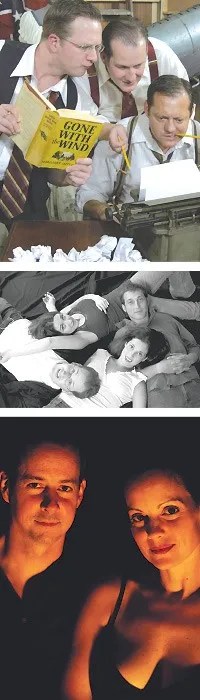
“We’re shaking things up this year,” says J.C. Conway, director of local company Theatre /verv/, and he’s not alone. Charleston’s board treaders are determined to try fresh tactics this year to snag larger audiences, ranging from new venues to more challenging productions. Those companies that aren’t taking a radical approach are going back to basics.
“We were very clear when we began what we were about,” says Village Playhouse cofounder and producing director Keely Enright. Since then, she feels that what she and her husband, cofounder and technical director Dave Reinwald, were trying to accomplish was lost. In their sixth season they aim to get back to their “initial passion” of taking classic literary 20th-century works and presenting them in an intimate space. “We wanted to take things that have been in larger theaters and make them smaller,” says Enright, emphasizing her desire to bring them down to an intimate level that would appeal to a TV-watching audience. “Characters sometimes seem whiny on a big stage and they can be hard to care about, but if they’re right here next to you, you do care.”
As Mt. Pleasant’s only repertory theatre company, the strip mall-based Playhouse has its own niche audience but is always trying to attract new blood from other parts of Charleston. “We’ve just signed a new three-year lease,” Enright says, “and it’s tremendously expensive — above $6,000 a month — but we’ve figured out how to keep ourselves afloat. Now we’re building up our membership base.”
In an attempt to appeal to a broad range of tastes as well as their own, Reinwald and Enright are mixing dependable comedies (Neil Simon, Alan Ayckbourn) with solid drama (David Mamet, Tennessee Williams). Also on the roster are the recent Tony-winning Urinetown: The Musical and the tender tearjerker She Loves Me.
Enright’s own penchant for slice-of-life drama and eras less well known to audiences is represented by the post-WWII drama The Subject Was Roses. “It may not be our big moneymaker,” she says, “but we want to show some things that people won’t ordinarily experience. Although they’re good moneymakers, you won’t see Steel Magnolias here and we won’t ever do Arsenic and Old Lace.”
Over at the Dock Street Theatre on Church Street, Charleston Stage’s founder and Producing Director Julian Wiles is also interested in putting on lesser-known shows alongside obvious crowd-pullers like Ragtime and The Best Christmas Pageant Ever. “You can’t just pick popular things if they’re not strong,” he says, explaining that although his productions have familiar stories and general appeal, he’s always looking for “unique, well-written plays.” The example he uses from last season, the hackneyed Baby, does not bode well for lovers of unique theatre at the Dock Street; this year’s Moonlight & Magnolias is a better indication of what Wiles is after.
Taking a humorous look at the rushed rewrite of the Gone with the Wind movie, Magnolias is a twist on that old theatrical standby, the backstage story. A small cast playing a variety of larger-than-life characters? Check. Plenty of scope for broad comedy? Check. Incompatible personalities trapped by desperate circumstances? Check. References to a classic slice of popular culture? Double-check. “People know something about [the backstory],” Wiles assumes, “but they don’t know that the screenplay was totally rewritten in five days.”
Another fairly new play, 2001 Obie winner The Syringa Tree, captivated Wiles when he saw it last year in Atlanta. So he’s bringing the production team to Charleston for a run in the new year, serving as the lynchpin of a season that aims at providing the goods for “sophisticated theatre audiences and the tourist market that comes in.”
Wiles should know those audiences pretty well — this is his 29th year as a theatre director in Charleston. He’s noticed some positive developments in the local theatrical community over the past seven to eight years, with the establishment of a few dedicated companies with a passion for the art form and the city.
“We now have an incredible range of things people can choose from, from cutting edge to musicals,” says Wiles of Charleston’s array of theatre companies. “The theatrical menu is bigger than it’s ever been. People don’t want to see the same thing all the time, just Broadway plays or just musicals; they want to sample different things.” Wiles admits that not every meal will be a gourmet one, but the tourist bumps help to sustain less palatable patches. “Every single production isn’t going to be brilliant, but there are 400 performances a year in Charleston and a huge number of people go.”
Rather than seeing the other theatres in town as mere morsels to his feast, Wiles has ganged up with them to form Theatre Charleston, the coalition formerly known as the League of Charleston Theatres. Partly that’s to help lure the tourists: “We want to make Charleston a theatre destination — people can come from out of town and see one or two shows in a weekend.”
Theatrecharleston.com provides schedule information and links for all five participating companies; actors can use it to find out about auditions and should eventually be able to add their resumes to the site. “We’re reaching out to the other theatres in town to join,” Wiles says.
That’s all dandy, but what does it mean for the rest of us? Wiles hopes that at some point, the site will provide discounts on tickets for individuals who join the league. In the long term, the best results might come from the increased communication and harmony the organization brings — local companies will stop grousing about each other and concentrate on producing great shows.
“Although Charleston Stage is huge, we don’t feel like we matter less or we have less to offer,” says Sharon Graci, cofounder of Pure Theatre on East Bay Street, on her company’s role in Theatre Charleston. Graci sees the league as a great opportunity to encourage audiences to be arts-inclined, tying in with her own desire to “attract, breed, and develop” challenging theatre. Whereas Enright and Wiles avoid quick-fire contemporary plays, Pure revels in them.
For its fourth season, Pure will present five Southeastern premieres, an American premiere (Pure International, directed by Bulgarian Alexander Morfov), and a couple of world premiere shows. The first of these will be Killing Chickens by the company’s cofounder, Rodney Lee Rogers. The other will be an as-yet unselected play to emerge from the company’s playwriting group, the Pure Lab. Both showcase new work developed by the theatre. Play development was one of the programs that Theatre Charleston members picked up on during an initial fact-finding mission to Chicago. “We want to emulate those company’s programs,” Graci says, “but still meet Pure’s needs. So we might go with two long one-act plays chosen from the work written by the seven writers we have in the lab.”
Graci describes this season as a mature one, as she and Rogers bring their company back to its Pure roots. Just like Enright, they feel confident and established enough to reaffirm what they set out to do. Since Pure was founded by actors and is geared towards them, they plan to get more technical support. That way, with more dedicated designers and stagehands, there’ll be less to distract the thesps from what they do best. Pure’s also moving the start times for all its shows from 8 p.m. to an earlier 7:30 p.m. kickoff, as well as introducing Sunday Brunch Matinée shows, with light nibbles at 1 p.m. and performances beginning at 2 p.m.
One unavoidable distraction that Pure must face is a move from their Cigar Factory space. “It’s pretty definite that the Factory will close to tenants in December,” Graci sighs. While the company explores some short-term options, it ultimately wants to find a place where they can expand their space over a 10-year period.
At least Pure has a home. The 10-year-old Art Forms and Theatre Concepts, Chucktown’s African-American company, finagles performance time in the Dock Street and Footlight Players Theatre. The equally venerable Actors’ Theatre of South Carolina, still waiting patiently for its new venue in the pending Folly Beach Fine Arts Center to become available, will team up with Footlight Players on the Dylan Thomas play A Child’s Christmas in Wales.
Pure isn’t the only group on the move, either. Charleston Stage is preparing to make an announcement on its own search for a space this month; its Dock Street Theatre home will close in June 2007 for a two-year makeover. “We’re staying in our present space completely for this season,” says Wiles. “We haven’t closed.” Meanwhile, doubtless motivated by occasionally disappointing audience numbers and a less-than-perfect rehearsal space for its shows in the downtown Dark Room, Theatre /verv/ is switching its shows to West Ashley’s Map Room. With its fresh-faced director and cast and a season of high-strung shows, /verv/ is geared towards younger crowds and hopes to find several in its new setting.
“We’re the first company in West Ashley, and I think we’ll benefit from that,” says J.C. Conway. Using the Village Playhouse as his niche market model, Conway has organized /verv/ around a core group of four actors — himself, Jan Gilbert, Beth Curley, and David Barr. “I’m by no means saying we’ll only do stuff with us,” assures Conway. “Our second show, Things You Shouldn’t Say Past Midnight, has a larger cast. But casting can be tough in this town.”
One way to encourage actors to join a production and stick with it to the bitter end of closing night is to pay them. Up until this year, only three companies threw their actors a bone — Charleston Stage, Pure, and Actors’ Theatre of South Carolina. Despite its tight budget, the Playhouse will join them in paying cast members this season for all but one production — She Loves Me, their latest coproduction with The Company Company (which doesn’t include players’ payouts in its remit).
There’s one institution on the peninsula where the actors pay the company instead of the other way round. “They pay us to get better,” says Mark Landis, director of Arms and the Man at College of Charleston’s School of the Arts. These student productions hold their own with Charleston’s professional fare, and this year SOTA’s trimming its number of Shakespeare plays down to one (King Lear) because of the amount of work involved in mounting a production.
“It’s to give our overworked technical department a break,” explains Joy Vandervort-Cobb, who will direct Wedding Band for SOTA in October. “When we’re doing all our shows, those people are torn, and we’re looking to lessen the load on the scene and costume shops. Not many people want to drop shows. It comes down to man hours, reality, and costs.”
SOTA is focusing on six shows this season, with ingredients that Vandervort-Cobb considers atypical. “I think we just went crazy,” she jokes. “We’re just going through a phase.”
While CofC cuts down on its bardwork, the Footlight Players are boosting its own number of productions in honor of its 75th season. The bulk’s made up of board-selected favorites from decades past, including Daphne du Maurier’s Rebecca and a community theatre staple, the Village Playhouse no-no Arsenic and Old Lace. 2006 will also see the introduction of a new offshoot season, “Salt & Battery,” in part to get younger audiences into the theatre. The experiment was first tried 50 years ago, when avant-garde shows ran concurrent with the regular stagings. The edgier productions will start at 10:30 p.m. on the same nights as three of the retrospective shows; for example, David Mamet’s Romance is set to parallel Inherit the Wind.
Apparently Charleston theatre works in cycles — every few years, the larger companies realize they’re getting staid and decide to shake things up a bit. They stage more challenging plays, then revert to more marketable stuff when the box office receipts disappoint them. Luckily for audiences, those companies seem to have short memories and the cycle is beginning all over again. — Nick Smith
The Village Playhouse
by Nick Smith August 26, 2009
YESTERDAY
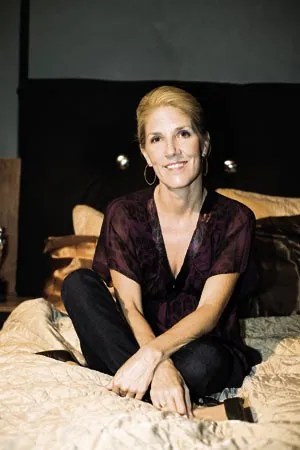
The Village Playhouse encountered a few rough spots when the economic downturn hit. “There was a time just before last Christmas when we had to tighten our belts,” Producing Artistic Director Keely Enright says. “Everyone was scared, and we lost donors and sponsors.” The best way to make up the financial shortfall was to put out more product, using box office revenue to help pay the bills. “If that’s all we had to bring in revenue, that’s what we’d use.”
In response, shows ran for four weeks instead of three, maximizing the marketing for each play and giving word-of-mouth plenty of time to spread. Hot on the heels of Piccolo Spoleto, the theater stayed open throughout the summer, presenting three full productions and a one-man show.
The choice paid off, audiences kept coming, and Enright says the company has experienced “large growth.” Returns on membership are high and ticket sales are good. The downside: Enright and husband/co-founder Dave Reinwald have forgotten what a day off looks like. “We’ve been working our tails off to keep the doors open,” she says.
TODAY
Although the output has gone up, the quality of the shows at the Village Playhouse hasn’t suffered, thanks to Enright and Reinwald’s insistence on varying their line-up. A mix of classic 20th Century dramas, musicals, and comedies keeps the company and the audiences energized (Awake and Sing, Mauritius, Shipwrecked). “We try to be as diverse as possible,” says Enright. “Personally, I love drama, and people get weary of too much contemporary theater — sometimes they just want to have a good time and be enlivened.”
Enright also knows there’s a constant market for musicals. “Two years ago, we did four major musicals in an 18-month period. It was exhausting.” Although the shows were good for the box office and received great feedback from theatergoers, Enright knew she had to provide more variety to avoid creative stagnation.
While this tactic of giving audience members what they want — but not too much of it — has paid off, the company has been reexamining its marketing strategy. As newspapers got thinner and media coverage lessened, Enright felt that theater was getting less attention than it deserved. “While I understand that editors focus on what’s interesting and what’s relevant, there isn’t an understanding by the general media that live theater is important.” Rather than garnering attention through press previews and reviews, the Playhouse has placed more emphasis on grassroots marketing and online avenues like Facebook.
Little City Musical Theater
by Nick Smith August 26, 2009

YESTERDAY
Little City Musical Theater was formed in July 2008 by local musician-performers Robbi Kenney, Ralph Prentice Daniel, and Adam Johnston. Since then, the company’s presented a series of hit-and-run shows in venues across the city, including the revue piece Songs for a New World and a zesty version of The Rocky Horror Show. Artistic Director Kenney has also played with the Charleston Symphony Orchestra, the Charleston Ballet Theatre, the New Music Collective, and other local organizations. Additionally, she’s worked as a musical director for Charleston Stage and the Footlight Players. During its one-year existence, it hasn’t had to change its tactics: producing edgy shows that are heavy on original musical arrangements with strong choreography and acting.
TODAY
Sometimes it pays to be small, fast, and mobile. While larger local theatre companies have become more reliant on box office than ever to stay afloat, the Little City Musical Theater is continuing proof that size doesn’t matter — it’s your performance that counts. “I feel strongly that the 70-year-old model of funding non-profit organizations is outdated,” she says. “It’s great to go after government and NEA grants, but as an artist and community member, it’s important for me to prove myself in the real world.”
Kenney believes that rather than relying on handouts, an organization should be able to stand on its own feet. To do that, the performers have to be flexible enough to switch venues, market themselves properly and give audiences what they want. So far for Little City, that means providing low-scale, high quality musicals and dinner theatre.
“That’s what live performance is all about,” says Kenney, “connecting with the audience. I love dinner theatre because of that, and I’m quite happy playing jazz violin in a restaurant. It’s the quality of the personal exchange that matters, not the greatest, fanciest smoke and mirrors or the lighting design. Just reaching and challenging people in an attempt to enlighten them.”
With this credo, Little City has successfully coped with the recent hard times. In the coming year, the company aims to build on its fledgling reputation with similar shows. “I can see myself having the same season as last year,” Kenney muses, “with medium sized shows, small shows, and really small things like our dinner theatre productions with just five people.”
The Footlight Players dust off Mark Twain’s foray into theater
by Nick Smith August 30, 2010
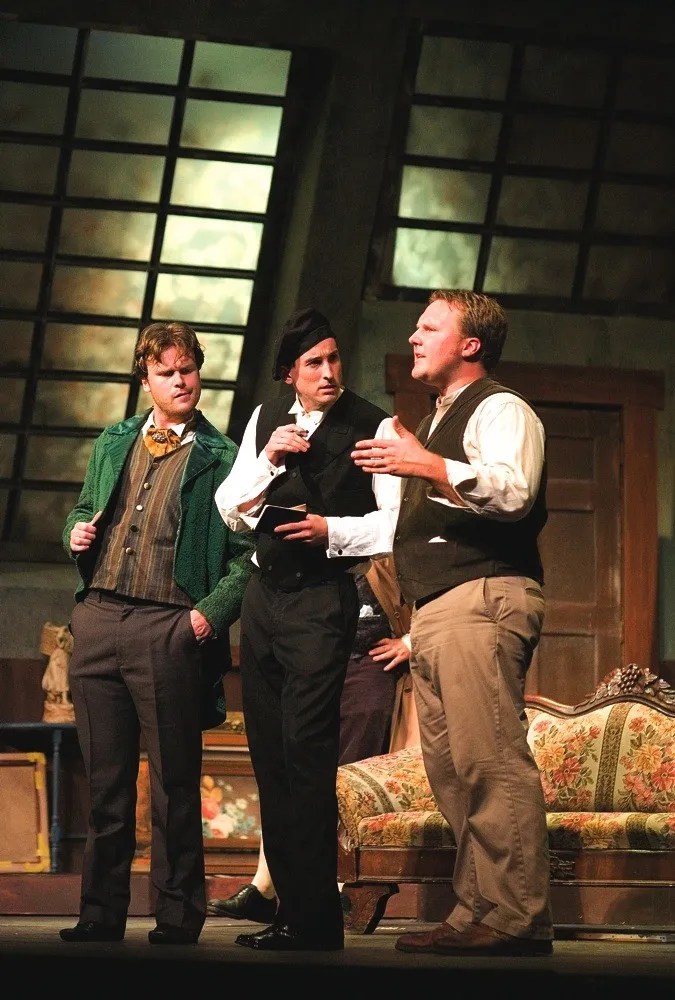
In The Adventures of Tom Sawyer, Tom and his friends Huck and Joe go missing, presumed dead. They enjoy watching their own funeral before announcing that they’re still alive, to the delight of the local populace.
Twenty-one years after writing Tom Sawyer, Mark Twain expanded his grim gag into a stage play. This time, artist Jean-Francois Millet is the rapscallion who lives to witness his own funeral, faking his death to bump up the price of his paintings when he realizes that collectors will pay more for the work of a deceased genius.
Twain didn’t get the chance to see his one and only play, which went unstaged until it was dusted off and revised in 2007. But if he’d been able to watch the Footlights version and observed the audience, Tom Sawyer-like from the wings, he wouldn’t have been disappointed.
After a sporadically funny first act, the second half of the show kicks into high gear with outrageous characters, ridiculous foreign accents and farcical action.
Peter Galle plays Millet, who disguises himself as his twin sister to cash in on his newfound fame. Galle seems most comfortable when he’s in a wig and dress, flouncing across the stage in high heels and fending off male admirers. Lee Lewis is Chicago, an all-American prankster and Millet’s close friend. Lewis is a stable force in a crowd of deliberately over-the-top performances. Rob Maniscalco and Craig Trow play Dutchy and O’Shaughnessy, the latter behaving like a cross between a leprechaun and Brad Pitt in Snatch.
The villain of the piece, dirty art dealer Bastien Andre, is brought to life by Don Brandeburg in the zestiest, most playful portrayal we’ve seen from this local veteran. Actresses Laura Artesi, Lisa Benson, Susan Lovell, and Kelly McDavid also give very confident and enjoyable performances.
Special mention must go to Terry Davey as Leroux, an older character who shows his childish side when he prostrates himself before Millet, and to Sam Jackel in multiple roles, including a British nabob and an uproariously camp valet.
Technical director and set/lighting designer Richard Heffner excels with this show. He’s a true artist, putting more work into the sets than the play requires or deserves. In act one, Millet’s studio is as fully realized as possible on a small stage set, and at the beginning of act two, the dressing room earned a hearty round of applause.
The play has its weaknesses. Despite the involvement of gifted writer David Ives, it’s still very dated and simplistic. There are only two scenes. The asides to the audience are clunky, disrupting the flow of the story. Although the characters are fairly distinct, some of them spend long stretches of time with little to do except react to Millet’s shenanigans, and most of them come across as childish and unsympathetic. The opening act leaves the audience subdued until the arrival of Trow, who particularly appeals to younger patrons.
Director Greg Tavares, better known as a founder of The Have Nots!, successfully spices up the stale material by encouraging his actors to clown around. The gusto streamlines the creaky plot and juvenile jokes. This is no realist masterwork; instead it’s a fun and gaudy postmodern piece painted with broad, sure strokes.
Is He Dead? was a critical hit on Broadway. It’s impossible to tell whether it would have been as successful if it had been staged in Twain’s day. But now that he’s recognized as a long-lamented genius, the value of this lively play has definitely increased, even if it’s not always dead funny.
Attorney Mark Mixson branches out
by Nick Smith August 25, 2010

“Theater should be amazing,” says local stage actor and director Mark Mixson. “I like breathing life into something in a new way, to astonish, surprise, shock the audience.” Mixson genuinely cares about theater. He’s been involved for more than three decades, both here and in New York. So why isn’t his name familiar to everyone in the theatrical community?
The busy trial attorney doesn’t volunteer for any old project. He carefully chooses each play he gets involved with, making sure he’s perfect for a part or that he can do something unexpected as a director. That means he’ll work on two or three plays a year at the most.
When Mixson does get involved in local theater, he’s guaranteed to make an impression. You may remember him as the complex, sympathetic villain Salieri in the Footlight Players’ Amadeus or as the conniving movie producer Bobby Gould in David Mamet’s Speed-the-Plow at the Village Playhouse. As a director, he re-energized that old chestnut The Miracle Worker and purposefully unsettled this year’s Piccolo audiences with Discretion.
“The playwright [Terry Roueche] wanted people to be disturbed,” says Mixson. “Discretion worked for me when I felt it was properly making people uncomfortable. It was supposed to be profoundly disturbing at some level.” The story of marital trust and betrayal stood out in a sea of crowd-pleasers during the festival. It was an extreme example of Mixson’s desire to “take a play and make the audience see it in a different way.”
When he signs on for a show, Mixson blocks out a good deal of time and throws himself into it “with the hope that it’ll be great.” That greatness can come from unexpected places. The director saw The Miracle Worker as a judicious challenge and opportunity because the audience was complacent about the material.
“It was a large play, somewhat complex in its ideas, but everyone thought they knew it.” Although that made it easier for him to exceed expectations, Mixson got incredible performances from his cast and re-established himself as an auteur in a city with limited opportunities for directors.
“Charleston could be the place to do the things I want to do,” he says, “but I don’t know if it will support epic theater except during Spoleto. I don’t know if there’s a strong theater community here … not even a nascent one.”
After a successful stint running The Romanceworks company in the ’80s, Mixson moved to New York to make his way as a city defense attorney and senior counsel. He was able to fuel his passion for theater, soaking up Broadway shows and establishing an edgy company called Threshold. As his four children grew up, it became more financially shrewd for him to move back to S.C. and set up his own Mixson Law Firm in Hollywood, S.C. and Myrtle Beach. When he’s not being “very theatrical” in court, he’s having weekly meetings about the creation of a new theater company with significant funding here. All he needs is the right venue to stage his productions.
“I’m lusting after the Memminger Auditorium,” he says. “It’s dark. No one’s using it. I could put six plays on easily that would blow people’s minds, using regular people from the Footlights, PURE, and places like that. The shows wouldn’t be expensive, but they’d be awe-inspiring. Jaw-dropping.”
Wherever Mixson’s oeuvre ends up, it deserves to be seen and appreciated. This is a man who gives a damn about local theater, and it shows in everything he does.
Review: High drama in Osage County
by Nick Smith August 23, 2010
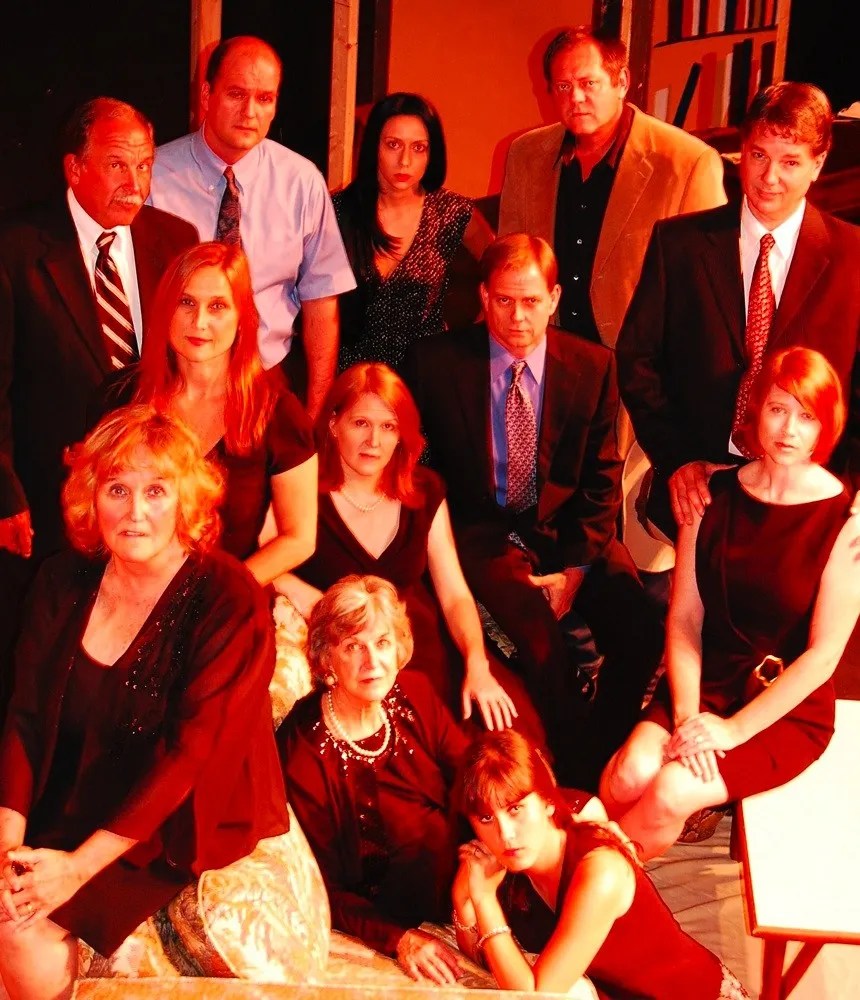
August: Osage County is a family drama set in a house where the shades are always drawn, the AC’s off, and the air is still. For years, poet/educator Beverly Weston and his wife Violet have stagnated, making no progress, retreating into states of delusion and bitterness.
The setting is a complete contrast to the Village Playhouse, launching its tenth season with this indelibly entertaining play. The Playhouse has been unwilling to stagnate. Married founders David Reinwald and Keely Enright have discovered their own way to escape from reality, putting on musicals, magical realist fables, and TV and film adaptations along with the classics. Unlike the Westons, they understand that surviving isn’t enough; progression is just as important.
Their version of Osage County never stands still. It’s full of smart dialogue, vivid characters, deep themes, and potent drama. But there’s more to this production than its Tony and Pulitzer-winning text. Lesser companies would have settled for the play’s reputation to fill seats. Enright and Reinwald go the extra mile, with strong casting and an ambitious set. As one local director recently put it, they slave over their productions. Nowhere has this been more evident than in this production, which has been in the works for six months.
O.C. isn’t so much complex as heavily populated. When Beverly goes missing, a deluge of family members rush to Violet’s side. There’s Ivy (played by Angela White), the daughter who’s stuck close to home and resents her absentee sisters, especially Barbara (Cristy Landis). Barbara has a tough exterior but struggles to cope with her husband Bill’s (David Reinwald) infidelity. Karen (Tracy Abeles), is so excited about her fiancé Steve (Robin Burke) that she’s out of sync with her sisters. Johnna the housekeeper (Sierra Garland) bustles in the background, a constant reminder of Violet’s precarious health.
Violet (Samille Basler) spends most of the play verbally dissecting her daughters, picking at their faults and being honest in truly brutal ways. She chases down an endless supply of pills with short drags on her long cigarettes, a matriarch with mouth cancer dispensing acid justice to anyone who breaks her arcane house rules. She is by turns playful as a child, wicked as a witch, and, first thing in the morning, as weird and incoherent as a David Lynch dwarf.
Basler seizes her opportunity to play this mercurial character. She is utterly riveting and believable. Landis is equally strong as Barbara, taking responsibility for the emotional chaos unfolding around her. The Westons have plenty of flaws for Violet to target: the males are dopey or unfaithful, Ivy is in love with a close relative, Barbara’s daughter Jean (Katherine Chaney Long) smokes dope, and Violet’s sister Mattie Fae (Mary Cimino) constantly knocks her son Little Charles (Josh Wilhoit). Because there are so many characters, the audience is kept on its toes as to who will get skewered or which revelation will be dealt with next.
Director Enright juggles all the subplots perfectly, and on the whole her casting choices are spot-on too. As in her previous play Dead Man’s Cellphone, Angela White flips a mousy character into a strong, well-rounded one. As the menfolk, Reinwald, Wilhoit, Nat Jones, Robin Burke, Tom Sterns, and Jeff Jordan all give their characters a solid authenticity in a handful of scenes. Chaney Long and Sierra Garland have shown greater range in past performances; here it’s as if Enright has told them to stay low-key. Only Cimino seems out of place, lacking the plausibility of her castmates.
Basler’s intense acting makes up for any shortcomings the show may have. Flaws and all, this is one of the best productions we’ve seen this year.
Harvard Sailing Team
by Nick Smith May 21, 2008

The members of Harvard Sailing Team (HST) have said it themselves: one of the great things about sketch comedy is the brevity of its scenes. If you don’t like one, then another one will be along shortly that’s more to your liking. But this New York humor group has the opposite problem. Some of their sketches are so captivating that you don’t want them to end.
HST has nothing to do with the Ivy League college except its clean-cut approach to material. It’s not so cerebral that gags are lost in equations of cleverness, and the team doesn’t resort to crude humor to get cheap laughs. HST reaches everyone in between, from kids to rednecks to blue rinse biddies.
The team has been honing its latest show “100 Years of Song and Dance” at NYC’s People’s Improv Theater for the past few months. We’re getting the Greatest Hits version. There’s nothing terribly sharp or groundbreaking here; that’s not what the performers are aiming for. Instead they deliver consistently enjoyable, droll, and downright endearing situations that contrast romantic notions with the harsh practicalities of life.
For example, what if the president got bored at work one day and started singing to an imaginary bluebird on his arm? Would his aides burst into song or send him to the funny farm? How about a dance routine with lovers miming the lows of their relationships as well as the highs? Or a version of Beauty and the Beast with a bookish Belle and a psychotic Gaston?
Although the group is large, each member is given a chance to show his or her strong personality. Jen Curran and Billy Scafuri make an effective double act. Rebecca Brey is the petite naïf who inspires others to sing. As far as vocals are concerned, it takes the team a while to warm up but once they do, Clayton Early and Chris Smith are particularly good at carrying a tune. But the undoubted star of this particular show is Adam Lustic, who gets the best lines and the best parts.
Lustic is great as the uptight loner who wants to fit in but is too weird or awkward to run with the clean-cut types. He plays an old man who uses a push button phone in an unusual manner. He’s Art Garfunkel, unintentionally sabotaging a duet with Paul Simon. He’s a hot dog vendor gangling around an ice rink during a figure skating championship. In all these scenes he embodies the combination of vigorous physical comedy, pop cultural references, and characters that are daft yet identifiable.
Although several members of the team could doubtless be stars in their own right, there’s a sense of camaraderie and selflessness in the group’s work together, which culminates in a big musical climax. All of the scenes have a solid structure and some of them — like a romantic number marred by an illiterate singer — would be great in a longer form.
The opening night of this production had the audience singing along to songs, laughing at every sketch, and empathizing with the silly situations. If you’re looking for mild yet consistent laughs, give this team a try.
Harvard Sailing Team • Piccolo Fringe • $15 • 1 hour • May 27-31, 2008 • American Theater, 446 King St.
Monkey: Journey to the West
by Nick Smith May 21, 2008
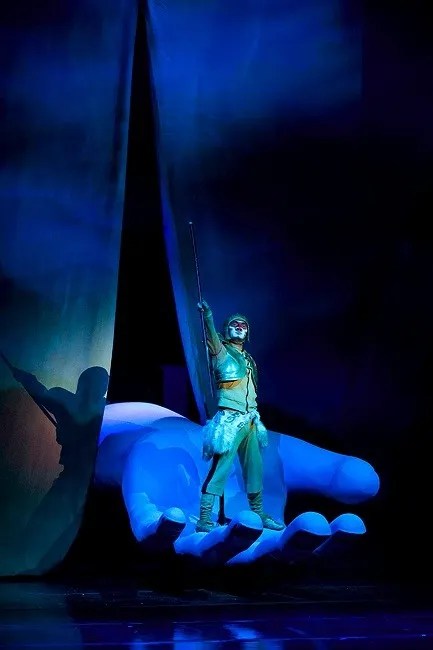
“Is this like Pokemon?” asked one audience member before Monkey: Journey to the West began. “Is it live action?”
She could be forgiven for asking these questions, gazing up at a large pre-show projected image of the show’s cartoonish characters — animal spirits, demons, and heavenly creatures among them.
Thankfully, this exemplary Chinese circus opera (performed in Mandarin with English supertitles) has nary a peek of Pokemon and is packed with action. It’s a hip musical retelling of a 1,400 year old epic about a pilgrimage to India. The pilgrim is the chaste Tripitaka, accompanied on his journey by three fallen angels, Monkey, Sandy, and Pigsy.
As the saga was retold over the years, the mischievous Monkey became the center of the story. But it’s the relationship between the four characters that’s helped the tale endure. Pigsy, a swine demon, chases chicks and stuffs his face. Sandy is the dour one, a hippy sea demon who’s the straight man to Monkey’s anarchist.
Monkey is a snarling, spitting, endearingly cheeky underdog, railing against forces greater than him and refusing to acknowledge his weaknesses. He’s no fool; he is a down-on-his-luck demigod, stuck on earth with a human priest on a 14-year trek through demon-infested landscapes. No wonder he loves a good scrap.
Chen Shi-Zheng’s Monkey: Journey to the West reimagines the pilgrimage as a series of breathtaking circus acts, searing opera solos, and colorful imaginary characters. The writer/director is aided by Damon Albarn, former Blur frontman and co-founder of the Gorillaz. He stamps his percussive brand on the oriental score. The visuals (and cool masks) are conceived by Jamie Hewlett, who is probably best known for animating the Gorillaz group. A few cartoon scenes help to give this production its epic scope, showing Monkey hatching from a stone egg, swimming deep under water and soaring to Heaven. The art is projected on a thin curtain, allowing energetic Monkey actor Fei Yang to blend with his animated alter ego.
Chen’s version of events holds together, even for audiences who don’t know the difference between Pigsy and Pikachu. Monkey seeks immortality, visiting an old guru and a sea monster (where he gets a magically shrinking staff to bust heads with). In Heaven, he dodges contortionist caterers and roller-blading angels to eat a peach that grants him the immortality he craves. Buddha isn’t pleased, trapping him for 500 years.
Monkey is released by Tripitaka, who is en route to India to collect Buddhist scriptures.
They are joined by Sandy, Pigsy, and a bizarre two legged horse.
Chen makes great use of the Dalian Acrobatic Troupe, who juggle, spin, and balance on top of each other various different scenes — a cave of spiders, a land of fire, and a Buddhist temple. The Dalian acrobats are joined by martial artists who do their best to chop the chimp in one sword fight after another, the best of which is a battle royale on top of the Fiery Mountains. On the opening night of the show, Li Bo handled the staff fighting during these scenes; typically, Li and Fei alternate portraying the Monkey.
Rounding out the cast is Yao Ningning as Tripitaka, playing the priest in a more lighthearted way than is traditional; Xu Kejia as Pigsy, emphasizing the porker’s oversized libido; and He Zijun as Sandy, who shines in one beautiful solo but has little else to do except follow his friends’ lead.
Zeng Li stands out in multiple roles, including that of a sensuous Spiderwoman balancing delicately from suspended silk. Jiang Qianru is a commanding White Skeleton Demon and a scheming Princess Iron Fan.
While there are a couple of female solos that are challenging to listen to, most of the vocals are gorgeous (Jiang’s included). Albarn’s music, directed by David Coulter and conducted by Jonathan Stockhammer, makes creative use of Chinese percussion, electronic instruments and the Klaxophone, which utilizes 12 car horns. The music helps to keep the story moving.
However, if there one point where Monkey falters, it is when it comes to the characters. The core relationship between the travelers is underdeveloped, and as a result, the production loses some potential charm.
Spoletians will still gets their money’s worth, though, thanks to Hewlett’s eye-popping costumes, the extensive wire work, and the swiftly moving large-scale sets, all organic shapes and Barbarella colors. With over 60 supple performers vying for attention, the visuals can be overwhelming at times, and if you’d like to read the supertitles sit at the back — anyone close to the stage is guaranteed a crick in the neck.
Monkey won’t bless you enlightenment, and some of the far-flung plot points may leave you scratching your head like an itchy ape, but Journey to the West is guaranteed a unique piece of musical theatre you’ll never forget.
Monkey: Journey to the West • Spoleto Festival USA • $25-$65 • May 22-30, June 1, 3, 5-7, 2008 • Sottile Theatre, 44 George St.

Desdemona: A Play about a Handkerchief
by Nick Smith May 21, 2008

Past productions of Paula Vogel’s Desdemona have been compared to another contemporary Shakespeare spin-off, Tom Stoppard’s Rosencrantz and Guildenstern are Dead. It’s easy to see why. Both take familiar characters from Elizabethan classics, play up the humorous aspects, and delight in contrasting patterns of speech. But while Stoppard’s hit uses excerpts from Hamlet, Vogel’s accessible three woman show steers clear of free verse and there’s not a “forsooth” to be heard.
Although Desdemona doesn’t have the complexity of Rosencrantz and Guildenstern it is a lot of fun, for the actors as well as the audience. The interplay between the three actresses is what really makes this play worth seeing.
Vogel’s liberating story is based on the conceit that Desdemona, tragic heroine of Othello, isn’t as chaste and unwitting as she seems in the source text. In a rustic laundry room of a Cypriot palace, she teases her maid Emilia with tales of affairs and prostitution and marvels at a phallic black hoof pick. Emilia doesn’t approve; despite her lower status, the pious peon has higher morals than her mistress and has stayed true to her husband Iago for 14 years. To keep him happy she’s stolen Desdemona’s handkerchief, leading Othello to suspect that his wife is knocking boots with Lieutenant Cassio.
Desdemona’s friend Bianca wants to tie the knot with Cassio in more ways than one. She runs the local brothel and she also has saucy tales to tell, including one about an S&M session gone wrong. As Bianca shows Desdemona how to receive a good spanking on the kitchen table, Emilia struggles to ignore their antics.
There are gentler, more introspective moments amidst the bawdiness. In their world, the only way for Desdemona and Emilia to improve their lot is to get married; they yearn for escape from the patriarchal system. Free spirit Bianca wants to settle down. No one stays happy, especially when it becomes clear that Othello’s jealousy will not fade and could prove fatal for his wife and her servant.
This College of Charleston production directed by Wayne Wilson has a great set designed by Geoff Maas, with crumbling cutaway walls and a welcome attention to detail. Laura Rogers’ costumes help delineate the different backgrounds of the women. Kaitlin Winslow plays Desdemona as a haughty, naughty upper crust English lady. As the jolly Bianca, Kim Rogers bounds around the stage and brightens the show with her presence. Meredith Potter provides the most realistic reactions of the three.
Unfortunately the actresses are saddled with accents that take a while to get used to. Winslow’s aristocratic Brit is too mannered and stagy to be authentic, and Potter’s Irish dialect is sometimes impenetrable. The accents improve as the show goes on, with Bianca’s cockney voice sounding the most natural. Vogel specifies the dialects in her text to make sure the audience knows that her characters have had different upbringings, but that’s apparent in what they say as well as how they say it. Gentler vernacular would help make those characters more believable.
Otherwise, this is a fast-moving play with lots of comedy, strong acting, and a thing or two to say about the challenges women face, whatever century they live in.
Desdemona: A Play about a Handkerchief • Piccolo’s Stelle Di Domani Series • $12-15 • May 25, 26, 29-31, June 1-7, 2008 • Chapel Theatre, 172 Calhoun St.
This War is Live
by Nick Smith May 21, 2008

In their quest to appeal to young, TV-watching crowds who wouldn’t normally go to watch a play, the team behind This War is Live have forgotten a cardinal rule of acting —– they have to project. The majority of thesps in this play talk as if they’re on the tube, not in a fair-sized theatre.
Perhaps the multimedia aspects of the show have lulled them into a sense of false tranquility. The narrative is interspersed with news footage (real and fictional), still images, captions explaining where scenes are set, and interviews with some of the characters.
The interviews are conducted by Grant Blake, a documentary filmmaker who prizes truth-seeking over towing the line. He’s in Iraq when the U.S. military rolls into Baghdad, toppling Saddam Hussein’s regime and settling in for the long haul.
When a soldier pours his heart (and his brains) out on camera for Blake, the filmmaker is confronted by Major Brad, an old chum who represents the military liaison with the media. Blake’s about to be kicked out of the country when the enigmatic Mr. X gives him a second chance by offering to bankroll his investigations. As the mystery man explains, the authorities will try all kinds of dirty tricks to discredit Blake. Will the journalist be able to outfox the government, or will Big Brother bounce him back to the States with his tail between his legs?
Although the actors are quiet, they still tell this convoluted story with passion and sincerity. In the starring role of Blake, Patrick Ryan creates a totally original character who manages to be simultaneously obnoxious and likeable. He’s backed up by his videographer Davey (James Pillow), a genial mohawked mumbler who carries his camera around like a shopping basket (a real camera would be heavier and more cumbersome).
As Major Brad, Mark Gorman turns in one of the best performances of the show. Not only is he audible, but he is genuine as well. He makes us believe that Brad and Blake are friends who go way back, which really helps add authenticity to the play.
Other actors in the large cast have opportunities to shine: Bettina Beard as the sex-mad Kit Parker, an understated David Barr as the gay Private Freeman, Eric Collins as the gut-spilling soldier, and Mike Ferrer in multiple roles, some funny, some tragic.
In a show so reliant on video clips, any technical hitches are bound to slow the story down or confuse the audience. On the night we saw the play, several hiccups were apparent. Technical director Geoff Maas needs to iron out the creases to really let This War is Live hit its stride. In the meantime, the actors kept the action moving on a stage with no standing set; there is one video screen and a couple of canvas sheets to obscure silhouetted sex and violence from the audience.
This production doesn’t have the epic feel that playwright Jeff Douglas Messer surely hoped for. However, if director JC Conway can fix his glitches and get his actors to speak up, the audience will be able to hear some important conversations about Iraq, political spin, and the perils of imposing our brand of freedom on other cultures.
This War is Live • Piccolo Spoleto Theatre Series • $15-$20 • 2 hours • May 28, June 2, 6, 8, 2008 • Footlight Players Theatre, 20 Queen St.
A Devil Inside
by Nick Smith May 21, 2008

Madcap. Bizarre. Bemusing. Raucous. All apt words to describe A Devil Inside, College of Charleston Center Stage’s contemporary murder mystery. The action gets out of hand at times, with too much crazy shit going on for the audience to follow. But the student actors derive some strong moments from David Lindsey-Abaire’s twisted script.
Gene Slater is a 21-year-old student living in New York who skateboards for tips outside his mom’s Laundromat. For his birthday, Mrs. Slater gives him a shocking revelation: His father was murdered and his feet severed. She’s kept them in a jar to prove it. Now she feels that it is time for Gene to become a man, seek out his father’s killer ,and avenge his death.
Gene thinks his mom is looney, so he continues his studies. He’s fascinated by Caitlyn, a serious young woman who is his Russian literature class. She has a thing for their professor, the moody Carl. Carl in turn is obsessed by Brad, a repairman who is so dull that the professor is sure no one will miss him if he wipes him off the face of the earth. Brad can’t get enough of Lily, an artist with a foot fetish.
All six characters intersect as Gene is drawn into the murder investigation. As their obsessions start to consume them and they lose their grip on reality, their whole world seems to be crashing down around them; Manhattan is flooding, wild dogs roam the streets ,and life is as cheap as a tumble in a coin-operated dryer.
Director Kelly Jewell splits her stage into five sections: a subway train, Brad’s Fix-It Shop, a classroom, the laundromat, and a bar. Richard Dunn’s set design is inventive, with windows on the shop and laundromat, posters in the bar, and other small touches that make each area seem functional and lived-in. A lot of the action takes place in the laundromat, where we first meet Gene (played with allure and wit by Will Haden) and Mrs. Slater (Jennifer McCormick, in an outstanding, utterly committed turn as a devoted if unbalanced mom with a New Yawk accent).
Next door, Brad (Michael Hanf) becomes increasingly unhinged, allowing the actor to become increasingly manic in Act Two. Hanf is a joy to watch even if he appears a lot younger than the character should be. Lily (Brittany Brown) is the most stable character, allowing Brown to deliver a solid performance. Richard Dunn also acts in the play as Carl, a dark and tortured soul who is fascinating to watch in his classroom scenes.
The quirky, sometimes gruesome goings-on won’t be to everyone’s taste. A few audience members left halfway through the show with comments like, “Oh my God!”, “Shit!” and “God, help me.” One can only wonder what they would have said about the gory climax. It’s a confusing flurry of activity switching from one side of the stage to the other (with a dream sequence thrown into the middle). Nevertheless there are enough jokes, satirical comments, wild coincidences, and Dostoevskyan references to keep this murder mystery interesting.
A DEVIL INSIDE • Piccolo’s Stelle Di Domani Series • $12-15 • May 28-31, June 1, 3-7, 2008 • Theatre 220, Simons Centers for the Arts, 54 St. Philip St.
Desdemona: A Play About a Handkerchief
by Nick Smith May 14, 2008

What is it? Desdemona celebrates Shakespeare’s bawdy sense of humor shot through with 21st-century irony and intertextual wit. Writer Paula Vogel is a Pulitzer Prize-winning playwright who gives Shakespeare’s female characters their due. She fleshes out a backstory for the unjustly vilified Desdemona, providing her with complexity and a lust for life that propels her relationship with Cassio’s lover, Bianca — a larger-than-life brothel madam (aren’t they all?) who shows Desdemona a trick or two.
Why see it? Think Sex and the Shakespearean City, with Othello’s Desdemona as Carrie Bradshaw. The show got a favorable review last August from City Paper critic William Bryan, who marveled at actress Kaitlin Winslow’s fake orgasm. With nine months to incubate the show, CofC’s Theater Department thesps should have a hit on their hands.
Who should go? If you think Shakespeare’s women got a raw deal, you’ll appreciate Vogel’s attempt to reset the balance. If you have a short attention span, you’ll like this too; the play is performed in 30 cinematic “takes.”
Desdemona: A Play About a Handkerchief • Piccolo Spoleto’s Stelle Di Domani Series • $12-15 • 1 hour 30 min. • May 23-26, 29-31, June 1, 4-7, 2008 • Chapel Theatre, 172 Calhoun St.
Maidens Gone Wild: An all-female show flips Shakespearean stereotypes
Of all of Shakespeare’s fictional women, Desdemona got a particularly tough break. Framed for an affair she never had, she was suffocated in a fit of jealous rage by her husband Othello.
However, the heroine of Paula Vogel’s Desdemona: A Play About a Handkerchief is, to quote Britney Spears, not that innocent. This female protagonist is no minor character or shrinking violet; she’s an intelligent, inquisitive woman who chats with her friends in the man-free zone of a laundry room as if she’s hanging out at an office watercooler. She gabs with Emilia, the wife of Othello’s rival Iago, and they’re joined by Bianca, the lover of Othello’s chief lieutenant Cassio.
Vogel, a Pulitzer Prize-winning playwright, reinterprets the connections between these characters and puts a new spin on our perceptions of them. Instead of being chaste and innocent, Desdemona has sexual desires and acts on them at the local brothel run by Bianca.
Vogel takes an entertainingly ironic stab at Elizabethan stereotypes by empowering her women, while acknowledging that the only way for them to get ahead in a male-dominated society is to get hitched or start whoring.
But sex is only part of the equation in Desdemona. There’s also an interesting class distinction between the three characters, emphasizing the put-upon Emilia’s modest social status compared to Desdemona’s eminence.
Vogel uses accents to denote the trio’s different classes. Dealing with this proved to be one of director Wayne Wilson’s biggest headaches when he first produced the play last year.
“It was the scariest problem I had,” he says. “I believe that when you do Shakespeare you use your own accent.”
Thanks to his many years of experience in community theater, the CofC professor knew accents were hard to maintain, that they risked being too thick or misunderstood, or “sounded like a bunch of mishmash.”
Actresses Kaitlin Winslow, Kim Rogers, and Meredith Potter rehearsed their roles without accents — which was particularly difficult for Rogers. Her character, Bianca the brothel madam, was written as a Cockney. She had to translate all her dialogue into Americanese.
Eventually, dialects were used.
“The girls worked very hard on their accents,” Wilson says. “The roughest of the three was Meredith (Emilia) Potter’s Irish accent. She worked as hard as she could to clear up things and be understood. It works well because it gives you a difference in characters that’s not only physical, but you can hear it as well.”
Camaraderie has grown since they first appeared in the play last August. Now they’re reviving the show again for the Piccolo crowd.
“What amazes me is how powerful this play is,” Wilson says. “During the most recent rehearsals, Kaitlin said, ‘It doesn’t matter where I am in my life, this play has meaning.’ It touches these girls and they’ve become really close. They trust each other. Seeing them again is like visiting an old friend.”
With this cozy ensemble, it’s easy to believe that Desdemona, Emilia, and Bianca are well acquainted. That’s fortunate since they’re required to do some naughty things to each other.
“The spanking scene is pretty awesome,” Wilson says. “The reason is because Kim and Kaitlin came up with a way of doing it, not me. I just told the two girls to be on a table and go for it.”
The spanking, a fake orgasm, and an improvised dildo, should add some extra spice to a play that’s mostly three people sitting around talking. But the lashings of humor and feminist commentary make Desdemona a memorably bawdy celebration of self-empowered women.
This War is Live
by Nick Smith May 14, 2008
What is it? A left-leaning documentarian investigates the Armed Forces in Iraq — with shocking results.
Why see it? Plays at Footlight don’t get any edgier than this. This War is Live, directed by local theater veteran J.C. Conway, premiered as part of the theater’s Late Night program this year. It immediately split audiences between lovers and haters of its movie-style pacing, heart-on-sleeve characters, Bush-baiting, and coarse language. An added dash of nudity and a streak of violence make this a memorable night of theater. As the performers interact with video sequences and documentary-style footage, a serious attempt is made to resurrect the grimy ghost of the Iraq War’s early phases.
Who should go? With its ironic humor and fatalistic storyline, the show’s aimed squarely at a younger, HBO-watching crowd. Its overt criticism of the war, the media, and the government will have liberals nodding their heads in agreement; conspiracy nuts will love the Deep Throat-style character, Mr. X.
PICCOLO SPOLETO • $15-$20 • 2 hours • May 24, 28, June 2, 6 and 8, 2008 • Footlight Players Theatre, 20 Queen St.
Cloud Tectonics
by Nick Smith May 14, 2008

What is it? A haunting, stage-struck love story that defies time, the natural order, and customary theatrical conventions. This show is back by popular demand. The actors have had a year to mull over its subtleties, but they’ll have to work hard to recapture the fresh, lively feel of their past performances.
Why see it? This is PURE Theatre in its truest sense — a great tale performed by a small cast with minimal props and an invisible set. The stripped-down production means there’s nothing to distract the audience from the acting and Jose Rivera’s magical realist dialogue. Rivera’s work has been favorably compared to the writing of Nobel Prize-winner Gabriel Garcia Marquez. PURE has produced this show a couple of times to great acclaim, most recently at Piccolo Spoleto 2007.
Who should go? This one’s for the lovers. Cloud Tectonics centers around the fascinating relationship between Anibal de la Luna and Celestina del Sol, played by real-life couple Rodney Lee Rogers and Sharon Graci. Luna and Sol’s adventures are by turns bizarre, intriguing, and out-and-out romantic.
PICCOLO SPOLETO • $25 • 1 hour 30 min. • June 3-7, 2008 • Circular Congregational Church, 150 Meeting St.
True Romance: PURE Theatre restages its 2007 Piccolo hit
With Piccolo Spoleto upon us, it’s surprising to learn that PURE Theatre has only been rehearsing Cloud Tectonics for a couple of weeks.
This is a show full of emotionally complex moments. It requires audience members to stretch their imaginations, with the actors conjuring set pieces out of thin air (there’s no set dressing and only a couple of props). It’s an out-there acting challenge, even by contemporary standards.
Has PURE lost its work ethic? Is the five-year-old company acting its age?
Not quite.
The short rehearsal period is a necessary evil caused by actor and director availability, along with the performers’ confidence in the material. After all, they’ve done the show before, in their fourth season and during Piccolo 2007.
The lines of the play are stuck in their heads like primal poetry. All they have to do is put the play back on in a new venue and recast one role.
How much rehearsal time could that possibly require?
In a nutshell, Cloud Tectonics is a boy-meets-girl story. A hardworking man picks up a bedraggled hitchhiker on his way home. Back at his house, the pregnant hitchhiker fascinates him with her strange perspective on the world. His infatuation grows — until his brother turns up to shatter the magic.
But the play is more than a traditional love story, thanks to the careful writing of playwright Jose Rivera. The boy and girl are named Anibal de la Luna and Celestina del Sol, drawn together like celestial bodies in an ever-spiraling orbit. Celestina exists out of time, losing track of previous relationships and the date of her baby’s conception. Clocks stop. A night lasts two years in Celestina’s mesmerizing stride.
As before, Sharon Graci will play Celestina del Sol. The PURE co-founder is fresh from a stint on Army Wives (presumably one of the reasons for the short rehearsal time). Her performance is the bedrock of this show; last year, she made her character a hauntingly beautiful pleasure to watch.
Anibal de la Luna is played by Rodney Lee Rogers, also appearing in Eurydice and The Tragedian (another reason for the stripped-down rehearsals). Music will be provided by guitarist Michael Moran. May Adrales will direct. Matt Bivins, who has played Anibal’s brother Nelson, is moving to Chicago. PURE regular David Mandel will take Bivins’ place.
The other major change is the space.
PURE has left its black box space in the Cigar Factory, its home of five years, now that the downtown building is being turned into condos, shops, and offices. Cloud Tectonics will be produced at the equally intimate Circular Church instead, with the same alley seating configuration on either side of the performance area.
Rogers’ main concern has been transferring the play wholesale to a new place. “We had to research how to draw on the floor in the church,” he says, referring to the lack of furniture in Anibal’s house (there are mere outlines instead).
“We’re trying to keep the simplistic beauty of the piece.” —Nick Smith
Piccolo Spoleto: Cloud Tectonics
by Nick Smith May 16, 2008
With Piccolo Spoleto starting next week, PURE Theatre is getting ready to revive their successful show from last year, Cloud Tectonics. That’s right. Getting ready. The play doesn’t open until June 3 but still, shouldn’t PURE be well into rehearsals by now?
Sure, PURE is a highly professional theatre company with some fine actors on its roster, but they haven’t done this play for a year. “It’s been in our subconscious for a while,” says Rodney Lee Rogers, who plays Anibal de la Luna in the play. But can his subconscious remember his lines for him?
“There are practical reasons why we’ve only just started,” Rogers explains. ”Director May Adrales is from New York. The first time we did this play, we rehearsed it up there at the Public Theatre. She may not be able to come down this year.”
“The director’s very busy,” adds Sharon Graci, who plays Celestina del Sol . Fair enough. The play’s simple to produce and the director doesn’t necessarily have to be there. But there’s another element that some rehearsal might help with. Cloud Tectonics has lost one of its actors from last year, Matt Bivins. Apparently he’ll be in Chicago – or packing his bags – by the time the show opens. PURE ensemble member David Mandel will take his place in the production.
Despite the absent director and the cast change, Graci remains confident. “We’ve known for a year that we’d go back to it,” she says, “and I still remember my monologues. I haven’t ‘released’ them. Now we’ve gone back to the text and started again. The answers lie in reconnecting with the beginning of the rehearsal process, going back to the script and looking at the relationships between the characters. We’re enjoying it. Being an actor rocks.”
Cloud Tectonics runs through June 7, 2008 at the Circular Congregational Church’s Lance Hall.
A Devil Inside
by Nick Smith May 14, 2008

What is it? David Lindsay-Abaire’s 1997 play about a young man who learns that his missing 400-pound dad was murdered while hiking through the Poconos. The youth sets out to avenge his father’s death.
Why see it? Lindsay-Abaire has playwriting awards out the wazoo, including a Pulitzer, an L.A. Drama Critics Circle Award, and an award from the S.C. Playwrights Festival. With A Devil Inside, he’s created a cruel yet wildly imaginative world that maintains a loose orbit around contemporary culture. The young protagonist and the wacky milieu are perfect for the College of Charleston’s theater department.
Who should go? Fathers, sons, hikers, PURE Theatre regulars, and other fans of finely written, quirky, contemporary theater. Morbidly obese folks might want to sit this one out.
PICCOLO SPOLETO • $12-$15 • 2 hours • May 23-26, 28-31, June 1, 3-7, 2008 • Theatre 220, Simons Center for the Arts,
54 St. Philip St. • (888) 374-2656
Dead Funny: Center Stage likes black comedy
David Lindsay-Abaire’s A Devil Inside is about a guy named Gene who resides in New York’s Lower East Side. He learns on his 21st birthday the truth about his father’s disappearance 14 years earlier. His mom tells him that his 400-pound dad, while hiking in the Poconos, was stabbed in the back, his feet were lopped off, and he was thrown into a ditch.
But Gene is more interested in Caitlin, an ardent literature major, than hunting down his dad’s killer. Caitlin in turn is less interested in Gene than in her teacher, a beleaguered genius steeped in Russian literature. Other characters pop up, including an enigmatic lady named Lily and her husband, a rut-stuck appliance repairman who writes children’s stories as an escape from his dull existence.
In Lindsay-Abaire’s hands it isn’t dull for long, thanks to the aforementioned severed feet, which have a tendency to show up whenever the characters meet.
So far, so macabre.
But this whodunit soon becomes a bizarre comedy.
It manages to include a city flood, fits, delusions, train crashes, suicide, and self-mutilation amidst its murder mystery elements. Think of it like Dexter, the CBS series about a forensic detective who kills criminals, says Todd McNerney, chair of the CofC Theater Department. In an entertainment market where a network can cheerfully broadcast a show where the main character cuts people up, it’s hardly a surprise that A Devil Inside has found a willing audience since its 1997 premiere.
“It’s very odd how this really obscure crime could be funny, but it is,” he says. “It has that very dark kind of humor.”
The play is produced by Center Stage, a student group that, as McNerney explains, “operates somewhat independently of our department.” This is the third year in a row they’ve put on a show for Piccolo. (Trust and Closer are previous productions.) As before, they’ll be in the cozy little black box space in the Simons Center’s Theatre 220. The cast includes Richard Dunne (recently seen in Arabian Nights) and Jennifer McCormick (Quilters). The director is Kelly Jewell, who played a memorably swaggering Catesby in last year’s CofC production of Richard III.
Spoleto takes a chance with a long-forgotten opera
by Nick Smith May 26, 2010

Carmen. The Marriage of Figaro. La Traviata. Madame Butterfly. For opera lovers, these are the popular pinnacles of the medium, and after awhile, the same old names become too familiar. Spoleto has had its share of classics over the years (Cosi fan Tutte, Don Giovanni), although it admirably strives to include work from other countries and cultures.
For those who crave something less well-known, there’s the incredibly obscure Flora. The ballad opera was a big thing in the early 1700s but disappeared from print and memory not long afterward. The form of opera which satirized the Italian opera of the day was particularly popular in Charleston, where it was performed in the country’s first purpose-built venue, the Dock Street Theatre. To make up for its lack of public recognition, director and set and costume designer John Pascoe is going to town with visually impressive costumes and set pieces. Orchestrator Neely Bruce has incorporated riffs from 18th century songs that will be familiar to today’s audiences.
Canadian soprano Andriana Chuchman plays Flora, the titular heroine of the opera, an ingénue who’s in line for a fortune. Although her servant Betty warns her that men are no good, she’s determined to bypass her guardian uncle and send a letter to Tom Friendly (baritone Tyler Duncan), the young gentleman she wants to marry. She sends it via a “country fellow” named Hob (Robert McPherson), who is intercepted by Flora’s uncle and two of his goons. Suspecting something’s up, the uncle orders his henchmen to throw Hob in the public well. With Hob missing and his parents frantic, Flora wonders if she’ll ever get to marry her chosen man.
Although Flora is unfamiliar, its director is the opposite. Pascoe has worked with many top opera houses, including The Met in New York, London’s Royal Opera House, and the Washington National Opera. He’s known for paying great attention to the trappings of the genre, updating and adding visual flair to productions like Ercole Su’l Termodonte and Ariodante at the Spoleto Festival, Italy.
Pascoe will bring associates from previous shows with him. Zach Staines, who played the lead in 2006’s Ercole, takes the role of Will. Choreographer Sara Erde has done six projects with Pascoe, including an exhilarating version of the old standard Don Giovanni.
While the director usually has previous recordings of an opera to fire his team’s imagination, this time he had none — until Neely Bruce created some for him. According to Pascoe, Bruce “composed most of the music based on the original manuscript,” working from fragments to put the opera back together. Some parts of the original material had all the foundations he needed (introduction, coda, and accompaniment included). Some had to be adapted to give Flora a bigger feel.
“We went with instruments that we knew were in Charleston in the 1730s,” Bruce says. The score relies on flute, oboe, bassoon, violin, guitar, and harpsichord. There’s no evidence of guitars being used here before the 1740s, but it fits Flora’s suitor Tom to a tee.
The action culminates at a village fair, where Tom’s family has a makeshift tavern. Tom sings a song, encapsulating a theme that was popular in his day: country folk are better than city folk, especially royal courtiers who are evil and mean.
“We call Sir Thomas ‘Mr. Horrible,’ brilliantly played by Tim Novan,” says the director. “I call it a tour de force. The public will find that each solo role is an incredibly strong performance.”
This version of Flora includes lots of dancing, familiar music, colorful costumes, versatile performers, and plenty of humor — some bawdy, some physical. Apparently Pascoe and Bruce aren’t the only ones going back in time to keep the opera true to its origins. They’ll be transporting the audience back there, too.
You don’t have to be an 18th century peasant to appreciate the songs and dialogue. The director and his team have put a lot of time and effort into making Flora relevant to today’s audiences while retaining its authenticity. Accessible or not, we can’t help but wonder if there’s a reason why this ballad opera disappeared. Not all great works survive to become part of a long-term lexicon, and this form of entertainment didn’t stay fashionable forever. We’re looking forward to seeing whether this little antique has the chops to compete with the classics.
Lobby Hero
by Nick Smith May 14, 2008

What is it? Monotony meets murder as Jeff, a 20-something security guard in a Manhattan apartment building, learns that a colleague has provided a false alibi for a sibling. Jeff faces a moral dilemma — should he keep his mouth shut or reveal the truth in an attempt to aid and impress probationary police officer Dawn? Kenneth Lonergan’s play has been hailed as a tour de force, and called his most accessible work. As Jeff, the accomplished Jamie Smithson should make the most of Lonergan’s complex characterization.
Why see it? It’s a lot of fun — Time Out New York called the play “a big-hearted masterpiece.” The cast is mostly made up of CofC alumni now living in New York, including Jamie Smithson (The Full Monty, Piccolo 2007’s Urinetown). It’s directed by David Lee Nelson of Skinny White Comics.
Who should go? Anyone who’s ever been stuck on a dull-ass night shift, worked with hapless colleagues, or has a fondness for New York apartment life. Whether you’re looking for light comedy or an intense ethical drama, this play should deliver.
PICCOLO SPOLETO • $15-20 • 2 hours • May 24, 25, 26, 30, 31, June 1, 4, 5-7, 2008 • Chapel Theatre
Greatest American Everyday Hero: Jamie Smithson is a rent-a-cop with a dilemma
Jeff is a luckless 27-year-old slacker stuck in a dead-end job as an apartment building security guard, just one step up from doorman.
He’s been kicked out of the Navy for smoking dope, and he’s looking for a quiet place to tuck himself away from the world for a while. Jobs don’t get much quieter than the midnight to 8 a.m. shift, with only his straight-laced superior William to keep him awake. When both guards get swept up in a murder investigation, Jeff must decide whether to support his captain or tell the cops.
Jeff’s a very lucky fictional character. He’s been created by Kenneth Lonergan, author of This Is Our Youth and The Waverly Gallery. Lonergan is famed for his complex characterizations, so Jeff has three dimensions, a backstory, and realistic tics. But that complexity means he’s up to his eyelids in angst when his equally well-wrought captain lets slip that he’s provided a false alibi for his brother in the murder case.
Two cops arrive to follow up on the case. One’s a hard-bitten veteran called Bill; the other is a rookie named Dawn. Jeff takes a shine to her when she’s left in the lobby. This attraction draws Jeff deeper into a maze of moral obligations.
The friction between them makes for lots of subtle interplay and realistic verbiage. (Critics have compared Lonergan’s ear for dialogue with David Mamet’s). There’s also a lot of humor, which makes stand-up comic David Lee Nelson a wise choice to direct.
“Lobby Hero‘s so funny and well written,” he says. “It’s one of my favorite plays, and I’ve wanted to do it for a while.”
Nelson is best known to Charleston audiences for stand-up show Skinny White Comics. He’ll be bringing his inherent sense of comic timing to direct the cast. It’s made up of Smithson (The Full Monty) and College of Charleston alumni Mandy Schmieder and Paul Rolfes (who both worked on Keeping Watch). The part of the captain will be performed by CofC Professor Joy Vandervort-Cobb.
The Tragedian
by Nick Smith May 14, 2008

What is it? In this one-man show, one of Charleston’s best actors embodies one of the best actors of the 19th century. Rodney Lee Rogers has had months to hone and improve his show since its premiere earlier this year, so this is the perfect time to catch the actor at the top of his game in an intimate setting.
Why see it? This play’s been a big hit with Charleston theatergoers, with its original run extended for months. Rogers plays Edwin Booth, a Maryland-born actor who specialized in Shakespeare’s tragedies. The play traces his life and career, exploring his fascination with Hamlet and his willingness to continue acting despite personal tragedies — the most notorious being the assassination of Lincoln by the actor’s brother, John Wilkes Booth. The show blends pathos with Elizabethan poetry, intense love, and terrible regret.
Who should go? History buffs who like to see underrepresented legends brought to life, budding actors who want to see how it’s done, and lovers of minimalist theater (Rogers’ main prop is a box frame on wheels).
PICCOLO SPOLETO • $25 • 1 hour 30 min. • May 29-June 2, 2008 • Circular Congregational Church,
150 Meeting St.
History Maker: PURE Theatre’s Rodney Lee Rogers revamps his solo show
It takes a special kind of thespian to take on a role like Edwin Booth, considered to be one of the greatest actors of the 1800s. It takes even more chutzpah to write a play based on the actor’s life, then perform it in front of a small, judicious audience. Rodney Lee Rogers has tackled the task and made his show a success despite performing in a 40-seat venue that doesn’t lend itself to rapid word of mouth.
“I like playing to small audiences,” says Rogers. “I like that direct contact. I’m working on a subtler palette at times.”
Like Rogers, Edwin Booth felt it necessary to take artistic risks. Booth came from a family of actors — two of his brothers joined him in the cast of Julius Caesar in 1864. But the Booths are best known for their black-sheep sibling John Wilkes, who assassinated President Abraham Lincoln at Ford’s Theatre.
Rogers says that the popularity of his show is a result of being “in the right time and the right place.”
He adds, “Interest in the subject has surged over the past two or three years. It’s got out in the ether and people have latched onto it.”
That interest has been fueled in part by James L. Swanson’s book Manhunt, recounting the events immediately after the assassination in vivid detail. Movie-maker Jerry Bruckheimer brought more Booth family factoids to the masses by using the disgrace of the clan as a crux for National Treasure 2.
In The Tragedian, Rogers allows the audience to feel what Edwin Booth felt as he tackled Shakespeare’s heroes in a naturalistic manner, revolting against the traditional, loud-and-proud acting style that his father advocated. We see him learning and growing as an actor, a father, and a brother in the lead-up to the assassination. We also follow Booth as he makes his fortune touring the world with his tragedies.
A revamp of the play has been necessitated by its transfer from a vestibule at the Circular Congregational Church to the adjacent (and much more modern) Lance Hall. During the church run Rogers made his surroundings part of the story, making great use of the vestibule and the sanctuary beyond.
“The whole production will have an overhaul,” Rogers explains. “It became such a part of the church as I found a way to use the space. I was grounded in that physical space.” Now he’s figuring out ways to manufacture it so that he can put it in any venue.
“With this Piccolo version of the play, I can now create a space, so the show can move,” says Rogers. “I want to get it to where I can show it anywhere.”
Although the playwright/performer isn’t looking to do a Booth-sized world tour, Toronto, Edinburgh, and New York are possibilities, and a run at Ford’s Theater would be a no-brainer. “We’d go up North, retracing his roots, filming as we go.”
Wherever it goes next, The Tragedian promises to delight audiences with its studied flair and its nimble use of 16th and 19th century language. And even if you’ve seen it already, the overhaul will help make it worth a second look. Because it has so many elements, emotions, and historical facts to absorb, Rogers compares it to a movie you can watch two or three times.
Under the Lights (or 10 x 10)
by Nick Smith May 14, 2008

What is it? Ten short plays written, produced, and performed by students of the College of Charleston’s theater department. We liked last year’s Under the Lights, but the success of this sequel depends on the quality of its writing and the performances of its actors. Judging by CofC’s strong theater offerings of late, this show’s a safe bet.
Why see it? These shorts are long on quality if the awards they’ve already won are any indication. According to theater prof Franklin Ashley, one is a finalist at the Kennedy Center’s American College 10-minute play competition; three others were staged in the regional competition. Others have won local playwriting prizes. These are stories told by disparate voices with completely unfettered imaginations.
Who should go? Spendthrifts seeking lots of bang for their buck — these tickets work out to be, at most, $1.50 per play. Budding writers will enjoy the experimental nature of some of the shorts, as the student scribes discover how much story they can pack into
10 minutes.
PICCOLO SPOLETO • $12-15 • 1 hour 30 min. • May 27, 28, June 2, 3 2008 • Chapel Theatre, 172 Calhoun St.
CofC playwrights aim for the soul of wit: Not all plays fit a perfect two-act length
There are smaller stories to tell. Slice-of-life glimpses, amusing vignettes, or preludes to something greater. For Under the Lights, the College of Charleston’s student playwrights only have 10 minutes to spin a yarn with a beginning, middle, and end. Ten such microtales have made the cut.
Proving how much can be packed into 10 minutes, the plays run the spectrum of drama and comedy, from tense situations to absurd humor. But as theater professor Franklin Ashley explains, characters have a transformational arc, and there’s a requisite epiphany or revelation in each piece.
“It’s a night of amazing student-written worlds,” says producer Sierra Garland, herself a theater performance junior, “all developed and acted by student talent. In particular, it’s about the potential they have.”
Their aptitude is nurtured in Ashley’s classes and his Playwrights Tonight series, which showcases students’ plays in readings. But by producing the 10 minuters for Joe Public, the writers face the rare, exhilarating prospect of hearing their words spoken by actors and seeing their characters on stage.
And the plays are populated by a host of different people, from the sad to the seedy, the cold-blooded to the cockeyed, and they feature talented young actors like Jessica Colie McClellan, who played the lead in The Arabian Nights, Elizabeth Bays from Quilters, and Meredith Potter, who also appears during Piccolo in Desdemona: A Play About a Handkerchief.
Henry Riggs, of sketch comedy group Maximum Brain Squad, was another finalist with It’s Not Delivery, a piece packed with bizarre humor about inept gangsters who have captured the wrong person. Writer/director Noah Smith’s The Gambler’s Bounty concerns two assassins and a detective facing off against each other. Many twists ensue.
The plays will be produced with stock props and a student-sized budget, prompting the audience to concentrate on the writing and acting.
“It’s all about the magic of the words and the interaction with the audience,” Ashley says. “Compared to film, theater in general is more proactive. It demands the engagement of the imagination to fill in the cracks.”
Charleston-raised Bill Patton confesses his fears
by Nick Smith May 25, 2011

In Bill Patton’s one-man show, One for the Road, he examines his life while his ghost struggles to decide whether to enter heaven or to stay anchored on earth. The 70-something Charlestonian’s soul-searching tale has struck a chord with audiences across the East Coast. When we talk to him, he’s in Alaska, preparing for a performance in a Native American tribal house.
“I can feel spirits in this place,” he says, mentioning that he is looking at totems and carvings in the house. “I have quite a responsibility to do the right thing.” That means being sincere in the way he tells his story, even if some of the facts are embellished or fictionalized. In the play, the central character is in despair. He’s an actor considering suicide, deciding whether or not he has fulfilled his destiny. Should he stay or should he go?
In his play, the actor struggles with the conflicts of his life, some personal (love and desire, captivity and freedom), some distinctly Southern (racism). His ghost-self becomes a sounding board and devil’s advocate. “Playing the two characters is a real challenge,” says Patton. “I try to do it physically — one questioning, the other responding. Hopefully, they’re distinguishable all the way through.”
As far as the playwright’s concerned, his concept is “pretty unique.” In some ways, it’s similar to Nick Nolte: No Exit, a 2008 documentary in which the movie star interviews himself about his motives and techniques. Patton has seen the film, but he says, “That’s different in terms of intent.”
Patton has lived a rich and eclectic life. He’s worked as a director, teacher, and counselor. He was a Lutheran chaplain at Duke University, the director of New York City’s Force 13 Theatre Company, a commercial fisherman in Alaska, and an executive director at a therapeutic facility for at-risk youths. These days he acts and directs at the Firehouse Theatre Company in Richmond, Va., but he says he’s most at home on stage communicating with people. “I write as well,” he says, “but I’m more comfortable when I’m doing it through some sort of performance.”
At an early age, Patton found he had an aptitude for acting. “I keep getting called to direct,” he says. “Acting is my preference. I use that to express my opinions.”
Some of Patton’s attitudes and beliefs were formed growing up in Charleston, where he went to Rivers High School, played football for the Charleston High School Bantams, and later worked as an adjunct theater professor at the College of Charleston. “It’s a great feeling coming back to Charleston,” he says. “The play had its genesis there and so much of what’s in the piece has to do with Charleston.”
But the show isn’t all specific to the Holy City or Patton’s real life. “People want to know if all these things really happened to me,” says Patton. “It’s obviously based on my life, but I’ve taken the liberty to fictionalize some of it. Some of it’s true. I think the audience can tell when it is actually based on fact. They can’t hold me responsible for any of it.”
Patton’s play continues to evolve as he performs it across the country. The question-response format has proven to be the perfect way to connect with audiences as he contemplates his existence and eventual death. Rarely have confessions been so grippingand inspiring.
“Tennessee Williams said if you’re going to do a play, people should go away feeling they’ve been knocked in the gut and thrown down stairs,” says Patton. “I would like my play to affect people and get them thinking about things.” He particularly likes the way that his two characters draw the audience in. “If I could make something very different in this format I would do that, but I want to finish One for the Road first.”
the break/s
by Nick Smith May 14, 2008

What is it? A multimedia show by Marc Bamuthi Joseph. The poet blends music, video footage, and spoken word to chart the development of hip-hop and what it means to his generation. The break/s was a hit at the Humana Festival in Louisville thanks to Joseph’s vigorous performance and his infectious fascination for the music he grew up with. His real challenge will be wooing audiences that wouldn’t normally listen to hip-hop.
Why see it? Joseph has been described by one critic as “virtuosic,” and Smithsonian magazine recently crowned him as one of the nation’s leading pacesetters in arts and sciences. Joseph uses his theatrical training and love of hip-hop to make a show that appeals on several levels. A call-and-response aspect means that the audience is actively engaged in the narrative — one that relates to modern life with its incessant flow of sound, imagery, and information.
Who should go? The hip-hop generation, but this should be a remarkable experience for anyone interested in multimedia theater, dance, and spoken word.
SPOLETO FESTIVAL USA • $32 • 1 hour • May 29 and May 31, 2008 • Emmett Robinson Theatre, Simons Center for the Arts, 54 St. Philip St.
The Message: Marc Bamuthi Joseph can’t stop won’t stop
The delicate line between hip-hop and spoken word is shattered in the break/s, Marc Bamuthi Joseph’s acclaimed multimedia show.
The New York native uses music, dance, poetry, and documentary-style video footage to explore his lifelong fascination with hip-hop culture.
Joseph has performed on Broadway (including the Tony Award-winning The Tap Dance Kid). He’s been a leading lyricist on HBO’s Def Poetry. It was his passion for hip-hop that led to the break/s.
“I’m a child of hip-hop. The specific code switching, the history, the call-and-response, and the multicultural aspects are all welcoming to an audience. They feel like the strength of the piece.”
Inspired by Jeff Chang’s hip-hop history Can’t Stop Won’t Stop, the break/s, directed by Michael John Garcés, traces the music’s legacy, deconstructs its lyrics, and makes room for Joseph’s personal take on the genre’s mighty impact.
“It runs through the culture with its bells, whistles, and clashes of beats,” Joseph says. “It’s as much a celebration as anything. I examine the culture in a multimedia way that’s compelling and provocative.”
The strength of the piece’s total design is how integrated the works are.
“The designers have made a beautifully immersive environment on stage,” Joseph says. “But the narrative is the most prominent part, and the energy of the piece drives it more than technology.”
That energy is man-made, with Joseph flinging and twisting his body around the stage to create visuals that are just as effective as his words. He examines the meaning behind “The Message” by Grandmaster Flash and recalls his early memories of his favorite music, piling on anecdotes, analyses, and pop culture post-mortems, mixing them to create something new.
“I’m among the pioneers of this form of theater,” Joseph says.
The form has grown in popularity. The Hip-Hop Theater Festival in New York City was established in 2000 and is spreading to cities like Washington, D.C., San Francisco, and Chicago. By breaching the “fourth wall,” he’s created a production he describes as “very human.”
“I want to activate inquisitiveness about how theater is made,” he says. “That would be the optimum response I’m looking for. I’ve failed if the audience isn’t intellectually or emotionally moved.”
THEATRE Coupling
by Nick Smith May 16, 2007

Company
Footlight Players
Running through May 26, 2007
Footlight Theatre, 20 Queen St.
For the final production of their landmark 75th season, the Footlight Players have chosen a Stephen Sondheim musical last performed in 1998, and the result is a mixed bag ranging from cringe-worthy to credible. Although it’s fun, it’s not Sondheim’s strongest, most memorable work. But under the direction of local theatre and dance veteran Bob Ivey, Company reflects the strengths as well as the weaknesses of the Footlights and community theatre in general.
When everyone in this show works in unison, it’s a pleasure to watch. When the cast sings as an approving chorus, commenting on lead character Robert’s life, they’re quite good. And they’re capable of signaling the larger-than-life quirks of their characters. The shortcomings of the individual actors and singers only become obvious when they don’t have any backup.
As Robert, Brandon Joyner always has plenty of support. Ironically, he’s the one who needs it the least. Robert’s a single guy torn between the loneliness of bachelorhood and the tedium of marriage, surrounded by friends who are all coupled up and full of advice.
Cory Miller and Ed Reynolds are Sarah and Harry, a pair who love each other almost as much as they love their vices. Sarah’s a food voyeur obsessed with brownies; Harry’s got a hard-on for hard liquor. They agree to disagree throughout their scene, which culminates in a mock karate tussle. Unlike some of their castmates, Miller and Reynolds are loud and wacky enough to make the scene effective.
As Peter and Susan, Ryan Rensberry and Meredith Dickard are less successful. Rensberry is particularly hard to hear at times, especially when he’s singing. But Peter and Susan’s scene still manages to continue the running theme of marriage-as-pain-in-the-ass; they cheerfully admit to Robert that their wedded bliss is a complete illusion.
The next segment proves that in a scene where people get stoned, only the smokers will be in hysterics. The moments that make the audience chortle come from the characters, not the clichéd situation — the outwardly straight-laced Jenny (Rebecca Knox) spouts mild expletives, egged on by her husband David (Jason Looney). Volume’s a major problem here, as it’s tough to hear any of Looney’s lines. After straining to hear Rensberry, it begins to sound like most of Robert’s male friends are subservient and timorous.
Sondheim’s smart lyrics and complex songs are part of Company‘s allure, so it’s a shame that many of those lines are drowned out by a three-piece band. There are times when the cast seem to be singing against the music instead of with it. The Footlights acoustics are part of the problem, but louder singing — or quieter musical accompaniment — would definitely help. Note to actors: you can give the greatest stage performance of your life, full of subtle nuance and emotional expression, but if the audience can’t hear you, there ain’t much point turning up. Likewise, if you can’t sing, spare a thought for the audience before you volunteer to appear in a musical.
There are no terrible singers in this production, but only a few strong ones. Fortunately, Brandon Joyner is confident enough to handle the main role. His solo “Someone is Waiting” is one of Company‘s high points. As his girlfriends, Kristin Abbott, Andrea Horath, and Amanda Allen all add fizz to the show, as does Bettina Beard’s cold-footed bride who faces the horrific prospect of lifelong fidelity.
June Palmer’s shrewdly varied costumes and scenic designer Richard Heffner’s set are also top notch. Heffner creates several different levels using a series of raised platforms, depicting a living room, terrace, apartment, kitchen, terrace, and other spaces. In the background a cloud-scraping skyline is suggested. Some unusual lighting helps to draw our attention to different parts of the set, but isn’t always flattering for the actors — at one point, Kristin Abbott’s skin is given a bright purple hue.
Company would be consistently enjoyable if all the actors could be heard and they found a little common ground in their acting styles, which range from big and farcical to quiet and natural. As it stands, this one’s for jaded marrieds only.
Theatre/verv/ takes on the Bard
by Nick Smith May 12, 2010

The men of Shakespeare’s day ruled the roost. If they were around now, they’d be lords of the couch with a monopoly on the remote control. They would never load the dishwasher, and their wives would be at their beck and call. But even in his less-civilized day, Shakespeare was smart enough to notice that not all women were happy with the assigned gender roles. Some of them even fought back with biting tongues. Like Taming of the Shrew‘s Kate.
Kate doesn’t want to get married, and she’s mad that her younger sibling Bianca has suitors swarming around her. She makes her displeasure known by slapping the wooers, tying up her sis, and even disrespecting her dad. Someone needs to tame her — someone as stubborn as she is. Fortunately, a gentleman of Verona is strapped for cash and just desperate enough to marry her in exchange for a tempting dowry.
Producer/director JC Conway (The Blue Room) has assembled an assortment of different types and ages of actors for this play. Considering his limited resources, the production is ambitious. He only has a few pieces of furniture and a couple of green boxes to convey multiple cities, streets, and houses. Costumes are part Elizabethan, part TJ Maxx. But the language, the story, and the character relationships are developed in a clear and entertaining fashion.
Some of the actors in this production are testing their chops, seeing if they can handle Shakespeare. Others, perhaps, are just excited to add the Bard to their resumes. Fortunately, the rhythm of the dialogue keeps them on track as they hurtle through this well-worn comedy. Conway aims to make this 400-year-old farce as accessible as possible, with slapstick, swordplay, and even a scene with some audience interaction.
Conway boldly casts a woman in the role of the lusty lout Petruchio. Laura Rose’s casting as Kate’s date cleverly overcomes the dangers of staging a sexist taming-a-woman play. She plays Petruchio with great passion, immediately striking up a good rapport with the audience. The shrew is energetically played by Carole Moore, who retains a mean-girl scowl through most of the show. Kate’s sister Bianca is portrayed by Annie Powell, who doesn’t have the energy of her fellow actors. That’s excusable, since she’s supposed to be playing a winsome, relatively passive character, but she’s a lot more fun when she falls in love and livens up in the second act.
Taming of the Shrew. May 13-15, 2010. South of Broadway Theatre.
THEATRE Philadelphia Light
by Nick Smith May 10, 2006

The Philadelphia Story
Running through May 20, 2006
Village Playhouse
It’s been five years and some 500 performances since Dave Reinwald and Keely Enright took an ex-gym in a Mount Pleasant strip mall and turned it into a cabaret-style theatre. To survive that length of time, they’ve tried to balance crowd-pleasing shows with more challenging fare. While they’re not afraid to try something potty-mouthed once in a while — next season they’ll mount David Mamet’s hard-talking classic Glengarry Glen Ross — they know on which side their bread and circuses are buttered, so the balance is heavily tipped towards musicals, wry period dramas, and romantic comedies; a pretty sure draw for the people who pay their rent.
The romance is accentuated in the end-of-season production The Philadelphia Story. It’s a familiar tale that’s been filmed a couple of times (faithfully with Kate Hepburn, Jimmy Stewart, and Cary Grant; musically as High Society with Grace Kelly, Bing Crosby, and Frank Sinatra). So the Playhouse is pushing a gentle, unassuming play with no big surprises in store for their intended audiences, and barring some slow-paced scenes, director Enright delivers.
The play’s heroine ain’t very nice. She’s Tracy Lord (Emily Wilhoit), variously described as a goddess, a spinster, and a prig (by her father, no less). She’s the ruler of a high-class 1930s world where privileged families are American idols, equivalent with royalty. Arrogance and selfishness filled the silver spoon she was born with, and she’s already messed up one marriage as a result, driving her first husband to alcoholism.
The rest of the Lords are introduced as they prepare for Tracy’s second wedding: Dinah is her precocious younger sister, Sandy (Ryan Ahlert) is her cheerful brother. Mother Margaret (Susie Hallat) tries to keep the family in line but isn’t strict enough; Seth (Steve Fordham) is the thoughtful father. Comic relief comes courtesy of the butt-pinching Uncle Willie (E. Karl Bunch).
The family welcomes Tracy’s new fiancée, George (Kevin Curler), into their bosom with few complaints. But the meddlesome Dinah invites Tracy’s ex, C.K. Dexter Haven to the wedding, and two snooping journalists provide further opportunities for farce.
Emily Wilhoit waits for the end of the play to fully defrost her Ice Queen character. By the time she gets drunk and flirty with reporter Mike Connor (smoothly played by Brian Smith), the audience is desperately seeking a reason to like her. Otherwise, it’s hard to care for such an unappealing bitch. Dexter Haven’s a different kettle of fish, brought to sparkling life by Dave Reinwald. Aside from the occasional hard-to-hear naturalistic mumble, Reinwald holds the audience’s interest throughout, conveying the love his character feels for Tracy with a few concise expressions. He builds an emotional core for the show, giving patrons someone to root for.
Katherine Long makes a confident Dinah, bouncing around the stage in ballet shoes or perching on a chair arm, spreading delicious gossip. Even when she’s wearing a stripy blue shirt that matches the wallpaper behind her, she doesn’t fade into the background. As Liz, the photojournalist with a “cunning little camera,” Carole Moore creates some effectively subtle moments, reacting to the events around her. The other actors effectively make up a farcical ensemble, clad in snazzy ’30s costumes, squeezing past each other on a compact set and delivering their lines with grins and gusto.
There’s nothing wrong with emphasizing the humorous side of The Philadelphia Story, and there are a smattering of serious moments to make this seem like a couple of hours well spent. If anything, the comedy demands a screwball pace that it doesn’t reach until the second act. With tighter timing and a few more performances as richly understated as Reinwald’s and Moore’s, this could be a great production.
THEATRE Sweet Dreams
by Nick Smith May 3, 2006

Once Upon a Mattress
Footlight Players
Running through May 14, 2006
Footlight Theatre
The Footlight Players’ latest musical comedy takes the simple tale of the Princess and the Pea and stretches it out to fit the full-length framework of a traditional stage farce. Harried characters run through doorways, a loopy old man chases girls around in circles, a shrewish woman makes everybody’s life miserable, and two young lovers get the wrong end of the shtick.
This time, the setting (“Spring 1428”) is as medieval as some of the jokes (the appearance of a rubber chicken is a good indicator of the humor level). The doorways lead to a moat, the loopy old man is King Sextimus, and the domineering woman is Queen Aggravain. The Queen tries every trick in her regal book to prevent her son, Prince Dauntless, from getting married; when the show begins, Princess #13 is failing Aggravain’s acid tongue test. The court vizier, part Merlin and part Regis Philbin, finds the contestant lacking, to the consternation of the ladies in waiting, who are doing just that — they can’t get married till Dauntless does.
Luckily for them, perky Princess Winnifred arrives to pep things up. But she’ll be out on her ear if she fails the Queen’s sensitivity test, which involves a pea and a towering pile of bedding.
Originally a hit vehicle for comedian Carol Burnett in 1959, Mattress revolves around the insomniac Princess Winnifred (Fred for short). Rebecca Knox works hard to hold the audience’s attention, belting out her songs, grinning, shrugging, and screwing up her face when her character’s thinking. Her harsh makeup and shapeless costumes don’t prevent her from making Fred likeable, though some of her calculated mugging seems out of place among other, more natural members of the cast.
James Alexander is also agreeable as the drippy momma’s boy Prince Dauntless, contrasting with the dashing Sir Harry, played by Brandon Joyner. The scenes between Joyner and Elaine Cray as Lady Larkin are more engaging than the Dauntless-Fred ones, with Cray providing the most notable performance in the show. She’s backed up by Amanda Allen, Henriet Fourie, and Carolyn Wenner as the other ladies-in-waiting, all providing some priceless reactions to Fred’s hijinks.
David Ardrey makes the most of his role as Sextimus the Silent, the henpecked, dumbstruck liege who struggles to explain the facts of life to his son. As the Queen, Jaqueline Helmer struggles to recall a few lines toward the end of the play and delivers others too slowly, throwing off the show’s fast pace (on opening night, anyway), but she effectively creates a grating, overbearing villain and a formidable opponent for Fred.
The show’s sets and props are sparse (only 14 mattresses instead of 20!) and the costumes unsophisticated — certainly compared to Footlight’s Amadeus last January. There’s far less attention to detail here, with a mismatch in quality that ranges from Sir Harry’s low-rent duds to the impressive, gravity-defying headgear of the ladies-in-waiting; the Wizard seems to be wearing a party hat decorated with glow-in-the-dark stars. To be fair, while Amadeus costume designer Cherie May had three credited assistants, this show’s sole costumier is Allison Duncil.
Thankfully, a few of the songs rock, with tunes so catchy that audiences won’t be able to help humming them on the way home. Songs like “Many Moons Ago” (ably sung by Evan Anderson’s Minstrel) and “Very Soft Shoes” (a solo for Dion Hargrave’s Jester) help to round out the minor characters. “Song of Love” is one of the best numbers, marrying a frenetic pace and humor (“I’m in love with a girl named Fred” sings the Prince) in a way that sums up the show.
Mattress‘ other big plus is its slick choreography, courtesy of director Robert Ivey, artistic director of The Robert Ivey Ballet. The dancing is tight yet exuberant, dragging only in an overlong dance-a-thon sequence. In the story it’s supposed to go on all night, but does the audience have to feel like it’s sitting through the whole thing?
This is definitely a show for lovers of fairy tales, rather than fans of carefully crafted theatre; little girls will love the princess’ antics, and parents will be tapping their toes to the tunes. Our advice: wait for the matinee and take the kids.
THEATRE REVIEW: Eurydice
by Nick Smith April 30, 2008

Produced by PURE Theatre
May 1-4, 8-10, 14-17, 2008
www.puretheatre.org
PURE Theatre specializes in startling and imaginative drama primed to resonate with a contemporary audience. The company’s latest beautifully strange concoction has many modern-day touches, but it’s also steeped in Greek mythology.
Eurydice is a play fresh from New York, written by Sarah Ruhl. Her script won’t appeal to everyone — you’ll love or leave its whimsical structure. But director Sharon Graci and her actors rise to the challenge of making a flawed play shine.
Ruhl retells the legend of Orpheus in the underworld from Eurydice’s point of view, fleshing out her character and giving her father a prominent role. By the time Eurydice begins, her dad’s been long dead and is familiar with the mind-numbing routine of Hades. Orpheus’ own distant father, Apollo, does not appear, but has given the youth great musical ability.
On their wedding night, Eurydice is lured away from her reception by the mysterious Nasty Interesting Man and falls down the steps from his penthouse crib to her death. Descending into Hades in an elevator, she is showered by the water of forgetfulness from the River Lethe.
What could have been a joyful reunion between father and daughter becomes a frustrating time for both of them. Eurydice no longer recognizes her father, and she can’t even communicate in the same language with him anymore; instead she speaks the “language of stones,” like a dead person should. The father patiently reintroduces himself to her through words and anecdotes from their family life up top.
This behavior is frowned upon by the Stones, a Greek chorus-like trio who complain about anyone who doesn’t act dead.
“Being sad is not allowed,” one of them says. “Act like a stone.”
Back in the land of the living, Orpheus tries to communicate to his lost love through letters (mailed via worms), a tin can phone, and music. He finds the express elevator to hell — but will he rescue his corpse bride, or will the spoiled-rotten Lord of the Underworld claim her as his own?
The most successful element in this play is the relationship between Eurydice and her dad. Ruhl writes from the heart, commemorating her own relationship with her late father. Rodney Lee Rogers wrings every ounce of sympathy, wit, and nuance from his heartbreaking role. Amanda Franklin Johnson plays the heroine with the right amount of passion and honesty. Chad Layman is lots of fun to watch as the petulant Lord of the Underworld, but seems somewhat one-note as the Nasty Interesting Man.
He’s just plain nasty.
Recent CofC grad Brian Smith gives one of his best performances to date as Orpheus, adding a dose of pragmatism to his romantic character. The Stones, played by Bill Carson, Ron Wiltrout, and Nathan Koci of the New Music Collective, double as accompanists with their own original score to the show.
On the night we saw Eurydice, understudy Nathan Koci took Wiltrout’s place and replicated his fellow boulders’ engaging comical presence.
So with a strong cast and clever mid-20th century costumes from Janine McCabe, what’s there to dislike about this production? Most of the problems lie with Ruhl’s storytelling choices.
In the surface world, Eurydice is introduced as a wide-eyed innocent, so her naivety after losing her memory in the underworld has less impact than it could have. And even with plenty of events and colorful characters, the story still seems slow at times.
Graci has done her best to keep the play tight and makes imaginative use of a space that’s new to PURE — 10 Storehouse Row at The Navy Yard. Beyond a set of cargo loading doors, characters move in slow motion as if they’re backstage waiting for their cues. Once they move inside they come alive (or become ghosts, depending on the scene). The setting certainly makes for some great stage pictures, most notably the sight of the three musicians standing outside playing a tuneful dirge for Eurydice’s funeral.
There’s wonderful language here, too — for example, Orpheus’ bedclothes “smile with a crooked green mouth” — but Ruhl needs to learn when to use such words and when to restrain them so that we get a stronger sense of the two disparate worlds. If you can get past her excesses, you’ll be moved by a play full of inventive imagery, starry-eyed notions, and everyday resonance.
Eurydice may be imperfect, but it’s by no means dead in the water.
Neely Bruce retools Flora for modern audiences
by Nick Smith April 30, 2010


Neely Bruce is itching to pick up his baton to conduct Flora, An Opera, and rightly so. As the first ballad opera performed on this continent and the first professional musical theater in English-speaking North America, it holds a special place in his area of expertise — 18th Century American music.
“I’m one of the few people who could have done this,” says Bruce, who has also orchestrated the piece. “I’m a composer rather than a musicologist.” He says he was delighted to be approached by Spoleto USA to recreate the piece for a modern audience. This was a great challenge. Flora had been out of print for more than 250 years, with only a vocal score and 18 pages of music still in existence.
“It was a big job,” admits Bruce, a 66-year-old Professor of Music and American Studies at Wesleyan University. “But it was fun from the get-go. I began to do this and it flowed like water.” Flora is a 15-year-old orphan with an inheritance of $8,000, a vast amount in the 1730s. Unfortunately, her greedy uncle Sir Thomas controls her dough and her destiny. Her only hope is Tom Friendly, a young man who wants to marry her. Sir Thomas keeps Flora locked up tighter than Rapunzel’s buns, so she sends a letter to Tom via Hob, a local country boy. Hob is an important character who whistles, sings, dances, and fights his way through the show.
“I like Flora because it’s extremely funny with a strong sense of language,” says Bruce, “and it’s quite salacious, with stock comedy situations — some of them very broad, almost slapstick.” Although Bruce has stuck close to the original text, he has made some concessions to modern taste by making the characters more balanced and real. “In one of Flora’s arias, she’s in two states of mind,” he says. Internal conflict was nonexistent for ballad opera characters of the period, but Bruce has added a Mozart-referencing song that gives Flora more depth. “That doesn’t happen in the other, more straightforward tunes,” he notes, “although they have different strains or tempos.”
Bruce’s retooling of Flora is in keeping with the genre. During its original run it morphed to reflect popular tastes. The growing status of The Beggar’s Opera led to Flora being reworked, according to Bruce, “to make it more political and salty.” In his hands, this update should have just the right amount of scholarly depth and accessible fun.
PURE cancels one Piccolo show
by Nick Smith April 28, 2010

Piccolo performances of Ginger have been canceled. PURE Theatre’s intriguing spin on the tale of Hansel and Gretel was originally scheduled to open on April 23, then pushed back to premiere during Piccolo Spoleto.
Co-author and PURE co-founder Rodney Lee Rogers cites “insurmountable odds” as the reason for the cancelation. “We had an actor conflict,” he says. “One of the actors that we wanted was double booked. We also had building [venue] conflicts.”
PURE uses Lance Hall next to the Circular Congregational Church on Meeting Street. The small space is adequate for simple shows like Speech & Debate and The Year of Magical Thinking, which will both be produced during Piccolo. But for a more ambitious show such as Ginger: A Story of Hansel & Gretel, Rogers and his team would prefer to use a larger space. “We’ve done everything we can do in Lance Hall and before that, the Cigar Factory. We need somewhere with more capacity.”
Despite the schedule change, Rogers feels he’s figured out how to run several shows during Piccolo smoothly and efficiently. “The trick is not having two things going on at the same time. When one show ends its run, another one starts.”
Three guest companies will also appear at Lance Hall: Main Street Theatre of Rock Hill with Discretion; a dance troupe from Washington; and Deuce Theatre with their strange examination of faith, Treeligion. PURE hopes to mount Ginger in July.
THEATER Six Feet Under
by Nick Smith April 11, 2007

Colder Than Here
Running through April 28, 2007
PURE Theatre at The Cigar Factory, 701 East Bay St.
For some theatergoers, British theatre means either heavyweight Shakespeare or Alan Ayckbourn-style farce (see previous page). This season, local audiences have been treated to Ayckbourn’s Absurd Person Singular at the Village Playhouse and Neil Simon’s homage to English silliness London Suite at Footlight Theatre. Ray Cooney’s madcap Out of Order opened at Footlight just this past weekend. But now comes something completely different: for those who think Brits spend all their time running in and out of bedrooms with their pants ’round their ankles, PURE’s latest dramatic offering from a serious, up-and-coming U.K. writer will come as a pleasant surprise.
Colder Than Here takes the stock characters we know so well from British farce — the no-nonsense mum, the pun-loving dad, the stoic daughter, and her screwed up sibling — and places them in an unremittingly real, dreadful situation. There’s no screwball humor here, although there are laugh out loud moments; instead the family deals with the impending loss of the mother, Myra.
After being diagnosed with bone cancer and told she has mere months to live, Myra starts to get her affairs in order and deal with the concept of her own mortality. It’s a tough one to grasp — when she’s lying dead in her cardboard coffin, should she wrap up warm to ward off the chill? Will she be scared when the dirt is chucked on her grave? Is her funeral for her at all, or for her husband and daughters to help them cope with her death?
Playwright Laura Wade structures the drama carefully, allowing the cracks in the family’s calm façade to reveal themselves slowly but surely. By the end of the play even Myra’s husband, Alec, is having trouble keeping his cool — despite the fact that the boiler’s on the blink and his house is as cold as a tomb.
As Myra, Cynthia Barnett is a warm presence who’s easy to relate to. Her performance is unstintingly believable, thanks to the focus she gives to her other actors. She listens to her daughters with such intensity that the audience is drawn to them as well.
Like Barnett, Nat Jones allows his parental figure to show great vulnerability when necessary. Both actors also make the most of comic lines and expressions that come as welcome breathers from a central plot that is, as one character puts it, “fucking morbid.”
In the low-key role of Harriett, Myra’s eldest daughter, actress Mandy Deneaux is as credible and dependable as her character. Kara O’Neil plays the annoyingly neurotic Jenna perhaps too well; she’s supposed to be self-centered, but after a while her frowns and pouts get tedious and her South African-sounding accent grates. As an out-of-her-depth 27-year-old, Jenna should be the person that younger members of the audience can relate to, but O’Neil stays unlovable through most of the play. Fortunately, a few well-wrought father-daughter scenes allow us to cozy up to her.
PURE Artistic Director and cofounder Sharon Graci directs the play with her usual attention to rhythm and pace. Events move so quickly that the show runs effectively without an intermission, even though it’s over 90 minutes long. With no break and a minimum of scene shifting, the actors still convince us that seasons are passing and Myra’s life is ebbing away.
True to their vow to concentrate more on the acting and less on the technical aspects of their productions, the PURE thespians have handed over stage managing duties to the proficient Tripp Hamilton, one of Graci’s two sons. Still, the set is one of the company’s strongest in recent memory, making use of tree limbs and black drapes to suggest a variety of outdoor locations. The lighting, while simple, is always effective: there’s one great cinematic moment when a warm light starts to shine on Myra and Jenna, Myra smiles and we know exactly how she feels.
This is a powerful, entertaining production with deep themes and authentic relationships that never gets cloying or overly predictable, but adheres to its cool British roots — and there isn’t a bedroom in sight.
THEATRE REVIEW: This War Is Live
by Nick Smith April 9, 2008

This War is Live
Presented by LateNight @ the Footlight
April 10-12, 2008
Footlight Players Theatre
20 Queen St.
www.footlightplayers.net
This War is Live was chosen after a call-out to playwrights by LateNight @ the Footlight. The goal was to produce a brand-new play by a regional writer. The winner by a nose was Asheville’s Jeff Douglas Messer, with his gritty, dialogue-heavy tale of journalists in the first year of the Iraq War.
Witty, cynical, and uncompromising, War has a brash left-wing slant, nudity, gay and straight sex scenes, gruesome photographic stills, and more F-bombs than real ones. Beyond those R-rated trimmings, the painstakingly executed play will appeal to anyone who concedes that President Bush might have made an error or two at the commencement of the Iraq War.
Grant Blake (played by Patrick Ryan) is an award-winning maverick journalist who has more luck with his stories than he does with women. The past couple of years have been a blur of troops and scoops for him; now he’s heralding preparations for the 2003 invasion of Iraq. In his search for the truth behind the military spin, he speaks his mind and doesn’t always mind his Ps and Qs. That loses him a job as a news channel reporter, but fortunately he has friends in high places — including Major Brad, an old friend who now has a position of great responsibility in the war.
Blake is accompanied by Davey Aldridge, a cameraman who takes care of his buddy by watching his back and helping him to foster sources within the military. As the war shifts to Baghdad, he even does background checks on Blake’s latest girlfriend, Kit Parker. She’ll do anything to get what she wants, with a habit that’s earned her the nickname “Cum-Shot Kitty” after broadcasting live with the remnants of a botched-up blowjob on her face.
Parker is only one of a horde of journalists who tag along with the troops in Iraq: Embedded TV teams are represented by “a pair of Fox fucks” who make Ron Burgundy look sensitive, and the chirpy Ashley Madison provides a female presence that’s more fair and balanced (and more believable) than Parker. After Blake dares to broadcast a soldier’s shocking true feelings about the war, he loses Major Brad’s support — but gains that of Mr. X, an upper echelon Deep Throat type. He convinces Blake to continue seeking the truth, warning him to trust no one. Ultimately, it’s Blake’s naïve, trusting nature that gets him in hot water with U.S. media and threatens to destroy everything he’s worked for.
Blake’s smarter than Forrest Gump, but he resembles him in many ways — his endearing gangly poses, his credulousness, and his ability to appear in so many historic places at historic times: Sept. 11, the first stages of Baghdad’s occupation, Abu Ghraib prison.
This allows the playwright to take the audience through the events of 2003 and ’04. Messer gives us a refresher course of FUBARs and cover-ups: the attempt to retrieve Saddam’s vanishing WMDs, the censoring of images of dead soldiers being shipped back home, the Abu Ghraib torture photos.
To squeeze a year of the Iraq War onto the Footlights stage is no mean feat, but director J.C. Conway and assistant director Christina Cummings also pack a complex plot, movie-style scene lengths, and over 20 characters into a palatable two-hour running time. Conway makes good casting choices, balancing young and veteran actors who reflect the age-range of the war’s combatants and hangers-on. But the play is heavy with liberal and conspiratorial diatribe that challenges the actors and impairs the audience’s sense of disbelief.
Patrick Ryan gets the audience to care about his character Grant Blake so that he can lead them through the harrowing events of the war. Ryan has a great gift for comedy that helps to break up speeches slamming the Bush administration and its handling of Iraq.
Bettina Beard, as Kitty Parker, is a strong actress, as she shows in her final scene with Ryan when their two characters collide. Her bold, sexual character comes on a little too strong in her early scenes, though, perhaps because Kit Parker’s written with little room for subtlety.
James Pillow (playing Davey Aldridge), Mark Gorman (Major Brad), and David Barr (Pvt. Freeman) all give understated, believable performances. There are also some evocative cameos from Eddie Sturgeon (as Lt. Jones) and Mike Ferrer (Ahmed), who also play other, humorous roles to counterbalance their serious soul-searching ones. Nat Jones makes Mr. X a compelling character, even though he’s only glimpsed facing away from the audience or in extreme close-up on a video screen.
The multimedia are impressive and, for the most part, enhance the story and make it more accessible for its intended audience. The video interviews shot by Witt Lacey are some of the most powerful in the production. There are no sets — just five canvases that are used as projection or shadow play screens. Conway and his crew create some great images with the white backgrounds, red lights, and shadows.
The Footlight Players have to be commended for a compelling play that could easily have alienated the board members of a less tolerant theater company.
THEATRE Sister Act
by Nick Smith April 5, 2006
Toys in the Attic
Running through April 15, 2006
Village Playhouse
It’s 1960. Anna and Carrie Berniers are two mildewing spinster sisters living in a house in New Orleans. Like Anna, the house is simply decked out, with few luxuries on display. Like Carrie, blooming flowers add cheer to the house with bright colors and a hint of fragility.
The two women have reached their middle years without any great extravagances, wild romances, or trips abroad. Their one ongoing indulgence is their brother Julian, whom they dote on despite his continual financial misfortunes. When Julian comes home with a heap of cash and top-notch presents, they reckon he’s struck lucky in a poker game. Maybe he’s pillaged a bank vault, or perhaps his jackpot has something to do with his wealthy mother-in-law, Albertine Prine.
Julian’s accompanied by his timorous young wife, Lily, whose insecurities threaten the status quo and endanger her husband’s life. But the sisters are the play’s pivotal characters and an unexpected love triangle causes them to act in unorthodox ways.
After staging The Little Foxes a couple of years ago, the Village Playhouse tackles another, more famous play by Lillian Hellman with Toys in the Attic. This one touches on some tough themes, including racial prejudice and poverty. While Hellman’s slant on them seemed shocking back in 1960 (when Toys premiered) it seems dainty now, thanks to a slew of other, lesser plays that have covered similar ground since.
Contemporary audiences will probably find other, broad-ranging aspects of the play fresher and more accessible — such as sibling rivalry, the importance of unrealized dreams, and the getting, keeping, and losing of money.
Director Keely Enright sticks to the period, building an effective New Orleans vibe with help from hubby Dave Reinwald, who constructed the sets and makes a cameo as a taxi driver. As usual, Enright and Reinwald do a lot with their modest theatre, creating the porch, living room, and staircase of a dwelling that looks lived in but uncluttered — at least until Julian turns up with his gifts.
As the family’s black sheep made good, Ryan Ahlert brings the right level of charm and innocence to the stage, livening up proceedings whenever he’s around. Never afraid to make herself look plain or aged, Angela Blanchard gives a remarkable performance as Anna, overcoming the inadequacies of her oh-so-fake wig to play the practical old maid who counterpoints the optimistic Carrie.
Enright’s Carrie is a realistically portrayed, complex character, switching from comic to cautious to sneaky in a seamless fashion. Rainey Evans isn’t quite as successful in that regard, giving Albertine an indecisive edge in the first act and a very decisive, confident one in the second in a way that jars. Once she settles into the enigmatic role, though, Evans effectively helps to create the “outside world” beyond the housebound scenes in the play.
John Smalls ably backs her up as Henry Simpson, her African-American confidant who provides a key piece of information for the characters. That gossip sends the unbalanced Lily over the edge, committing an act that threatens to shatter her husband’s hopes while keeping him in her trembling clutches.
Frances Morris has the thankless role of Lily, a whining, overemotional catalyst of events. Morris chooses a broader, overemphasized performance that doesn’t suit a theatre as small as the Playhouse, and doesn’t match the naturalism of her fellow actors. Occasionally shrill and inaudible, Morris’ appearances slow the pacing of a longer second act.
The highlight of this production is the believable interplay between Carrie and Anna as they switch motives and moods, discovering how they really feel about each other in a way that makes the show work despite its annoying inconsistencies
THEATRE REVIEW: Songs for a New World
by Nick Smith April 2, 2008

Songs for a New World
Presented by Little City Musical Theatre Company
April 4-6 2008
South of Broadway Theatre, 1080 E. Montague Ave., North Charleston
The Little City Theatre Company packs a lot of energy into its debut show, Songs for a New World, which opened Friday. It’s an effervescent collection of different musical theater styles that moves quickly and leaves a good, solid impression of the cast’s abilities.
Usually a new company picks a crowd-pleasing, well-known production to herald its arrival. As far as their choice of material goes, Little City prefers to do their own thing — please themselves and hopefully take a few like-minded audience members with them.
“We’re doing what we want to do for our own enjoyment,” says co-founder Ralph Prentice Daniel. “We’re taking it slow and low key.” The mop-haired Daniel isn’t set on packing the house every night. “If we touch five people and give them a new experience, we’ll be happy.”
Fortunately for the rest of us, Little City picked Broadway composer Jason Robert Brown’s first musical to have their fun with. Brown’s better known for The Last Five Years and the Tony Award-winning Parade. In most of his work, each song is like a mini-play of its own — perfect for young performers who want to highlight their individual skills.
Songs for a New World, written while Brown was still a teenager, is no exception. It opens on the deck of a sailing ship, with the company hoping and praying for a better life in a new-found land. Daniel handles the characteristically demanding vocals as a warbling Christopher Columbus, blasting the audience with miked-up notes that are carefully balanced with a trio of musicians. In the intimate setting of the South of Broadway Theatre, the music is just loud enough to enthrall audience members without blowing their ears off.
The second song flips to present day, trading drama for comedy with “Just One Step.” Cara Dolan (another company founder) plays a lady on a ledge, a desperate hausfrau who seeks attention through attempted suicide. Dolan’s obviously very comfortable with comedy, and she handles it well, making the number one of the most effective in the show.
Christina Yap receives a letter from a lover in “I’m Not Afraid of Anything,” balancing her strong singing (she’s a classically trained opera singer) with convincing characterization. The fourth Little City founder Adam Johnston also creates a convincingly screwed up character in “She Cries.”
Thanks to their strong personalities, the cast members bring coherence to what could otherwise be a stripped-down song cycle. There are no costume changes, no character names, a scant few lines of dialogue, and the underlying theme is loose even for a musical: the paths that we choose make us who we are, and if we take the wrong one, we risk forgetting where we’ve come from.
Hardly original stuff, but Songs did premiere in the same year that brought us Waterworld and Pogs. Long after its sell-by date should have expired, this show still works thanks to the enthusiasm of the performers, musical director Robbi Kenney, and musicians Michael Hamf, Jeremy Wolf, and Ben Wells.
Enthusiasm can only get them so far, of course. Daniel and Yap are the most proficient singers, and even they miss a couple of notes. Johnston’s posturing would work on a large stage but looks unsubtle here. The contemporary costumes are unflattering. And toward the end of act two, “Flying Home” lacks its potential power. The song fails to engage the audience despite its dead-on musings on mortality. That motif also comes across as heavy-handed in its staging; to make sure we understand the whole death thing, there’s a gravestone and a dying Civil War soldier heading for a bright-lit doorway.
Complaints aside, this show’s recommended for all lovers of raw, modern musical theater. All four of the performer-founders worked on Charleston Stage’s Beauty and the Beast, and they mix that company’s technical ability with their own zest for the musical genre. They make the most of their rented theater space — South of Broadway has a modest stage and minimal lights, but they still manage to evoke settings like a Spanish sailing ship, a jail cell, and a gathering place for hobos.
Yap is a long-time acquaintance of SOB’s owner Mary Gould; she helped to open the theater five years ago. So it’s understandable that she would want to kick off Little City’s season there. But SOB’s location has always been problematic. North Chuck just isn’t the must-go place for theater buffs — at least, not yet. Little City might consider moving where the action is — downtown. In any event, by maintaining quality and targeting an audience, Daniel and friends should be able to sustain a company.
Five Women bond and bitch in Footlights’ latest
by Nick Smith March 17, 2010

It’s a nice day for a WASP wedding in Knoxville, Tenn., where Tracy is marrying Scott. While the perfect bride works the crowd in her unforgettable gown, her bridesmaids do all they can to avoid the reception. Instead, they retreat to Tracy’s old bedroom, now occupied by her rebellious sister Meredith (played by Carole Moore).
The five women discuss who will catch the bouquet or will get to throw a bag of rice at the sickeningly happy couple. They get drunk, smoke dope, talk about boys, and have as good a time as possible, considering the high-pressure circumstances and their outlandish dresses.
An atmosphere of fun runs through most of this show. The relationships between the women are organic and believable. Playwright Alan Ball (Six Feet Under, American Beauty) incorporates some more serious themes along with the crackling one-liners that feel in-character rather than tacked on. The champagne-chugging Georgeanne (Andrea K. McGinn) is married to a man who she recognizes is a big piece of wet toast.
We never see wedding guest Tommy Valentine, but we hear a lot about him. He’s a lothario who has touched the lives and broken the hearts of more than one bridesmaid in his time. He’s even made passes at Frances (Darielle Deigan), a staunch Christian, and Mindy (Adrianne Dukes), a lesbian who’s enjoying her shock value at the society event.
The girls have different ways of dealing with his presence. Georgeanne gets so drunk she can barely stand, Mindy discusses him with innocent amazement, Trisha compares him unfavorably to a hunky lifeguard, and Meredith weeps as she recalls her love for him.
Apart from men and their flaws, topics range from throwing up to body parts (Mindy likes hooters). The play’s greatest strength is its slumber party feel of five girls getting together to bitch, barf, and strengthen their friendships. All the actors help to make this work.
As the eldest bridesmaid, Jennifer Metts gives a particularly natural and likeable performance, even though her character Trisha is a total tart who’s slept with half the men at the wedding — including Tommy Valentine. Dukes and McGinn both have priceless facial expressions, with McGinn earning the highest laugh-per-line ratio in the show. In the second act, Antonio Nappo plays Tripp, an usher who takes a shine to Trisha. Nappo has done good work in the past, but like Deigan, he just isn’t as relaxed or natural as the other actors. Nappo and Deigan both need to loosen up or find a more suitable staid, old-fashioned play to work on.
Not that Five Women is completely up-to-date. Although most of the characters are young, there are references to Vietnam and ’60s TV shows Mission: Impossible and The Man From UNCLE. The lesbian character is intended to be shocking, and the ridicule of Frances’ Christianity is regarded as something new. At the 1993 premiere these elements were old hat even then. Now the play seems out of date, neither ’90s nor 21st century. But veteran director Catherine Shroka makes the weak points work by emphasizing the camaraderie and creating some strong stage images as the girls gather together at the foot of Meredith’s bed.
The F-bombs dropped on a regular basis make this edgy fare for the Footlights, but Shroka’s main aim is to make her audience laugh. In this regard, she’s always on target.
THEATRE Cartoon Carnies
by Nick Smith March 15, 2006

A Thurber Carnival
Running through March 26, 2006
Footlight Players Theatre
As A Thurber Carnival begins, the curtain opens just enough to allow a glimpse of the ingenious set — what looks like a rollercoaster rail suspended high across the proscenium, with a wooden structure and door underneath. James Thurber appears through this curious chink, introducing the show with a brand of gentle humor that causes as much head-scratching as mirth.
Thurber’s little intro is the show in microcosm — a glimpse of the renowned humorist’s work, laced with some warm-hearted, mediocre gags and a sense of the vaguely familiar. For some, that familiarity will come from having read Thurber’s work (think Dave Barry with bigger words and darker themes) or his posthumous TV show, My World and Welcome To It. For others, his insight into human nature will resonate.
His carnie folk include anthropomorphized animals (monkeys, mongooses, and bears, oh my!), military bumblers, dreamers, and dancers alongside everyday secretaries, sales people, doctors, and nurses. The cast cover all of these oddballs and archetypes with deft precision. It’s fitting that professional local storyteller Brian McCreight plays Thurber; in many of his appearances, that’s just what the character is doing — telling stories. In others he’s an attentive observer or participant in his own vignettes. McCreight is assured and amicable, never overplaying his jokes.
His fellow actors each play several characters, with certain roles that stand out. Calais Gomes-Guglielmi is memorable as a giggly floorwalker and Nelly, an over-enthusiastic poetry pillager. Terry Schildcrout makes a couple of brief, memorable appearances as Walter Mitty’s insufferable wife. Mark Wheeler brings subtle touches to a part that could easily be hammed up — a hung-over General Ulysses S. Grant, struggling to accept the Confederate surrender. He’s also entertaining as a stoic British man, although his performance in “The Human Being and the Dinosaur” is disappointingly one-note.
Wheeler’s monodimensional reading of “The Human Being” is a hazard of doing this show. Aside from his writing, Thurber was feted for his minimalist cartoon sketches that often appeared in The New Yorker. Many of the carnival characters are little more than that, caricatures depicted with big fat brushstrokes, ciphers for thin gags or sly social comments. A lot of the time, men are drunken bears and women are shrews or ditzy dames. Thankfully, the casting helps to counter any stereotypes; in fact the actors give many of the characters more credibility than they deserve, including Christina Rhodes’ American Woman and Greg Lovelace’s Walter Mitty.
Mitty’s the spiritual granddaddy of Billy Liar, Alley McBeal, and other fictional creations who persist in dreaming despite the constant disappointments of their real-world surroundings. His imagination seems to have rubbed off on director Kyle Mims and set designer Richard Heffner, who provides an ingenious transforming set that incorporates a portable staircase and swing, a code-breaking crate, and interior design elements from the ’20s through the ’50s. The costumes are visually pleasing, too. Film and stage veteran Gwendolyn James-Chisholm helps create strong period vibe, particularly effective in an overlong “File and Forget” scene.
There’s plenty to admire in this eclectic show: the choreography, as flappers dance across the stage and stop to quote Thurber in the first act; the brass quartet, playing a jazzed-down “Smells Like Teen Spirit;” the imaginative leaps that transform a stepladder into a ship’s rigging or a Shakespearean tragedy into a murder mystery. But time hasn’t been kind to all of Thurber’s witticisms, and some of the play’s references are too obscure to work. Others are hilarious because we can still relate to them.
Experiencing this mixed bag is like looking at most New Yorker cartoons — you can get the joke if you stare at them long enough, but they’re not that funny. The Footlight Players do their best to keep their production relevant, but by choosing to put on this quaint old cavalcade they’re up against something as blind and callous as any of the intolerances Thurber railed against — the whirligig of time itself.
THEATRE Sight Unseen
by Nick Smith March 14, 2007

Andrew Cotlar and Sheridan Essman float through the summer of love in Butterflies Are Free
Charleston Stage drops the drama for laughs
Charleston Stage Company
Running through March 24, 2007
40 Years Ago: Playwright Leonard Geishe develops a story about a blind man who starts a new life in a rundown New York City apartment. He’s inspired by the true-life adventures of Harold Krents, an attorney so adept at coping with his lack of sight that his local draft board thought he was faking and declared him fit for duty.
38 Years Ago: Geishe’s finished play, Butterflies Are Free, opens on Broadway. Geishe drops the law angle, transforming Krents into Don Baker, a blind wannabe folk singer browbeaten by his clingy mother. Baker falls in love with next door neighbor Jill Tanner, a ditzy ’60s hippie chick. The strength of the play lies in its balance of comedy and melodrama, and audiences dig the mélange — Butterflies runs for 1,128 shows.
35 Years Ago: A film adaptation helps boost the career of a young Goldie Hawn, who embodies the naïve, high-spirited Jill. The film retains the strong dramatic elements of the play along with its elements of screwball comedy.
This month: Charleston Stage brings the play out of mothballs, ditches most of the dramatic nuances, and produces Butterflies as a simple comedy. This works fine in the opening act, when Jill and Don meet and fool around. But it’s hard for the actors to hold the audience’s attention when they’re playing flimsy comedy stereotypes through most of the show.
Andrew Cotlar plays Don, the mom-pecked young man striving for independence. Cotlar is credible as a blind guy in a vulnerable emotional state, although he misses out on some opportunities to contrast his home-schooled, mannered character with that of Jill the flower child. His finest scene revolves around an argument with his mother, where he stops simpering and shows a stronger side.
Sheridan Essman captures Jill’s outgoing, unselfconscious nature with the requisite breathless enthusiasm. She helps keep the first act moving swiftly and her performance is more naturalistic than Cotlar’s.
Missy Lansing has the best lines as Mrs. Baker, Don’s domineering mom. At times, Lansing shows flashes of what might have been — those little expressions of concern and regret that map out any parent’s face. At others, her mannerisms are contrived and annoying, particularly when she screws up her face to express disgust at lowbrow punchlines.
The fourth character is Ralph Austin, a rival for Jill’s affections and another potential caricature. Burton Tedesco excels at this role. As the theatre director who’s always saying the wrong thing at the wrong time, his appearances adds much-needed pizzazz to a slower second act. In his short time on stage Tedesco adds extra dimensions to his character — subtle when he can be, over-the-top when he needs to be.
Austin threatens Don’s burgeoning relationship with Jill, who wants to act in a play called Do Unto Others (which, with its climactic naked drug overdose, sounds like a hell of a lot more fun than Butterflies). Jill has to decide whether to stay with Don or move in with the director, by which time the audience is close to not caring — why should we be concerned with the fates of ciphers or stereotypes?
This is partly the playwright’s fault; Jill can be exceedingly dim for the sake of cheap laughs. Two hours into the play, she still forgets that Don is blind for the sake of a cheap laugh about “seeing.” It’s also a choice of director Marybeth Clark, whose plan to present a broad comedy will leave audiences smiling but gives them scant food for thought.
The actors follow their direction well and get plenty of laughs. Costume designer Barbara Young’s fab gear is suitably groovy, scenic designer Stefanie Christensen’s apartment set is adequately grungy, and the whole show maintains an air of perky innocence, despite (or because of) the inclusion of free love, booze, cigarettes, and actors in their underwear. Yet since this is a play about seeing beyond surface appearances and “feeling” what a person’s like deep down inside, Clark and her crew have missed the point. There’s little in this production that will be worth remembering 40 years from now.
Best Music in a So-So Musical
by Nick Smith March 5, 2008
South Hall
July 19-22, 2007.
Footlight Players Theatre
www.footlightplayers.com
He can sing. He can write and play top-notch music. His lyrics balance LOL irony with the harsh realities of life. He’s Toby Singer, musical director of the Kahal Kadosh Beth Elohim synagogue and writer of songs like “Big Empty Room” and “The STD Song” for his stage musical, South Hall. A thoroughly modern student-led storyline and some killer tunes couldn’t stop South Hall from being a half-assed production, despite competent acting and singing from Patrick Melton, Regan Blum, Tony Nappo, and others. It wasn’t all director David Frederick’s fault — according to Frederick, Singer insisted on casting and narrative choices that made the show hard to follow. It seems that all this blossoming Sondheim needs is a Jerome Robbins to back him up.
Best Black Comedy
by Nick Smith March 5, 2008
Colder than Here
April 6-28, 2007. PURE Theatre.
Colder than Here had the elements of a British farce — an exasperated father, outspoken daughters, and a mother trying to keep the household together. But in a play where the main prop was a cardboard coffin, the subject matter was bleak at best. Nevertheless, PURE’s production matched the bittersweet drama of a woman’s final days with germane comedy. From the outset, the family was aware of the mother’s death and struggled to cope. The cast, led by Cynthia Barnett, managed to laugh in the face of death and show that life must go on, even when there’s a coffin in the middle of your living room.
Best Imaginary Set
by Nick Smith March 5, 2008
Cloud Tectonics
March 9-23, 2007. PURE Theatre.
PURE Theatre has always strived to strip down the artifice of theater with minimal props and sets. But in Cloud Tectonics, a play where lovers lose track of time and space, they constructed an entire (invisible) set by chalking the outlines of walls and furniture on the stage, as actors sometimes do in rehearsals. The audience had to imagine the rest. Amazingly, it worked. With nothing for the eyes to wander to, the actors held our rapt attention for the duration of Jose Rivera’s magical realist play. We cared deeply about their relationships and their fates — no set required.
Best Oh Shit! Moment in a Play
by Nick Smith March 5, 2008
Shining City
Ran Aug. 31-Sept. 22, 2007 at PURE Theatre.
If the audience wasn’t blown away by the performances in PURE Theatre’s Shining City or playwright Conor McPherson’s way with words, there was always the twisted finale. The main character, a therapist called Ian (R.W. Smith), is visited throughout the play by John (Mark Landis), a dull man whose life has been spiced up by the reappearance of his dead wife. Is he being haunted or does he need therapy? When the ghost finally appeared, the effect on the audience was stunning. A combination of costume (a bright red coat), makeup, and staging created an image strong enough to keep this reviewer awake long into the wee hours of the night.
Review: Village Playhouse tells a tale from the cell phone crypt
by Nick Smith March 3, 2010

My Gramps died last year at the ripe old age of 83. He was a fun-loving man with a childlike sense of wonder for computers and contraptions. Every month, Facebook asks me if I want to reconnect with him.
Gramps got an account a year before he passed away. Every time his name pops up on the site, it’s like a kick in the heart. But his page is more than a digital memorial. It’s an eerie kind of afterlife for my gadget-loving Gramps.
In Dead Man’s Cell Phone, Gordon Gottlieb leaves vestiges of his life behind when he dies suddenly in a desolate café. A nosy lady called Jean answers his ringing phone, meets with his weird family, and tries to right the wrongs he committed while he was alive. Along the way she is attracted to Gordon’s brother Dwight. However, since this play is written by Sarah Ruhl who likes to give her work a magical realist touch, Jean might end up in some strange Starbucks purgatory instead of with her newfound love.
Director Keely Enright knows her Mt. Pleasant audience well. She keeps the comedy broad so that some of the play’s more esoteric touches don’t put people off. Rather than being a mousy creature slowly coming out of her shell, the Village Playhouse’s version of Jean is very active — she starts answering Gordon’s phone quickly, speaks loudly, and shares quizzical looks with the audience when she hears something surprising. The other characters are equally overstated: Dwight is amusingly meek, overshadowed by his more powerful brother and browbeaten by his mother. The elder Mrs. Gottlieb is a cross between an aging stage diva and a boorish English aristocrat.
Hermia is Gordon’s wife. She sublimates her fantasies in respect of her husband’s wishes, internalizes her feelings but then shares them with Jean. There’s also a mysterious, impressively feminine Other Woman, who has known Gordon for a long time and wants her share of his legacy. Though dead, Gordon himself is a pivotal character. He even gets a lengthy monologue in the second act.
Angela White plays the heroine, following a trail of phone messages to Gordon’s home and far beyond. Her character’s relationship with Dwight is believable, even though it happens rapidly; as Dwight, Josh Wilhoit is so lovable that we root for him to get the girl. Susan Kattwinkel performs the role of Hermia with the right amount of wifely weariness, and it’s fun to see her get more impulsive as she escapes from Gordon’s shadow. Stacy Rabon is enjoyable to watch as the other woman, particularly in her funny first scene. Dave Reinwald seems a little shaky on a few of his lines, but he’s playing a scatterbrained dead guy, so he gets away with it and accomplishes two hard tasks — convincing the audience to empathize with the obnoxious Gordon, and helping them to understand the quirky plot.
The real star of the show is Samille Basler, who creates a powerhouse version of the demented Mrs. Gottlieb. Aided by Julie Ziff’s outrageous costumes, Basler is angry, mournful, pathetic, and downright scary. She’s a Cruella de Vil for the cell phone set, raging against the machines in our pockets.
The story’s hard to swallow, but Enright and her company bring out the central love story without sacrificing Ruhl’s smart ideas. Gordon’s gone, but his relatives’ love for him grows, partly because of the cell phone he left behind. Mrs. Gottlieb is comforted by the thought that he exists somewhere on hold, waiting for her.
THEATRE War of the Roses
by Nick Smith February 28, 2007

The Subject Was Roses
Running through March 10, 2007
The Village Playhouse
It’s 1946 and a war is raging. Old wounds are reopened and alliances shift as family members fight against each other. This psychological conflict is waged between a son and his parents in a little house in the Bronx. Each combatant is fighting for some personal freedom.
Mr. and Mrs Cleary don’t mean to fight. They’re excited when their son Timmie (Adam Miles) returns home from World War II. They throw a $100 party for him and do everything they can to make him feel welcome. Dad (played by Michael Easler) takes him to a game; Mom (Lucille Keller) makes him waffles, his favorite breakfast. But three years in the Army have changed Timmie. He’s outgrown all his old clothes, his religious beliefs have been shaken, and he prefers bacon and eggs.
The characters in Frank D. Gilroy’s autobiographical play aren’t unlikable; the actors highlight the witty, humorous aspects of the script, and Easler makes the antagonistic dad particularly sympathetic. But as the mother and father grow jealous of the bond each has with their son, their painful flaws become apparent — there are no perfect heroes in these petty hostilities.
Mother Nettie wants to hold onto Timmie so tight that she literally pinches him, takes her waffle-making way too seriously, and frequently urges her son to make guilt trips to see his physically challenged grandpa. Mr. Cleary likes his coffee strong, his women loose, and his alcohol — well, let’s just say he likes his alcohol. Timmie has all the tact of a two-year-old, asking his parents questions that bring up some ugly responses.
All the action takes place on a finely detailed period set designed by Keely Enright and decorated by Julie Ziff. It’s authentic down to the working fridge and the newspaper that wraps Nettie’s cherished roses. Technical Director Dave Reinwald also handles the lighting, which suffers from a couple of slow cues and a pale white light in one part of the living room. It makes the actors look ghostly pale, which creates an effective subtext when Mr. Cleary talks about what might have been if he’d gone to war himself, but doesn’t do anyone else any favors.
Director Enright makes good use of the stage, keeping the 40-year-old play fresh and lively. Only one piece of blocking — when Nettie and Timmie fall down and sit on the floor — goes on for too long.
The actors have memorable chances to develop their characters; Keller shows some powerful acting chops when Nettie reminisces about meeting her husband. In a couple of other moments she’s hard to hear, but she always holds the audience’s attention. Miles’ acting has improved since he starred in last year’s Arsenic and Old Lace at the Footlight Theatre, appearing more confident on the stage as Timmie struggles to recover from his hangovers and hangups.
When John Cleary threatens or swipes at his son, the part seems intended for a bigger, brawnier actor than the slim Michael Easler. The rest of the time he’s utterly believable in the role.
This is a strong production with a witty script and intelligent acting, recommended for ’40s music lovers (for the great incidental tunes) and 20-something momma’s boys still living with their parents. But be warned. When the characters aren’t boozing, they’re either talking about eating or drinking or contemplating it. Grab a bite or hit the bar before The Subject was Roses starts, or you’ll be left feeling mighty thirsty.
Review: Charleston Stage’s Prohibition-era Twelfth Night is all laughs
by Nick Smith February 26, 2010

The poster and program cover for Charleston Stage’s Twelfth Night hints at mystery and danger. It shows a silhouetted man with a long cigar, its smoke wreathing into a dark blue sky. He tips the brim of his hat with the muzzle of his handgun. This unknown gangster has stepped out of some film noir fantasy, ready for a cold stint in a Dashiell Hammett nightscape.
In the actual show everything is played for laughs, from the major mistaken identity scenes to a minor appearance from a pair of Keystone Kops. For this production, director and company founder Julian Wiles has reset Shakespeare’s popular comedy in a Prohibition-era speakeasy, full of tough-talking hoods, flappers, and molls. The text is the same but the attitude is sassier.
Wiles and his cast get a big kick out of the update. Duke Orsino (played by Christopher M. Diaz) is now a Godfather. The woman he loves, Countess Olivia (Amber Mann), owns the gin joint. Her steward Malvolio (a hysterical Kyle W. Barnette) is a bartender and their fool Feste (James Lombardino) is a stand up comic and crooner. Audiences will enjoy the scenario too, as Wiles effectively translates Shakespeare’s humor by using slapstick and keeping his characters constantly in motion.
As The Duke pines for Olivia (“if music be the food of love…”), a gun battle erupts in a back alley. Sebastian (Justin Tyler Lewis) is shot, presumed dead. His twin sister Viola (Lindsey Lamb) disguises herself as a man and goes to work for the Duke. He uses her to send messages to Olivia and — alas and alack! — the Countess falls in love with Viola. Meanwhile, Olivia’s drunken uncle Toby Belch (Nat Jones) and bar maid Maria (Jan Gilbert) punk the gullible Malvolio to such an extent that he lands up in a straitjacket.
The show benefits from a strong, well-rehearsed cast. Most of the actors have a good grasp of the antiquated text, although some of Diaz’s lines are rushed or lacking in depth. We suspect this has as much to do with a directive to hurry the story along as it does with Diaz’s acting skills. Jones and Lamb have a particularly good idea of the play’s saucy subtext.
Apart from humor, the show also emphasizes imagery. Costume designer Barbara Young evokes the ’20s while giving all the main characters a distinct identity, decking out the Duke in a brilliant white suit and black shirt, Olivia in elegant gowns, and Malvolio in a golfing outfit complete with yellow stockings, cross-gartered. Wiles’ set also helps the jazz age vibe with a clever cutaway revealing the alley behind. Cannily, he uses the split set continuously so that there are no big pauses between scenes. Wiles also designs the lighting, making a good muted use of the color blue.
A lot is gained from the new setting, which creates a comic counterpiece to the 1955 gangster movie Joe Macbeth. But there’s something missing, too. All great comedies have elements of seriousness as well, so that we believe in the characters and truly care about them. In this version of Twelfth Night, a vein of melancholy goes unmined. There’s nary a hint of the bitter sadness of unrequited love in the Duke’s famous opening speech. It’s impossible to worry about the plight of the twins when they bound clownishly in and out of their scenes. And it’s hard to believe that Olivia would fall in love with Viola in her guise of the brash, abrasive Cesario.
Wiles and his cast are intelligent people. They must know that to create a powerful theatrical experience, they need their audience to feel dark emotions as well as light ones, to sympathize with the antagonists as well as cheering the good guys. This Twelfth Night is a funny, entertaining show, but it could be so much more, especially considering the talent involved.
Quirky play at Village Playhouse explores technology and mortality
by Nick Smith February 24, 2010

Some guys seem hell-bent on irritating the people around them with their obnoxious phone manners. In a practically deserted diner, Jean gets so annoyed by the unremitting ringing of Gordon Gottlieb’s cell that she answers it. It turns out that he’s got a good reason for not returning his calls: he’s dead. Jean’s simple act of answering a stranger’s phone sets her on a life-changing adventure. It links her with Gordon’s strange family, which includes a snooty mom, a lonely widow, an unpretentious brother, and a mysterious “other woman.”
Despite the high concept, this is not an Agatha Christie-style mystery or a Hitchcockian whodunit. Sarah Ruhl’s play is an examination of the connections and disconnections created by modern technology. Our friends and family may be a button press away, but has that made our relationships stronger or do we actually take less time to see them in the flesh?
In other plays like The Clean House and Eurydice, the imaginative Ruhl proved she could use theatrical conventions to explore language, movement, and human relationships in fresh and interesting ways. Here she incorporates a ubiquitous modern device into a stage drama, merging classic storytelling with current cultural concerns.
“Ruhl understands our growing dependence on the machines we carry in back pockets,” says Keely Enright, who directs the Village Playhouse version of Dead Man’s Cell Phone. “I hadn’t read a play that articulated that and made it such a human story. The way she marries the two elements made it compelling to me. I wanted to see it on stage.”
Enright cast Angela White in the lead. “She doesn’t often have lead roles. She played the mom in A Christmas Story. She’s a character actress who has a fantastic handle on who Jean is. I think Sarah Ruhl would love her interpretation.”
Dave Reinwald plays the dead dude. “There’s a lot to Gordon,” says Enright, adding that he’s “more than just his body.” Samille Basler is his mother Mrs. Gottlieb. “She’s a genius at playing sweet characters, villains, and everything in between. She’s the least likeable character in this show with the most shades of gray.” As the widow, Susan Kattwinkle portrays “probably the loneliest, most damaged character. She gives us a sense of the isolation of being married to Gordon and the aftermath or being freed of him.”
Stacey Rabin is the mysterious other woman. Enright can’t say much about her — she is supposed to be mysterious, after all — other than that she is “enjoying her role.” Josh Wilhoit is Dwight, “a classic younger sibling to a charismatic older sibling, pushed aside, never the star of the family, who is solid, dependable, less glamorous, but rises to many occasions.”
In the past, audiences have been spoiled by the Playhouse’s compact yet extravagant sets, which are full of minutiae. This time Enright is going for something different. “This is much more modular and pared down,” she says. “Jean has to travel to many different locations, halfway across the world at one point. We’ve tried our best to facilitate easy movement. The audience will enjoy seeing how we go from place to place without losing the flow of the play.”
Ruhl creates fables for our age. She adds unexpected or fantastic elements to her plays — dream logic, philosophy, absurdist humor, leaps of imagination. Putting these in a 21st century context allows her to give old themes new relevance and frequently surprise the audience.
“I can’t compare it to anything we’ve done before,” says Enright. “People will come away very pleased; some people will be scratching their heads asking, ‘What the heck?’ ”
CBT presented Balanchine for its second Big 20 performance
by Nick Smith February 20, 2008
Charleston Ballet Theatre’s marking its 20th anniversary with several blasts from the past, including Rite of Spring and Philip Glass’ Poetry with a Splash of Blood. The mother of all greatest hits was performed last weekend — two previously produced pieces and the S.C. premiere of work by George Balanchine, using no-frills costumes and a stripped down set, priming the focus firmly on the dancing.
What’s so special about Balanchine? He’s regarded as one of the 20th century’s greatest ballet choreographers. Although he died 25 years ago, the George Balanchine Trust is very picky about who performs his works. In this state, CBT is the sole dance company awarded the performance rights and they did justice to his energetic numbers on Feb. 16.
Balanchine’s perfect for ballet lovers with ADD. There’s always something unexpected happening on stage, with multiple dancers forming shapes and patterns that create memorable images and moods. Best of Balanchine had no stories to tell per se, but explored plenty of themes from biggies like love and death to subtler ones such as amity and joie de vivre. The show opened with “Serenade,” utilizing 24 dancers to make swirling frost-blue configurations. Basic movements contrasted with the fluid dancing of the company’s ballet mistress Jessica Roan, but it was Nicole Harden who really stood out with her lively, likeable performance.
There’s an attention to stage presence in all the company’s work. Spontaneity is a hallmark of the theater — the best performers make it seem as if their characters are acting on instinct. Only Roy Men Wei Gan seemed to be anticipating a few of his moves; the rest of the dancers looked elemental, gliding across the stage as if the floor were moving and they were floating above it. Ruth Hutson’s lighting helped build this illusion, bouncing delicate light off the stage to reflect the performers’ feet.
The Tchaikovsky-backed “Serenade” was followed by “Rubies,” with the dancers in sparkling red costumes, their collars like shiny necklances. Set to Igor Stravinski’s Capriccio for Piano and Orchestra, the “Rubies” segment was the wildest of the bunch. Loose moves represented Balanchine at his most playful — Jennifer Balcerzak Muller and Trey Mauldwin cavorted round the stage in a celebration of the limber antics of gangly youth. Gershwin’s music added accessibility to “Who Cares?” featuring Roan and Melody Staples with a more assured appearance from Wei Gan, forming a genial part of the ensemble. It was a treat to see “Who Cares?” again after its S.C. premiere last year, and it was a fitting way to mark CBT’s Big 20. We hope to see more Balanchine from them soon.
Review: Swearing, smoking, and screwing aplenty in The Altruists
by Nick Smith February 19, 2010

Some days doing the right thing just makes things worse, and you know you should have stayed in bed. But even sleeping late can have fatal consequences, as in the case of the tucked-up murder victim in The Altruists.
The main characters in this satirical farce are young protestors who want to get out and demonstrate, make a difference, make themselves heard, and build a better world. But first they have to find their pants. They also have to figure out what the hell they’re supposed to be marching for, who’s been sleeping with whom, and, oh yeah, who soap opera star Sydney has just shot in a fit of pique.
Director Robbie Thomas staged a frothy Frost/Nixon last year at the Footlights, and he adds equal zest to this riotously lewd new Late Night show. He stops Nicky Silver’s story from getting too heavy-handed, ensuring that the playwright’s caricatured protesters are grounded with real world emotions.
Although there are plenty of funny gags, Thomas wisely emphasizes the relationships between the characters. Ronald the social worker (Jesse Budi) is so infatuated with hopped-up prostitute Lance (Nick Smithson) that he’s oblivious to life’s harsh realities — like Lance’s pimp Scar. Ethan (Will Haden) is so infatuated with himself that he’s more interested in getting laid than saving his girlfriend from a murder rap.
The brother-sister bond between Ronald and Sydney (Charley Boyd) is very believable, especially when Sydney puts her hands on her hips and answers back to her sibling. And Cybil (Emily McKay)’s love-hate relationship with her girl fiend Audrey also rings true.
In a typical play, there’s one character whose appearance spices up the show whenever he pops up onstage. Here, there are three. Budi gives his character many amusing and endearing expressions, tics, and vocal variations. Smithson is equably likeable as the pay-me-now rent boy who learns to trust Ronald. Haden captures the essence of the kind of guy who goes through life loving himself more than any woman could, glorying in his role of macho sex god.
In less believable parts, the two actresses maintain the narrative flow despite their lengthy monologues — mostly rants at their significant others or society, men or The Man. Amazingly, Boyd maintains audience sympathy even though her character is a homicidal rich bitch narcissist. As Cybil, McKay is saddled with the least likeable or realistic character. Although she has some memorable lines and moments, she needs to add more variety to her performance to keep it interesting throughout the play. However, the cast as a whole provides fresh evidence that Charleston is turning out intelligent, versatile young actors.
The costumes are black, basic, or non-existent. The altruists wear T-shirts that read “Black Power” or “Fuck Giuliani;” Lance doesn’t wear much at all. The stage is split into three bedroom sets, the center one raised, each reflecting the situations of the characters who inhabit them. (Lance’s eyes match Ronald’s blue wallpaper.) The lighting, designed by Stage Manager Paige Stanley, does not draw undue attention to itself, switching our attention to each scene in quick succession.
It’s no coincidence that the gay bar where Ronald meets Lance is called the Ram Rod. There are no subtle asides here, no obscure witticisms or gentle prods at the proletariat. Silver’s parodies of fly-by-night protesters, closet straights, lipstick liberals, and naïve youths are broad, harsh, and all the funnier for that. There is swearing, smoking, and fucking aplenty, but if you’re not easily offended, this play will make you laugh and make you think about getting all your facts straight before you jump out of bed to take on the world.
The Footlights’ latest follows rebels without a clue
by Nick Smith February 17, 2010

Although The Altruists premiered off-Broadway in 2000, author Nicky Silver’s unpretentious, politically-incorrect tale of well-meaning radicals seems more relevant than ever in this time of tea baggers and powerful pundits.
Ronald, Ethan, and Cybil are three naïve humanitarians who protest something different every day: arms funding, school and welfare cutbacks, drunk driving, and other moral outrages. They aim to help those who struggle to help themselves — but they’re the ones who really need a guiding hand.
When Ronald’s sister Sydney thinks she’s murdered her boyfriend, she turns to the group to protect her. She’s the one cause they don’t want to back, but she’s rich and they realize that her money could help a lot of needy people. So they set up dumb hunk Lance as the fall guy, which would be the smart thing to do if he wasn’t the love of Ronald’s life. Meanwhile the do-gooders are trying to get to a protest, although they can’t remember what it’s for.
“This play is one of funniest things I’ve ever read,” says director Robbie Thomas. “It’s written by a bad-boy playwright who just says things and knocks you down. It’s like an episode of Seinfeld on speed — it never stops.” Thomas also directed Frost/Nixon at the Footlights last year. He says that The Altruists is something “completely different.”
Although the script calls for actors in their late 20s and early 30s, Thomas decided to use a younger cast, which makes sense considering the shallowness of these social crusaders. Going older was “not the vision I wanted to portray,” says Thomas. Instead he chose thesps in their early to mid-20s who are studying at the College of Charleston or have recently graduated. They all know each other, which helps with the on-stage chemistry, and Thomas has worked with most of them before.
“In high school, Charley Boyd was my friend’s annoying little sister,” he says. “She graduated from college last year and she’s become a pretty darn good actor. Her part of Sydney is so wordy — she starts the play off with a five page monologue with nobody else there.”
Jesse Budi plays Ronald the social worker. “Jesse always seems to make choices that I would never think of,” Thomas says. “I honestly don’t know if any actor should make such off-the-wall choices, but they work for him. He’s incredibly funny.”
The cast is rounded out by Will Haden as Ethan, Emily McKay as Cybil, and Nick Smithson as Lance. Concerning Smithson, Thomas says, “He has a great quirky talent.”
Critics have accused The Altruists of being a simplistic string of gags made at the expense of overzealous political agitators, an hour-and-a-half rant against thoughtless campaigners. But Silver acknowledges that his targets are soft, insisting that these dangerous dimwits need to be satirized anyway. The playwright focuses on entertaining his audience rather than preaching an alternative to protesting for its own sake.
The age of the cast emphasizes another theme: the moral malleability of the young, eager to make a difference but not mature enough to consider a point of view that doesn’t appeal to them.
“The main message appears in the last five minutes,” Thomas says. “It’s a really powerful message about hypocrisy, where doing the right thing isn’t always the right thing.”
At its core, the play is about avoiding hypocrisy by making sure you know all the facts before you embark on a crusade. Thomas adds, “It’s about standing up for what’s right but making sure it’s right. I definitely want people to come away with that.”
Review: Tail Wagger Productions make a healthy debut
by Nick Smith February 15, 2010

Health Nuts is a modest but fun slice of original theater. It’s the brainchild of Christine Power and Lindsay Wine, a local mother and daughter team. Over the past few months they’ve been rehearsing and producing their first stage musical, with a dozen actors, a live band, and about 30 people working behind the scenes.
It’s easy to see why the cast and crew got enthusiastic about the project. There are some very witty lines, addictive songs, and memorable characters. Although the production values are humble and the experience level of the talent is uneven, this is still an enjoyable show.
Fortunately, Nuts benefits from the involvement of some gifted individuals. Wine makes a strong impression as Gwen, a lovelorn lady who joins a gym to hang out with three disparate women. There’s JoAnne (played by Power), who has never met her soul mate. Claudia (Kain Cameron) is on husband number five and is more interested in cocktail hour than a workout. And bubbly Bonnie (Leslie Bogstad) is dim as a post but keeps the other girls going with her enthusiasm for all things fit-related.
The foursome are content to exercise in the dilapidated Health Nuts Gym, but a neighboring rival called Workout World threatens to put it out of business. Owner Roland (Will Lindsay) has to let his staff go and hire his cheaper, clumsier nephew Barrett (Brandon Joyner) instead. JoAnne, Claudia, Gwen, and Bonnie try to save the gym from foreclosure, while Roland brings in a new fitness trainer called Ricardo (Brian Bogstad, also directing) to drum up new members.
There’s plenty of scope for humor, with no fitness or diet gag left unexplored. Gwen “can’t wait to start hurting myself on purpose” in the gym. JoAnne’s ass is so big, she needs a larger saddle for her exercise bike. Claudia’s regime consists of pouring herself drinks, and Bonnie has a different kind of cupcake to take her mind off any problem.
The ensemble aren’t afraid to make fun of their own figures — their boobs, their butts, their legs, and their love lives. This seam of self-effacing humor really helps to make the whole play work. It’s also obvious how much fun the leads have with their characters — Leslie Bogstad bounces around the stage in a pink outfit, portraying an effervescent airhead; JoAnne’s two big criteria for a man are that he’s over five feet and under 80. Claudia usually has a cigarette in her hand. Gwen is a grumpy gym-phobe.
The production is elevated by some strong supporting cast members. Brian Bogstad brightens up the show whenever he appears, with more sparkling energy than a sugar-free Red Bull. Local theater mainstay and assistant director Brandon Joyner revels in his role as a nervous, gibbering youth, and Will Lindsay belies his lack of experience by being game for anything as Rolly Poly Roland.
Power seems the least comfortable on stage. She just isn’t as relaxed and believable as Wine, Cameron, or the Bogstads. In the opening number she’s hard to hear and she’s slow to respond to some of her cues. Later she warms up and handles her solos admirably. Doug Callahan’s performance is more exaggerated than anyone else’s, as if he’s in a different, broader comedy.
A moment when one character is left alone with no love in her life could be milked for more emotion. The Hispanic, Chinese, and gay stereotypes are a little too obvious. But Power and Wine have achieved a feat merely by getting this ambitious show running. Its memorable writing and acting, costumes (by Naomi Doddington), and music are added bonuses. Its themes of love and friendship make Health Nuts perfect for the Valentine’s period. As long as audiences don’t expect a Charleston Stage-sized production and make allowances for the less experienced performers, they’ll leave with their tails wagging.
Newcomers Tail Wagger Productions dissect the female gym rat
by Nick Smith February 10, 2010

When we received a cryptic press release about a musical by first-time writers that would be produced by a new, unnamed theater company, we were skeptical.
The PR told us the musical company had been created by a “mom and daughter… taking charge of life and chasing a dream that will ultimately bring prime entertainment, enjoyment, and lots of laughs to people of Charleston.” There was no mention of the show’s venue or any other details. Although this sounded like a lot of noise with no action to back it up, we doggedly followed up the lead and found Tail Wagger Productions.
Chris Power and Lindsay Wine, the brains behind Tail Wagger, are the mother and daughter team who wrote, produced, and starred in the musical. They called it Health Nuts. We weren’t sure what to make of that, but the ladies had our attention. And by the time they’d filled us in on the plot and their goals, the project sounded a lot healthier — and less nutty — than we’d originally feared.
Wine should know how to get people’s attention. She’s the communications specialist for Water Missions International, an organization that brings clean water to countries in need across the globe. While Tail Wagger is not affiliated with Water Missions, she brings the same work ethic, enthusiasm, and strong faith to her new venture that she applies to her doughty day job.
Wine is joined by her mom Chris Power, a local educator who currently works in Hollywood, S.C. Wine and Power are like two peas in a pod. They have the same taste, laugh at the same jokes, and drive the same kind of car. One day when they were getting a pedicure together, they started talking about a musical. This evolved over many meetings, discussions, and glasses of wine into Health Nuts, a comedy set in a gym that’s a hang-out for women of different ages. When the gym faces closure, the women come up with several schemes to keep it open. But the real source of the humor comes from the characters, not the situation.
“Joanne is an older divorcee,” says Wine. “She’s been running the race of the dating scene, but she’s never able to find the right man — there’s always something wrong with him. She’s loosely based on my mom, who plays her.”
Wine also has a part in the show. “Gwen is best described as a Janeane Garofalo type, dark and cynical,” Power says. Joanne and Gwen trade quips with Claudia, who marries for money and has had so many husbands that she doesn’t call them by name any more (she’s currently hitched to a man she refers to as Five). Bonnie doesn’t have any quips; she’s dumb as a brick, confuses her clichés, and has a high time keeping track of all her men. Instead of a little black book she has a “big ass black binder.”
“Some of the characters are based on friends and family and people we’ve known,” says Wine. “We’ve used our relationships and experiences.” In case you haven’t guessed already, the production is geared toward women. “With this show perhaps we’re capturing a niche, focusing on women,” Wine says. “But that’s not necessarily something we’re carrying over to other shows.”
“They’re dealing with issues that are important to women,” says director Michelle Lakey, “not just relationships but being healthy, staying in shape, that kind of thing.”
Lakey was assistant director of the Flowertown Players’ Into the Woods, in which Wine played the baker’s wife. Even though Tail Wagger is an untried company with an untested play, she believes that “they absolutely have a chance of success.” That’s mainly because of Wine’s go-getting attitude. “She’s a marketing genius, passionate about everything she does. She throws everything into it.”
With luck, this exuberance and the stars’ popularity in the local community will pay off when they get on stage. Power and Wine certainly think so; they’re already planning their next production, a family-friendly variety show called Magic Jukebox.
THEATRE Love and Curses
by Nick Smith January 24, 2007
Romance
Jan. 25-27, 2007
Footlight Players Theatre
20 Queen St., Charleston, SC
www.footlightplayers.net
When the Footlight Players tested a “curtain warmer” comedy on the audience of Arsenic & Old Lace late last year, the response was mixed. Folks expecting a venerable farce also got a new, hip, high-speed quickie called i am drinking the goddamn sun by New York playwright Brian P.J. Cronin; reactions ranged from gentle amusement to total bemusement.
In contrast, there’s no room for reasonable doubt about the intended audience of Romance, the first official entry in the Players’ “Salt & Battery” offshoot series. A late-night performance time, discounted ticket prices, the film farce-style pre-show music, and the choice of writer (David Mamet in ultra-playful form) all cry out for a full house of broad-minded punters. When a show is this funny, the place deserves to be filled to the gills with laughter.
Romance points up the absurdities of the legal system with a series of sharply focused confrontations and character-driven gags. Its doped-up driving force is a judge who’s suffering from hay fever, popping antihistamine tablets like they’re M&Ms. The more he takes, the more he loses track — and control — of proceedings.
It’s never clear whether the judge’s addled state is a good or bad thing for the defendant, a dissembling chiropractor. In fact, the whole trial isn’t all that important. It’s just an excuse for Mamet to place his abrasive characters in a high-pressure situation and set the sparks flying.
In the court of King Mamet, the judge can pass any sentence he fancies, the lawyers present more f-bombs than affidavits, the bailiff calls his own adjournments and confesses to screwing a goose, the Jewish defendant vows to bring peace to the Middle East but is barely aided by his Christian lawyer, and the prosecutor is nagged by his barely dressed boyfriend Bernard, who is nicknamed “Buns.” By the end of Scene Three, the audience will know those buns all too well.
Karl Bunch handles the lead role of the dotty presiding judge well. The actor’s sense of pace and comic timing have been honed over 41 Footlight shows, and he needs them to keep Romance aloft. As the different pills take their effect, he switches from happy, peace-loving evangelism to self-doubting inquisitor in the space of minutes. He’s a joy to watch, with or without his clothes on, although his wife will surely be washing his mouth out with soap after every performance.
In a 2003 stage adaptation of Breaker Morant, Chris Sheets played a kick-ass prosecutor who successfully had half the show’s characters shot, jailed, or thrown out of court. Here he shows a gentler side, playing a slightly more reasonable prosecutor who is the most sincerely romantic guy in the whole play. His boyfriend Bernard may complain that he’s neglected, but the couple share a couple of brief moments of genuine affection. Ryan Rensberry is totally committed to the camp character of Bernard, and Kyle Mims displays all the sense of urgency and impact that was lacking in his direction of last year’s Rebecca. David Barr and Mike Ferrer, fresh from Footlight’s I’m Gonna Kill the President, add memorably knowing touches to their simpler roles as the defendant and a doctor. Bob Sharbaugh also provides some very funny reactions as Jimmy, the soft-spoken bailiff.
Director Don Brandenburg keeps the play moving rapidly, and only one scene — a racist slanging match between the defendant and his attorney — suffers from uninspired blocking. There’s little time for the audience to take a breath and question the lack of narrative or deep character development. Brandenburg recognizes that Mamet is celebrating traditional farce, no frills attached.
At 10 bucks a throw, this show is a bargain for anyone not offended by invective, gay or racist stereotypes, or the notion that “Shakespeare must have been a Jewish fag, because no Christian could write that good.” It’s a bold and effective way to launch “Salt & Battery,” which returns in April with CofC theatre major Michael Smallwood’s Talk.

