ARTICLES
- Sex
- Voyeurism
- Spinning Wheels
- Eco-Pop Quiz
- Poetry with a Splash of Blood
- Denyce Graves
- Ben Fagan
- Blue Bicycle Books in Jeopardy
- Best Cab Company
- Best Chilled-Out Chiropractor
- Best Cosmo
- SEWE 2007: Animal Attraction
- SEWE 2007: Animal Magic
- Jack Hanna Interview
- Masterpieces of Dance
- Amadeus
- The Syringa Tree stage review
- Pecha Kucha
- Monk Business
- The Miracle Worker
- Yankee Tavern
- Charleston gets some Wi-Fi
- Elephant Larry
- Beautiful Creatures
- Kenny Z
- Upright Citizens Brigade
- Rob Belushi
- Local Sketch Night
- Fighting Gnomes
- Distracted Globe
- Inherit the Wind stage review
- Steel Magnolias stage review
- Charleston Acting Studio
- Beyond the Gallery
- Florence Foster Jenkins stage review
- Thrive Decade by Decade
- Cage Fighting for Dummies
- Maximum Brain Squad
- Crazy Rednecks
- Gillznfinz
- Spoleto 2010 Preview
John Carroll Doyle goes Back to Basics
Part of the Furniture art review
The Sound of Music stage review
Double Breasted Mattress Thrasher
A Christmas Carol stage review
John Hull and Barbara Duval art review
A Little Night Music stage review
Karin Olah: Incantations in Thread
Ghost Hunting with Darkwater Investigtions
That’s So Raven: The Edgar Allan Poe Show
In the Dark: Sean Clancy art exhibit
Glengarry Glen Ross stage review
The Further Adventures of Kevin E. Taylor
Itchy and Scratchy To-Do Lists
Arsenic and Old Lace stage review
Charleston Theatre Overview 2006
The Elams of Second City Chicago
Martin Dockery’s Holy Land Experience
Spoleto Festival USA 2010 Preview
Tim Burton’s The Melancholy Death of Oyster Boy
SEX Private Dancers
by Nick Smith December 28, 2005
“The vice presidency is sort of like the last cookie on the plate. Everybody insists he won’t take it, but somebody always does.”—Bill Vaughan
THE DANCER
Ruth Cole gets paid $25 a night for her work at a local strip club. “On a good night, I can earn hundreds in tips,” she says. “I get to keep what I make on the stage. Private dances are $25, and I keep $20 of that. So when it’s busy, I can make a lot of money real quick, tax free.”
Cole took her job solely to get some serious bucks in the bank. “I’d racked up quite a debt on my credit and store cards,” she says, “and I paid them off in a few months. I bought a car with my earnings and put some into a new house, too.”
Cole has a supportive husband and a couple of kids. She doesn’t plan on dancing for much longer. “I’ll finish up long before my kids are old enough to ask awkward questions about what I do nights. But I feel safe, the customers are polite and I’m doing what a lot of girls can’t — doing the job well, earning good tips, and saving up for the stuff my family needs. What I do is a lot more honest than someone with an office job who uses her looks to get ahead.”
THE BOYFRIEND
Harry Miley dated a stripper for two years. Marie, a College of Charleston student, was looking for a way to make some fast summer cash. “She was horrendous at waiting tables,” says Miley, “so I went with her and two friends to a local strip club.” Marie was fascinated with the way the women presented themselves, and she got a job dancing there.
“I didn’t have a conflict with it,” Miley shrugs. “I wasn’t all that insecure. I knew that if Marie treated the job as just that — a job — and didn’t mess around with the customers, she’d be okay. I watched her dance a couple of times and it was exciting to see whether she getting more tips than the other girls.”
There was just one problem. Marie needed a few belts of booze before she could get up on stage. “She became very chemically dependent,” Miley recalls. “She broke up with me because she didn’t think she could date me and strip. But we stayed in touch, and she called me one time crying, saying she’d been raped.”
Miley had to draw his own conclusions from the conflicting accounts that he heard. “She’d got really drunk, gone out with some girls from the club and a bunch of men. She passed out in a hotel room and one of the guys took advantage of her.”
After getting fired from the club “for doing something with a customer that she shouldn’t have,” Marie worked nights at another, more seedy establishment. “I was getting calls at 2 a.m.,” says Miley, “and I had to pick her up a lot. She was too drunk to stand up.”
Now school’s out of the question for Marie, but she’s swapped stripping for work with a New York jewelry company. Miley hasn’t visited a club since. “When Marie was moderately sober, she was able to handle any situation. But when she drank she became self-destructive. It’s like modeling or being in a rock band — you’re expected to lead that kind of hedonistic lifestyle.”
THE CUSTOMER
When Columbia native Martin Ward visited a strip club for the first time, he was there strictly to observe. His friend was dating a girl who worked there, and he was offered a free dance. He describes the experience as “an anthropological study,” which obviously required more in-depth research, because he kept going back to the club.
“I felt comfortable in that environment,” says Ward. “It became a hangout at the end of the day, somewhere I could go drink some beer and see some titties in the background.”
After graduating from USC, Ward moved to Charleston. “Out of sheer boredom, I flipped open a phone book and looked for a club. I discovered a more professional establishment than I was used to. I could go there to avoid the college crowds and tourists, and there was interactive entertainment if I wanted it. It became a weekly treat, a Saturday ritual.” Ward got to know the girls there, “as real people, not just entertainers — that gave me an incentive to go back. It broke down the fourth wall.”
Accepted as a regular, he now goes two or three times a week, enjoying the underground atmosphere. “The subcultural side is attractive to me. The people who go there and work there are either rejected by society or rejecting it. A strip club can be so many different things, and it’s up to the customer what it is to them: you can go with a sexual motivation, for entertainment, for company in a Cheers-type bar environment, or just for fun. There’s this great option of making it whatever the hell you want.”
VOYEURISM Confessions of a Junkie
by Nick Smith December 28, 2005
NB: The interviewee asked for his name to be removed from this article after his private life was disrupted as a reult of his confessions. – Nick
“Vice is its own reward.”—Quentin Crisp
“When I wake up in the morning, I put a movie on, then turn it off when I go to work. In the evenings I watch a couple more. I’ll get through about 15 movies a week.
“I started going to movies really, really young. My parents were pretty intense moviegoers themselves and they’d take me to everything. They weren’t shy about taking me to R-rated movies, although I wasn’t allowed to see Silence of the Lambs at age nine or ten. I bought it on video when it came out the next year, watched it in secret, and didn’t tell them.
“I really started going to the movies religiously in the early ’90s, and by 1995 I was in way too deep, watching 20 films per week. Around ’99, when I got out of high school, I got a job working in a video store. I’d rent five and sneak the rest out the back door, bringing them back when I was done.
“Movies are an important source of ideas for me because I’m so closely involved in the local theatre scene — I just graduated with a degree in music from the College of Charleston. Watching videos for the directing and camera angles is fun but it doesn’t have any practical use around here. So I zone in on performances — Anthony Hopkins in Lambs, Robin Williams in Good Morning Vietnam, Orson Welles in Citizen Kane — and I learn from them.
“I also study the differences between then and now. For example, an old musical might allow me to watch Mario Lanza’s technique. You can actually see how he’s making the sound with his body.
“I probably should go outside a little bit more. I used to play sports, basketball, but I’m way too competitive anyway, and I normally watch movies late at night. About three or four weeks ago I was feeling stressed out, fighting with my girlfriend Ellie. There wasn’t the usual hop in my step. It was because I hadn’t been getting my usual fix.
“When I’m watching a movie I’m completely absorbed. I put the weight that’s on my shoulders on the character in the film. Let’s say a rehearsal was crappy and I’ve had a bad day; I can look forward to watching a film where someone’s trying to run a newspaper, or a man’s attacked by a dinosaur. It very much eases the pain of the day.”
Spinning Wheels
by Nick Smith April 9, 2008

On a dark morning in November 2006, my S.O. Ros was cycling from our home in West Ashley to work at MUSC. As she passed West Harrison Road, her front tire caught on something, and she was sent flying to the ground. In a daze, she picked up her bike and kept cycling, but when she got to work, she looked so shitty that she was sent to the ER. Paralysis set in; she was unable to speak or move.
The doctors figured that the cold morning air had delayed her reaction to a severe concussion. Hours after the accident, she was still unable to talk and could only move one hand.
Miraculously, Ros recovered from her injury and returned to work within a couple of days. We traced the accident back to a collapsed wall, where bricks had fallen onto St. Andrews Boulevard. Ros counted herself lucky to be alive.
Charleston Moves and its forerunner, the Charleston Bicycle Advocacy Group, have been crusading to make the city safer for cyclists for 12 years now, pedaling hard to promote alternatives to the automobile. Its volunteer members have improved the lot of walkers and cyclists by driving debate and advocating bike paths, greenways, and lanes. Their most visible success to date has been their part in the development of the cyclist/pedestrian lane on the Ravenel Bridge. But as Ros’ story proves, cycling through Chucktown is still a risky proposition.
The solution, according to Charleston Moves Director Tom Bradford, lies in educating the public. “We want to give people options instead of getting behind the wheel of a car all the time,” he says. Bradford is sure there’s room for motorists and cyclists to coexist without giving each other the stink eye all the time.
He adds, “I’m not a bike maniac — I enjoy driving a car — but whenever it’s convenient, especially if I’m going for groceries or to a meeting, I go by bike or on foot.”
Charleston Moves isn’t all about bikes. The nonprofit organization supports all kinds of “human-powered locomotion” as well as mass transit and active living. “Not strictly by design but by outcome,” says Bradford, “this is all green stuff. There are health issues involved.”
Bradford believes that a city with a transportation balance, with lots of mass transit and bicycles, thrives more than an automobile-oriented place. “Take King Street,” he says. “If 15 percent of people shopping there arrived on bike or on foot, imagine the diminished requirements for parking. How cool would that be?”
Charleston Moves will need a lot of help to change the habits of resident car junkies. So the organization is planning a major membership and fund-raising drive. A May 10 ride along the West Ashley Greenway dubbed the Tour de Tomato should help boost the group’s profile.
“We want to help focus the public’s attention on how meaningful greenways can be,” Bradford explains.
The current West Ashley path runs along an old railroad right-of-way from South Windermere Shopping Center all the way to Main Road, near the drawbridge to Johns Island. The City of Charleston hopes to extend the path to Albemarle Road and eventually make it part of a projected bikeway along the coast.
Also on Charleston Moves’ radar: the proposed Maybank Highway extension on Johns Island, widening the road to five lanes to create a Highway 17-style roadway. To the crusading cyclists, the proposed emphasis on gas guzzlers over greenery is clear evidence of the enormous momentum car culture still has.
Aside from getting across their side of the debate, cyclists have found that one of the best ways to tackle this mentality is to lead by example.
Ros continues to cycle whenever she can, and for her, the positive experiences outweigh the bad ones. She’s seen the sun rise over the harbor, watched dolphins cavort in the water, and greets fellow riders en route to work. Those incidents override any obstacles — or stink eyes — she may face.
For more information, contact Charleston Moves at (843) 579-4100 or go to www.charlestonmoves.org.
Eco-Pop Quiz
by Nick Smith April 9, 2008
Questions
1. It’s morning. Your car breaks down. What do you do?
A. Get a ride from a colleague
B. Walk or cycle to work
C. Ditch work and go on a beer run in your pickup
2. You realize you’ve accidentally put some recyclable cardboard in your regular trash. Do you:
A. Root through the garbage, get your hand covered in coffee grains and spaghetti sauce, and give up
B. Root through the garbage, dig out the cardboard, clean it up, and put it in the recycle bin
C. Root through the garbage, find that turkey leg left over from yesterday’s dinner, and have yourself a snack
3. Your drink of choice is:
A. Bud Light, America’s most popular beer
B. Kujawiak, a green-friendly Polish beer mixed with pure water
C. Just gimme a beer already (but if there’s a choice, make it Natty Light)
4. You’re choosing your first home with your spouse. Do you pick:
A. A small starter home to save on bills
B. A small, energy-efficient home to restrict your global footprint
C. A double wide ‘cos that’s all you and your cousin have been dreaming about since your wedding day
5. Your bumper sticker reads:
A. Would somebody please give Bush a blow job so we can impeach him?
B. Re-Elect Al Gore
C. Elect Kid Rock
6. Your tattoo says:
A. Nothing. You don’t have any tattoos
B. Nature Lover
C. 3
7. When you fish, you take:
A. Your dad’s old Fenwick fishing rod
B. A Carrot Stix rod (made from carrot compounds) and an all-metal reel
C. A stick of dynamite and a burlap sack
8. Your favorite sports star is:
A. Tiger Woods
B. Lance Armstrong
C. Michael Vick
9. You’re hungry. You go to the kitchen and grab:
A. An apple you bought from Wal-Mart
B. A locally grown strawberry
C. Some beef jerky to dip in a jar of mayo
10. When you dispose of your garbage, you use:
A. A trash bin
B. Biodegradable refuse sacks
C. A bonfire on your front lawn
Results
Mostly As: Congratulations. You’re an average American.
Mostly Bs: Congratulations. You’re ecologically aware. Give yourself a pat on the back for helping to keep the planet clean!
Mostly Cs: Congratulations. You can read.
Charleston Ballet Theatre got primal to conclude its anniversary
by Nick Smith April 2, 2008
Usually while writing about this kind of progressive ballet with its striking imagery and complex movements, we’d say this ain’t your momma’s classical ballet. But since one of the pieces in this second program of Charleston Ballet Theatre’s 20th anniversary dates from 1987, chances are she did. It’s a memorable and impressive experience called “Poetry with a Splash of Blood.” Set to a segment of Philip Glass’ Mishima movie soundtrack, it’s as relevant now as it was back then.
Jill Eathorne-Bahr choreographs, Ruth Hutson sets evocative lighting in the wings, and Don Cantwell costumes the dancers in black with blood red gloves (and ties for the men) against a stark black background. But before the whole thing turns into a Grace Jones video, the males and females start to move; one after the other, they mirror soft and forceful movements against each other to symbolize the excitement and frustration of relationships. By making totemic images with their bodies, arms jutting out, the male dancers help to give this exploration of love and death its primal appeal.
Bahr is less successful with “Wings,” the second dance in the program. Cantwell’s flowing white costumes help to give the dancers a swannish quality; a blanket of dry ice at the beginning emphasizes the theme of stratospheric flight. Majestic ballet mistress Jessica Roan and dancer Steven Hammell ably lead the lithe troupe, challenged to pack the stage while avoiding a mid-air collision. After the complexities of “Splash of Blood,” Bahr’s choreography for “Wings” seems repetitive. Hutson’s subtle lighting is a delight, though, and dancers Trey Mauldwin and James Peronto help to spice things up — they obviously enjoy being up on the stage, and they’re not afraid to show it with mischievous movements.
The show wraps up with “Rite of Spring,” using Igor Stravinsky’s brassy Le Sacre du Printemps to create an otherworld where women rule. A statuesque, straggly-haired Melissa Weber makes a great impression as The Matriarch. She emerges from a pile of dirt to lead morning rituals around a large metal structure that looks like a cross between a giant soccer goal and a rock concert lighting rig. A group of men, led by the dynamic Alexander Collen (The First Man), arrive to shake things up. The messy union of The Matriarch and The First Man creates The Chosen One, played by an energetic Jessica Roan. As with “Splash of Blood,” ballet acrobatics are melded with primitive, ceremonial dance moves to build a striking set of images in a fitting end to CBT’s celebrations. —Nick Smith
Dock Street gala getting a new diva
by Nick Smith March 25, 2010

Photo by Devon Cass
There’s a change of chanteuse at the Dock Street opening gala.
Coloratura soprano Natalie Dessay, one of France’s leading opera singers, was set to appear at the much-anticipated event. But she’s canceled all engagements due to illness, so another internationally renowned performer will take her place. Dessay was also scheduled to star in Hamlet at The Metropolitan Opera in New York. At the Dock Street, she was slated to sing a selection of arias including La Traviata’s “Sempre Libera.”
Denyce Graves, a celebrated mezzo-soprano, will appear at the event in Dessay’s stead. Long-time Spoletians will remember her as Giulietta in the 1991 version of Les contes d’Hoffman. She’s a worthy replacement, with high critical acclaim across four continents.
Other musicians appearing at the event include violinist Geoff Nuttall, performing with other well-known chamber artists Caroline Blackwell, Pedja Muzijevic, and Christopher Costanza. Singers from Flora, an Opera will give a brief preview of the 2010 Spoleto production. Heather Gillespie will perform DuBose Heyward’s prologue to The Recruiting Officer. Gillespie’s last Dock Street appearance was in Mamba’s Daughters, also by Heyward, in 1999.
The gala will be preceded by a champagne reception, and followed by a formal dinner served in the theater.
The semi-charmed life of Ben Fagan
by Nick Smith March 19, 2008

It was a far cry from Folly Beach.
Ben Fagan jumped from the pirate ship, splashing through blue waters as clear as a swimming pool. Emerging from the water, he forged his way through a tropical jungle until the green mountains were in sight. Dominica was the most beautiful place he’d ever seen, but he couldn’t stop to enjoy the view. Even though Fagan was tired, sick, and undernourished, he had a treasure to unearth, and he had to do it before any of his shipmates.
Over the course of his 33 days filming the CBS reality TV series Pirate Master, Fagan had been faced with one obstacle after another — a snake-infested mud pit, a thorny net of vines, a collapsing bamboo tunnel, and an avalanche of coconuts. And he endured them all with the same determination that had enabled him to earn a kung fu black belt at age 12, a double major at the University of South Carolina, and a loyal horde of supporters for his two bands back in the Lowcountry. In early 2007, though, he was focused on one thing — beating his fellow contestants and walking away with the gold. And that he did, even though the nonstop production schedule had pushed him to his physical limits. But no one seemed to notice. Pirate Master was yanked from the prime-time line-up, the remaining episodes shown only on the internet.
“I would have paid to go,” says Ben, a fit and tanned 24-year-old with blonde hair and a pleasant, easygoing demeanor. “I wouldn’t have told CBS that, but I was ready for anything. I would have slept on a dirty cold floor eating cockroaches if I had to.”
However willing Fagan was to eat cockroaches and wear a silly pirate costume, being a reality TV star has never overshadowed his true ambition — to play music for a living. “His whole adventure on the TV show didn’t distract him from his goal of getting attention for his bands. He’s devoted to his music,” says his father Bill, who owns East West Health Arts on James Island. “Charleston isn’t the musical center of the country, but a couple of people have made it out of here, made it big.”
The ever-optimistic Ben shares vocals and plays percussion and guitar with his older sibling Chris in The Fagan Brothers and is a singer and rhythm guitarist for The Plainfield Project. The Brothers’ sound leans toward heavily harmonized acoustic rock set to the beat of an African djembe while The Plainfield Project is a hard-working four-piece featuring Fagan, Daniel Shahid, Carter West, and Overstood’s Matt Thompson, which plays laid-back white boy reggae rock. (Think Jack Johnson meets Matisyahu.) The Plainfield Project regularly plays at O’Malley’s Bar and Grill, and they were the 2008 Best of Charleston readers’ pick for best local band.
“As with all musicians, there’s a thin line between genius and half crazy,” says Ben wryly. “Nothing makes me happier than writing and creating music that people can connect with. It’s therapy for me.”
And it was during one of these therapy sessions that Ben caught the eye and ear of a CBS recruiter who asked the musicians to send a showreel to the producers of Survivor. A few weeks later, Ben was tapped for something that he thought might be even better — he was asked to try out for Pirate Master. The network flew him out to LA for several days of interviews, and on the last night they told him he had made the cut. The timing couldn’t have been better; he had just graduated from USC in December. The show would start filming in January.
Given the short time frame, Ben prepared for Pirate Master as best he could. With no specific guidelines for training and no prescribed destination, Ben could only imagine how the game would work before shooting began. “It was an unbelievable feeling knowing that I was going to be a part of such a unique and potentially life-changing event,” says Ben. “The anticipation between the tryouts and when the game actually started was crazy because they tell you nothing about what you will be doing until you are actually doing it.”
His dad worked to get Ben into tip-top shape, but living the life of a musician complicated matters.
“He came and went and trained at his crazy hours, usually rolling in in the afternoon,” says Bill. “He’s like a vampire, sleeping until noon.”
Although Ben was told nothing about the swashbuckling new series, he knew there was booty up for grabs. A grand prize of $500,000 awaited the winner. To the network execs who had lofty hopes for a ratings success, the reward would be money well spent; after all, the show concept was a no-brainer: Survivor meets Pirates of the Caribbean, with photogenic young contestants like Ben, bartender Sean Twomey, and Joy McElveen, another South Carolinian, to hook viewers. Older participants like Nigerian Christian Okoye and Reno Deputy District Attorney Cheryl Kosewicz promised to add some maturity to the melee.
Judging by the crowds that flocked to last year’s American Idol auditions at the North Charleston Coliseum, nearly everyone wants to be a reality TV contestant. The risks are nominal — maybe a month away from home and the prospect of embarrassing yourself in front of a few million strangers when you’re the first contestant sent home — but the potential benefits are enormous: fame and fortune, maximum glory with a minimum of work.
But while the glossily shot Pirate Master, the brainchild of reality TV mastermind Mark Burnett, looked and felt like the adventure of a lifetime, all thoughts of Hollywood glamour left Ben’s head as soon as his plane landed in Dominica.
“Growing up on the coast is one thing,” says Ben, “but being in a tropical atmosphere took some getting used to. That in itself was tough.”
Ben still didn’t know the premise of the game, and nothing could have prepared him for the 20-hour shooting days. As soon as the sun came up, the competitors were set to work. Food was hard to come by, with a meal at 7 a.m. and then nothing until midnight. The portions were small and not very nourishing. In fact, the producers did everything they could to keep the pirates tired, sick, and grumpy. Who wants to watch a survival show where everybody’s being nice to each other?
“The purpose of the conditions was to break everyone down to test their composure in tough situations,” Ben says. “When the game called us to do something crazy, the real players stepped up.”
Gradually, he learned the rules of the game. Over the course of 33 days, 16 contestants would live aboard a 179-foot pirate ship, seeking clues in the nearby rainforest that would lead them to gold coins. Taking its cue from Survivor, there were challenges, the pirates were initially split into tribes (in this instance, crews), and betrayal was encouraged by the producers. Unlucky lubbers got voted off the show by a pirate court and “set adrift” on a raft. “It was a stressful time,” admits Ben.
The pirate theme extended to the outfits that Ben and his crewmates wore. “They were very goofy,” Ben recalls. “We didn’t get to choose them flat out. I did what they told me to do. I was grateful enough that I was on the show. I wasn’t going to tell people ‘I’m not gonna wear that.’ Although I had a little orange vest that was pretty embarrassing. You do what you need to do. I was just there to try to win some money.”
When they were ashore in the verdant rainforest, the contestants ran expeditions on miles of rough uphill terrain, searching through mud or under waterfalls for treasure. Sleep was fitful, snatched between the lengthy shoots. “It really tested my social, emotional, and mental strength in an unfamiliar environment,” says Ben. Camera crews and microphones were ubiquitous — the crew was being filmed 24/7, so that the production company could grab as much footage as possible from week to week. The structure of each show was shaped during editing.
Although some viewers complained that the program seemed scripted or over-edited with events steered by the producers, Ben says everything was shot in sequence and actual events were screened with scant post-production trickery. “They did not change the storyline much,” he recalls. “It was actually delivered pretty accurately.”
Despite all the hardships and distractions, Ben survived his ordeals and found the grand prize at the end of the game. “The feeling of popping open the final treasure chest was a feeling that is unmatchable … to finally look down at a chest packed full to the rim with $500,000 in coins was the craziest feeling imaginable. I just ran around the boat screaming in celebration. Honestly, it is still slowly sinking in that I actually won.”
Of course, he couldn’t tell anybody about his victory, or he’d ruin his chances of walking away from the experience a moderately rich man.
With taping complete, Ben thought he could finally relax and look forward to well-earned national fame. The show’s high production values, good-looking cast, and Burnett’s Midas touch practically ensured that Pirate Master would be a monster-sized summer hit. It wasn’t. There were bad reviews and complaints about the show’s rigid formula and utter lack of humor. A shifting time slot didn’t help matters either. The show sank in the ratings. At the end of July 2007, CBS decided to broadcast the remaining five episodes — including a two-hour finale — on the internet.
Ben feared his prize would disappear like the ratings. “I was unsure if I would still get paid if it was taken off of the network,” he says. “Knowing that 500K was on the line, I was super stressed, but because no one knew that I had won but me, I couldn’t talk to anyone about it.”
A few days after the cancellation, the participants heard news that was far worse. Thirty-five-year-old Cheryl Kosewicz, voted off the ship during the fourth episode, had died in her home from an apparent suicide. Her boyfriend Ryan O’Neil had reportedly committed suicide six weeks before her.
“I feel so deeply for her,” says Ben, who formed a friendship with her despite the competitive element on the ship. “She must have been going through some terrible things. It was devastating to lose someone like that.”
The press made an inevitable link between Cheryl’s death and that of The Contender‘s Najai “Nitro” Turpin, who had shot and killed himself in 2005. The Contender, a boxing themed reality show, shared the same creator, Mark Burnett. Was it possible to push an addictive TV format so much that it could become harmful to someone’s mental health? Were the casting agents, harsh critics, or popular culture to blame?
“I’m just floating around lost,” Kosewicz had written in a comment on crewmate Nessa Nemir’s MySpace page. “And this frik’n show doesn’t help because it was such a contention between Ryan and I and plus it’s not getting good reviews.” Kosewicz’s own MySpace page is still online.
“She enjoyed herself on the show, and she was rock-solid tough on the surface. I’m guessing she had deeper rooted issues,” says Ben. “I don’t think the show being canceled or Cheryl not winning had much to do with her committing suicide.” He points out that “she had a professional life and was doing plenty of big things with no relation to the show,” so she didn’t have all her hopes pinned on winning.
As to the criticisms of reality TV’s powerful influence, Ben says, “The program makers do a lot of research when they’re picking people. They needed us to be a little quirky, with personalities that are not quite average. But they’re not going to put someone on who seems like they would be the type to do something crazy or commit suicide.”
Since winning Pirate Master, Ben has returned to Folly Beach with most of his loot stashed away in a most un-pirate-like fashion — it’s earning interest in his bank account. “I took a little to catch up,” he says. “I was wearing hand-me-down clothes. My car had problems. But I’m still working to pay the bills.”
In the long term, he plans to invest some of the money, put a down payment on a house, and use some as start up capital for a business or two. Since he focused on entrepreneurship in college and he’s already had a couple of small businesses (including a landscaping company), he hopes to create “another money-making machine.”
“Some jackasses buy a sports car and live in an apartment and just blow all the cash. But Ben’s got intuition. He’s taking his time, keeps plugging with his music,” says his brother Chris.
“It went to the right young man,” says Ben’s father Bill. “The money hasn’t changed him apart from making him more serious while he’s weighing what he should do to build a safe financial base for himself. People who’ve won the lottery, it can destroy them.”
Right now, Ben could be the wealthiest struggling artist in town. He plays music full-time and has been writing and recording new tracks this year. “I have a lot of hopes and dreams, but I like a simple, stress-free environment,” he says. “I need to take life one a step at a time — if there’s too much stimulation, it’s hard to appreciate. Life’s going too fast as it is. I just want to be free to create music.”
More than the fortune or the brief flirtation with fame, Fagan cherishes the experiences that Pirate Master gave him. “It removed me from my comfort zone,” he explains. “The harsh conditions broke me down and allowed me to start clean with a new appreciation for how cool regular life in America is.”
At least how it is for a happy-go-lucky guy who won half a million dollars on a TV show.
Blue Bike Books on Jeopardy
by Nick Smith March 15, 2010

Think Alex Trebek is a cocky guy? Not according to Blue Bicycle Books owner Jonathan Sanchez, who appears on Jeopardy March 22.
“Alex is very self-deprecating during the commercial breaks,” says Sanchez, who flew to LA in January to record the game show. “People think he knows all the answers, but he’s just being authoritative. He’s definitely rooting for everybody.”
Sanchez, a long-time viewer of the program, auditioned three times before he was chosen as a contestant. When a roadshow came to Charleston seeking potential candidates, he realized that he could try to get on. “I auditioned here, in Orlando, and in Charlotte,” Sanchez says. “That’s when I got on.”
At home, the store owner excels at Double Jeopardy. But being on set was very different from sitting on the couch. “Everyone on the show’s quick, smart, and knows the answers,” he says. “And there’s a knack to getting in on the buzzer — you have to be a fraction of a second faster than everyone else.”
One of the biggest challenges for the soft-spoken Florida native was being “loud and outgoing, clear and articulate as I was trying to play a difficult game.” Although Sanchez is not allowed to reveal whether he won or not, we’re betting all that time spent with books gave him a fighting chance. His episode is scheduled to air Mon. March 22 at 7:30 p.m. on Channel 2 WCBD. —Nick Smith
Best Cab Company
by Nick Smith March 7, 2007

Charleston Black Cab Company
We don’t want to dispel any cherished ideas for Anglophiles, but London isn’t always the slick, swinging city its tourist board makes it out to be. It’s also a big, damp burg full of grumpy white-collar workers and gridlocked traffic. For Londoners, the greatest scourge is the black taxi cab.
In the wrong hands, these cabs have no regard for pedestrians and little for their passengers. The dregs of the drivers like to feed their fares nonstop bullshit about their authentic Cockney heritage and the celebs they’ve “had in the back.”
In London, these motorized monochrome monsters are a necessary evil. Here, it’s a different story.
“Last time I went back to London I was disappointed with the drivers I had,” says Charleston Black Cab Company director Carl Rowe in his thick English accent. “The ones I’m used to back there are happy, they get out and open the door for you, give you lots of knowledge.”
Rowe found that his own company, which prides itself on its top-notch service, offered a better experience for passengers. And although Charleston’s black cabs aren’t as ubiquitous as London’s, they’re becoming an increasingly common sight.
“At first, no one really knew what they were,” says Rowe, a British entrepreneur who spent four months checking the feasibility of his business before he brought three cabs over via London Taxis International. “The service team at Jones Ford didn’t know what to make of them. They hadn’t seen an engine like it — the closest they could think of was a lawnmower.” At a per-vehicle cost of $52,000, that would have to be one hell of a mower. “Even the Mayor asked, ‘Exactly why did you choose Charleston?’ It was a gamble. I didn’t know it was going to explode.”
Thanks to some capital from his previous hotel business, a strong novelty factor, and a pair of brass balls the size of Bow Bells, Rowe and his wife, Verity, have expanded their fleet to include 16 cabs, three Dodge Sprinter vans, and a Krystal minicoach. Business has boomed since last August, when an exclusive deal was struck with Charleston Place to become its transportation vendor. To the Place and any of the company’s regular passengers, the match between the cabs and the city’s historic downtown area is blindingly obvious.
“Visitors here are searching for a little taste of how it used to be,” Rowe feels, “and luxury. We try to offer both of them.”
As such, this may not be the cab to use for a weekly trip to Publix; along with the luxurious ride come limo-sized rates. As the company grew, it switched from a City-metered “introductory price” to a self-metered rate.
“We are expensive compared to a yellow or express cab,” Rowe says, “but we strive to be on time, with safe drivers. No disrespect, but most cars in America leave a lot to be desired and it ain’t that hard to be best in Charleston. It’s about making a living. If you’re going to have a dirty car or one that’s off the road, you’re not going to make no money.”
So Rowe makes sure the cabs are kept clean and fully serviced and tries to keep his passengers happy. One of the company’s biggest problems occurs on peak nights, when the phone rings off hook and demand outstrips supply. Smart customers go to Charleston Place or one of downtown’s upscale restaurants, where they can catch a black cab within a ten-minute waiting period. The really smart ones prebook.
It’ll be a while before Rowe expands his fleet again. It’s already the largest in the country, but he’s waiting for 10-15 new, environmentally cleaner versions of his cabs to arrive in late 2009. Made in Mexico and China, they’ll retain the familiar black taxi silhouette. Beyond that, Rowe plans to base cabs in Daniel Island, Kiawah, and northern Mt. Pleasant. Eventually he’d like to see black cabs in every major urban center. “Ultimately, it’s a good idea for a city, whether it’s an Anglified town or not.”
Best Chilled-Out Chiropractor
by Nick Smith March 5, 2008
Keystone Chiropractic
912 Savannah Hwy, West Ashley.
www.keystonechiropractic.org
Keystone’s as far removed from a sterile doctor’s office as you can get. Located on Hwy. 17 for the past three years, it’s a family-run private practice with a cool, informal atmosphere. It’s not just for people with screwed-up spines. Patients in high stress, underpaid jobs visit regularly for physiotherapy, pain relief, deep tissue massage, and muscle therapy. Nimble-fingered chiropractor Dr. Alex Cooker is also a concert pianist, and he emphasizes total body healing and relaxation. Best of all, he doesn’t have all those discomforting, scary charts and models of the human spine that you’ll find in most back doctors’ offices.
Best Cosmo
by Nick Smith March 5, 2008
O’Charley’s
2126 Henry Tecklenburg Drive, West Ashley.
www.ocharleys.com
Apparently, the secret of O’Charley’s popular cosmos lies in its Northern barman. “This is the South,” says Paul, who works at the O’Charley’s in West Ashley. “So people like everything sweeter than it should be. Real ones shouldn’t be so sweet.” In one of Paul’s tart concoctions, you’ll find mostly vodka, cranberry juice, lime juice, and triple sec — with no sugar on the rim of the glass. The fruity drink isn’t just popular with the Sex and the City crowd; Paul sells 10-12 a night to men and women. No wonder. A couple of these after work on an empty stomach, and anyone should be having a good time.
FEATURE Animal Attraction
by Nick Smith February 21, 2007

Some say it’s the art. (Though there are those who insist there’s little to no real art anywhere to be seen). Others like the local restaurants, or the historic ambience. But for whatever reason, the Southeastern Wildlife Exposition draws an estimated 40,000 people to Charleston for a single weekend every year. I’d heard enough hype about SEWE to make me wonder what the real fascination was, so I went to find out and discovered a diverse world of chatty painters, Labrador lovers, and seasoned collectors all packed onto the peninsula.
Last Wednesday, purveyors of everything from etchings to duck decoys to African safaris arrived to set up shop. By Friday morning, Marion Square was packed with tents, stalls, animals, and families, the latter drawn to a “Children’s Square” area. In Eudora Farms’ exotic petting zoo, kleptomaniac camels tried to steal the feeding cups from wary young hands and baboons shook their moneymakers. But, pleasingly, the zoo and other attractions like the Edisto Island Serpentarium tent didn’t charge for entry. Sharing an interest in wildlife welfare seemed as important to these organizations as turning a profit; for the many conservation exhibitors in the Square, saving a buck seemed as important as making one.
Tell that to the hunters who like to cull with kindness. Surely it was no coincidence that most of them were placed at the other end of the peninsula, in Brittlebank Park, too distant to take potshots at the zoo creatures. I saw more than one bumper sticker this weekend that read, “Keep Honking, I’m Reloading.”
Not all hunters shoot first and preserve nature later, though. Duck stamp star Jim Killen is a sportsman and conservationist as well as a wildlife artist. A few of his original paintings were on display in the Embassy Suites amid 26 years’ worth of waterfowl prints. These products of the S.C. Migratory Duck Stamp and Print program, which is separate from SEWE but has enjoyed a longtime natural concurrence, were chosen annually to be used as “stamps” for licensed hunters. On Friday, the Suites were quiet and the wide space of the atrium afforded plenty of room to appreciate the paintings from different angles.
Killen is one of several artists at SEWE who’ve stuck around for the long haul — he was Featured Artist back in 1987. Over at the Charleston Place hotel he told me that the one major change he’d seen over the years was an infusion of African-themed art about 15 years ago. “It was at the forefront for a number of years,” he explained. “Now it’s balanced out.”
In Killen’s own work, the balance is tipped in a canine favor. Many of his paintings displayed at Charleston Place were dog portraits. But he’s highly regarded for his waterfowl art as well — in a break from tradition, the duck stamp competition for entries has been discontinued this year; Killen will provide four new scenes through 2010. “It’s one of the strongest state programs in the U.S.,” said Killen, pointing out that print sales support breeding and nesting habitat projects for Atlantic Flyway migratory waterfowl.
Other artists at Charleston Place were just as concerned with wildlife and the environment, and not just in their own back yards. David Kitler sat with a small canvas on his knee, adding the finishing touches to an acrylic piece. “It’s too hot in the jungle for watercolors,” he’s found, “and oils take too long to dry, so I tend to use acrylics.”
Kitler was surrounded by images of the harpy eagle, the world’s most powerful bird of prey, which he’d studied in the Panamanian rainforests. He’s passionate about preserving the eagles and their habitat and aiding the subsistence farmers who live there. “This isn’t just about painting pretty pictures,” he told me. “Through art we can change lives.”
While the animal art at the Expo was rarely life-changing, it was mercifully varied. Kim Shaklee’s skillfully wrought “Nature in Bronze” sculptures rubbed antlers with Larry Seymour’s realistic gouache paintings, Art Lamay’s subtle watercolors, Frank Gee’s bright acrylic boat scenes, Rick Reinert’s plein air landscapes, and Sarah Brown’s blooming flower studies. Like Kitler, many of the artists were happy to discuss their work and their desire to create expressive, exuberant animal portraits.
Nearby, this year’s featured painter Edward Aldrich looked surprisingly chipper, considering he’d been sitting at a table for two days signing copies of his official SEWE poster. Despite a 13-year absence from the event, he felt that little had changed. “There’s classy nature art here, the artists are treated well, and the whole thing’s well-run,” he said. “Other Expos have come and gone. Out west there are more game hunting and safari shows for tour groups, but there’s nothing like this that’s been running for 25 years.”
So maybe that’s the draw — the combination of contented wildlife artists, varied art subjects, and an efficient team of organizers, including President and CEO Jimmy Huggins and Exhibit Coordinator Lainey Halter. SEWE has a reputation for efficiency, and festival organizers deserve it. Sure, everything about it reveals it as the anti-Spoleto — the patrons, the artists, the locations, the politics — but Charleston seems big enough to accommodate both. And, as the local hospitality industry knows, a SEWE dollar goes just as far as a Spoleto dollar.
FEATURE Animal Magic
by Nick Smith February 14, 2007

Once a year a herd of nature lovers descend on Chucktown to graze through an array of wildlife art. The 25th SEWE seems to offer a wider range than ever, with a healthy balance of sculptors and photographers sharing the Expo with 80 painters.
The art will be comprehensively displayed in the Mills House Ballroom and the Grand Ballroom of Charleston Place, with reproductions nesting in the Charleston Riverview Hotel. But after a while, the bewildering scores of photorealist animal portraits, bird scenes, and snow-flecked landscapes are in danger of blurring together in one big zoo mural.
To help make life a little easier for expo enthusiasts, we’ve broken down what’s on offer into a few familiar species, highlighting some superior artists along the way.
Best in Show
Artwise, 2007’s top dog is Edward Aldrich (pictured), nationally known for his lifelike oil paintings. He’s as at home depicting common animals as he is out in the wild, capturing the likenesses of wolves and foxes, lions and elephants, and birds from around the world.
“It’s not realism,” says SEWE President and CEO Jimmy Huggins, “but it’s not so loose that you can’t understand what it is.” Aldrich’s primate portraits are particularly striking, posed on tasteful brown backgrounds. Many of his subjects look remarkably coy, as if they’ve just been caught doing something naughty.
As is traditional, Aldrich will be present in the Charleston Place ballroom to glad-hand collectors and add his John Hancock to a poster of his “Red Fox in Grass,” the official 2007 SEWE image. It’s easy to see why SEWE targeted Aldrich as their featured artist this year. With an all-around interest in animals, he indicates the variety of different subjects in the event and embodies what it’s all about — decorative art with a wild side.
Hot Stuff
“Ten years ago we introduced African art,” recalls Huggins, who’s been with the Expo in various capacities since 1983. “It was really scoring for a while and that waned. Then North American game got more popular.” The cyclical tastes of collectors notwithstanding, there’s still a lot of safari art on show.
Based in Australia, Lee Carter uses pastels to create expressive extreme close-ups of big cats, elephants and monkeys. Her keen eye for detail and fine lines gives the portraits a photographic feel. Peter Blackwell goes for more intense, dramatic, testosterone-pumped pictures of elephants having tusk-to-tusk tussles, and while he’s not averse to painting cute animals in oil or watercolor (such as a zebra family in “A Stripey Hello”), we think he’d rather watch them have a smackdown; two daddy zebras with a grudge go at it in “Clash of the Titans.”
Earth Fare
“Landscapes are popular at the moment,” says Huggins, “because anyone can relate to a landscape; magazines are always showing them and this kind of art puts people in touch with the outdoors without having specific subjects.” The wild vistas also hearken back to American landscape art of the 17th century, a genre that cemented the country’s worldwide reputation as a rugged place of wonder.
Bucky Bowles covers fishin’, huntin’, riverboats, and golf with a light palette that occasionally conjures up an old fashioned, almost sepia effect. Modest rural landscapes like “Early Fall” and “Back of the Hole” focus on picturesque places to fish. D.J. Chapin is less literal in her approach to birds and landscapes, adding a sheen to her oil paintings, “Rhapsody in Gold” and “Nature’s Haystack.”
Plant Life
Not an animal lover? Maybe you’ll go ga-ga over green stuff. Botanical artist Vivian Boswell can re-create a dock leaf in gouache that looks so real you’ll want to pick it up. She imbues her flora with more life and character than some of the doe-eyed animal paintings you’ll see at the Expo. The way she observes and savors life through her work is evident in every stem and vein of her flora.
Elegant Prints
“Original prints” may seem like a misnomer, but when the exquisite art’s by John Audubon and the printing’s courtesy of Robert Havell, the results are worth crowing about. Engravers Havell and William H. Lizars reproduced Audubon’s watercolors for the first edition of The Birds of America back in 1832. While plates from the book often crop up on eBay, these beauties are from the private collection of Gilbert Johnston — no bidding required.
All this means that amidst the brouhaha of naturalist shows and doggie demonstrations, you can track down talented artists who have built up a body of finely detailed work. Don’t look for all your favorites from previous years, though — the roster is rejiggered every year. “Some don’t make it in sales or they’re getting stale,” Huggins explains. “We rotate them, try to keep the show fresh.”
As long as visitors keep flocking back to see the work of so many animal artists all within walking distance, keeping the Expo fresh shouldn’t be much of a problem. »» Nick Smith
Animal Man
by Nick Smith February 13, 2008

Jack Hanna
Gaillard Auditorium
77 Calhoun St.
Jack Hanna has an incredible passion for his life’s work: animal conservation. He loves to talk about animals and interact with them, so it’s no wonder this is the fourth time he’s been invited to SEWE.
The silver-haired Hanna’s no slouch at giving presentations, either. He takes his accessible naturalist talks all over the country, and he’s familiar to millions as a guest on The Late Show and Good Morning America. He’s also the host of Animal Adventures and recently shot a reality show, Into the Wild. He’s director emeritus of Columbus Zoo and Aquarium in Ohio, famed for its state-of-the-art facilities and educational programs. He’s also taken quite a shine to SEWE.
“Nothing compares to it. It’s not just the magnificent artwork; it’s the whole thing,” he says. “A lot of these expos are set up for adults, but SEWE’s fun for the entire family. Whatever income or age group you’re from, there’s something here for you.”
Hanna’s shows will be held in the Gaillard Auditorium on Friday and Saturday. Anyone with SEWE tickets or VIP badges can attend, but if you want to get a ringside seat, we advise you to get there early — Hanna fans usually start lining up an hour before the start time, with doors opening half an hour before the show.
The captivating presentations will include video footage of gorillas from Hanna’s recent adventures in Rwanda. The scheduled menagerie of animals he’ll be bringing onstage includes birds of prey, serval cats from East Africa, a spotted leopard, cheetahs, a penguin, and a flamingo. He’ll also stick around for people who want to ask him questions or get his autograph.
While the exotic animals are undoubtedly the highlight of Hanna’s show, it’s his zeal that really makes this such an entertaining affair. No matter how ferocious or endangered his critters might be, Hanna gives their world a positive angle — looking on the bright side of wildlife.
CBT taps some national talent for Masterpieces of Dance
by Nick Smith February 10, 2010

You may not know this, but the Charleston Ballet Theatre is acknowledged as a world-class company. In fact, it’s the only one in the state with the license to perform the works of George Balanchine and Twyla Tharp. Its resident choreographer Jill Eathorne Bahr has her ballets in many regional repertoires, and her version of Dracula is in the repertoire of four national dance companies. Meanwhile, her dancers are well-honed, amazing to watch, and flexible in form and style.
So how do you improve on that? How do you polish a troupe that’s already close to flawless? The answer comes in the charismatic form of Bruce Marks, an extraordinary coach with over 50 years’ experience in dance.
“He’s in constant demand,” says Bahr. “Everyone’s clamoring to get him around dancers. At first, the aura of being around him is so monumental that his instructions go in one ear and out the next. But he says things that you reflect on years later.”
Marks is extravagant in his speech and movement, even at the age of 74. He’s in great shape, and an entertaining guy to watch, hear, and talk to. “If you’re meant for this profession, you can’t stop,” Bahr believes. “He’s the essence of that. He’s a very innovative thinker in the development of dancers — not just understanding the technical aspects, but seeing which dancers can deal with the stress of being on stage.”
Marks is also adept at putting across the idea that dancers have to show the “story” behind their movement — the emotional depth you might find when a character comes to life. “He has the ability of a good storyteller or artist of making people see past what’s there,” says Bahr. “He has a beautiful use of metaphor.”
In a series of master classes, Marks schooled the CBT for their upcoming Masterpieces of Dance — specifically a piece of his own in the show called “The Lark Ascending.” It was inspired by George Meredith’s poem and set to Ralph Vaughan Williams’ music, which used the verse as inspiration. “It isn’t that the piece itself is so remarkable,” says Bahr. “It’s the way he transcended simple postures into the effectiveness of a lark ascending. It really has a Zen, yoga base to its movement.”
Although they’re Balanchine certified, CBT isn’t allowed to slack off. The George Balanchine Trust sends a répétiteur to make sure his pieces are being performed correctly. Jerri Kumery, a Richmond Ballet master, helped to coach the dancers for “Serenade” and “Rubies,” two revered works from Balanchine’s oeuvre that will make up the rest of the Masterpieces. Bahr describes her as “very giving … known for her uncanny ability to offer honest praise or a positive gesture that has special meaning only to that person.”
“Serenade” was Balanchine’s first American ballet, evolving from the classes he taught at the School of American Ballet in New York. The iconic choreographer used the rehearsals to inform the choreography; if a student fell or turned up late, these occurrences became part of the ballet. The Trust calls “Serenade” “a milestone in the history of dance”; it’s traditionally performed by 28 dancers in blue costumes in front of a blue background, moving to the music of Peter Ilyitch Tschaikovsky.
“Rubies” is a mesmeric facet of Jewels, a three-act ballet with no storyline. It’s a brisk, light-hearted piece set to Igor Stravinsky’s Capriccio for Piano and Orchestra.
According to Bahr, the worst fear of a lot of famous dancers is that the next generation will lose touch with the intangible aspects of dance — not the technique, but what she describes as its “mythical side.” By working with veterans like Marks and Kumery, the CBT is helping to keep a century-spanning legacy alive and performing ballet that can’t be found anywhere else in the state.
THEATRE Mostly Mozart
by Nick Smith February 1, 2006

Amadeus
Running through Feb. 12 2006
Footlight Players Theatre
20 Queen St.
First, a confession — I’m a fan of Antonio Salieri. Not of his music (although he was talented enough to become Vienna’s Imperial Royal Kappelmeister) but of the man. Like Othello‘s Iago, Salieri embodies all the petty, human jealousies and longings that so many of us harbor. Or at least he does in playwright Peter Shaffer’s 1980 play Amadeus. And as an aficionado of the sympathetic bastard, I wasn’t disappointed by Footlight’s production, which opened last weekend.
As with all great villains, Salieri (played here by Mark Mixson) has his compassionate side. He’s a pious, capricious composer who does good deeds for his fellow musicians and has pledged allegiance to God in return for some musical inspiration and “sufficient fame to enjoy it.” He’s devout enough to keep his hands off his protégé Katherina (Brandi Boone), and he tends to the limited musical needs of ruling monarch Joseph II (Kevin Curler).
Then along comes former child star Wolfgang Amadeus Mozart (Henry Riggs), who’s way ahead of his time. Not only does he compose complex operas with insufferable ease, but he also acts like a big child. These days, immaturity is tolerated, if not encouraged, in 20-somethings, but back in 1781 it didn’t go down so well.
The battle lines are drawn early on in this play. Salieri and Count Rosenberg (E. Karl Bunch) share Italian chittero-chattero, parrying Mozart’s attempts to curry Joseph’s favor. Baron van Swieten (Scott Cason) and Count von Strack (Bob Sharbaugh) realize that Mozart is proficient, but they don’t care for his childish antics. Salieri alone appreciates the pipsqueak’s music for what it really is — exquisite.
It isn’t fair that the foul-mouthed Austrian should possess such a gift, which Salieri views as a direct hotline to God. So the irate Italian makes his own call to the Lord, vowing to destroy his rival.
Mixson does his best work when he’s speaking to God or describing the passion in Mozart’s music. There’s a heavy load on the actor’s shoulders — he’s the narrator, antagonist, and instigator of events all rolled into one. He does a great job in what at times is almost a solo show, holding the audience’s attention throughout. He trips over a few lines and occasionally he’s too quiet, but perhaps it’s fitting that his words are overwhelmed by Mozart’s notes.
This is a well-cast show, with the actors contrasting with each other through their voices and expressions. For example, as Joseph’s three courtiers, Cason has low, booming tones; Bunch is higher-pitched and wheedling; while the calm, collected Sharbaugh balances the two.
Henry Riggs plays Mozart as a cheeky, immature genius. With a penchant for toilet humor and an occasional, crowd-pleasing cackle, he creates an innocent, well-rounded character. He only struggles with a couple of tough transitions from comic to serious moments that are a pitfall of the play’s rapid pace. Jelena Zerega complements him perfectly as Mrs. Mozart, Frau Constanze Weber, and the capable Cat Cook and Adam McLean provide vox pops as a pair of Venticelli.
The audience enjoys the promiscuous prodigy’s tomfoolery almost as much as Salieri’s machinations. Like a mischievous playwright, the Italian manipulates the characters around him, determined to beat his opponent, God. His careful maneuvering is reflected in the blocking, with a raked stage section and steps positioning characters at different heights depending on their hierarchy or mind state. The play’s visual elements captivate without engulfing the actors, using extravagant costumes and effective lighting to create an operatic ambience.
The set is deceptively simple, with golden trimmings and a very grand piano showing off the opulence of Joseph’s court and Salieri’s house. Wobbly back-projected images help to set each scene. Toward the end, audience members are required to use their imagination, as the squalor of Mozart’s own home is described but not shown — a device perhaps more in keeping with director Rodney Lee Rogers’ minimalist PURE Theatre productions.
Rogers’ assured handling of this play highlights its serious, soul-searching elements, but there’s also plenty of comedy — if you were a guy strutting around in a wig, pink coat, and stockings, you’d need a sense of humor too.
All the world is noting Mozart’s 250th birthday this month. Celebrate it yourself by seeing this prime piece of community theatre, and spare a tear for Antonio Salieri, patron saint of the average Joe.
THEATRE Waiting for the Rain
by Nick Smith January 31, 2007

The Syringa Tree
Atlanta’s Horizon Theatre
Presented by Charleston Stage
Running Jan. 31-Feb. 10, 2007
Dock Street Theatre
35 Church St.
In a theatre not known for economizing on sets or cast numbers, The Syringa Tree makes for a refreshing change. Actress Carolyn Cook tells a simple tale that touches on complex issues of race and identity, building an intimate portrayal of the Grace family, their servants, and neighbors in ’60s South Africa. In the process she gives the production an intimate feel, despite the fact that she’s performing in a 240-seat theatre.
An effective, unchanging set suggests a drought-ridden patch of Johannesburg, with a swing for six-year-old Elizabeth Grace. A lot of Syringa‘s action is seen though Elizabeth’s eyes; Cook captures her innocence, which contrasts deeply with a deceitful adult world dominated by harsh apartheid laws. Elizabeth’s Jewish father Isaac bends those laws, allowing his maid Salamina to keep her child overnight at his home. This contravenes the National Party’s “White by Night” regulation, where black children are not allowed to stay with their parents in white areas after nightfall.
Isaac, Salamina, and her daughter Moliseng are played by Cook with no props or costume changes, as are 23 other characters in an astounding parade of acting prowess. All of the Afrikaner, English, Zulu, and Xhosa characters have distinct, instantly recognizable voices and mannerisms. Many have a particular trademark gesture. Isaac, the wise local doctor, stuffs his hands in his pockets; his wife Eugenie anxiously twiddles with her pearl earring; Mabalel, the skeleton hanging in Isaac’s office, grimaces and dangles its arms. Salamina puts her hands on her hips and dances with the same rhythm and liveliness that runs through the play’s dialogue and all of Cook’s movements.
The events of Syringa are inspired by writer Pamela Gien’s own childhood memories. The play is energized by Elizabeth’s attitude to the events around her — she’s rarely still, jigging around the stage, sometimes addressing the audience and telling them stories, at others looking up at the adult members of her family that Cook then proceeds to portray. It’s never confusing and often a joy to see the actress spin around and become someone new.
As the play progresses, we witness flashpoints in Elizabeth’s young life — the birth and subsequent disappearance of Moliseng, an attack on Granny and Grandpa Grace by a member of the anti-apartheid Liberation Movement, and the poignant fate of her beloved friends and family. Songs, dancing, and dialects add subtle glimpses of South African culture and help to open out the play and give it a sense of narrative unity.
Since Elizabeth’s the main character in the play, it’s lucky for us that director Lisa Adler restrains any potentially annoying little-girl traits. Adler also ensures that the show never gets sentimental, even at a conclusion that’s full of reunions and wistful remembrance. Most of the time, Horizon Theatre’s busy lighting plot helps to suggest shifts in time and location. Only a few swift changes in mood and color seem unnecessarily distracting, as when Cook skips from her doorway to her bed and back again. Along with the lighting scheme, Horizon Theatre provide sound effects that include barking police dogs, aircraft, and insistent drumbeats.
By telling a story of segregation in South Africa, Cook and Adler hope to create fresh entryways into a conversation about racism closer to home. Even if the setting of this play is too far removed for that to happen, it reinforces the importance of family and the incommutability of the human spirit in this rare example of Charleston Stage bringing in another company to do a show. If they’re all going to be as strong as this one, then it’s an experiment that’s worth repeating.
Six minutes and 40 seconds to go
by Nick Smith January 27, 2010

Two weeks ago I got an e-mail from a guy named Terry Fox, a co-founder of Pecha Kucha Charleston (PKC). He asked me if I’d like to be a presenter at their next event. I’d heard of the alien-sounding evening, but I’d never attended. I did know that it involved several presenters who spoke for a short amount of time on a multitude of creative topics. I said yes, and tried to find out more about PKC.
Pecha Kucha means “the sound of conversation” in Japanese. It’s designed as an ideas forum, a creative get-together, a drinking man’s think-tank, an unorthodox networking opportunity, or as Fox described it, “an instrument for engendering dialogue about the arts.” It began seven years ago in Tokyo, spreading like wild rice to 276 cities worldwide.
In 2008, the event was brought to Charleston by a group of locals which included Josh Nissenboim of graphic design company Fuzzco; Beth Meredith of New Carolina, a statewide council on competitiveness; and Patrick Bryant and Robert Prioleau, co-chairs of a creativity committee called Parliament. “We don’t have any titles,” says Fox, “but we do have specific roles, like choosing presenters, finding venues, furniture rentals, and AV rentals.”
Over the past four Kuchas, Fox helped recruit an eclectic bunch of speakers — an urban designer, a book store owner, a conservationist, a fashion designer, actors, chefs, and artists. Their common ground: they’re all creative people.
“There’s such a diverse group of people from all over the community doing all kinds of things,” says Fox. “We provide a forum for their diverse and perverse ideas.”
I visited technical wiz Prioleau, who explained the rules of the night to me. The venue is kept secret until a few days before the event. Each of the eight presenters has six minutes and 40 seconds to say their piece. A countdown clock is projected behind them to make sure they don’t waffle on. A series of pictures, videos, or animated clips stream in parallel with their talk, with the images switching every 20 seconds. Once the clock and the slideshow have started, stopping is not an option.
I didn’t feel nervous about speaking at PKC until Prioleau said, “It can make you nervous, standing up in front of all those people.” Exactly how many people was he expecting? Quite a few as it turned out. The venue was announced: the Terrace Hippodrome on Concord Street, with a 74-foot screen and 400 luxury-size stadium seats. According to Fox, the $5 tickets sold out in two and half days with people looking for spare tix on Craigslist. No pressure.
The popularity of the event owed a lot to the caliber of my fellow presenters. The proceedings were led by artist and motivational speaker Michael Gray, who soon relaxed the crowd with some self-effacing banter. The first presenter was architect Kevan Hoertdoerfer, who showed pictures of natural construction, from bird nests to termite mounds. He compared them unfavorably to our own flawed urban planning. The crux of his talk was that we have to plan for the future, not just the present.
Painter Nathan Durfee discussed his process, observing the world around him to get ideas, drinking lots of coffee to keep himself awake, creating unique portraits out of seemingly abstract shapes and imbuing them with his own personality. Nikki Hardin, founder and editor of Skirt magazine, was just as entertaining. She wasn’t afraid to share her fears, her failures, and her beliefs with us. She made us feel like we were right to break the mold and try something different. These speakers set a high benchmark for the rest of us. Now I was nervous.
As the night progressed, we were introduced to a number of erudite, experienced Charlestonians — photographer Peter Frank Edwards, tattoo guru Jason Eisenberg, webzine editor Caroline Nuttall, and Al Fasola of Current Electric Vehicles. They all had inspiring things to say and found different ways to say them.
About halfway through I stood up to talk about moviemaking, my nervousness gone. Despite the large venue and the cold bright spotlight shining in my face, I could feel the warm atmosphere in the theater. I didn’t recognize a lot of the people there, but I knew we were all brought together by a willingness to be inspired and encouraged by our peers.
Dakpa Topgyal’s journey leads him to spread the Buddha’s teachings
by Nick Smith January 26, 2011

It was freezing cold and pitch dark when Dakpa Topgyal was woken by his family. The 6-year-old Tibetan boy was told to pack his things and taken out into the night. After decades of slow but steady incursion, the Chinese had reached Western Tibet and the Topgyals were no longer welcome. His parents had selected their best yaks and horses for a trek to Nepal. The year was 1968.
Leaving their yak-hair tent behind, they traveled through ice and snow, climbing high over the mountains. It took them several days to reach the Nepalese border, where they had to leave their animals and walk on with only their essential belongings.
Their exodus led to the sweltering heat of Varanasi, an Indian city on the banks of the Ganges. The family was placed in a refugee camp on the city outskirts. The camp was surrounded by a fence that had a high gate and armed guards. Holes were dug in the ground and packed with cartons to make outhouses. Over the course of 45 days, 80 refugees died from the heat. Many of them were cremated in a corner of the camp.
Life got worse for Topgyal and his family. When Southern India accepted 50,000 Tibetans, they were sent directly by train from the camp to Hubli, a major railway nexus in the state of Karnataka. During the journey, Topgyal’s younger brother Sangpo developed a high fever. Unused to the extreme temperature in the train, his parents gave him no water, thinking it would be bad for his illness. Sangpo died of dehydration, and his body was removed by an undertaker, either to be discarded or cremated. The family was never told.
In Hubli, Topgyal was taken by truck through a moonlit jungle. He heard the wolves, wild elephants, pigs, and cobras as he was put in a tent by his parents. Soon after, the refugees moved to a grass hut. This was worse than a tent. The animals made nests in the walls. Topgyal found snakes in his shoes and fighting scorpions would drop onto his head.
Each day, the Topgyals didn’t know where their food would come from or whether they would survive. Sanitation and medical care were practically nonexistent. All the while they thought they’d go back to Tibet. They lived like this for two years.
After months of misery, foreign governments took pity on the refugees and built a camp with much safer brick houses. It became apparent that the displaced Tibetans would not be returning to their homeland any time soon.
On my way to the Charleston Tibetan Center, I wonder what to expect. I’m going there to interview Dakpa Topgyal.
The center is an unassuming white house on Parkwood Avenue, right near Johnson Hagood Stadium. I knock on the door, and there’s no answer for a while. I’m about to knock again when the door is opened by a tall, white-haired man named Leon “Buzz” Edwards, the level-headed treasurer of the Charleston Tibetan Society. He’s dressed in street clothes, friendly and talkative. He ushers me upstairs toward a small office. Documents cover the desk, the chairs are mismatched, and there’s just enough room for three people to squeeze in for a meeting. The place is no different than other nonprofits I’ve visited.
Apparently, Topgyal is in the kitchen making a cup of tea. He greets me and I give the slightest indication of a bow, faintly aware that this is how one shows respect to a geshe, a monk with a doctorate in religion and philosophy. Since it’s chilly in the center that morning, he wears a bright yellow zip-neck sweater over his traditional brown robes. There’s kindness in his eyes, but it appears to be tempered with caution.
In his youth, Topgyal had no reason to become a monk. But as he grew up in India, he saw how devoted his father was to Buddhism. Topgyal’s father was visited every week by his spiritual mentor, who taught him for two and a half hours. The respect paid to this mentor inspired Dakpa. “The teacher was like a most kind parent,” says the geshe. “But I had no idea about the need to preserve Tibetan culture.”
That came later, after the young man trained in the Drepung Loseling Monastery in Atlanta and eventually toured the United States. He first came here in 1993 to increase awareness of Tibet and spread a message of peace and compassion, using lectures, sand mandalas, temple music, and dance as the tools to do it. He visited 97 cities, including Charleston, in more than 30 states across the country.
Tibetan centers are few and far between in the South. There are Thai and Zen Buddhist centers, particularly in cities where immigrant communities have brought a monk with them. But for Topgyal, the Holy City is the perfect place to offer guidance and comfort to people of all religions. “Charleston is more open-minded than most Southern cities,” he says. “Here we provide authentic, traditional Tibetan practices. One day we will see ripe fruit.”
The center is supported financially by devoted members and contributors, with one or two fundraisers held every year. Drop-in visitors don’t have to leave a donation, and they aren’t pressured to return. If students like Edwards are inclined to tell people about the center, they “invite them to come but don’t push them.” He admits that when he tells people of his involvement with the center, “they think it’s queer and strange.” But that doesn’t seem to dampen Edwards’ enthusiasm.
The monk splits his time between here and Columbia at the S.C. Dharma Center, a place for instruction and meditation sessions. In the state capital in 2009, He made a heartfelt speech about China’s grudge match against his homeland. “Tibetans have been jailed, tortured, and killed,” he told his audience. “They have experienced human rights abuses and cultural and religious genocide … because China cannot digest Tibet, despite decades of attempting to do so.”
Remorselessly, China still tries. The Dalai Lama demands autonomy for his country, but not independence. The Chinese consider him a trouble-making separatist. “World leaders should oppose China’s use of Tibet for its own economic, political, and military interests,” Topgyal declared. “[They] should pressure China to change its policy toward Tibet and improve its disgraceful human rights record.”
Rather than condoning the Tibetan riots of 2008, Topgyal asked his listeners to join him in prayers for world peace, Tibet, and the economic crisis. Sitting in his office, I ask him if he feels powerless with his native country under the thumb of a global giant. He shakes his head, relating the situation to two Buddhist terms: ahimsa (do no harm) and satyagraha (insist on the truth).
“One versus many is not overwhelming,” he says. “The truth will never be revealed as false. Lies, exaggerations, and deceptions will reveal themselves as wrong. This was the belief of Buddha, Gandhi, and, I think, Martin Luther King. Once you have trust and insistence in these, the problems will be solved. It might take eons — it is like an elephant facing an ant — but the truth will shine one day.”
For a guy-next-door perspective, I turn to Buzz Edwards, who also believes that “wishing for change, praying, can help.” He uses this positive philosophy in his personal life. He says he’s been volunteering at Roper Hospital since his wife died of cancer. “Sometimes sick people can’t be helped, but you can still give them support.”
Edwards is the kind of open-minded South Carolinian that attracted the geshe here in the first place. A child of World War II, he was fed anti-German thoughts by his father. Growing up as the U.S. went toe to toe with the Soviets, Edwards vividly remembers regular duck-and-cover drills. It was enough to instill disquiet in any child. “They permeate you,” he says. “These delusive emotions not based on fact.” He found that meditation helped. He practiced yoga at Holy Cow and then went to India.
Edwards doesn’t believe Buddhist beliefs conflict with Christianity or Christian services.
Topgyal cites the similarities between Buddhism and Christianity. “The Bible says, ‘As you sow, so you reap,’ ” he points out. “This is karma. What you do today is cause for tomorrow. What you do in this life affects your experience in the next life.”
After more than a decade in Charleston, Topgyal doesn’t consider himself to be a local. But I ask the geshe if life in the States has had an affect on him. “I came here trying to change Americans,” he tells me, “not for America to change me.”
He uses food as an example. “I teach how to prepare homemade, healthy food, and how it comes to the plate. It is a way to gather a family around the table so that they can’t talk and ask each other if they have fulfilled their responsibilities.”
With more than 6 billion humans on the planet, Topgyal doesn’t expect them all to share the same culture. But there’s no reason why they can pay attention each others’ positive traits. Over the past 13 years, he’s developed a distinct perspective on how we live and behave.
“American culture is based on family values, giving, and sharing,” he says. “At the same time, there are some parts of that culture than need to be corrected or avoided, especially overindulgence. When I ask people why there’s so much consumption, they just say, ‘It’s in our culture.’ ”
Topgyal also notes the negative aspects of our independent spirit. “This leads to selfishness and eventual loneliness,” he says. “When children grow, they forget the kindness of the parent.”
The monk also sees too many greedy Americans. “They want more of everything, bigger, better, in a different way. They waste so much food while other parts of the world go hungry.” The geshe sees this as pure negligence. “Why don’t they change these negatives? They expect joy from material things. If they’re unhappy, they go and shop.”
For some, this may sound like a foreigner coming over and criticizing how we live. But Topgyal says it all with a kind expression on his face, charming me with his common-sense attitude. He says what many of us think but neglect to mention out loud.
According to Edwards, visitors at the center include those from a variety of religious backgrounds, including Hinduism, Islam, and Christianity. As he points out, visitors don’t need to be hardcore Buddhists to attend the center. But although a website helps to spread the global word about the Charleston Tibetans, Topgyal doesn’t want folks from his homeland to move here anytime soon.
“Tibetans would sink into American culture like water sinks into sand,” he says. “They would be financially and materially better off. Their lives would be easier, with more physical comfort. But they would lose their family values, and the conflict between their old and new environments would cause psychological illnesses. The young are exposed to Western culture. They think it’s paradise. If they come here, they will have to live and die with their wrong decision.”
Topgyal doesn’t want to transform Charlestonians into card-carrying Buddhists either. For him, a little enlightenment goes a long way. “I’m not a missionary,” he says. “I put no effort into conversion. It’s about producing a good human being. We don’t say, ‘As long as you’re not Buddhist, you’re junk.’ ”
The Charleston Tibetan Society owns a 28-acre patch of land in Dorchester County. This wooded area, roughly halfway between the Holy City and Columbia, is the future site of the Radiant Mind Retreat Center, a place for society members to learn, meditate, and gather. A colorful Tibetan entry gate already stands in place, ready for the rest of the retreat to be built. Designs have been drawn up for a meditation hall, dormitories, a boardwalk, and other eco-sensitive structures.
It’s been a long, rugged path from the Himalayas to St. George, but Topgyal keeps moving forward with determination and enthusiasm. “Love, respect, simplicity, mental wealth, knowledge and wisdom, and strength of heart,” the geshe says. “These are Buddha’s teachings.”
Footlight Players tug at emotions without getting too treacly
by Nick Smith January 26, 2010

Nobody expects the Footlight Players to work miracles. They’re a community theater group with actors and crew of all ages and abilities. Their plays have to be well-known enough to fill a certain number of seats, and most, if not all, of the company members have school or day jobs that distract from preparing for a show.
So it’s a pleasant surprise when a production as capably directed, gripping, and emotionally effective as The Miracle Worker comes along. This stage classic by William Gibson tells the story of a young Helen Keller (played by Eily Mixson), the deaf and blind kid who went on to become an important author and political activist. But to develop from a spoiled shut-in to a college-educated adult, she needs a supernanny.
This game governess is Annie Sullivan (Lara Allred), a 20-year-old Irishwoman haunted by her own long bout of blindness and her dead brother Jimmie (Abby LeRoy). She appreciates Helen’s plight, but she’s also tough enough to bitch slap the blind girl if necessary. And it often is — Helen’s a handful, throwing tantrums when she doesn’t get her own way. It doesn’t help that she’s being indulged by her parents Arthur (David Moon) and Kate (Valarie Kobrovsky). Annie’s challenge is to figure out how to make Helen understand that words relate to the objects they describe — the key to a whole world of comprehension and connection with other people.
The Miracle Worker succeeds because of the commitment of its two leads. Sixth grader Mixson, the director’s daughter, is convincing as the frustrated Helen in her theater debut. Imagine how hard it is to act blind and take a pitcher of water in the face without flinching, and you’ll have a small idea of the girl’s talent. Allred puts across a feisty, quaintly Irish personality with a natural performance that often seems effortless.
Director Mark Mixson is the real miracle worker here, tugging just the right number of heartstrings without getting maudlin. Funny and touching in equal measure, The Miracle Worker provides a full sensory experience.
PURE returns to form with Yankee Tavern
by Nick Smith January 25, 2010

As soon as Yankee Tavern begins, playwright Steven Dietz encourages us to question what we see and what we hear. In a run-down New York drinkery in 2006, Janet is preparing invites for her impending wedding to the owner Adam. We immediately learn that Adam’s guest list is full of made-up or deceased people. They’ve been chosen like characters in a play to conceal Adam’s lack of pals.
Adam’s one real confidante is a lady he doesn’t really want to mention to Janet. He’s been earning extra credit with his International Studies professor. Ray, a tavern regular and diehard conspiracy theorist, spills the beans about Adam and the Prof. This delicate information, along with Ray’s wild ideas about 9/11, JFK, and the moon landing, make Janet doubt her motives and beliefs.
When the low-key Palmer (Mark Poremba, Sea Marks) sidles up to the bar and proposes that some of Ray’s theories are true, Janet’s whole world is in danger of crumbling around her.
All these characters want to believe in something. Adam, portrayed by the handsome and self-assured Will Hodges (Hogs, Dawson’s Creek), has convinced himself that his father did not commit suicide, but was trying to foil a robbery instead. Janet indulges Ray and sees kernels of truth in his circumstantial scuttlebutt. Palmer believes he can make a difference by warning Adam that he’s in danger. Ray has “an enormous capacity for belief.” He thinks that the truth will come out if enough people question the lies around them.
But Janet is the focus of Yankee Tavern. Katie Huard (Mauritius) gives the character enough depth and range of feelings to maintain our sympathy throughout. She is serious without being gloomy, and when she gets upset, it’s consistent with her emotional development. We believe her.
Hodges can be likeable and assertive when the plot requires, but there doesn’t seem to be enough of a build-up from Ray’s assertion that Adam’s dad killed himself to a subsequent argument between the two men. During the first act, the writing seems to suggest that he becomes increasingly frustrated with Ray. That isn’t consistently shown. The brief lovey-dovey moments between Adam and Janet don’t ring true; the kisses are too chaste, the embraces almost non-existent. This is supposed to be an engaged couple, not a married one.
In a smaller role, Mark Poremba (Sea Marks) plays Palmer with great presence and assurance. Not everyone can make sitting at a bar look interesting, but he does it. The real star of the show is Equity actor Randy Neale (The Seafarer, Killing Chickens), who gives the potentially crackpot Ray plenty of complexity.
Neale certainly has lots of good material to work with. He makes the most of his funnier lines (“I’m not a vagrant, I’m an itinerant homesteader”) without breaking character. He gives us food for thought; for example, he points out that the planet doesn’t need to be saved, we do. The planet will do just fine whether humans are here or not, it’s just a ball of rock. He even makes an overwritten line about “rats like a shimmering gray carpet” work.
Aside from getting convincing performances from the actors, director Sharon Graci also makes the uneven play work as a satisfying story. She makes some strange choices in placing her actors — they sometimes perform with their backs to the audience, and Poremba is seated upstage at the end of the bar so other actors have to turn away from us to face him. But this certainly helps to suggest messy tavern life in the most intricate set PURE has attempted in years. Michael Moran (set construction/design) and Chris Romano (props/set) actually make the proscenium look larger than usual with a mirror, liquor bottles, a jukebox, sturdy chairs and tables, and louver doors.
We may not accept everything that Ray tells us, but you can believe this is a return to form for PURE Theatre after the lighter, less polished It’s A Wonderful Life. Conspiracy theorists and fans of the company will not be disappointed.
FEATURE No Strings Attached
by Nick Smith January 25, 2006

For a while now, the City of Charleston has been exploring ways to provide wireless internet access to users on the peninsula. The launch has been pushed back a couple of times — a soft opening of the service was initially planned for November 2005, then mid-January of this year. But it’s finally about to become a reality, without taxpayers getting shafted in the process.
The job’s been farmed out to two companies — the Charleston-based Evening Post Publishing Co., which owns The Post and Courier, and Widespread Access, a telecom company with a Mt. Pleasant HQ. Together they’ve formed AccessCharleston.com and in exchange for agreeing to invest approximately a half million bucks in the service, the suppliers have won a five-year contract.
Evening Post Publishing plans to make back its investment by selling more newspaper subscriptions to users and online ad space to businesses. Widespread Access, meanwhile, will offer bumped-up subscription packages with faster access and more bells and whistles.
“We’re throttling free access at 250KB per second,” says Sam Staley, president of Widespread Access. Even so, at around 10 times the speed of a dial-up connection, that should suit a casual user. “We’ll probably charge $19.99 a month for a higher speed,” he says. The company plans to offer one megabyte per second to start, with up to three MPS soon after — enough to check out the other incentives available. “ESPN 360 is one that we’d like to include,” says Staley, “that’s been a popular request.”
Using a mixed bag of nodes, phased-array panels, and mesh networks (if you have to ask, then you probably wouldn’t understand the answer), WA’s aim is to offer 90 percent outdoor and 70 percent indoor coverage across the lower peninsula for its rollout. “Our goal is for it to be a ubiquitous service,” says Staley, “with a grand opening on March 31. But at least some of the service should be available by the end of January or February 1.”
Indoor users unlucky enough to be in the remaining 30 percent or live just outside the six-mile coverage area will be able to purchase wireless modems to boost their reception, and it’s not just public spaces or participating businesses that will get the signal. That has been the case in the past, with Chamber of Commerce-sponsored areas dubbed “Thinkspots” established in 2003 that can be used with prepaid cards.
“The U.S. has gone from number one to number 16 in the world for broadband usage,” says Ernest Andrade of the Charleston Digital Corridor, a knowledge based company with partners in the private and public sectors. “We want to slip away the impediments to broadband usage.”
For Andrade, Charleston’s WiFi venture is a testament to dogged execution. “We just stay in the trenches,” he says. “For me, the drivers are legislative, political, and content-oriented, not technological. The most significant aspect of the WiFi project is that it doesn’t use public funds.”
The involvement of a media company will help to take the edge off arguments from existing service providers that the competition’s unfair. Big-name broadband providers like BellSouth and Comcast started bellyaching when Columbia decided to plan a WiFi service last year, and the bitching has only increased in volume with Charleston’s plans. But the big telecom companies will still have far fancier content than WA’s effort. “Our biggest rival is content,” says Andrade. “As hardware becomes more robust and mainstream and less expensive, there’ll be an increased usage of broadband across the board.”
Although it’s footing a sizeable portion of the bill, Evening Post Publishing will save a few pennies by recycling content from its P&C website, Charleston.net, for the new WiFi site. “When you connect you’ll be greeted by a portal to the City,” Staley explains, “with location and time-based information. It’ll act as your entryway into what’s going on in Charleston.”
There’s still a long way to go before everybody has WiFi access. The providers hope to extend their service beyond the peninsula in the near future, working in phases and involving users in their plans. “This is an open network,” Staley states, “we want people contributing to it. It’s a community-type portal.”
The way Andrade tells it, the success or failure of the service rests on the users. “It’s the community’s role to validate what’s going on,” he says. “This is just the beginning. But it can definitely be used as a model to stimulate economic growth.” Even if the new service doesn’t encourage that growth, it’s worth establishing just to see the phone and cable companies sweat.
Elephant Larry
by Nick Smith January 20, 2010

We’ll never forget Elephant Larry, the five-strong comedy team from NYC. These doyens of dumb humor brought their sketches here twice in 2006, for the Comedy Fest and Piccolo. This time they’re trumpeting a Greatest Skits package, with a random assortment of jokes, songs, and pop culture spoofs.
“We have a closing number called ‘The Clothes Song,’” says co-founder Geoff Haggerty. “I teach the rest of the group how to wear clothes, but I don’t know how to do it either. It’s fun to do, all the characters are stupid, but we have to rehearse to get it stupid in the right rhythm.”
The group has won multiple awards in its seven years of existence, from the Audience and Jury Awards at the 2004 Bass Red Triangle Comedy Tour to The Village Voice’s Best Comedy Ensemble of 2009. Their painstakingly unintelligent humor draws inspiration from their idols Monty Python, Kids in the Hall, and Second City, although they have a silly style all their own. “We sometimes do wordier sketches and ones that are thought out,” Haggerty says, “but more than anything we want to convey how much fun we have doing them. We’re energetic on stage.”
That energy has translated well to the internet, where the group has had considerable success with short comedy videos. They’re probably best known for “Minesweeper: The Movie,” an elaborate adaptation of the desktop game. “That got over a million hits on YouTube and three million on another site,” says Haggerty. John Landis (Trading Places, The Stupids) directed their JibJab.com competition entry, “Tall Cop, Short Cop.”
“I watch those videos, and I’m surprised by how far we’ve come,” Haggerty continues. “Even ‘Minesweeper’ was two and a half years ago. The stuff we’re not so proud of, people don’t watch anyway.”
Instead of waiting for someone to hand them a silver-plated deal, the comedians make their own TV pilots and web series. “We funded, filmed, edited, and wrote a pilot last year,” says Haggerty, then checks himself and cracks a joke. “Writing it was the last thing we did, because we thought we should have a script to put the random stuff we shot into some kind of order.” It comes as no surprise that if the group ever has a chance to fool around with a concept, they run with it as far as they can without leaving their “comfort zone” of effective humor.
Haggerty is itching to perform one of his favorite songs, “Sitting on a Bear” (a parody of Bon Jovi’s “Living on a Prayer”). One of the team, Alexander Zalben, has just become a father, nixing their plan to parody the Jerry Bruckheimer/Nicolas Cage movie Con Air on stage (Con Bear, maybe?). But Haggerty, Chris Principe, Jeff Solomon, and Stefan Lawrence will all be present with a “whole new package of stuff” for Charleston audiences.
Locally-based YA novel mixes Southern with supernatural
by Nick Smith January 20, 2010

Never underestimate the lure of the Lowcountry. As teen fiction authors Kami Garcia and Margaret Stohl have discovered, there’s an international fascination with our landscape and Southern Gothic heritage.
Garcia and Stohl’s first novel is the surprise hit of the season. Beautiful Creatures is number three in the New York Times bestselling chapter book list and got to number five on the Amazon’s Editors’ List of the 100 books of 2009. It’s set in Gatlin, a fictional town near Summerville and Lake Moultrie. Gatlin harbors dark supernatural secrets, as high schooler Ethan Wate discovers when he falls in love with the mysterious outsider Lena Duchannes.
Lena lives in Ravenwood Manor, an old house neighboring a plantation. Like the town, Ravenwood has its secrets. With twists and character developments in every chapter, the authors have gripped teen readers in 26 different countries.
“It’s amazing how far a supernatural and teen reach can go,” says Stohl. “We met with our French fans, chatted on our Spanish fan site, and talked to our German publisher. The Germans are really interested in food.”
Although the writers live in LA, Garcia has strong ties to the Southeast. “Charleston is my favorite southern city, I’ve been there a million times,” she says. “My family is from North Carolina.” While researching the book, the authors visited Lowcountry plantations, looking for houses and land that backed up to the Ashley River. They were particularly inspired by Magnolia Plantation with its moss-covered oaks and cypress trees. “We’re captivated by the strong sense of place here,” says Garcia, who returns to Charleston with Stohl this week as part of an extensive book tour.
Listening to Garcia and Stohl, you’d think they’d been writing books together their whole lives. But, while they’d been reading each other’s writing for a long time, their first full-length collaboration was spawned over lunch a couple of years ago.
At first, Beautiful Creatures wasn’t a novel at all — it was a series of installments written for an eager audience of seven teenage girls. “We just wrote it for our daughters and their friends, and put it online for their friends,” says Garcia.
“They shaped what happened in the book,” adds Stohl, “through the questions they asked about characters and what would happen.” That way the writers knew what their target readership was interested in — and they had to keep going. “The girls dared us to write it, and they were our taskmasters. We’d come home and they’d ask, ‘where are the new pages? You didn’t do anything, did you?’”
The completed story was read by Stohl’s oldest friend Pseudonymous Bosch, who writes the “Secret Series” of books for grades 4-6. He gave it to his agent.
“I got a call from someone,” Stohl says, a tone of I-can’t-believe-it wonder still in her voice. “I didn’t know who it was. I was just excited to get a call from New York. But when I got off the phone I told Kami, ‘I think we have an agent.’”
The wonders continued. The hotly sought-after manuscript found a place at Little Brown; before the novel was even published, it had a Warner Brothers movie deal. So what is it about this supernatural romance that has publishers, editors, and filmmakers so spellbound? Stohl has a theory. “The teens we wrote with felt that there were themes they related to — feeling powerless, wanting to make decisions for themselves, feeling controlled. The idea of being truly powerful and going against the grain resonated with all seven people.”
“They want to be individual and express who they are,” says Garcia, “but also have friends and fit in.” With its milieu of sorcery and Civil War history, Beautiful Creatures explores all these subjects via a coming-of-age story that authentically channels the authors’ inner teen, and the dark side of Charleston that fascinates people so much.
2010 Charleston Comedy Festival
Stand Up Showdown with Tig Notaro and Kenny Zimlinghaus
by Nick Smith January 20, 2010

Stand up comedians Tig Notaro and Kenny Zimlinghaus(aka Kenny Z) have very different expectations of Charleston. Notaro, best known for her role as tough gay cop Officer Tig on The Sarah Silverman Program, imagines “being picked up from the airport and taken from show to show in a horse and carriage.” Otherwise she’ll be disappointed. Festival veteran Kenny Z just expects locals to be “blonder” than his regular New York audiences.
“I’m always careful when I come to Charleston,” he says, “because I’ve caught myself too many times staring too long at what I thought was a hot blonde long-haired girl only to find out it was a surfer guy… still hot though.”
Tig Notaro
Tig Notaro is a non-blonde Comedy Central darling with a solo half-hour special and guest appearances on Dog Bites Man and Premium Blend. She’s also performed on Last Comic Standing, Jimmy Kimmel Live, Last Call with Carson Daily, Comics Unleashed, and Showtime’s Live Nude Comedy! The Jackson, Mississippi native’s routines are part languorous subtlety, part acid wit. Time Out Chicago once described her as “a Steven Wright and Bebe Neuwirth love child.”
With deadpan delivery, Notaro’s routines often include comments on her childhood, school years, and real-life encounters with strange people in public places. Her best known bits include “little titties,” inspired by a crude comment made by a passerby, and “No Moleste,” riffing on the leering lobos at a Mexican restaurant.
Notaro says that comedian Todd Barry encouraged her to come to Charleston. “I don’t typically trust Todd, so I’m not sure why I listened to him this time.” But she’s looking forward to finding out what our comedians are like. “I think the only comedian I know from those parts would be Aziz Ansari,” she says. “I can’t imagine he represents the scene. However, I’d be very pleased to find that the area is riddled with young male comedians from India. What a fun surprise.”
Kenny Zimlinghaus
In the second half of the Stand Up Showdown, Kenny Z will be trying to get in touch with his feminine side. He’s currently co-hosting SIRIUS-XM’s Cosmo Radio every morning on Channel 111 and XM162. “I talk for four hours every day and I get weirder and weirder,” he says. “I state what I think is true. The things I say don’t fit in, and people laugh at it.”
On his radio show, Z covers “all the things I’ve learned about girls over the past three years,” which he’s looking forward to sharing with Charleston audiences.
Z is a stalwart of the festival. Longtime comedy lovers will remember his Comedy Free with Kenny Z show in what used to be Bar 145 and 96 Wave’s late, lamented Storm & Kenny Radio Show with Stupid Mike.
“Every time I come I try to do everything different,” says the comedian. “I’m always working on stuff, and I use Charleston as a testing ground.” He describes his style as observational funny stuff. “It’s not too offensive, I don’t care to be. Mainly it’s just me, stranger than ever.”
The Upright Citizens Brigade Touring Co. presents Pangea 3000 and Sidecar
by Nick Smith January 20, 2010

If an asteroid was heading straight for earth, and we were faced with the annihilation of society as we knew it, the best comedy sketch groups to get caught in a comedy venue with would be Sidecar and Pangea 3000. At least you’d die laughing.
Both New York groups have previously built half hour shows around the apocalypse, and they both manage to make the end of the world funny as hell. Their show is being presented by the Upright Citizens Brigade Touring Company.
Pangea 3000
Pangea 3000 will open the show with a selection of their favorite skits. Dan Klein, Arthur Meyer, Zack Poitras, and Seth Reiss are all contributors to The Onion and perform at the Upright Citizens Brigade Theater. Klein describes their humor as “playful, with the sense of silliness of a five-year-old combined with 100 combined years of comedy knowledge and expertise.” Hence their laser-tagging raptor logo — it looks silly, but it’s also a potent blend of ancient and high-tech.
Pangea strive to be new and unique. “We’re always asking ourselves, ‘Is this funny? What is comedy?’” says Klein. Combining this self-analysis with daft noises and fart jokes, the foursome start weird and get funnier as they go. Past examples of their absurdist sketches include acting out an incomprehensible Japanese videogame, pranking each other with a whoopee cushion, and a scatologically inspired spelling bee.
“We’re always finding new ways of being funny,” Klein says. “We’re so jaded, we work in comedy and we all watch so much. If something isn’t genuinely making us laugh we don’t have the heart to put it on stage.” The guys spend a long time on their scripts, constantly rewriting as they gauge audience response.
“When we first started we were slaves to the scripts,” Klein remembers. “Now we follow them pretty tightly but let ourselves go in the way we approach them.” So the way a sketch is performed can change if the mood takes them. We anticipate a funny, farty, and slightly surreal half hour that will leave audiences dazed but desperate for more.
Sidecar
The young men from Sidecar take well-known situations — an awkward date, cops interrogating a suspect, a man’s voracious hunger for pizza — and twist them in bizarre ways. The date ends with a Mario Bros. battle. The cops keep losing their handcuffs. And the pizza teases the man with its doughy tastiness throughout his life. Co-writer/performer Matt Fisher describes their compilation show “This One’s for the Losers” as “strange.”
Sidecar tour extensively. “It allows us to put our material in front of a wider variety of people,” says Fisher, who is joined by Justin Tyler and Alden Ford. “But our core audience is probably pop-culturally literate, over-stimulated young people.”
One of their signature shticks is an homage to early 20th century comedians and singers. “There will be waxed moustaches,” Fisher smirks. One of their funniest past sketches starts with a stand up comic called Nick Deebs, who has filched his material from a 1920s performer who jumps on stage and does the routine in perfect period fashion, complete with Edwardian hat and, yes, a mustache.
Whatever form their cutthroat razor-sharp comedy takes, Sidecar’s skits are guaranteed to be unusual and unpredictable.
2010 Charleston Comedy Festival
BS (Belushi and Stoltenberg) & Eliza Skinner is: SHAMELESS!
by Nick Smith January 20, 2010

Some comedians give the audiences exactly what they want — straight laughs, no chaser. Others are more masochistic, pushing themselves to invent new characters and situations that are harder to sell to the crowd. But once they do, the payoff is far more satisfying.
The double bill of Eliza Skinner and B.S. is full of twists, turns, and outrageous individuals. The first half is a scripted trip to the world of New York narcissism. The second pairs Dad’s Garage alumnus Tim Stoltenberg with Rob Belushi, who continues the Belushi family legacy of unforgettable comedy.
Eliza Skinner is … Shameless!
Eliza Skinner (I Eat Pandas, Baby Wants Candy) knows something about being shameless. After all, you need to have some brazen qualities to write and stage your own 30-minute one-person show. But the Queens-based Skinner has examined that compulsion to take center stage and uses it to inform her portrayals of three hateful, blatantly self-centered women: arrogant Karen, youth-obsessed Debra, and Amy, the man-chasing party girl.
“I wanted to create characters who were all pretty unlikable, then try to make them likable for the audience,” she says. “I was trying to see how much I could get them to care about the characters.” Quite a lot, apparently — she earned a glowing review from Time Out NY, which promised “you will love her.”
Each twisted woman is visited three times. They’re desperate for adoration and shameless about how they get it. Although the characters are products of Skinner’s imagination, she has taken some juicy details from real life. “There are all kinds of people [in New York], driven about what they want to get. That leads to some shamelessness.”
The show finds humor in the “horror of people in life who you can’t stand, but once you get to know them they’re not so bad.” Skinner doesn’t have to yearn for attention — she’s beautiful, wickedly funny, and spot-on with her investigation of the human hunger for the spotlight.
BS: Belushi and Stoltenberg
While Karen, Debra, and Amy spout more than their fair share of egocentric bullshit, Shameless! is followed by a different, improvised kind of BS: Belushi and Stoltenberg, a two-man team from Chicago that makes light of topical news, politics, history, and personal observations.
Rob Belushi’s incredible resume includes work with Second City, The Steppenwolf Theater, New Line Cinema, and his dad, Jim (John Belushi was his uncle). Three months ago he performed a one-off show with fellow Second Citizen Tim Stoltenberg. “We felt good about it, didn’t want it to end, and stayed in contact afterward,” Stoltenberg says. They could smell success and that smell was B.S.
The comedians’ fast and furious 30-40 minute set is spurred by an audience suggestion. According to Stoltenberg, “The audience plays a huge role in the show. We’re always asking ourselves what’s going to connect with them.”
Like Skinner, Belushi and Stoltenberg want to take their format in unanticipated directions. “Variety’s really important to us,” Stoltenberg continues. “We like to keep the audience expecting the unexpected. Sometimes it doesn’t work out, but that’s part of the rush and opportunity improv provides. It’s scary and fun. The excitement of getting out on stage keeps you on your toes.”
While the performers can’t help play themselves, the “everyguys” from time to time, they try to change that by transforming into different characters. Once again they’re trying to exceed audience expectations. Since he’s made previous trips here with Dad’s Garage, Stoltenberg feels comfortable trying new things here. “[Theatre 99] has done such a good job of creating a community that respects our style of theater,” he says. “That’s great for us because we want to do new things to keep us moving around. We want to be enjoyable, and we really want to do something with the time we’re given here.”
COMEDY FESTIVAL Sketch as Catch Can
by Nick Smith January 18, 2006

Local Sketch Night
Wed. Jan. 18, 9 p.m.
Theatre 99
280 Meeting St
$8
In a festival chock full of improv and even some stand-up, the Local Sketch Night provides a chance to see some prime comedy that performers have actually had a chance to think about before they go on stage. With some of the scripted scenes running up to eight or 10 minutes, there’s time to develop a plot, establish characters, and build up to a climactic musical number or two.
Three of the night’s sketches will be performed by members of The Bottom Line comedy team, a Have Nots! offshoot that started up three years ago with shows at Theatre 99 on Cumberland Street. TBL hasn’t officially appeared since late 2004, so this show provides audiences with a chance to catch key members of the team presenting their most popular work.
“Some of our members have moved away or gone on to different things,” says Jason Cooper, one of TBL’s founders. “But since we started up in 2002, we’ve written tons of sketches.”
The performers picked three of the best for the Local Sketch show, one of the events kicking off the Comedy Festival on its opening night tonight. Special Day, about a wedding day gone awry, is by Jessica Chase, from another Theatre 99 group, Mary Kay Has a Posse. Stormtroopers concerns a pair of the white-helmeted Star Wars minions bitching about the Death Star with New York accents and attitudes; The Bicycle is the story of a boy, his stolen bike, and a bunch of fake ballet dance moves.
“We’ll hopefully end on that one,” says Cooper, who always likes to set the audience up with comedy and knock ’em down with a Broadway-style number. “We like to end all our shows with a musical kind of act.” Caleb Usry, Dana Mitchell, John Brennan, Matt Perry, and Sean Sullivan will all step in.
The evening will also include quick skits by Bill Davis, City Paper assistant editor and host of Lite Affair’s Liquid Courage open mic nights. Davis will be joined by actress Andra Watkins, with Sean Sullivan providing commercial-skewering voice overs. His scenes will be short, sharp, and surprisingly civil. “They aren’t even mildly scatological,” says Davis, sounding disappointed. “It’s the cleanest stuff I’ve done, pretty funny and always pretty fast.”
In an effort to prove that the richest comedy comes from the easiest pickins, Davis will poke fun at The Post and Courier, Kwadjo Campbell, Clay Aiken, American consumerism, speed dating, and relationship problems — all in quick-fire sketches that don’t outstay their welcome.
“One of the problems with most sketch shows is that they drag,” says Davis, “they go on for too long or the show takes a while to pick up speed when a new sketch starts. Because we’re alternating, we won’t have that lag between scenes, and our sketches will be short, standard comedy, almost to a whack-out level. The show moves really fast, and if we’re wrong and one sketch ain’t funny, we’ll knock it out and move on to the next one.”
Davis and the folks from The Bottom Line make for a heady combination of gag-fuelled ideas and smart stage moments, so this is one sketch show that definitely won’t drag. Unless of course, an actor appears in drag. And then all bets are off.
COMEDY FESTIVAL Who You Calling Short?
by Nick Smith January 17, 2007

The Fighting Gnomes
Thurs. @ 8:30, Stars at the American Theater
The closest most of us came to acting in high school was when we faked our IDs and tried to buy beer from the local convenience store. But these days there are plenty of after-school activities for young actors, including a top-notch improv class at Charleston County School of the Arts.
For several years now, the school has selected its wittiest kids to perform as The Fighting Gnomes. The name is a reference not so much to their height – though there is that – as it is to an old garden gnome that was found on campus when the group was founded. Their shows, performed in schools, at conferences, and pro-level gigs like Theatre 99’s Laugh for a Lincoln, are part Whose Line is it Anyway?, part scene-based comedy. “It’s semi-long form,” says Theatre Department head and Gnomes teacher George Younts. “They’ve done three or four pieces over 30 minutes, and there’s short form in there, too.”
While Younts takes great pains to point out that the Gnomes are the only high school group participating in the Comedy Fest, their productions are hardly kid’s stuff. Try-outs are tough, with 35 hopefuls auditioning for 10 to 15 places. There can be up to three rehearsals a week and the students are challenged to use their individual strengths – some are adept at singing while others rely on their physicality. At least newcomers are encouraged and aided by older, returning students, lending a cohesive energy to the group despite ages ranging from 14-18.
“Showing a wide variety of age ranges makes the art form more credible for the audience,” says Younts. “It’s not just a career jump-off.” The director reckons that about 30 Gnomes have graduated from SOTA so far. This could be a good chance to catch an improv artist in the making before they move on to create big belly laughs elsewhere. –Nick Smith
COMEDY FESTIVAL Star-Crossed Distraction
by Nick Smith January 17, 2007

Distracted Globe
Sat. @ 8 p.m., Stars at the American Theater
What mirth breaks out on yonder stage? Could it be some high-class, short-form improv from Greenville, S.C.? As a matter of fact, it is, as Distracted Globe brings its high-octane adaptation of Elizabethan theatre to the Comedy Fest.
Globe audiences will be treated to edgy, post-modern versions of Shakespeare’s tragedic work. In the best improv tradition, they’ll also be invited to contribute their own garbled recollections of his plots to the show.
“We take what the public knows about a play,” says Globe player Anne Tromsness, “and use what they provide as we interact with the theatrical text.” The best suggestions are incorporated into the proceedings with wildly unpredictable results.
The concept has gone down so well Upstate that it’s spawned a host of performances based on classic works, all prefixed Suddenly, as in Suddenly Hamlet. Popular targets have included Tennessee Williams, British comedy, and the Bard, with the latter being such a passion for the cast that they just can’t help coming back to the original plays for more off-the-cuff demystification.
“It’s fun, it’s accessible, and we keep it as clean as possible,” says Tromsness, “but that doesn’t always happen.” Shakespeare himself was no stranger to bawdy farce and dirty double-entendre; no doubt he’d be pleased that his stories are appealing to modern Southern audiences, even if Globe’s Romeo likes to serenade his sweetheart with a washboard. The players plan to treat Comedy Festival audiences to some heightened teen lust in Suddenly Romeo & Juliet, but if Charleston audiences’ knowledge of the play is as addled as in Greenville, expect Friar Tuck and Disney characters to be thrown into the mix. –Nick Smith
THEATRE A Mighty Wind
by Nick Smith January 17, 2007

Inherit the Wind
Running through Jan. 27, 2007
Footlight Players Theatre
20 Queen St.
www.footlightplayers.net
Inherit the Wind packs a lot into its two-hour running time. It’s a riff on the famous Scopes Monkey Trial of 1925, a comment on the McCarthy witch hunts that took place when the play was written, an indictment of closed-minded rural Southern communities, and an example of great, taut playwriting.
Writers Jerome Lawrence and Robert E. Lee worship at the altar of the wisecrack in their intelligently calculated script. Although Wind whips through some weighty issues, they still find room for lashings of humor. For most of the time, director Bill Stewart gets the tone right and keeps a wordy, 50-year-old legal drama fresh and entertaining.
It isn’t just Wind‘s creation-versus-evolution debate that’s relevant to today’s audiences. The mid-1920s marked a return to a simple adherence to faith after the grubby turmoil of a World War that many Americans were initially reluctant to enter. In this nostalgic climate, Scopes and his agnostic defense team faced a wall of with-us-or-against-us conservatism.
Lawrence and Lee neatly paraphrase the case, changing the names of major players but including all the highlights. In their hands the trial is presented as a battle of wits, pitting Bible thumpers against thinkers. The conflict is embodied by prosecutor Matthew Harrison Brady and defense lawyer Henry Drummond, going head to head within the sweaty confines of a courtroom in Hillsboro, Tenn. The play stands or falls on the acting strengths and believability of the actors who play these two characters.
Fortunately, Ken Thomas and John Edwards both deliver honest, authentic performances. Local stage vet Edwards is particularly strong, and his timing is perfect; like Thomas, he brings surprising depths to Drummond.
There are plenty of other colorful characters for the Footlight Players to get their teeth into in this 27-strong cast. Chris Dowling plays presiding Judge Baker with the kind of effortless enthusiasm that never draws attention to itself but ideally suits the production. Sean X. Marino, who excelled as Felix in 2005’s The Odd Couple, depicts narcissistic reporter E.K. Hornbeck like a ’50s screwball caricature. Striking grandstanding poses on the stage, he seems ready to burst into song and dance at any moment — perhaps in homage to Gene Kelly, who played Hornbeck in the movie adaptation. In the romantic lead roles, Kate Graham (as Rachel Brown) scowls and borders on hysteria, while Josh Keller (Bert Cates) slows the first act down with some unnatural pauses.
Fred Hutter revels in his lesser role as Rachel’s father Rev. Brown, spiritual leader of the blinkered berg. Footlight newcomers Jim Bunch (as Mr. Meeker), Glenn Stafford (the blustering Mayor), and Greg Wright (Elijah) also show admirable commitment in smaller parts. Sadly, it’s not always so easy to hear them. The way the set’s designed, with exteriors suggested in a raised upstage area, keeps the characters well away from the audience for some important scenes. When they turn away or wave fans in front of their faces (to suggest the heat), they become even less audible.
Scenic designer Richard Heffner could create a great set with a few wood planks and some duct tape. But this time around the background is disappointingly sparse — a few buildings are suggested with outlines and a solitary doorway.
Director Stewart does what he can with these token trimmings, but doesn’t always block the actors so that they’re all visible — no mean feat when two dozen people share the stage. The enthusiasm of the cast helps to overcome this, though, and they successfully create the sense of a large, zealous crowd packed into a small courtroom.
Marla E. Miles varies her costumes just enough to suggest a contrast between country folk and sophisticated city slickers without being too obvious about it. John Thompson makes some unusual choices for the music, with subdued pre-show organ tunes hardly getting the audience in the mood for what is to come: a predominantly well-acted, dynamic production that takes a frothy, satirically-edged look at the importance of free thought, the inseparable elements of Church and State, and the ever-present dangers of dogma.
Charleston Stage takes a seat in the beauty parlor for this sweet and simple production
by Nick Smith January 16, 2010

A star-making movie for Julia Roberts in 1989, Steel Magnolias began life a couple of years before it was an off-Broadway hit. It takes a simple, funny look at life in a beauty shop in Louisiana. When a new girl starts at the shop she meets five quirky, loveable ladies who change her life.
Charleston Stage’s version of the show keeps things pink and fluffy, with a focus on surface gloss rather than complex character development. Yet director Kyle Barnette ensures that each of the women in the play have a clear arc — none more so than Annelle Depuy, the initially winsome newcomer.
Annelle is hired by Truvy, a good ol’ southern gal who speaks her mind and runs a tight shop. “Time marches on,” she says ruefully, “and sooner or later you realize it’s marchin’ across your face.” Truvy’s friends are Clairee Belcher, ex-First Lady of Chinquapin Parish, wealthy enough to visit Paris and attend all her favorite football games; M’lynn Eatenton, who blurs the line between For Sale and On Sale when she’s shopping for clothes; and Ouiser Boudreaux, her tremendously grumpy neighbor. “Ouiser, you sound almost chipper,” Clairee tells her. “What happened today, you run over a small child or something?”
The young Annelle’s first day of frostin’ and streakin’ coincides with a very special occasion, the wedding of M’lynn’s daughter Shelby, an easy-going girl with chronic diabetes. Each scene jumps forward in time, with events progressing drastically each time.
Melonea Locklair Marek has a great time as roost ruler Truvy. She delivers her jokes with relish (“I’d rather walk on my lips than criticize,” she lies) and has the perfect hair, walk, and voice for her character.
Beth Curley is a last-minute replacement for Dana Kyle DeMartino. She’s delightful as Clairee, particularly when she’s cracking age-related jokes. “You are evil and you must be destroyed,” Ousier tells her. “Mother Nature’s taking care of that faster than you could,” she replies. Early on Curley smiles a bit too much, but in this gag-heavy show the accent is on fun most of the time; don’t expect the protracted sentimentality of the film.
In a play where the characters’ southernness sometimes makes them indistinct — they share the same opinions on beauty, recipes and men — Marybeth Clark’s M’lynn stands out. She gives one of the more realistic, identifiable performances in the show. G. Terry Shildcrout portrays Ouiser with vim and vinegar. With some of the best lines in the play, she quickly builds a rapport with the audience.
Courtney Pierce has the unwelcome task of being the “straight” girl in a room full of wisecrackers. While she doesn’t display much range in her first scene, she becomes the most fully developed of all the characters as she transforms from church mouse to smartass. Angela Rogers is incurably cute and good-looking as Shelby, perfect for her precious role. She knows how to milk her sweetness without being cloying.
Barbara Young’s costumes are full of straightforward colors that help to reflect each character: Ouiser’s autumnal brown, Clairee’s regal red and purple, Truvy’s sexy blue chiffon, Shelby’s pink outfits that come in two shades, blush and bashful. Scenic/lighting designer Stefanie Christensen and propmaster Michael Christensen pack the parlor with ’80s era goodies for this period piece. There’s a functioning sink for washing hair, a manicure station, salon gear in a back room. The main set has yellow walls with a pink door, trim and wainscoting, and it’s full of equipment and decorations that mix the tired with the shiny and new — just like the characters.
Framed with recorded tunes by Madonna, George Michael, and Phil Collins, this trip back to 1987 is definitely one for the ladies. It will make a good, unchallenging night out for moms and their daughters, while the fellas who get dragged along will appreciate the sharp one-liners.
James Island’s new theater company does good work
by Nick Smith January 15, 2010

A good play is hard to find in Charleston, especially when you’re looking for it in a strip mall at night. Even though I’d been there before (in the daytime), I had trouble locating the Charleston Acting Studio. On my second cruise around the block I saw it on the corner of Camp Road behind Walgreens, overshadowed by the neon delights of the Family Dollar next door.
Once inside I found an intimate space with stadium-style seating and bright LED lights. The set for this solid production of The Shadow Box is complex and impressive for such a small black box-style theater, decorated to suggest three cottages in a Californian hospice center. The patients at this hospice are all terminally ill; for maximum comfort in their final days, they’re given a place to stay and allowed family visits.
The play opens with the interview of Joe, played by Terry Terranova, seen in shows like Clue the Musical. Joe is a salt-of-the-earth guy who has worked hard all his life. As he sits on a stool bathed in blue light, he is interviewed by an unseen man (Tom Michal, A Flea in Her Ear) who speaks as dispassionately as possible given the circumstances. The audience is like a group of observers, sitting in the darkness monitoring him. The effect is suitably eerie.
We meet a second patient, Brian (Christian Self, Love’s Fire), a talkative teacher who tells stories whether the people around him want to hear them or not. He’s living with his lover, Mark (Ryan Ahlert, Forever Plaid), trying to deal with the mood swings caused by his medication.
The third patient is Felicity (Samille Basler, Twilight Zone), an aging, wheelchair-bound mother who rails against the doctors who have kept her alive this long. She’s cared for by her long-suffering daughter Agnes (Krissy McKown, Reefer Madness).
Joe’s tranquility is shattered by the arrival of Maggie (Linda Esposito, Sordid Lives) and son Stephen (Sam Book, A Christmas Carol). It will be the last time they see him, although Stephen doesn’t know that yet. Brian’s life is equally turned upside-down by a visit from his sloppy, trampy ex-wife Beverly (Andrea K. McGinn, Rumors) who proudly displays the gewgaws given to her by other lovers. She brings a lot of humor to a potentially stark, depressing scenario.
Director Jan Gilbert successfully keeps all these different relationships developing at a steady pace. Terranova and Esposito make a convincing mature couple, although sometimes they seem to be playing for a larger space than the studio. As written, Stephen is more annoying than he’s portrayed on stage here, but Book adds an air of calm and naturalism to his scenes. He also has a Bad News Bears-style foul mouth, which may have been funny in the ’70s when the play was originally produced, but is just distracting now.
Basler and McKown create a believable mother-daughter relationship. Basler manages to be cantankerous but still likable; McKown makes great use of her character’s development in act two. Self manages to play an intellectual bore without being boring. The understated Ahlert is also technical director — he designed the set, lighting, and sound, helped with set construction, and probably made the coffee. Since his character is quite aloof, he doesn’t get much chance to connect with the audience. McGinn has excellent comic timing and nails her more serious moments as well. Gilbert’s costumes include lots of little details that help add a sense of reality to The Shadow Box.
When some plays end, the characters cease to exist and you think nothing more of them. Gilbert gives us a strong sense that these people have had lives before we met them, and they will continue to live (for a while, at least) after we’re gone. We are the ones who fade away like winter shadows while the cottage dwellers remain, wrestling with their problems.
Considering this is the first full Studio production in this space and this is Gilbert’s first time directing a two-act drama, the results are highly competent. The story is clear, the acting engrossing, and the action moves quickly. I hope that Gilbert and her team will be able to mount further productions in the near future — and sneak some signs outside the studio to help visitors find it.
Beyond the Gallery resurfaces with a well-crafted show
by Nick Smith January 12, 2011

Josh James is a young, determined, and dedicated Charleston art advocate. He represents a baker’s dozen of talented artists, from traditional painters to sculptors to abstract dabblers. He’s devoted to selling their work and building his reputation as a gallery manager. But he has no permanent space to show the art.
In an environment where book and electronics chains are suffering because more people shop online, James seems to be one step ahead of conventional galleries. Beyond the Gallery is a virtual space where he can display a practically unlimited amount of work, save thousands of dollars in rent, reach clients instantly, and expand his market far beyond French Quarter browsers. So why isn’t he happy?
“I’ve been trying to get gallery shows in different places,” he says. “I’ve been having a tough time getting the word out.” For James, temporary physical spaces are an important part of marketing his artists — collectors get to see the work in the flesh, which has far more impact than a JPEG thumbnail. He’s tested alternate venues like Tides on Charleston Harbor and pushed hard for a pop-up gallery during Spoleto.
“A company tried to charge us $2,000 for rent and charge us for utilities,” says the Indiana University graduate, “plus 30 percent commission on anything we sold, and they wanted us to clean the place up — this was a boarded-up building. I would have had to sell several thousand dollars’ worth of art in three weeks to cover the costs.” Undaunted, James continues to look for properties with subsidized rent. In the meantime, he’s put up a small but intriguing temporary exhibition in the Real Estate Studio, showcasing Chris Dotson, Joyce Hall, and Martin Ahrens.
Dotson provides an eclectic mix of paintings and media. His pieces read like a wall-length retrospective, from experimental abstracts and standard still lifes to colorful cubist riffs. But this is only a mere hint of Dotson’s output. The Virginia native works with acrylics, ceramics, pen and ink, and graphite; at this show, oils predominate.
One of his most striking paintings is near the studio entrance. “The Social Lite” is an acrylic and oil diptych of a wistful-looking woman, patterns scratched into her brightly painted dress. Split over two canvases, she’s like a blueblood volunteer sawn in half by a deft illusionist.
Dotson works more magic in “Interval I” and “Interval II,” two playful mixed-media pieces that intertwine figures with subtle circles. He refines this idea in a larger, 36″ x 24″ painting, “The Bridge.” A female form is surrounded by delightful circles and colors, suggesting different moods and attitudes.
The most accomplished paintings are the compact, realist “Blue Hand” and “Calcified Mind,” which wouldn’t look out of place in one of Robert Lange’s better shows. Not all of Dotson’s paintings are as successful — some, like “Canned Fish,” look rushed and simplistic. But there are enough vibrant ideas here to stand out from his diverse collection.
The other two contributors to the show are married artists Hall and Ahrens. They give Collective | Eclectic its strongest thread with depictions of dancers. Hall leads the line with a warm-hued, rose-tinted series of figureworks. In “One Little Dancer,” the subject’s face is in shadow, but her poise is incredibly expressive.
Hall has studied and painted dogs, horses, and humans throughout her distinguished career; she founded the riding programs for the College of Charleston and the Citadel, eventually retiring to devote her time to art. It’s been time well spent. She shows a mastery of shadow, reflections, and color in paintings like “Dancers in the Kitchen” and “Dancers and Flamingos.”
Ahrens channels Edgar Degas with his oil-on-canvas “Dancer,” which is accompanied by a charcoal study of the same female figure. Some of his work has a nostalgic, 1920s feel, such as “Yellow Hat” (pastel on paper), in which a woman’s sharp features jut against her soft, feminine clothing and pastoral surroundings. “Park Bench” shimmers with fall colors of brown and pale yellow. Juxtaposed with Dotson’s progressive art, Ahrens proudly represents a statelier age of dependable painting. He knows what works, and he’s sticking with it.
So does James. Focused on establishing a foothold in our fickle market, he relies heavily on conservative art for this show. However, he includes enough variety to hook viewers. Like any good businessman, he’s used a small opportunity to get people clamoring for more. He’s also succeeded in showing some high-quality pieces by three of his most talented artists. Maybe he doesn’t need a permanent gallery after all.
Susie Hallatt warbles through a poignant show
by Nick Smith January 12, 2010

In America, mavericks are modern-day heroes to be lauded and emulated. From early childhood we are urged to go our own way, do what we want, follow our dreams, and use our gifts. But what if our gifts suck? In this era when spelling your name right gets you a pat on the back at school, it’s easy to fool ourselves into thinking we have great abilities. What if those abilities are nonexistent? If that’s the case, we probably won’t be as lucky as Florence Foster Jenkins, a singer who unknowingly turned her lack of talent into a hot ticket in 1930s and ’40s New York.
Souvenir is a humor-laden tale told from the perspective of pianist Cosme McMoon (played by Randy Risher), who accompanies off-key diva Florence (Susie Hallatt) on her journey from singing arias for her Park Avenue friends to becoming a national laughingstock. Flo’s unaware of her distinct lack of talent, “feeling” the music rather than performing it in tune.
McMoon plays along. It pays the rent, and he gains great affection for the self-deceiving soloist. He is incredibly tactful about her aptitude, to keep his job and avoid bursting her happy bubble. He achieves many of his dreams — cutting records, getting his sheet music printed, and ultimately performing them at Carnegie Hall — but never in the way he expects. All the while, everyone is laughing at Flo’s tunelessness as she warbles along obliviously.
Playwright Stephen Temperley takes a true story and lays it out simply for the audience to laugh at and think about, examining the themes of self-delusion and the contempt that lurks behind “polite” society. McMoon is a man most people will be able to relate to, compromising his dreams and beliefs for the sake of money and friendship. Florence’s fame causes him to question his own talent; is he fooling himself into thinking the songs he writes have any merit, or is he as talentless as his patron? It’s a poignantly posed question all unsuccessful artists ask themselves.
A great deal of this show’s success rides on Risher, reacting to the terrible songs while his character tries to retain some dignity and shield Florence from total ridicule. Hallatt revels in her role of the not-so-great songstress, packing her painfully bad ballads with energy and effort. Although her character is outré, lampooning every drama queen you’ve ever known, she keeps her performance consistent and sincere throughout.
For a play that hinges on songs like “Crazy Rhythm” and “Ave Maria,” Souvenir has surprisingly strong visuals, with Hallat swaying and moving her arms to the music. Costume designer Julie Ziff provides a number of dazzling gowns for Hallatt, all larger than life, complete with outrageous hats and shimmering jewelry. For a wartime tribute version of “Praise the Lord and Pass the Ammunition,” Hallatt dresses up in uniform. For casual practice sessions she dons purple clothes with an enormous pearl necklace.
The purple helps Hallatt stand out on Keely Enright’s classy monochrome set. With a few columns, a black piano, and silver furnishings, Enright evokes black-and-white Hollywood movies. Enright also directed the show and designed the lighting. She maintains a screwball pace that keeps the thin plot moving throughout. Musical director Justin Wham manages to keep Hallatt’s songs discordant without them being annoying.
Souvenir continues to explore the same subject as the Playhouse’s last show, Shipwrecked: the nature of success in a celebrity-obsessed culture that values instant spectacle over long-term profundity. This professionally mounted production has spectacle, depth, clever dialogue, and a knowing comedic tone that keeps its audience laughing from start to finish.
THRIVE Decade by Decade
by Nick Smith January 11, 2006
In 2006, the Charleston City paper asked me to interview adults in their 50s through 80s for a cover story called “Thrive,” all about how to thrive as you get older – Nick
50s FEMALE
Linda Dunning, 53, has a family with a history of heart disease. Her father died at age 69 from a heart attack and her mother has high cholesterol. “I’m trying to keep that at bay with aerobics,” she says. “I use an elliptical trainer, a treadmill and some weights, and I underwent hypnosis to lose weight. I’ve cut down on my biking and walking, though.” Dunning has been a widow for three years and for her, that’s the toughest part of the aging process. “I have to do things alone now. I am dating a little bit, though.”
—Nick Smith
50s MALE
ennis Molesky, 54, has found that the secret of feeling young is not to worry about getting old. “I live for today,” he says. “The past and the future don’t concern me. The only thing I worry about is my eyes — they’ve always been bad but now it’s getting real tough. Besides that, I eat and drink what I want and I do what I want. I feel just as good at this age as I felt at 30.” Molesky attributes this to variety in life, experiencing anything and everything whenever possible. “I keep on the go, but I gained two pounds in the last four years — I don’t usually gain weight at all. But I don’t let it bother me. I don’t sit still, I’m no couch potato.”
—Nick Smith
60s FEMALE
Judy Bennett, 63, sees the aging process as a positive experience, enjoying an increased amount of leisure time. “Nobody wants to look older,” she says. “The outwardly physical, visual aspects of getting old bother everybody. But balance is one of the first things that goes — I need to work on that even though I’ve danced all my life. At our age, you have to keep yourself moving, stay healthy and be the best that you can be. Then you’ll realize that every age has its advantages.”
—Nick Smith
60s MALE
Julius “Shorty” Frazier, 66, keeps trim by walking around a school track every morning. “When I worked I did lots of standing,” he says, “but I did a lot of exercise too. Farm and warehouse work helped keep me where I’m at now physically and I never drank or smoked, that made a big difference. These days I keep movin’, I eat good and I go to bed, sleep for eight hours.” Frazier successfully endured radiation treatment to tackle his problem prostate. “I didn’t worry about it, I just left it to the Lord. I’m thankful to see 66 at all.”
—Nick Smith
70s MALE
Tom Anessi, 71, was brought up during the Depression, which has affected his attitude toward health. “There was a fear of not being able to survive that hasn’t been experienced since,” he says. “I’ve always felt the need to work and stay healthy.” He walks his dog for long distances, but doesn’t believe in anything too strenuous. “I’ve always thought you should only exercise when you feel like it; the body will tell you when to stop.” His time in the military helped him to develop an exercise regimen, “but I never really tried to hide the signs of aging. A few fellas want to maintain a youth and vigor look — others like to let themselves go because they can do that at their age. They wear looser clothing and they don’t bother hiding the belly. It’s just not that important any more.”
—Nick Smith
80s MALE
Dick Barbour, 83, goes to exercise classes four times a week. “I only do Dancercize once a week cause it about kills me,” he admits. “Afterwards, everyone looks like they’ve been through the car wash, they’re sweating. I didn’t start exercising till I was 78, on my doctor’s advice. I wish I’d started sooner. I’ve started watching what I eat, but the clock’s always ticking and that’s the worst part about getting on.”
—Nick Smith
2008 Charleston Comedy Festival
Cage Fighting For Dummies
by Nick Smith January 9, 2008
The Simons
Fri., Jan. 18, 2008 at 10 p.m.
Comedy Royale
Sat., Jan. 19, 2008 at 9 p.m.
Presented by DCUP Comedy
Comedy fact No. 1: Chickens are funny.
Especially the rubbery, yellow kind.
The District of Columbia Unscripted Players (DCUP) know this and have built a successful act in their hometown of Arlington, Va., on that fact.
But for their first Charleston gig, the chickens have been chucked, says DCUP co-founder Jack Reda. He’s bringing ventriloquist dummies instead.
The Simon Sez dummies, purchased on eBay, used to be part of the Boneless Chicken Cabaret. Because the chickens “didn’t speak any English at all,” the Simons allowed DCUP to add funny dialogue to their short-form improv act.
“The Simons got such a great reception they got their own show a couple of years ago,” Reda says, adding that all three of the Simons talk the same, act the same, and have identical pretensions.
They’re creepy but hilarious enough to have won the Best Sketch Performance at 2007’s Miami Improv Festival. The dummies vary their act every time they appear. When the Transformers movie opened, one of the Simons became a truck in disguise. Another suited up as a wheelchair-bound “Simon Hawking,” talking via a computer voice, and answering cosmic questions from the audience.
And let’s not forget DCUP’s six-team comedy competition appropriately called Comedy Royale. Nothing’s off limits for DCUP. From singing a dirty ditty to performing a Tickle Me Elmo autopsy, anything’s fair game.
2008 Charleston Comedy Festival
Brain Drain
by Nick Smith January 9, 2008
Maximum Brain Squad presents
A Day That Will Live in Industry!
Thurs., Jan. 17, 2008. $8; Charleston Ballet Theatre
Uncle Sam is under attack. Standing tall with his striped hat and Abe Lincoln beard, he’s beset on all sides by dark, evil wraiths with logos ’round their necks. The wraiths are corporations: IT giants, pile-it-high retail outlets, fast food fiends. Uncle Sam becomes the ghouls’ horrified puppet.
This is Maximum Brain Squad’s one-hour production, A Day That Will Live in Industry! As the dark humor of the Sam-bashing suggests, it’s not your regular Saturday night sketch show. While goofy characters and hit-and-run gags abound, a strong political thread gives it extra depth and merit.
The Squad are perfectly placed to understand and comment on the commercial pressures placed on today’s youth. The average age of the group (Henry Riggs, Amanda Lester, Gray Robbins, Andy Livengood, and Chris Drake) is 22.4. They love their iPods and digital whatnots as much as anyone. But is the amassing of gadgetry worth selling Uncle Sam down the river?
Therein lies the crux of the show.
“America’s becoming lazy,” Riggs says.
They see our nation as descending on a slippery slope of apathy, sloth, and an over-reliance on machinery. Their show depicts a world one sidestep from our own where everything’s for sale and Apple products are the juiciest of forbidden fruit, lusted after by thoughtless characters who fail to empathize with their fellow human beings. The Squad addresses their concerns by savaging an era in which “we’re becoming blind to actual human contact.”
Perhaps Uncle Sam isn’t doomed after all.
2008 Charleston Comedy Festival
Like Crazy Rednecks
by Nick Smith January 9, 2008
The Pushers
Sat., Jan. 19, 2008 at 9:30 p.m.; $12.50; Charleston Ballet Theatre
Not a year goes by without the latest brand of comedy being heralded as the new rock ‘n’ roll. The Pushers may not have the instruments, but they’ve got enough fans, chutzpah, and hotel bills to make a case for the affirmative.
The Pushers are visiting Charleston from Norfolk, Va., where their audiences are drawn to their politically incorrect brand of caustic comedy — a kind of R-rated Saturday Night Live, says Pushers poobah Sean Devereux.
A sample favorite scene: Michael Jackson and a priest fight over a little boy.
“It’s a very, very horrible joke,” Devereux admits, “but for some reason people love it. There’s not a PC bone in our bodies and our biggest response seems to be, ‘I cannot believe you said that or did that.’
“We have some popular recurring characters,” he adds. “Like Hump, a guy in an egg suit. The actor who plays him can’t walk down the street in Norfolk without someone shouting, ‘Hey, you’re the egg dude!’”
Hump is The Pushers’ mascot and has appeared in a trilogy of short films. The most popular is Hump’N New York. The big egg cracks the Big Apple.
“We do sketches based on the Super Friends with a dysfunctional Superman, Batman and Wonder Woman,” Devereux says. “We did a Holocaust joke once, and right after that, we did a Mel Gibson sketch.”
This followed Gibson’s drunken anti-Semite rant back in ’06.
“In hindsight, the two together were probably a bit much,” Devereux says. “But we tell all our writers that no subject is off limits.”
Members of the group include Devereux, Brad McMurran, Sandra Hernandez, Tiffany Chilcott, Ed Carden, Saeed Wilkins, Rob Wilson, Courtney Wolter, and Amber Heckler, all adding material in a quest to keep sketches innovative and unpredictable.
“Everyone writes and has a slightly different sense of humor,” Devereux says. “So it’s not potty-mouth jokes over and over. For some people that’s their specialty. For others, it’s situational or character-based comedy. I’m pretty good at pop culture type sketches. There’s enough of a mix that we won’t get pigeonholed.”
The amount of thought they’ve put into their set is understandable: This is the Pushers’ first major out-of-state show. “We’re excited by the trip,” Devereux says. “We already have a following here, because Brad McMurran’s brother Rob went to the College of Charleston. We’re like a rock band, trashing our hotel.”
Does the Holiday Inn know about this?
“We did get banned from a hotel in Richmond,” Devereux says. “But that was during NASCAR week. We ended up with crazy rednecks.”
Gillznfinz TV show is a prime-time fishing hit
by Nick Smith January 6, 2010
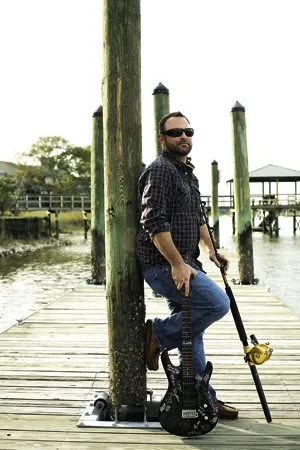
For any outdoorsman, Kevin Costner’s 165-acre ranch near Aspen, Colo., is idyllic. In the middle of the land that holds elk, deer, and bear, there’s a large pond perfect for fishing. Captain Adam Paul and his guests, Charleston roots rockers Dangermuffin, are in awe of the mountains that tower around them.
The idyll is broken by the sound of an approaching storm. Thunder echoes round the mountains, appealing to lead singer Dan Lotti’s ear for dramatic timbre. As the storm hits, Costner offers them shelter in one of his smaller houses and the hard-touring band revels in the strong sense of camaraderie that a fishing trip can create. Storm or no storm, this is a hell of a lot more fun than staying in a hotel room.
Fun comes first for charter boat captain Adam Paul. He’s pursued his passion for years, hooking his friends and business partners with his infectious enthusiasm. He’s the executive producer of the web-based video series Gillznfinz, a combo fishing-and-music show that was recently picked up by the World Fishing Network and Versus. With Gillznfinz successfully on the internet and cable, Paul is planning spin-offs, like the hunting-oriented RackznWingz.
“I’ve been fishing my whole life,” says Paul. He started as an 18-month-old minnow catching his first Big One on Aunt Bessie’s Trout Farm. He hasn’t stopped since; even when he rested his rod to get a degree in sculpture at the College of Charleston, he made stainless steel fish. By the time he was 24, he was a product and pro staff manager of Sufix, the world’s largest fishing line company. There he saw what a big following the sport had, so he started a website to cater to people who shared his obsession.
“I wanted the Gillznfinz videos to be simple so that people could relate to them,” says Paul, now 30 years old. “I love to fish, listen to music, eat, party, laugh. I put them together in the show.”
The format can’t be simpler: every other week Paul takes a musician or band out fishing, they share a few beers, get something to eat, and the adventure is interspliced with footage from a live show (often filmed at the Music Farm). His guests have included Snoop Dogg, Widespread Panic, Slightly Stoopid, Umphrey’s McGee, Leslie, and Sol Driven Train.
“Every trip is different, with different musical genres,” says Paul. “365 days a year the bands are performing and entertaining fans. This is my chance to entertain them and let them kick up their feet, have a cold beer. It’s cool to see them relaxing off stage in an outdoors environment.”
According to Paul, the show was popular enough to lure the World Fishing Network, who picked it up for national broadcast. “It’s been in the prime-time spot eight times a week, with phenomenal feedback and a growing fanbase. It’s not just the fishing clientele that like it. Women say ‘Hey, thank you so much, finally there’s a show I can watch and enjoy with my husband.’”
Paul admits that production-wise, “nobody’s doing anything with artistic merit whatsoever” behind the camera. The camera-work is as raw as sushi, the sound quality is erratic, and the editing is as choppy as a storm-swept sea. But Paul’s love of the sport and the live music hold the programs together.
Gillznfinz was inspired by the bloom of social networking sites a couple of years ago, and it succeeds by the same principle — finding a niche, encouraging user content, and sharing an interest with new viewers. In this way, Dan Lotti equates fishing to music. “It all has to do with a sense of community, as with any genuine experience,” he says. “That’s how you build a fanbase. You get to know people really well; they make an experience what it is. Musicians are outdoorsmen as well, everyone can appreciate that.”
Paul will soon launch the second season of Gillznfinz, which he says will be available in 133 million households nationwide. Along with the hunting show, he’s developing an animated series that he describes as “Family Guy meets SpongeBob.” As long as it involves fish, Paul will be happy.
Spoleto 2010 offerings include a first for the Dock Street Theatre
by Nick Smith January 4, 2010
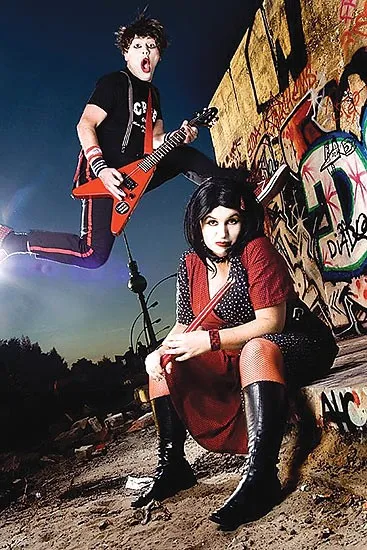
The Dock Street Theatre is said to be haunted by the ghosts of recidivist actors, whispering ushers, and wailing, gnashing directors. With a legacy dating back to the 1730s, it’s had plenty of time to rack up the specters. More recently, the theater has been closed for a two-year, $20 million renovation. It will reopen just in time for the Spoleto Festival USA 2010.
“It’s a very big deal,” says Paula Edwards, Spoleto’s director of marketing and public relations. “It’s one of our primary venues. The Chamber Music Series is going back in there and Gate Theatre is returning to perform there.” Ireland’s Gate Theatre was last here with The Constant Wife. This year it will perform Present Laughter, a Noel Coward comedy.
One of Dock Street’s earliest productions was Flora, the first ballad opera performed in colonial America. Overshadowed by The Beggar’s Opera and out of print since the 1850s, Flora is being revived for the 2010 festival. Adaptor/conductor Neely Bruce has pieced together the surviving 18 pages of music so that Flora can be mounted here. The ballad opera takes folk tunes and popular love songs of its time and adds lyrics pertinent to the story.
Proserpina, a Wolfgang Rihm opera, will be directed by Ken Rus Schmoll. John Kennedy will conduct the Spoleto festival USA Orchestra. “Goethe’s Persephone poem is filled with Sturm und Drang — in fact it defined it,” says Festival Director Nigel Redden. “In this particular interpretation, the fates’ commentary — basically, tough luck — is made wonderfully beautiful with Rihm’s music.” With a heroine fighting against the enticements of glamour and overwhelming emotion, the opera should appeal to audiences of various ages, from goth teens to faded beauties.
Philemon and Baucis shows yet another side of opera. It’s produced by the Colla Marionette Company and was composed by Franz Joseph Haydn specifically for marionettes in 1773. Although Haydn created a handful of puppet operas, most have been lost over years. According to Edwards, this one has only been performed once before in the States.
A something-for-everyone approach extends to dance as well. “Our program’s always bold, going from one end of the spectrum to the other,” says Edwards. The traditional storybook ballet Giselle from the National Ballet of Georgia will feature prima ballerina Nina Ananiashvili.
The Ballet Trockadero de Monte Carlo is an all-male troupe executing female ballet steps in Go for Barocco. Although they weigh twice as much as ballerinas, the mood is light. “It’s not mockery of dance,” Edwards emphasizes. “It’s technically impressive, and it accentuates the fun elements of the piece.”
Solo shows include Erik Friedlander’s anecdotal play Block Ice & Propane and Daniel McIvor’s U.S. premiere of This Is What Happens Next. The Spoleto Festival USA Orchestra will perform renowned works like Richard Strauss’ Also Sprach Zarathustra, Maurice Ravel’s La Valse, and Richard Wagner’s non-operatic Siegfried Idyll. The Westminster Choir will wrap their lungs around Mozart, Brahms, and Marc-Antoine Charpentier. The Ebony Hillbillies and the Carolina Chocolate Drops will both bring their popular brand of string-band music to Charleston. Germany’s Die Roten Punkte promise to rock the Emmett Robinson with their late-night theatrical show that’s more punk than plot.
Building on these highlights, the festival organizers have put together a program aimed to satisfy any attendee. There’s even a visual arts quotient, something that’s been missing from the main festival for years, if only through a partnership with the Gibbes Museum and the Halsey Institute of Contemporary Art. The mix of old and new arts should be enough to invigorate a few Dock Street ghosts, and encourage live audiences to haunt Charleston’s entertainment venues this summer.
VISUAL ARTS Back to Basics
by Nick Smith December 20, 2006

Start looking for John Carroll Doyle’s work and you’ll find it all over town: Carolina’s, 82 Queen, A.W. Shucks, Charleston Place Hotel. But from New Year’s Day there’s one place that Doyle’s work won’t be found: his own gallery.
After nearly 10 years in business, the John Carroll Doyle Art Gallery at 54 Broad St. will shut its doors for the last time at the end of the year. The reasons aren’t financial; according to Doyle, this has been his best ever in terms of sales. Instead, they’re personal. The painter who’s widely known for capturing the complex splendor of the Lowcountry wants to go back to basics.
Last year was another good one for Doyle, Chucktown’s premier homegrown artist. He became the first Charlestonian to headline the Southeastern Wildlife Expo, with carte blanche to paint whatever he wanted for the official poster (he chose an egret). More recently, his third book is proving as successful as its predecessors; I See London, I See France, a frisky compilation of black-and-whites of panties and their owners, has already garnered enough word-of-mouth attention to prompt the likelihood of a second edition with extra photographs. Hotels, restaurants, and clubs continue to purchase his work, reflecting a growing fondness among collectors and the public for his glowing depictions of jazz musicians, sport fishing, and wildlife.
Although he delegates much of his retailing to managers Sharon Crawford and Belinda Cole, Doyle still has gallery business on the brain and he’s decided to devote those energies to other things — specifically, creating more art.
“I want to use 90-95 percent of my time painting instead of 50 percent,” says Doyle, who sees his move away from retail as a leap in the right direction. “It will give me a chance to explore new territory. I don’t think I’ll become an abstract expressionist, but I’ll see which path my work takes.” For 36 years, the artist has been painting with sales in mind; this will be his first chance to let loose without concerning himself with creating a commercial product.
The 64-year-old Doyle’s earned his chance to live a little. He’s still mindful of the times when, early on in his career, he was drinking heavily, happy to have commissions and be alive at all. In 1983 he quit the sauce for good and continued to devote himself to his self-taught, loose painting style. The results of his labors are all over town, and have appeared on sport-fishing magazine covers, the Illinois-based Blue Chicago nightclubs and even in an ad campaign for Absolut Vodka. These days, his work is nationally known, and the past five years in particular have seen an output of increased maturity and popularity.
All the same, in the art world there’s no such thing as being too popular. Hence a new association with Joe Sylvan, who’ll be selling Doyle’s work at The Sylvan Gallery on 171 King St. from Jan. 1 onwards. “I picked him because I felt like he’s bringing a lot of well-known painters to Charleston,” says Doyle, who was lobbied by several local gallery owners. Sylvan’s contacts from his days running a similar business in art-centric Santa Fe, N.M., mean that Doyle’s work will reach more collectors out West.
Sylvan is modest about his part in setting up the agreement. “I didn’t do much,” he shrugs. “When we first came to town four years ago, John was very supportive. I consider him to be a friend and his art makes me smile. I won’t carry anybody’s work that I don’t like or enjoy, and I love his enthusiasm for the whole art process.”
Doyle is also enthusiastic about having his work displayed beside art by the likes of Rhett Thurman and Glenna Goodacre. “Stan Gerhartz is one of hottest painters in America right now,” he explains. “I’m proud to be shown alongside him.”
Doyle will keep his studio above La Hacienda on King Street, in a space that used to be a ballet school. He’ll still have work for sale there to appointment-only visitors, though he doesn’t intend to spend as much time there as usual. As all the artists he admires worked outdoors, he’s eager to paint on the streets of Charleston. “I tend to stay in the studio too much,” he says. “It’s like being a chef. It’s easier to cook in my own kitchen than do a picnic. But I definitely plan to do more plein air painting.”
There are plenty of other interests that Doyle wants to pursue. A children’s book is scheduled for next year, and the artist hopes to hearken back to his work as a fashion illustrator “many years ago.” Although Doyle has designed suits for himself, he’d rather develop clothing for women. “Their clothes are much less limited,” he believes, hoping that he’ll be able to design a gown for 2007’s Spoleto auction.
In between bursts of designing, painting, and photography, Doyle will continue to support the American Heart Association, to which he donates a painting every year. He’ll also be ready and willing if Darkness to Light ever needs him.
‘I was there in the beginning,” he says of the locally founded child sexual abuse awareness organization that’s gained international attention in recent years. “I did some commercials and paintings, donated money.” Sexually abused in his early teens, Doyle has realized how important (and rare) it is for male survivors of abuse to speak up about their experiences, giving others the courage to come forward. “We get calls from places like Maine and California from people who have been abused,” he adds, praising Darkness to Light President/CEO Anne Lee for her work as the organization’s main mover.
With so many irons in the fire — art, publishing, philanthropy, clothing, and even interior design — something had to cool, and while it might take a while for buyers to make the switch to the Sylvan, it seems like Doyle’s made the right choice. He’s entering a brave new world of plain white canvasses, no strings, no pressure, just a willingness to experiment and grow.
Undo the ink
by Nick Smith December 19, 2007

It’s inevitable. Human nature dictates that we’ll try unwise things from time to time, make mistakes or make decisions that we regret later. Some of these bad decisions can be forgotten as swiftly as a fading thought. Others aren’t so easy to forget — like a tattoo.
As a clinical assistant at the Dermatology and Laser Center of Charleston in West Ashley, April Gaylen has seen her fair share of folks who need to have their tattoos removed, and their bad decisions erased — particularly young professionals who have discovered that their tramp stamps and barbed wired biceps aren’t as popular in the workplace as they were in college. But now it’s her turn to lose a tat.
Gaylen’s tattoo is a little souvenir from a road trip over a decade ago. She’d driven to California and back with friends, stopping at places like Vegas and Tijuana. While out West she’d dropped into San Diego and got some ink — a solid jet black tribal design on the right side of her upper back.
Now that she’s 33, she wants to stop hiding her back and start wearing low-cut dresses. “I’d always heard horror stories about tattoo removals,” she says, “but it’s not bad. They rub on the topical cream and you’re supposed to sit for 30 minutes while it numbs the area. It’s not as uncomfortable as I expected.”
Then the laser comes out. And for two minutes, the hot, stinging beam hits the skin and starts to break up the ink. Not surprisingly, some patients find the process to be rather painful. But not Gaylen. “It didn’t really bother me.”
After her first try, she’s opted to go without the cream. The laser work is more painful for some people than others, depending on the placement of the art, the sensitivity of their skin, and the amount of detail and color that has to be eradicated. Since Gaylen’s tattoo is simple and plain black, she has less to worry about.
After several treatments, Gaylen says her tat had been reduced to a faint outline.
Gaylen feels lucky to have her job and the opportunity to get her treatment in-house. At last she can consider wearing open backed outfits again. “I’m excited just to see what will happen,” she beams. “I’m just lucky to have gotten this job.”
In Good Hands
by Nick Smith December 19, 2007
Dr. Scott Bradley’s patients never call the hospital to arrange an appointment, and they often arrive unexpectedly. They never say a word, they turn their noses up at hospital food, and the only time they yell for a nurse is when they crave warm milk. His specialty is pediatric cardiac surgery, and his smallest patients weigh 500 grams.
When Bradley, cardiothoracic surgeon at MUSC, first encountered pediatric heart surgery at Harvard Medical School, he was hooked by the field’s challenging complexity and the variety of heart defects. “I saw the opportunity to do some good, help people born with things wrong with them,” he recalls. “It seemed really fascinating.”
Bradley performed his first infant heart surgery in Ann Arbor, Mich., in the early ’90s. “It was intimidating, because everything’s so small,” he says. The surgeon had done most of his training with adults, so to get used to dealing with smaller hearts, Bradley practiced on lambs. And on top of all that, he had to deal with puzzling defects.
“There’s such a wide range of problems,” says Bradley. “We really don’t know what causes heart defects. Some are genetically linked. A lot that we do involves rearranging the heart from the way it was to how it’s supposed to be.”
During the precarious procedure, Bradley wears glasses that magnify the membranes of his fragile patients. It’s a process that can take up to 12 hours, although the surgery can be broken up into two to three hour stints for smaller premature babies.
“Some of them are in intensive care on a ventilator when I first see them,” he says. “They can’t even go home. They can’t eat, or they don’t grow. It’s remarkable to see them afterwards. The parents tell me that their baby eats like a champ, can’t get enough. It’s exciting to see how they do and rewarding to completely change someone’s life.”
Some operations are more successful than others. “I always hope for the best and try to do my best. But there are difficult days that can be pretty discouraging,” he says. “I have to talk to the parents about it afterwards, but it’s impossible to put yourself in the position of somebody who loses a child.”
Bradley knows that if he dwelt on the tragedy of an unsuccessful surgery, it would stop him from working for a month or two. But each day brings another family and a brand new patient. “I try to live in the present. And although it’s difficult sometimes, I’m fortunate that I work in this time and this field. The operations usually work well. Twenty years ago, a baby might have had a 50/50 chance of surviving. Techniques were not as advanced as they are now.”
VISUAL ARTS REVIEW: Screen Printing 101
by Nick Smith December 19, 2007

On view through Dec. 31, 2007
52.5 Records, 561 King St.
These days we’re so used to corporate-led, mass-produced ads that it’s hard to appreciate the amount of effort that goes into screen printing.
This isn’t work made on a computer and printed out in one go. It’s made by hand, carefully printed layer by layer, with a color painstakingly added each time.
If one layer’s screwed up, the artist has to start from scratch.
Some of the art in Screen Printing 101 is amazingly intricate, with 10 or more colors and great attention to detail. Most prints were put together over a two-day period. But it’s not just the production process that’s fascinating in this satisfying group show at 52.5 Records.
The finished pieces riff on 20th-century pop culture and art history, showing how effective a few basic colors can be in the right combinations.
Above all, the show is a guide to the sheer array of ways a memorable print can be created with direct, unpretentious images. In fact, the simplest artworks were the best sellers this time around, such as Mike Klay’s “Star Trail #1359.” Showing a moon with concentric circles, it has branches rustling at the print’s edges and a light brown sky that’s mesmerizing.
This show’s a sequel to a poster exhibit held earlier this year at 52.5. Both events were organized by local artist Chuck Keppler, whose own work is remarkable for its half-tone nods to silent movie stars, pop art, and contemporary photography.
Over a dozen artists are involved, including Dan Grzeca, Strawberryluna, Johnny Pundt, and Standard Design. Some of the pieces are holdovers from the last show, including gig posters for Arctic Monkeys, Maria Taylor, The Black Keys, Gore Gore Girls, and The Melvins.
Other work exhibited: Leia Bell’s smooth, flowing illustrative art; Crosshair’s streetscapes like “1319 W. Lake,” meticulous in its registration and use of several colors; and Adam Turman’s prints, which have a curvy ’70s look — with its portrait of a svelte lass in “Hot Cocoa.”
The abundant references to the 1960s and ’70s are a throwback to that era’s relatively primitive printing methods before innovations in digital print technology sent handmade pictures underground. Screen prints at 52.5 are hung among racks of CDs, but that never diminishes the art’s cumulative effect.
The juxtaposition of colors leads the viewer through the store from one print to the next. There’s variety here, too, though it’s never overwhelming. And the art is affordable (limited-run prints for $30-$40), all of which makes this new show a strong move forward for 52.5 as an alternate art space for underground and contemporary art.
Jill Hooper has her eye on decay
by Nick Smith December 16, 2009

When summer turned to fall this year, Jill Hooper struggled to adjust. The temperature was changing, the humidity was different, and little critters were raring to eat her pal’s pomegranates.
“My friend’s tree was bursting with them,” says Hooper, an award-winning realist painter. “I was determined to get to them before the squirrels.” The pomegranates ended up as subjects of a still-life painting in her sold-out show, On the Nature of Autumn. It’s a series of five oil-on-linen pieces that show her calmer, more reflective side.
“Subconsciously, I was drawn to these beautiful fruits of autumn,” she recalls. Further inspiration was close by. Next to the pomegranate tree were persimmons, fruits glowing a distinctive orange color with a smoky blue-gray film over them. They are featured in “Stolen Persimmons,” a 12½” x 43″ painting that juxtaposes the orange with wilting leaves and rich blue cloth.
In her late 30s, Hooper is the youngest artist to have work collected by the Gibbes Museum of Art, and she’s been hailed as a “top emerging artist” by Art & Antiques magazine. Even though it’s been 15 years since she graduated from the College of Charleston with a BA in Fine Arts, Hooper shows no signs of taking a break. She still paints every day and finds insight in everything she sees, including moldy fruit. Hooper allows her objects to have a breath of their own. She says that she finds “the beauty in letting the leaves of a twig start their decay to being brittle, having been clipped from their branch.”
“Pomegranates From a Tree on Queen Street” has a similar background to “Stolen Persimmons.” Its coppery tones are accentuated by a metal pail placed right of center, the fruit reflected in its surface. The succulent red pomegranates draw the eye across the painting. In “Lemons, Plums, and Clementines” the artist uses rich yellows to lead us to the center of the image.
“Bread Crumbs” demonstrates Hooper’s mastery of detail, a rustic Tuscan table scene depicting two loaves of bread down to the smallest ort. This is a softer painting, lighter in shade and mood. The pale crusty bread contrasts with a few small green olives and a dark vase casting an insouciant shadow on the wall.
The show’s final piece departs from the fruit theme but continues that of food and its association with life and death. The copper bowl in “Beaufort Oysters” has overturned, spilling empty bone-colored oyster shells toward a crumpled white cloth. From a distance the shells look like the curved skeleton of a strange animal.
“Working from life always offers the unexpected,” Hooper states. “Though I start out with an idea, I know that things have a life of their own and it’s best to follow the natural path even if it breaks from the original plan.” If her fruit rots or the leaves turn brown, she incorporates this fact of death into her work. It fits in with the autumnal premise.
Unexpected surprises notwithstanding, these large-scale still lifes are very different from some of Hooper’s landscapes and portraits. Her self-portrait “Pugnis et Calcibus” (“With Fists and Heels”) is messier than her usual calculatedly classical work. Apparently, it shows the artist as she sees herself rather than her in actuality; she described its creation as “carving out a monster.” The honesty paid off; in 2007 the piece was selected from 1,870 entries for a highly prestigious BP Portrait Award, and it now hangs in the National Portrait Gallery in Edinburgh, Scotland.
We’d love to see more of this kind of work from Hooper, who has had some great mentors (D. Jeffrey Mims, Charles Cecil, Ben Long) and an ability to find significance in everyday nature. Recent landscapes show a closer attention to texture and adding the “rough edges” that can be found in life.
Despite her training and experience, there’s a sense that Hooper is still learning how far to push things. She says that’s the hardest aspect of her work, mentioning the paintings that she’s had in progress for years. “I have several … sitting in my studio now,” she explains. “I learned that leaving them for awhile helps me see clearer.”
She’s found a musical term that eminently describes what she wants to achieve with a painting over time — rubato, carrying a note just long enough to fully feel it through, but not one moment longer to ruin it.
“It’s so hard,” says Hooper. ” Obviously, that’s where you hope instincts come in.”
Forever Plaid is a harmonic and joyfully unhip affair
by Nick Smith December 16, 2009

Forever Plaid mashes up Glee and The Twilight Zone to form the most interactive and innocent local show this season. This musical revue has enchanting characters, an imaginative framework, and a song selection that will be refreshingly unfamiliar to younger audience members.
The show is named for a fictional close harmony group that performed at wedding receptions, proms, conventions, and country club socials in the late ’50s and early ’60s. Although they never made it big, they loved to sing and knew how to entertain a crowd. The Plaids were all set for their first major gig at the Airport Hilton’s Fusil Lounge when they died in an auto accident. Now 45 years later, the stars are perfectly aligned for them to escape from purgatory and perform the show they never could in life. This plot gives Forever Plaid a fun supernatural twist and adds a sense of urgency too — the four singers have to keep the tunes flowing before they run out of time and move on to a higher plane.
Group leader Frankie (Ryan Ahlert) is a smooth-as-soda young idealist. There are opportunities for the gifted Ahlert to flesh out his role, whether by egging his friends on, reminiscing about their early days, or waxing lyrical on the incomparable joy of singing a tight chord. Jinx is portrayed by Husain Williams, who gives his character a sensitive edge, despite having a powerful singing voice. Meanwhile, Sparky (Brandon L. Joyner) says what’s on his mind, whether it’s right or not, and Joyner is not afraid of making himself look silly when the script calls for it. As the socially inept Smudge, Brian Bogstad is a last-minute addition to the cast, And while he has only five rehearsals under his belt, he has all the songs, dialogue, and choreography down.
Each singer is distinctive with his own quirks and failings. With their nose bleeds, anxiety attacks, and stutters, these are nerds who spend their lives chasing a dream they never realized — and we love them all the more for it.
Meanwhile, director Sheri Grace Wenger knows how to emphasize the jokes without sabotaging the narrative.
VISUAL ARTS Part of the Furniture
by Nick Smith December 14, 2005
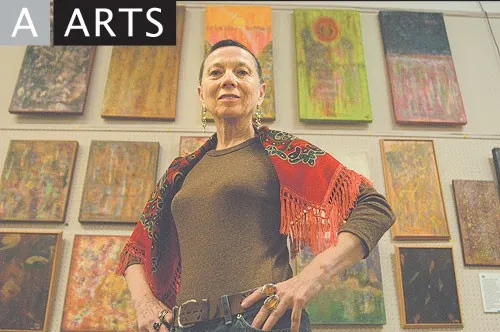
Last weekend’s hit-and-run group show The Chase Is On was an exhibit with many similarities to Different Artists, Different Mediums, an extended-run show still on view at the old 96 Wave offices in West Ashley. Both events commandeer unorthodox venues, championing local artists and giving them each a cohesive space to strut their stuff with few restrictions on what their work should constitute. The shows even share a few artists (Kevin Taylor, Philip Hyman, and Bea Aaronson). But the similarities end there.
The Chase occurred in the old Chase furniture store at 414 King Street, next to the old county library, with more room for visitors to appreciate the work from more than a few feet away. Slick oil paintings were displayed beside sculptures, textiles, ceramics, and jewelry. The store even had room for lighting and furniture, most notably Boyd Boggs’ curly wood creations.
Many of the artworks benefited from having room to breathe. Typically tucked away in Studio Open on Folly Beach, Sherry Browne’s collages looked complex and imaginative here, including Japanese-tinged pieces like “Eventide.” EMS Barnwell’s watery work in pen and ink also seemed better suited to this location than in its previous solo venue, Nula on lower King.
McLean Stith’s work also appeared at this year’s In the Spirit exhibit for Piccolo. Stith’s impressive, larger-scale paintings featured ambitious, multilayered brushstrokes that gave weight to subdued colors in scenes of white woodland, dark skylines, and landscapes with bridges and powerlines.
Only one artist had a room of his own — Kevin Taylor, holding what he described as “part garage sale, part art show.” The ubiquitous artist was selling off private knick knacks along with his original art spanning student sketches from 1994 (hung on a clothes line) to paintings from the past couple of years. The area was intended to resemble his living room, complete with couches and TV sets. The artist’s moving to San Francisco soon, and his adventurous, darkly comic work will be missed.
Taylor’s cheeky nudes are likely to have angelic wings on their backs or fried eggs for faces. Peggy Howe’s pastel nudes are more traditional but no less intriguing, capturing somber moments with stark figures on black backgrounds.
Alongside the familiar local names (Aaronson, Howe, Hyman) were other artists who don’t always get much of a look. Lynne Riding’s creative world is one of windswept beaches, bowed tree branches, and shifting sands. She describes her vertical paintings as “dimensional portals,” made to scale with her body so that an outstretched arm can create a correlating line. Her oil on canvas depiction of Pritchard Island (“#46”) includes twisted limbs like pale blue roots, with speedlines to suggest intense motion. Riding, a College of Charleston professor of Studio Art, also shows aptitude with collagraphs — a collage printmaking technique — in “Pritchard Island #37.”
Anj is a local pioneer of Creative Energy Release, a technique encouraging people to let their energy flow freely through art. So it’s ironic that she seems to be holding something back in her own work. Her abstract paintings are carefully defined; “Two Thoughts” is split in half, with a dark and light side. “Celebration” is divided vertically by a skinny sax shape. And her visual essays on emotion, “Anger” (using red and black colors) and “Fear” (with more cautious, tentative strokes) are also surprisingly subdued.
It’s great to see contemporary art outside a gallery, in a prominent place where new viewers can see it. Shows like Read Brothers’ outsider art events with Geoffrey Cormier and The Chase are obviously successful enough to make them a worthy part of Upper King’s prettification. Best of all, though, the Chase artists mucked in together, helping to run the show and sharing some bright ideas. It’s that kind of creative give-and-take that makes even the most commercially-concerned exhibition good for the city.
COMEDY Morons from Our Space
by Nick Smith December 14, 2005

While rooting through the trash behind Theatre 99 in an attempt to dig up some dirt on The Have Nots!, we found a prop list for a new historical comedy catering exclusively to idiots. The Complete History of Charleston for Morons is written by Greg Tavares and directed by Tavares, R.W. Smith, and Caleb Usry, the three cast members. The first three productions were an attempt to clue in citizens ignorant of Chucktown’s action-packed past — and also to workshop a show they hope to see become a regular addition to the Theatre 99 repertoire.
Here are some items from that remarkable prop list, along with some thoughts on the production itself:
A wrinkly piece of cloth for use as a projector screen to show video footage at the start of the show. The footage features vox pops shot on the streets of Charleston. The trio ask members of the public about local history and respondents mostly dazzle the audience with their ignorance.
The wrinkles make the images a little hard to see; that’s a disappointment after the slick video elements of Theatre 99’s recent short run of Vampire Lesbians of Sodom. Still, the sound’s good and the candid man-on-the-street clips are entertainingly dumb, with a memorable turn from a dude who makes Keanu Reeves sound like Edward Gibbon.
An atlas of all the Charlestons in America. While Greg Tavares delivers a lot of the actual historical information during the show, a section on Charleston timelines gives R.W. Smith (better known as a PURE Theatre ensemble member) a chance to shine. He’s warm, funny, and — unlike the third member of the cast — relaxed. Caleb Usry fidgets his way through Morons, shifting from one foot to another like he’s standing on an ants’ nest. But he also gets some of the best lines and makes the most of them.
A box of tea, a conquistador’s helmet, and a tomahawk — special items used in Apprenticing Survival in Charlestowne, a reality TV show set in the 1600s. Movies and TV shows get spoofed a lot in this production, an attempt to make the historical facts more palatable for today’s attention-deficit-afflicted audiences: a bunch of morons. (Yes, the cast get considerable jollies from insulting their patrons. Who else but a dummy would attend a play with “Morons” in the title?)
A map of South Carolina’s coast, 1686. Tavares gives an assured performance in various roles. As meteorologist “Fob Rowler,” he announces that the entire coast is on Invasion Watch when the Spanish plan to attack Charlestowne. Smith holds the map, which includes a little galleon that he wiggles around a bit.
Angelina Jolie’s left breast, adding some star power to a movie script version of the Revolutionary War. One or two lighting cues are off here, while others are purposefully pickled. Smith doesn’t always find his light, leaving his left side in darkness. Along with Usry, he pitches the script, while Tavares gives the historical commentary. Tavares seems unaware that after his many previous humorous interludes, the audience probably won’t believe a goddamned word he says, factual or not.
Blackface makeup for off-color gags about race.
Gingham bonnets for a riff on Gone With The Wind, segueing nicely into a look at the Civil War. A stony-faced Tavares brings us the latest news from The Secession Room while his colleagues report from the front line.
With echoes of Eclectic Eel Productions’ Frankly Charleston and the Reduced Shakespeare Company’s The Complete History of America (Abridged), this is an informal piece that threatens to break out into improvisation at any second.
The whole thing could be tighter, with Usry and Tavares occasionally shaky on their lines. But they get away with it because of the easy rapport they have with the audience and plenty of improv experience, relying on our knowledge of their prior work — and a lot of local insider jokes — for some of the laughs, though neither is guaranteed to serve them well with tourist-heavy audiences in the future. Although the lively blocking holds our attention, there are no sets, the props are makeshift at best, and there’s only one sound cue — an abrupt harp chord. If they need music, these guys whistle. Humor relies heavily on puns, parochial jokes, and the personalities of the presenters.
Tavares, Smith, and Usry hope to develop Morons into a monthly two-act show and possibly make it part of Theatre 99’s Piccolo Fringe lineup next spring. With a bit more polish it will make a solid play to draw in tourists and even locals who don’t mind some well-aimed, good-humored jabs at the Holy City.
GET THE PICTURE Pretty Propaganda
by Nick Smith December 13, 2006
Following in the footsteps of past Redux directors like Bob Snead and Kevin Hanley hasn’t been easy for Seth Curcio. When gallery co-founder Snead left for a grad program at Yale University School of Art and, later, Hanley departed, citing creative differences with the Contemporary Art Center’s board, Curcio was left holding a big brick baby.
After a come-on-and-give-the-guy-the-job-already period as “acting” executive director, Curcio officially took the reins this summer. Now the vast amount of work he’s put into sourcing and developing shows is starting to pay off. As if to prove his gallery can handle anything that’s thrown at its walls, he’s invited two aerosol artists to use the space as a large-scale canvas for their “visual propaganda.”
Curcio’s the kind of guy who seems quiet at first, but when he starts talking about progressive art he becomes as animated as a Pixar table lamp. And he’s particularly passionate about Project Aerosol, a two-man show that brings a bit of Baltimore to downtown Charleston.
Rather than try to squeeze all their work into small, manageable picture frames, Jason Kear, a.k.a. KEAR, and the artist known as Sheepman have been given enough room to express themselves the way they’d do outdoors. Painting on a layer of latex, they’ve created a blend of graffiti and gallery-sanctioned, classically-composed art that’s colorful and effective, attracting a large array of visitors to Redux with its accessible dynamism. According to Curcio, the opening reception was attended by a larger-than-usual crowd of nearly 250.
The turnout isn’t so surprising when you consider how much the two artists promote themselves. Sheepman’s favorite local open air ad-land is ’round the back of the Berle Shopping Center off Folly Road, sporadically transforming and repainting the space. KEAR’s murals are well-known in Philadelphia and NYC as well as Baltimore.
As Sheepman’s hit that city’s streets with KEAR, it’s clear that the artists have influenced each other. The materials they use, with paint dribbling down from the top of the walls, helps the different pieces compliment each other. Sheepman likes his green and aqua blues, while KEAR tends more towards urban browns and yellows, but they share a fascination with photorealism, close detail, and the role of nature in our citified world.
For these guys, every bare wall is a potential canvas. But they don’t seem hemmed in by Redux’s limited space; there’s room for explosive self-portraits, with paint shooting through Sheepman’s ears and out of his mouth in a spray of imagination; photos of previous murals; and even a gift shop of sorts, with a small room converted into a gallery of past Redux successes (etchings, serigraphs) and some reasonably priced products (such as a Sheepman mesh cap). But Redux isn’t ready to sell out yet. Its art has always been for sale; this is just a more aggressive form of propaganda that suits the current show. I can’t fault the gallery for its commercial pursuits — not as long as it keeps hosting exhibitions as vital as this one.
Verv’s Katie Holland directs a fast, funny, fresh Criminal Hearts
by Nick Smith December 10, 2009
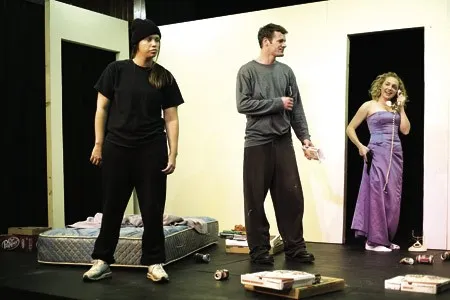
There’s something about girls with guns that turns us on. Maybe it’s a Southern thing. It’s one of the reasons why we liked Criminal Hearts, an unpredictable comedy from the boisterous North Charleston-based company Theatre/verv/.
From the opening moments of the play when Bo the female burglar enters wielding a handgun, it’s obvious that this isn’t the kind of play to snooze through. The story revolves around Bo and the lady she’s trying to steal from, Ata Windust. Ata is a 33-year-old nervous wreck who spends most her time hiding in bed. By sneaking in through the window, Bo makes it impossible for Ata to avoid the exciting, dangerous outside world any longer.
For any sane person, a break-in would be a disaster, but sanity is an alien notion to Ata. When we first see her, she’s dressed in polka-dot pants and slippers with fluffy pink balls. “Women shouldn’t shoot each other,” she cries. “Men shoot each other. Women relate!”
And they do, finding things in common with each other despite being from different worlds. Bo is a “hustla” scrounging a living through cons and thefts. Ata is a society gal who has fallen foul of her swinish husband, a lawyer named Wib. He’s left her with nothing but an expired credit card, a closet of designer clothes, and no self-esteem. But once Ata has possession of the gun, she can’t let go, so the two women hatch a plot to wreak revenge on Wib.
Jane Martin’s 70-minute play has lost none of its freshness since its first performance in 1992. It breezes along in just three scenes, developing the two main characters as they learn who they can trust and make decisions about how they want to live their lives, honestly or dishonestly. Along the way Martin takes cracks at boorish male behavior, the jargon of psychotherapy, and the shallowness of high society.
Many of the clever/funny lines in the play go to Ata, so it’s fortunate that Moss plays her in this production. Moss takes what could have been a hysterical stereotype and makes her enjoyable to watch whenever she’s on stage. Moss gives an endearing and sympathetic performance that holds the show together.
As Bo, Rose obviously enjoys her role. Maybe too much. She finds it hard to keep a straight face, particularly in her first scene. Even if this is part of Bo’s freewheeling character, it looks like Rose is fighting off a fit of giggles. In the second act, she seems more composed.
Boogie Dabney is Bo’s beau, Robbie. He’s a candy-chewing, beer-loving, totally untrustworthy dude, a criminal in a cummerbund who’s always looking for an angle. Dabney manages to be charming even though his character is despicable.
J.C. Conway is saddled with the equally loathsome role of Wib. He has a couple of long, stodgily written speeches that almost lose steam, but then he rallies round when Wib loses his temper with Ata. It’s an effective moment that makes us hate his character more than ever. J.C.’s wife Andrea Conway has a hilarious (and we don’t use that word lightly) cameo as nosy neighbor Mrs. Carnahan, responding to a gunshot in Ata’s home. Sadly, only half of the audience can see her because she’s tucked behind a door. The same goes for some later reactions from Dabney, who eavesdrops outside the apartment for a time.
Director Katie Holland pays attention to detail and does a good job of keeping the play moving; Ata’s wordy monologues are performed with alacrity. It would be good to catch more of the actor’s faces — they sometimes look upstage instead of letting the audience see them.
The play benefits from Dabney’s set, which conveys an apartment gutted of its furnishings and paintings. A couple of lighting effects also help to enhance the story, such as the moonlight on the window that Bo sneaks through.
Holland has decided to keep the tone light and funny throughout, making this a fast and friendly night of theater.
Emily Wilhoit delights, but The Sound of Music is marred by so-so singing
by Nick Smith December 10, 2009
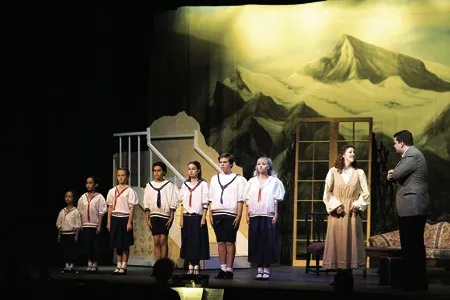
How do you solve a problem like Bob Ivey?
As a director he’s a done a fine job of attracting theatergoers to the Footlights over the past few years with shows like The Full Monty and Once Upon a Mattress. He can craft appealing dance numbers that have a grand feel even when they involve a mere handful of actors. He is also good at getting solid acting performances from inexperienced players, especially kids. The focus, though, is undoubtedly on his first love: dancing. After all, he is also artistic director of the Robert Ivey Ballet and director at the Charleston Dance Studio.
Other aspects of his shows get less attention. In The Sound of Music, it’s the singing. In a show that relies so heavily on its songs, this is a hitch.
The 50-year-old musical is set in pre-WWII Salzberg, Austria. At the local abbey, postulant Maria Rainer (played by Emily Wilhoit) would rather sing and dance than behave like a boring old nun; she even dares to wear curlers under her wimple. Obviously, something has to be done about this troublemaker.
Fortunately the kind Mother Abbess (Druid Hamrick Joyner) takes pity on Maria, solving the issue (and getting some peace) by sending her to the von Trapp family. There Captain Georg von Trapp (Tony Nappo), a widower, needs help keeping his seven kids in line. Maria manages it with a guitar in her hands and a song in her heart, melting the captain’s in the process.
There are flies in this ointment in the form of Nazi invaders, personified by Admiral von Schreiber (the underused David Moon) and Herr Zeller (Steven Bryant). Georg has to decide whether to cooperate with the Germans like his friend Max Detweiler (Robbie Thomas) or flee over the mountains to Switzerland.
Ivey succeeds in squeezing this epic tale into a tightly paced production that lasts just over two hours. Nothing seems rushed, the characters are fully formed, and there are many amusing moments: the stunned reactions of Maria’s sisters at the abbey when she sings “My Favorite Things;” the dry humor of Georg’s butler Franz (a perfectly wry David Graham); and the practiced swagger of Max, a government official who’s desperate for the von Trapps to sing at the prestigious Kaltzberg Festival. There’s also room for a puppy love story between Georg’s eldest Liesl (a confident Sarah Callahan) and telegram boy Rolf Gruber (Kyle Kasten), who sing “Sixteen Going on Seventeen.”
Wilhoit makes a great fresh-faced Maria. She’s full of energy with a strong singing voice. The same cannot be said for Joyner, Nappo, Thomas, or Kasten, who all seem more comfortable acting than singing. Sometimes it’s hard to hear them over Nancy Eaton Stedman’s peppy three-piece band. At other times, they have trouble hitting their notes. Luckily, Rodgers and Hammerstein songs like “Climb Ev’ry Mountain” and “No Way to Stop It” are effective no matter who’s singing in them, and the well-performed title song, “The Lonely Goatherd,” “Do-Re-Mi” and “Edelweiss” (the von Trapp family equivalent of “Purple Rain”) are all emotionally powerful.
Georg’s children run the gamut of ages, and they all give memorable and distinctive performances. Chase Saulisbury and Satya Tranfield come across as particularly sincere on stage.
Sets are suggested with a few items of furniture, a pair of impressive light-up stained glass windows, a staircase, gazebo, and Austrian flag. Scene changes are amazingly fast, a credit to the efficiency of Stage Manager Esther Lapin and her crew. A mountainous Austrian backdrop looks very wrinkly, and a couple of hills have their wood and metal struts showing, but the overall look of the show is another testament to the ingenuity of scenic designer/tech director Richard Heffner. Bruce Bryson, Sharon Willis, and June Palmer’s costumes also help to enhance the show’s visuals.
However, until the director pays closer attention to the singing and the blocking (some characters are occasionally hidden behind others), Ivey won’t be able to create the great Broadway musical tribute that he really wants this to be.
Painters join forces for a chaotic mix of high concepts
by Nick Smith December 9, 2009
By framing a picture or putting an object in a gallery, we change its status. It’s deemed more worthy, more valuable than a painting on a loose piece of paper or a sculpture stuck in an artist’s studio. As Vincent van Gogh found out the hard way, not all great artists get their work sold or exhibited. But the reverse is also true: Just because art is shown in a fancy gallery doesn’t necessarily mean it’s good.
Michael Krajewski and Justice Littlejohn’s new show is packed with exuberant and imaginative work. The City Gallery deserves praise for exhibiting such avant-garde art. But quality-wise, the two artists have a long way to go.
Rather than taking the time to develop or hone a particular image, they seem impatient to pile their ideas onto canvas — and there are some fine ideas here. Delve through the squalid doodles and the angry daubs and you’ll find strong pieces like “Faces in Vases,” with female heads in place of flowers, and the Miroesque “Light and Black,” with its matchstick figures. But there are a lot of other artworks that seem half-finished or overdone.
The self-taught Krajewski lives in Columbia, S.C. His solo work is the best in the exhibition. He uses a dark, earthy palette, lots of black lines, and disembodied eyes, mouths, and other body parts. Like Littlejohn, he incorporates cubism and fauvism into his art. He uses different types of canvas, including matte board and fabric with variable results.
“Two Wings” is a good example of the simple, thin-lined style of some of Krajewski’s work. It shows a bird with human lips in a field of long-stemmed flowers. In “The Meeting,” a half-skeleton man encounters a half-naked woman in a painting that visualizes their true intentions. “PM Talk” features a robot with a fish crotch and a counterpart in lingerie. Krajewski is never short of wild ideas, but his energy appears to be unchanneled and his draftsmanship is hasty.
Justice Littlejohn is based in Greenville, S.C. His style looks even more rushed and raw than Krajewski’s. He’s an instructor as well as an artist, and his passion for painting comes out in his work. He observes everyday life and turns it into art. His street scenes give a sense of what it’s like to jaywalk through heavy traffic, all blurred motion and gawking passersby. He’s good at choosing unusual angles; “Lookin’ Down” shows a man’s lap and feet from his point of view. Food, drink, and cigarettes are prominent in Littlejohn’s pieces; several of his characters are jonesing for pizza.
These accessible perspectives anchor his images in the real world. But they lack professionalism, and the more ambitious his concepts become, the more muddled the results. When he paints groups of figures, they are a blobby connection of torsos and limbs. His multicolored backgrounds often threaten to overwhelm the main subject — an issue with Krajewski’s work, too.
Littlejohn’s at his best in still-life mode (“Some Personal Space,” “Still Hungry”) and when collaborating with Krajewski in tableaux like “Swine & Dine” (featuring pigs at a Thanksgiving dinner) and “Never Forgotten,” a depiction of a speeding fire truck on a long, narrow canvas, with red lights streaking by.
Littlejohn and Krajewski call their joint work “collabin’,” creating a chaotic mix of high concepts and raw brushwork. They’re not ready for prime time yet, but they’re prolific, enthusiastic, and never short of subjects they want to paint. All they lack is artistic maturity. On Dec. 10, the artists will be giving a free talk, demonstration, and workshop at the City Gallery. They will be encouraging attendees to collaborate on some impromptu projects. We get the feeling that making this kind of art is a lot more fun than looking at it.
Santa gets his hours cut
by Nick Smith December 9, 2009
For me, the Christmas season doesn’t really start until the downtown tree lighting and parade. That signals the start of Holiday Magic, a three-week-long festive program led by the Office of Cultural Affairs (OCA) in association with several city departments.
The action centers on Marion Square, where bows, wreaths, and giant gift boxes glitter in the Carolina sunlight. There’s an old fashioned sleigh, cute reindeer made out of logs and branches, and live music. I’m in the thick of it — this will be my seventh Christmas as a Santa on the square, waving to passersby, handing out candy canes and good wishes, and greeting parties of school children as they arrive by the bus load to jaw with Mr. Claus.
Except this year, he won’t be as ubiquitous as usual. The school visits will be few and far between. And worst of all, there will be no little helpers. America’s money slump has hit the North Pole, too.
Visits with the Big C have been trimmed to the three weekends leading up to Christmas, Fridays through Sundays, starting late and finishing early. This ties in with the Farmer’s Market on Saturdays and Sundays, when busy foot traffic guarantees Santa some action. Mr. Claus and an elf handler will be on hand to corral the kiddies.
According to OCA Director Ellen Dressler Moryl, the pared-down schedule is not the brainwave of some municipal Scrooge. “Schools have cut back on their field trips,” Moryl says. “We didn’t get much response from them.” She believes that a lack of money may be to blame.
Charleston Stage’s Audience Services Manager Gina Barredo agrees. “There’s been a downturn in school groups attending our shows over the past two seasons,” she says. “They have to cancel their visits because of budget cuts, the cost of hiring buses, or parents being unable to pay their $10.” The downtown theater company still packs out some of its school matinees, but not all of them.
On the square, Santa’s presence has dwindled drastically. Up until a few years ago, the Clauses would arrive on the square by 9 a.m. and stay well past dark, becoming bright red targets for passing drunks to dribble on. Photos were $2 each in order to cover the cost of the Polaroid film. Whenever possible, we took time to talk to the children properly rather than moving them past us in assembly line fashion. We couldn’t offer animatronic reindeer or pre-wrapped toys, but we tried to offer a more affordable alternative to the mall.
Amazingly, the kids came back year after year. I’ve seen children grow from kindergarten to middle school age, from believers to know-it-all tweens who remember their school trips to the square. They never thought it was weird to find two people dressed in heavy fur-trimmed suits and wigs, sweating in the crazy, hot Charleston weather. They were just pleased to see us.
The Holiday Magic visits were often combined with other downtown activity, from a simple picnic in the square to live musical performances coordinated by the city or trips to a Charleston Stage show, a big deal for little ones used to doing time in their classrooms for most of the year.
But the program’s real job is to encourage people to come downtown and get into the holiday spirit. The core of Holiday Magic remains, and Moryl is determined to make this the best one ever. “We’re maximizing our programs, having Mr. and Mrs Claus there on days when most kids go there,” says Moryl. “We’re spending the dollars we have to spend responsibly.”
According to Mayor Joe Riley, the Holiday Magic budget remains the same as last year. “There’s not as much activity on weekdays,” he says, “so we looked at ways to be more efficient. We’re being frugal and thoughtful with circumstances the way they are now.”
Frugal and efficient? Santa would surely approve.
But if you pass the square during the week and the grotto is empty, don’t blame the big guy. Blame those wonderful wizards of Wall Street who have landed us in reindeer dung.
THEATRE March of the Penguins
by Nick Smith December 7, 2005
Nuncrackers
Footlight Players
Running through Dec. 18 2005
Footlight Theatre
20 Queen St
When it comes to comedy, nuns, like monkeys, are gold. You can’t go far wrong lampooning the rigid mores of a convent and contrasting them with the free spirits of the ladies who live there. It was a standard Hollywood device long before Sister Act, and writer/composer Dan Goggin has made quite a killing Off-Broadway with his Nunsense franchise.
Over the past two decades he’s put together several shows featuring the Little Sisters of Hoboken, a bunch of klutzy nuns whose true personalities continually threaten to burst from their drab habits. The first Nunsense had gags aplenty, moving at a screwball pace. But the law of diminishing returns must inevitably kick in. The writer fumbles the ball with Nuncrackers and it’s the audience that gets screwed.
The premise is as simple as it is ripe for farce. The sisters transform their basement into a TV studio for a Christmas broadcast, complete with “on air” sign and clerical commercial breaks. A New Jersey version of The Nutcracker ballet is postponed by various injuries and mishaps, including the disappearance of the nuns’ gifts. Sister Amnesia (Rebecca Knox) provides funny interludes with her scatterbrained twists on Christmas carols; Sister Robert Anne (Cory Miller) is desperate to sing a song but no one will let her. At the end of the show, a deus ex machina marvel forces the ladies to make a moral choice.
The jokes are often predictable, using tired puns and vaudeville shtick. The songs last too long, running for four verses or more when two would do. The premise is stretched thin to meet its running time, and the humor that does hit home elicits gentle chuckles rather than gut-busting laughter.
This is the kind of show where the cast seem to have more fun than the patrons. That’s a shame, because the cast work strenuously to get the most out of the flabby script. Dusty Bryant plays Father Virgil, a bible-loving booze hound. He spouts a few of his lines in a mechanical fashion, drawing our attention to the fact that he’s an actor who’s memorized his lines rather than a fully rounded character. But his singing lets him off the hook, with fancy tenor vocals that transcend the occasional sour note.
Similarly, Miller’s rendition of “All I Want for Christmas” is gutsy enough to excuse her Brooklyn accent, which meanders all the way to Hoboken and back. Elaine Gray, as Sister Mary Hubert, lends great vocals to the gospel-inspired “It’s Better to Give.” There are four juvenile members of the cast — Mary Bailey Jamieson, Cameron Jenkins, Chelsea Jennings, and Olivia Prichard. They’re hard to hear when they sing “Santa’s Little Teapot,” and Jamieson tends to turn her face away from the audience in her tender scene with Bryant, but the quartet eke some rich humor out of short musical pieces like “The Holly and the Ivory” (it’s supposed to be “ivy” — geddit?).
A show like this stands or falls on the audience’s love of the characters. Nuncrackers is a typical sequel, where the characters have already been developed and stretched to their limits in prior episodes. We’re left with two-dimensional ciphers on the stage, their personalities long since played out: the Reverend Mother (Jaqualine M. Helmer) who’s harsh on the surface but has a funky side, the ambitious Sister Mary Leo (Emily Phillips) who wants to be the first ballerina nun, the chaste Father who’s treated as one of the girls, and the blessed Sister Mary Paul who hits the jackpot and uses her dodgy gains to do God’s work.
There’s a lot to love about this show, not least the lively choreography and a nifty swiveling set courtesy of technical director Richard Heffner (who literally gave himself a hernia building it). But it seems that the Footlight Players have chosen Nuncrackers because it’s part of a familiar, popular series that will fill seats; still, that’s no
excuse to select such a desperate collection of sketches without tightening it up.
At one point the Reverend Mother dismisses a broadcast gaffe, saying that “we’ll fix it in edit.” Live theatre has no such luxury, which is a pity for audiences stuck with a Christmas show in need of some serious trimming.
VISUAL ARTS Mixed Media
by Nick Smith December 7, 2005

Different Artists, Different Mediums
On view through Jan. 7 2005
1964 Ashley River Rd.
A Matter of Light and Depth
On view through Jan. 13 2005
Robert Lange Studios
151 East Bay St
R.T. Shepherd gets bored easily. Instead of sticking to one medium, he switches from landscapes to abstract acrylics to portraits in pencil. In Brenda Cook’s Different Artists, Different Mediums show, Shepherd gets a large room to himself, but it isn’t enough to contain his energetic creations, which spill down a corridor on each wall.
This is a man who has to create art, whether he has a canvas handy or not — hence the flurried dashes of paint on a Delta boarding pass for “Double Breasted Mattress Thrasher.” His sculptures have a similar spontaneous verve and often use found objects; one contains coins, another has a mounted staple remover. Shepherd says that he threw in the 3D work “to give the room muscularity,” and while the space is busy enough without these oddments, their colors contrast well with his black-and-white sketches.
Shepherd’s just one of 18 artists featured in this contemporary exhibition, which opened last weekend in the old 96 WAVE headquarters in West Ashley’s Pinepoint Plaza. The skeleton of a radio station is still there, with soundproof rooms and windowed booths. Each room is self-curated by a different artist, and no space is wasted. With over 3,000 square feet to play with, participants have room to show old and new work to its best advantage.
The show mirrors Shepherd’s eclectic interests with art in every nook, including installations in cubicles and a well-stocked office kitchen commandeered by Bea Aaronson. The wall cupboards display her sculptures, while another room showcases her abstract work.
Aaronson, who provided the image for last spring’s Piccolo Spoleto poster, has never been sniffy about the location of her shows; radiant pieces from her “Synergies” series were recently displayed in the Earth Fare café. But here she has a better opportunity to show her range of abilities. Her “Exquisite Surgery” has a graphic art sensibility, using vivid and glossy collages to sell an idea. “Inspiration” shows a pen overlaid on a lightbulb; “Carpe Diem” evokes strong emotions, with a hand pushing flora aside. Aaronson successfully elevates everyday objects, giving them a Hollywood sheen.
Organizer Brenda Cook recently moved back to Charleston from New York and brings a frenetic Chelsea art scene sensibility with her, transforming a wasted office space into a gallery. Keen on giving young artists a break, she’s included paintings by Jesse Hendrix, whose ambiguous figures are carefully composed, creating a sense of depth combined with a fluidity of line. Hendrix makes a confident use of colors, making brighter objects shine by placing them on dark backgrounds.
Christina Bailey, like Hendrix, works at the Gibbes Museum. She uses discarded canvases for her own work. In one example of her “Falling With Hope” series, a matchstick man dances on a background of green, white, and red verticals reminiscent of the Italian flag. A tulip motif keeps the mood light. Bailey hasn’t found a niche yet, and her playfulness could be mistaken for a lack of vision. Yet she’s obviously enjoying the process as she explores the potentials of line and texture.
All the show’s artists are from Charleston, including Trey Beasley, Julie Townsend, and the ubiquitous Phillip Hyman, whom Cook describes as “the Barnum and Bailey of all the artists.” Leo Hamsberry provides colorful oil on canvas work, some with an ancient Egyptian influence, others akin to Picasso’s cubist portraits.
There will be receptions every Saturday night (6-11 p.m.) through the show’s run, giving visitors a chance to hear music and sound installations. There’s such an array of art work on hand that viewers may need more than one evening to experience it all.
More sedate but no less appealing, Robert Lange has a new exhibition of oil paintings at his downtown East Bay Street gallery. The 25-year-old hyper-realist also tackles different subjects, juxtaposing still lifes with figurative paintings. They’re by turns winsome, melancholy, and teasing, with a knowing nod to viewers that’s evident in witty titles like “Lonesome Pear.”
“Tucked Away” (oil on linen) depicts half a row boat moored at the top of the frame, floating on unnaturally smooth inky blue water. There are no ripples or reflections other than a few shadows on the surface, in parallel to the curves of the boat. Conjuring a mood of isolation, it’s as if viewers are witnessing an interlude, an empty moment between events.
“Why I Paint” is one of a series featuring a girl in a kimono, her back to the viewer. She’s looking through a window at a yellow, parchment-hued sky. The choice of colors and the girl’s posture create a wistful quality.
The studio’s latest offering makes good use of a cozy downtown gallery space. Frustratingly, many of the contents are variations on themes that the artist has explored before. Lange is capable of so much more. Perhaps his more experimental work is tucked away to make room for the pieces that sell. One hopes we have a chance to see them one of these days.
VISUAL ARTS Still Life
by Nick Smith December 6, 2006

Confession time: last week I took my first art walk. Yeah, I know, the French Quarter Gallery Association’s regular walk is a thriving, throbbing part of the city’s art scene, but I’d never made it before. I want to see some art, not the backs of people’s heads as they crowd round a wine server — and I’d always heard that the mobs that flocked to galleries on those four evenings each year made that rather tricky.
However, I’d also heard that the December event isn’t quite as heaving as the other three (on the first Fridays in March, May and October), maybe because this season’s extended shopping hours make the walk seem less unique. So I took a chance and headed for King Street, where I found a lot more elbow room than I expected.
I hit Joe Sylvan’s gallery just after 5 p.m., where self-proclaimed enthusiasts were starting their walk early to avoid the crowds. The weary-looking veterans of the event reported that it had gotten bigger and pricier, especially over the past five years. They still liked visiting the Sylvan Gallery, though, which is cozy without seeming cramped, with an influx of smaller (and more affordable) paintings that make perfect stocking fillers.
At Ann Long I found my first art dorks cooing over Jill Hooper’s work, but at least they were there to enjoy the paintings, not just to socialize. Everyone was sober.
It wasn’t until 6 p.m. that I saw a couple of gals ambling down Queen Street clutching cups of red wine. This was more like it. Before long, I reckoned, the streets would be pulsing with red-nosed inebriates looking for the nearest piss-up. Punters were already spilling out of Lime Blue into its adjacent alley, and Corrigan Gallery was packed to the gills. Owner Lese Corrigan was pushing a simple motif, her front room filled with Sue Simons Wallace’s gyotaku
fish prints. The theme was a hit; the well-behaved visitors snapped up goldfish crackers and Wallace’s art as well.
Also on Queen, Mike Elder’s EyeLevelArt was taking it easy this time around. In October, Elder tried a tie-in event in the gallery’s courtyard, but as manager Landis Carey explained, “That’s too much to do every three months, and this time of year it’s too dark to move cars and put art out on the street.” Carey believes that the walk’s handy for working stiffs as well as tourists. “The people who come in for the walks are at work during the day. They’re not all on vacation.”
By 7:30 the rotgut had started to set in. As I turned onto Church Street I passed a group of middle-aged ladies following a friend to the Dock Street Theatre. “She’s taking us to Dock Street?” said one of the women. “I know that ain’t the art.” She was wrong. The City Gallery was open because a show was in progress at the theatre, allowing me to sample Robert Epps’ photography.
“Because we had no free wine, I didn’t know if anyone would come,” said Epps in a voice too big for the compact space. “But I must’ve seen 200 people come through here. And the ones on the art walk are more interested in my art than the ones who attended the reception, who seemed to be there just to be there.”
For Fraser Fox Fine Art, on the corner of Queen and State, the lack of booze was a bonus. A decidedly unBacchanalian clientele studied the art, while across the street the Smith-Killian was filled with college guys professing their admiration for the “nude dames,” girls spilling drinks on each other, and well-dressed gents showing off their surf moves.
With plenty of galleries cashing in on the walk, there was a good balance between hot spots for socialites and stuffier fine art spaces for collectors. I was able to catch a lot more art than I expected and found some pleasantly tipsy artists on hand happy to talk about their work. My Smith-Killian experience notwithstanding, the night lacked a surfeit of boozy buffoons, dispelling the growing myth that the walk’s complimentary vino turns the Quarter into a Mardi Gras for students and art farts.
THEATRE Wired
by Nick Smith December 6, 2006
A Christmas Carol, A Ghost Story of Christmas
Charleston Stage Company
Running through Dec. 17, 2006
$35
Dock Street Theatre
135 Church St.
We all dream of flying, soaring over rooftops, leaping over trees. Curtis Worthington is no different. As Jacob Marley, the first specter to swoop onto the Dock Street stage in this year’s Christmas Carol, he took a crash course in wire work so uplifting that during rehearsals he almost forgot he couldn’t fly for real, such was the buoyant feeling of the experience.
Would that we all were as lucky. The Dock Street audience gets plenty of opportunities to check out the wires during this show, which is a pity. When the airborne actors are lit right and the wires are obscured against a black background, it’s possible to suspend disbelief and forget they’re there. But most of the time they’re too obvious, and the wires aren’t the only visible joins in a distressingly uneven production.
As with last year’s version, Stephanie Christensen’s sets are a mishmash of German Expressionist interior pieces, storybook picture-style backdrops, and more solid, hall-decked sets. Each of those on their own would be effective, but together they just look weird.
Barbara Young’s costumes are eclectic, too, but most of them are suitably rich and colorful. Unfortunately, several of the actors who play three or four different characters don’t look all that different from scene to scene; with a few more costume and make-up variations, their moonlighting wouldn’t be so obvious. In the meantime, it looks as if a childhood incarnation of Ebenezer Scrooge keeps cropping up in the present, and Bob Cratchit’s son Peter gets invited to a party at Scrooge’s nephew’s house.
Some mistakes from the production’s Christmases past have been fixed. Mike Christensen’s backstage effects are thankfully concealed from the audience this time around, and only a cartful of phallic fireworks outstays its welcome as it waits in the wings for half the show. The wreaths of fog don’t smother the front rows too often, and even when the stage is packed with 30-odd actors, the action is competently blocked.
Some holdovers from previous years are good ones, including David Ardrey as an unerringly cheery Bob Cratchit, David Hallatt’s Liverpool-accented Ghost of Christmas Present, and a couple of original characters, Mr. Wiggins and Mrs. Tabor. These are Scrooge’s butler and cook, invented for the show by adaptor/director Julian Wiles; David and Susie Hallatt play them with such charm that they fit neatly into the proceedings.
As the Big Bad himself, guest star Rob Donohoe seems most content when he’s being miserable. The veteran Broadway Scrooge hits all the low and high points expected of his character. He gamely shares the limelight with less confident actors like Braden Joyce-Schleimer, whose soppy performance as young Scrooge is redeemed only by his singing. His rendition of “Tomorrow Shall Be My Dancing Day” stands out from a baker’s dozen of musical numbers, where live musicians accompany carolers and Yule-pepped Londoners.
In Julian Wiles’ hands, England is filled with fog and grog, bell ringers, a May pole (in December!), and blokes who toil hawking chestnuts and “awranges.” But in capturing the clichés of Dickensian city life, Wiles loses some of the author’s careful symmetry. This show has more endings than Lord of the Rings: Return of the King, three different narrators, and some extra slices of sentimentality as Scrooge turns over a new leaf (and some stomachs) with his newfound niceness.
As we get older, our dreams of flying fade until they’re lost like snowflakes in a warm breeze. But the moral center of A Christmas Carol has yet to drift away, and it remains as effective as ever, even in this ambitious yet ultimately unsatisfying show.
Magic Bus
by Nick Smith December 5, 2007
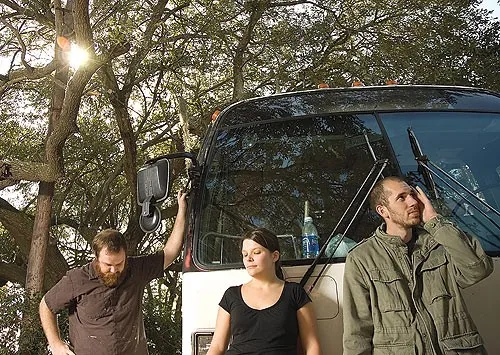
Artists Bob Snead and Seth Gadsden are best known in Charleston as the founding fathers of Redux Contemporary Art Gallery. Snead has twinkling blue eyes and a near-constant serious expression on his youthful face, which is obscured by a Nordic red-brown beard. The dark rings under his eyes make him seem glummer than he really is. Gadsden is ganglier, with a quieter beard and a slightly louder personality.
They’re both laid-back and humble, despite their prodigious artistic talents, their MFAs, and their hard-won roles in the Lowcountry community. They’ve been friends for a long time, watched each other get a little older, start families, lose a bit of hair. But over the next couple of years that friendship will be tested like never before.
In January 2008 they’ll embark on their maiden Transit Antenna voyage, venturing into unknown territory, traveling across the country in a 26-year-old Philadelphia metro bus that runs on a vegetable oil fuel system. It’s an artistic experiment in mobile living and a touring studio/exhibition/outreach project that will take them to small towns and cities in every mainland state. They’ll spend some time in each place, collaborating with artists that they meet and creating installations, performances, and documentaries about their adventures.
They’re in for the long haul, with an ETA of 2010 for the project’s completion. They’ll take their partners, Bob’s young son Taylor, artists Amy McBrine and Josef Kristofoletti, and hopefully Ketridge the family dog, too.
Their mode of transport is a modified GMC transit bus called “Big Walter,” named for Seth’s bus-driving grandfather, Walter Alexander. The vehicle’s a 40-foot municipal workhorse bought in Pennsylvania from a repo man named Animal. The artists plan to collect their vegetable oil fuel from Chinese restaurants as they go. WiFi internet will be picked up, hopefully, with an antenna made from a Pringles tin.
“We’ll probably adapt what we have to do,” says Snead. “We won’t plan everything before we get there.” This adaptability is the key to Snead and Gadsden’s creative process. “It’s healthy for an artist to be doing new things,” says Gadsden. “We have to keep learning, otherwise we’re spinning the same bottle around over and over again. So we’re constantly challenging ourselves.”
They don’t have a lot of funding, their itinerary is scattershot, and their fuel resources will be dependent on friendly neighborhood restaurants giving them some oil. What could possibly go wrong?
The artists are optimistic. Sure, there’ll be mechanical screw-ups and wrong turns on the road, but they thrive on frustrating challenges and unlikely outcomes.
Failure to Launch
August 15, 2007: Jeffrey Deitch is a man of average build in an impeccable blue Italian suit and glasses. As the head of Deitch Projects, he’s a top-flight contemporary art gallery owner with a flair for performance art and public events. Before that he was a vice president of Citibank, co-developing and co-managing the bank’s art finance and art advisory businesses.
On this day, though, he isn’t in a bank or an art gallery. He’s strapped into a harness with an abundance of ropes tethering him to 3,200 balloons. He’s about to be lifted high above the New York skyline. Snead and Gadsden have spent 16 hours inflating the helium balloons, and they hold tight to ropes that will prevent Deitch from floating off to Jersey.
The art project/stunt is an important opportunity for Snead and Gadsden to raise their profiles in the Big Apple art world. So they’re bummed when, instead of heading for the stratosphere, Deitch jumps up and down like a baby in a doorway bouncer before sinking back to earth. The red and white balloons clump together like sclerotic blood cells. There are just too many of them and not enough helium per square inch to lift a human being very high.
Once the no-show’s over, Snead and Gadsden pop the balloons. Hanging from their strings, the burst latex resembles a cluster of desperate dishrags. The artists have failed miserably. That’s happened before and they know it will probably happen again, but this blow represents a real career low.
Re: Evolution
But that August day in New York wasn’t the first time Snead and Gadsden had faced a seemingly insurmountable challenge. In 2002, they were College of Charleston art students looking for a place to show their work and establish studio spaces for other artists. They hooked up with Print Studio South in July 2002 when Snead got a job there as director of its studio facilities, exhibit space, and classes. Out of that opportunity came Redux Contemporary Art Center on St. Philip Street, which absorbed PSS in March 2003 and steadily continued to grow. But setting up Redux wasn’t easy. Once they’d signed a lease agreement for their Contemporary Art Center building, Snead and Gadsden had to rely heavily on studio rentals to pay the bills. Yet they survived through word of mouth, inventive shows like Loren Schwerd’s Flock installation, and art auctions; for example, July 2003’s Hot Artists Take It Off helped pay for the air conditioning.
Within a couple of years, the founders — with like-minded artists such as Schwerd, Krist Mills, Erik Johnson, and Max Miller — had beaten the odds and established a feasible studio system for artists to rent space and show work. Although Snead and Gadsden soon moved on to attend graduate art programs at Yale and Boston University respectively, they’d launched an institute that has grown more successful than they could possibly have hoped. It’s now in a position not just to obtain grants, but to give them. And one of the recipients of its funding is Transit Antenna. The project name refers to the transit bus they’re using, and their process of communicating via wireless internet and their Pringles “cantenna.”
After a few years living in New Haven and Boston, respectively, Snead and Gadsden are happy to let someone else be the boss at Redux. “We didn’t expect it to still be here,” says Snead.
“We’re surprised it’s still standing,” Gadsden agrees. At the moment it’s thriving under the aegis of Executive Director Seth Curcio and a growing roster of staff. The funding Redux provides will help the project make it across the country. “It will create awareness for Redux programs, especially for people who might not come to Charleston otherwise. Along with general community awareness, it will also give us the opportunity to connect Redux with artists who might not normally know about it. A lot of the stuff we’re going to do is going to end up being in some kind of arts community, so it’ll be interesting not just to stick around the same art groups — we’ll be exploring.”
While the Contemporary Art Center’s profile has risen through its international calls for entries and progressive shows, Transit Antenna will help spread the word about Redux to the smaller communities that Snead and Gadsden pass through. There’s a strong sense that the artists want to give something back to the contemporary art community that supported them when they started Redux. But despite the PR wet dream that an alternative-fuel, cutting-edge art bus could be, they say that collaboration with a wide variety of artists is their real impetus.
“We see it as research and development, an adventure, and a crash course in video editing and mural work,” Snead explains. “And a chance for people to hear the Redux name more. But it’s not so much about getting ourselves out there as working with others.” And despite all the tribulations, he feels like he’s slowly but surely achieving his own goals. “We’re getting our ideas done.”
Repo Man
April 29, 2007: Bob and Seth are shopping for a bus. They follow Animal’s no-frills classic Hurst/Olds into a white and blue maze of used vehicles. Animal (a.k.a. Pat) has purchased a fleet of buses, and he has one available in the artists’ $1,000 price range. Animal is soft spoken for a salesman, with a knotted ponytail dangling down to his butt and a genuine interest in helping his customers save some money on the road.
As Animal demonstrates the bus’ air brakes, rumbling engine, and dashboard buttons — Snead likes the cool buttons — the wheeler-dealer seems to know his stuff. There are a few signs of wear and tear on the bus, but they seem cosmetic; one window has a crack in it. There are other issues that the buyers will have to deal with on their long haul — for example, there’s no gas gauge. Big city buses have no need for one in their daily work. So a “gas checkin’ stick,” feet longer than an oil dipstick, will have to be used in the meantime.
Snead and Gadsden buy the bus and leave Animal’s labyrinth, black smoke chugging from their exhaust. Five miles down the road, they break down. The accelerator dies completely.
Over the next week and a half, the artists realize they’ve bought more of a beater than they first thought — there are structural problems like a big crack in the floor, the body’s tatty, the tires droop, the air system leaks, and the power generator has good and bad days. Even if they do manage to convert the engine to run on alternate fuel, they’ll get only seven miles to the gallon and their tanks will hold just enough for a 600-mile drive. A thousand bucks in the red, a project that began as an enjoyable challenge is starting to look totally unfeasible.
Bus Nuts
“It’s been a little bit of a learning curve,” says Gadsden, who’s recently found out more about interlock systems, rear differentials and the Pennsylvania DMV than he ever thought it possible to know, thanks in part to the RTS-Bus-Nuts Yahoo forum. “We always knew we were trying the impossible. Seemingly every step of way, Transit Antenna’s been impossible. Redux was kind of the same way too. There have been points during this whole process when Bob and I wanted to kill each other.”
The artists have coped by jumping one small hurdle at a time. “We don’t look too far ahead,” says Gadsden’s writer/musician wife Jamie Self. “There’s always been a lot of excitement but doubt about pulling this off. Every task we undertake with the bus makes the trip easier. I’m not going to say all our experiences have been just peaches — we share goals and ideas, but we’re also different people. Sometimes we have conflicts, but we’ve done well to push through and be honest about how we feel. It’s nice to have a little creative tension. It makes things exciting.”
While trying to back a 40-foot bus out of a gas station might not be everyone’s idea of excitement, the Transit Antenna participants have made headway. Help with their duff purchase came in the unlikely form of Animal, who directed them to the Bus-Nuts group and eventually sold them a more expensive replacement with a rebuilt engine and a lot less wrong with it. With a shinier bus that actually runs and stops when they want it to, the artists have been able to convert to vegetable oil fuel tanks.
Over the past few years, a few singers and bands (Pearl Jam, Jack Johnson, Gomez) have switched their tour buses to biodiesel. Most recently, a “Big Green Bus” took a group of students to the Bonnaroo festival. But a cross-country drive on veggie oil hand-outs is a far more daunting undertaking, especially without a big record label or major funding organization standing by to give Big Walter a jump start along the way. The upside is that Snead and Gadsden have no tight tour schedule to adhere to. Right now, they don’t have much of a schedule at all.
“We haven’t set out a complete itinerary,” says Self. “That’s intentional. We consciously haven’t nailed it down because if we did, we might miss something — a place that could bring good material, interesting people, or an organization like Redux that people don’t know about.”
“In my artwork, when I try to plan everything it always falls flat,” adds Gadsden. “You only see later on what works and what doesn’t.”
That process of adapting to circumstances ties in with the team’s ethos of looking at a challenge as an artistic catalyst. By dreaming the impossible dream or simply losing their way down a back road, the artists may come across something new or inspirational.
“Oftentimes we’ve spoken of the trip as research and development, seeing everything we can and recording everything we can,” says Gadsden. Nevertheless the lack of a precise route is going to make refueling a hairy process. Their stops will be dictated in part by the availability of oil from local restaurants.
“Chinese restaurants are the best,” Snead has decided. “They’re the cleanest and easiest to get fuel from. Fast food places are tougher. Burger King won’t give vegetable oil to individuals.”
Help is at hand from visitors to the TransitAntenna.com website. In a nifty bit of interactivity, friends are invited to suggest places for the team to visit. They can pin their recommendations on a wikimap and chart the bus’ progress — however slow it may be.
“We’re expecting days when we’re in the middle of nowhere and the bus breaks down,” Self admits. “Things might become difficult, but we’ll roll with the punches.”
There are more personal concerns, too — five people will be packed into Big Walter, with no warm shower and no place for individual quiet time. Any storage space will be filled with art and supplies for the two-year trip, as well as a talking ATM that will spiel a stand-up comedy routine in clubs and galleries across the country. The machine shows still images on its monitor to accompany sprightly-written, prerecorded gags told from its perverse POV (sample joke: like Martha Washington, he’s had George inside him).
Preparations for the journey are intense. The body of the bus has been painstakingly stripped, cleaned, and sanded down. Its fiberglass sections will make a workable canvas (or canvases) for the trip, and the panels can be removed at the end of the trip for an exhibition.
Inside will be a chaotic patchwork of colors and fabrics that the passengers have been saving up for some time. The front half of the vehicle will retain its old look, while the back will be partitioned into living quarters with a bathroom, bedrooms, and furniture. For fresh air and me-time, the artists will be able to go on top of the bus, where a deck is being built and a tent can be pitched. More tents will go beside the bus when it hits festivals. “The living space is much bigger than the apartment I had in Boston,” says Gadsden.
After lots of cutting, grinding, welding, and drilling, two 50-gallon vegetable oil tanks have been installed and the filtering system checked; there’s room for a third tank, so that unfiltered oil can be stored for long stretches of the journey. More storage space has been created under the bus near the air tanks. At the same time they’ve developed their website, illustrating their learning process with comments and videos, and encouraging visitors to add their names to the site and become part of the adventure. The wikimap is just the beginning of the interactive process.
“It’s a new forum for my work and a public forum for our accountability,” explains Self. But the artists will need more than website ad revenue and ATM stand-up gigs to pay their way. Fortunately, they’re all painters and they hope to pick up some cash on their stops, whether through selling art at the festivals they visit or offering to repaint small town signs. As with their route, Gadsden is prepared to adapt: “When we need it, we’ll figure out a way to get it.”
The Transit crew have already received lots of creative input via the site, plus a sprinkling of bus maintenance hints. Some teaching tips are sure to follow, as Snead’s wife Dawn has been homeschooling their son Taylor, getting him ready for two years away from a regular school environment. By starting before the trip, Dawn aims to give him a smooth transition. The rest of the passengers will pitch in with the fourth grade education. “He’s a bright kid,” says Self, who taught writing to Boston University freshmen before joining Gadsden down south. “Bob and Dawn include him in everything.”
Taylor has certainly learned patience over the year it’s taken to set up Transit Antenna. The monetary aid from Redux has certainly helped get the project moving.
“We’ve been in these systems and organizations for a long time,” Gadsden sighs, “as undergraduates, at Redux, then at grad school, with all these people to answer to. We wanted to stay as far away from any organizations as possible, so we didn’t apply for a lot of grants.” That way they figured they wouldn’t spend all their time jumping through hoops to satisfy funding bodies. “But Redux is really flexible.” So the Center is helping to ease the financial burden of their money-pit metro bus while leaving the artists free to plan their own ideal outreach program.
With a Bang
September 8, 2007: With the balloon fiasco far behind them, Snead and Gadsden participate in Deitch Projects’ third annual NYC Art Parade, a popular procession of artists, performers, and designers with floats, placards, sculptures, kites, and street performances. They’ve created nine stick-of-dynamite costumes to hurry from West Broadway and Houston down the streets of SoHo in a Looney Tunes version of Mardi Gras.
Snead and Gadsden call their section of the parade the Washington Generals Versus Nine Sticks of Dynamite; they present the Generals as the “losingest” professional basketball team in history, beaten thousands of times by the Harlem Globetrotters in exhibition games. The Generals’ unlucky streak continues — the sticks beat them in a foot race.
At the crowded finish line on Wooster Street, the artists bravely attempt their balloon stunt again. This time, fewer balloons are used — but with more helium — and a giddy female volunteer is hoisted into the heavens by a cluster of red, white, green and yellow orbs. It’s a bittersweet moment for the flight attendants.
Two months later, Gadsden reflects on the experience. “It felt good when she went up so easily,” he says, “but the easiness took a bit of steam out of it. It only took four hours to blow up the balloons.” He sounds disappointed. “The mystique was taken away from it.” Now that he’s figured out the math and the challenge has been met, there are no artistic breakthroughs forthcoming. But his fascination with balloons continues — recently 2,000 of them were incorporated into a Redux mini-parade to celebrate the Center’s anniversary, and next month, he and Snead will contribute work to a show that will help raise funds for Redux and its artist in residence program.
After years in the comfort zone of academe and grants-aided art projects, Snead and Gadsden are in for a rude awakening. As their ideas for using alternative energy and art outreach projects become a reality, they’ll continue to adapt to the demands of living on the road. If all goes as (un)planned, as new challenges arise, challenging new art will form as well.
THEATER REVIEW: A Tuna Christmas

by Nick Smith December 5, 2007
A Tuna Christmas
Presented by the Footlight Players
Dec. 6-8, 13-16, 2007
The Footlight Players Theatre
20 Queen St.
www.footlightplayers.net
A Tuna Christmas is the festive follow-up to Greater Tuna. Both star two actors playing multiple parts that lampoon small-town life in Texas. It’s set in a fictionalized place where a Smut Seekers society cleans up Deuteronomy, Episcopalians are frowned upon, and carolers never ride unarmed in a one-horse open sleigh.
This serving of Tuna is bracketed by broadcasts from Radio OKKK, spreading neighborhood gossip like it’s national news. The headlining story of Christmas Eve is a Yard Display competition. In the running: Vera Carp, with a real flock of sheep in her mocked-up manger; Didi Snavely, owner of Didi’s Used Weapons (“if we can’t kill it, it’s immortal”) and the waitresses at the local diner, Helen Bedd and Anita Goodwin. The outcome may be tipped by the Phantom, a prankster who messes with festive decorations.
It’s a funny show where the jokes come thick, fast, and unsubtle. The Footlight Players do justice to the lively script, serving up a witty, entertaining, and thankfully unsentimental Christmas show.
This isn’t the first time director Mary Cimino has tackled Tuna. It’s her third go at the play, but there’s no sign of ennui here — the actors obviously enjoy playing old ladies, busybodies, and lame-brains as much as Cimino enjoys directing them.
She encouraged the actors to imbue each character with different mannerisms, quirks, and tics. For example, Robin Burke plays Didi Snavely as a swaggering, cigarette-puffing loudmouth but still manages to make her endearing (if you like people who decorate their Christmas trees with gun cartridges). Dean Infinger’s Bertha Bumiller has a great rubbery hangdog expression. Together they play eleven characters, so half the fun is watching them cope with costume and character changes. And they don’t miss a trick.
Wardrobe mistresses Julie Ziff and June Palmer help create the host of characters with simple, distinctive clothing, and headgear. Since the population of Tuna seems to consist of stereotypical Texans, there are a lot of big hats, checked shirts, and no-frills frocks. The most amazing dress probably belongs to Bertha Bumiller, whose red outfit makes her look like a grown-up, hard-knock Little Orphan Annie.
Ed O’Donnoghue’s lights are likewise straightforward, but effectively evoke the mood of the play. He gamely creates the multicolored hub of a passing UFO; only Didi’s off-stage yard display seems underlit — it’s supposed to be so bright it gives the competition judges retinal damage. Karl Bunch’s sound manages to create the sense of a whole town full of backward ideas with a few cowbell clangs and musical cues.
Some of the cues are heard from a radio suspended from the top of the proscenium, part of a sparse yet clever set courtesy of scene designer Richard Heffner. With a couple of chairs and mere hints of doors, store counters and Christmas trimmings, Heffner gives the audience members just enough reality to stoke their imaginations. Only one incredibly creaky chair distracts from the performances, groaning more than Burke and Infinger’s two old lady characters, Pearl and Dixie.
Although it’s been done before, this is a refreshing shift in direction from the larger-cast, period-set productions that the company has favored recently. Burke and Infinger are lots of fun to watch, and they develop roles that are vivid and well-defined. The pace lags at times, but that’s the fault of writers Jaston Williams, Joe Spears, and Ed Howard. With so many one-liners, it’s not surprising that the director left it at its full length. There are a couple of moments — as when harried housewife Bertha Bumiller reflects on her husband’s infidelity — where a more serious tone could have been struck, just to contrast all the comedy. But this show’s perfect for a night of light Christmas giggles.
Heather Lee Moss and Megan Rose are a new kind of odd couple
by Nick Smith December 2, 2009
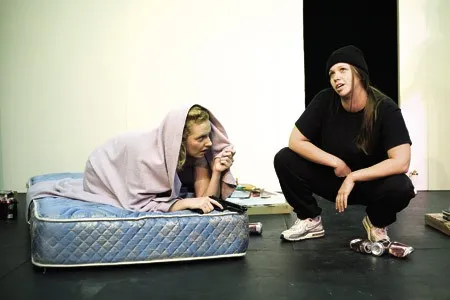
A lot of marriages start with a bang and end with a whimper, but how many end with the husband leaving with all the furniture? That’s what happens to Ata Windust, the young, hysterical heroine of Criminal Hearts.
Ata (played by Heather Lee Moss) finds herself at an all-time low. After discovering that her husband’s a cheating scumbucket, she can’t believe that things could get worse. They do. Hubbie leaves her and takes all her possessions away, including the furniture. To top all this, an armed burglar named Bo (Megan Rose) enters her home. For a phobic like Ata, this is the end of the world.
But wherever Bo’s concerned, things aren’t what they seem. Bo is a young woman who supplements her burglary earnings with con tricks. She and her boyfriend Robbie need an innocent-looking woman to hook their marks, so they get Ata involved. Despite her agoraphobia and her allergies, Ata quickly takes to crime — especially when it gives her the chance to steal her furniture back.
“Ata and Bo hit it off, and a friendship develops,” says first-time director Katie Holland. “The play is about two women finding things in common with each other despite coming from completely different backgrounds.” The upper crust Ata is brought down to earth by Bo, a girl from the wrong side of the tracks. “The audience will be able to identify with Ata,” says Holland, “because she’s so neurotic. She shows a part of all of us that we don’t get into.” She adds that actress/comedienne Heather Lee Moss “fully throws herself into that world of being highstrung, not allowing herself to be touched.” Ata and Bo’s conflicting natures create an entertaining contrast between putting up a front and going with the flow.
Bo’s partner Robbie is the muscle, the guy who does the legwork and the getaway driving. He places greater importance on baseball and malt balls than the policemen who might be waiting to arrest him. He’s played by Boogie Dabney, a thoughtful actor who gave a very strong performance in Verv’s The Blue Room.
J.C. Conway, so perfectly slimy as an adulterer in The Blue Room, is typecast here as Wib, another two-timing husband. Ata describes Wib as “devoid of center, soul, and commitment” — which sums up Martin’s view of men in this play.
“The two guys get the short end of the stick,” admits Conway, a co-founder of Verv, “but they’re not portrayed as evil, just idiots.” He doesn’t think that Criminal Hearts is anti-men, but he did want a female director’s take on it because “a woman will relate to it and handle it differently.” It’s written by Jane Martin (Anton in Show Business, Vital Signs), who is notoriously mysterious and reclusive. Some critics think she could be a man using a female pen name.
Verv’s version of the play emphasizes the comedy. It’s fun and fast-paced tone has spilled into rehearsals. “I’ve incorporated a lot of acting games and exercises into the rehearsal process,” says Holland, “to bring focus and get different readings and emotions out of the actors. I’m proud of them. They’ve made the experience of directing so easy for me.”
For co-star Megan Rose, the rehearsal time must seem like a luxury — she also acts in films, which give much less time for thespian prep. Her most recent short was The Matchbook Mysteries, a local film noir made for the National Film Challenge. She played a world-weary gumshoe dealing with danger and lies — the perfect experience for her current role of a grifter.
Holland has a clear idea of her target audience — young and old alike. “Trying to find yourself is a lifelong battle,” she says. “That search is always an education, discovering new sides of you, new strengths, embracing the people around you and learning from them.”
We predict that this play will be most popular with young couples who want to hit Park Circle, grab a bite to eat before the show, and a drink after. By choosing the increasingly amenable area for their shows, Verv is developing a solid fan base. This raucous comedy will help grow that support.
VISUAL ARTS View Askew
by Nick Smith November 30, 2005

New Work by Kevin Harrison
On view through December 2005
At Max Jerome
45 John St
Kevin Harrison is a New York-born, mid-’30s firebrand with as many painting commissions as he can handle. Adept at photography, filmmaking, and graphic design, he’s also a one-man marketing army.
Harrison’s publicity stunts have included 2001’s The Entropy Show, with a rented crowd stirred up by a make-believe smear campaign threatening to overwhelm its Spoleto-timed art exhibition, and similar event-cum-exhibits. Of course, this is just the sort of narcissistic nonsense that real people expect from artists. But the results were impressive enough to attract the attention of a major marketing firm, which gave Harrison the rather redundant task of faking a riot in Chicago.
He’s been so busy being a golden boy (and a new father) that New Work is his first exhibition of originals in Charleston for a couple of years. Most of the pieces are oil and acrylic on canvas, with four hand-embellished giclee prints also present. One of these, “Silas and Grace,” shows both the old Cooper bridges with traffic in the foreground, passing in a speedline blur. The time-lapse effect betrays the artist’s photographic background, and he reuses it in some of his new works.
There are other photographer’s techniques in use, including a fish-eye lens distortion and some off-the-wall angles. Instead of a straight-on view of the French Quarter, we get a bird’s eye gander. A low angle gives the new Cooper Bridge a majestic sense of scale in “A New Beginning.”
Sickly yellows and greens contrast with a dark blue sky, an indication of the artist’s love of surprising contrasts. Warmer yellows appear in “Il Cortile,” another fish-eye take on King Street restaurant Il Cortile del Re, while cozy, glowing artificial light emanates from windows in “French Quarter,” piercing a gloom-streaked, cloudy sky. The passionate, dangerous colors suit Harrison’s forms — buildings are animated with bends and twists, giving the nightscapes a tremendous momentum. As a whole, this series presents the city as a groovy, fast-paced place looked at from a half-cut perspective, neon signs and street lights emitting a beer-goggle haze. The paintings capture the way most of us see our streets — in a rushed blur as we hurry to work, from the corner of an eye or a car window.
With an apparently unending stream of people who like what he does, Harrison’s main challenge is undoubtedly to keep his work fresh. The element that’s changed the most over the past year is his choice of colors. He’s still a self-admitted “dirty painter,” with a penchant for muddy colors rather than pastels or primaries. But his palette has lightened and his paintings are less gritty.
“They’re indicative of where I am now,” says the artist, who with his wife recently adopted a daughter. “I’m in a soft cuddly place. The skies aren’t so foreboding. They’re not always Halloween skies now. I’m trying to still make them interesting without them being witchy.”
In contrast to Harrison’s past publicity barrages, the opening of his New Work exhibition at Max Jerome was relatively subdued, partly due to the limited space. The reception spilled out onto the street and there was no room to project Harrison’s surrealist film, The Untuning of the Skies. Instead, a little portable TV played a motley collection of his previous film work — in his words, “a remix of all kinds of old stuff.” The tight space means that some of the paintings are easier to see than others but they’re not always complemented by the decor. A careful selection of fewer paintings would give this show more impact, which is, after all, Harrison’s forte.
FEATURE Heaven Can Wait
by Nick Smith November 30, 2005
Michael Purro described South Windermere Theatre as “the best-kept secret in Charleston,” but he knew he had something special. He spent years building a strong following for his family-run business. Regular visitors to the theatre are among the many Charlestonians, from local filmmakers to sports fans, who were saddened last week when he had a heart attack, passing away on Monday, November 19. He was just 40 years old.
Just over three years ago, Purro took over the theatre with only one day’s training on the projection equipment from the previous owner. The business had changed hands a lot, closing for periods of time. The determined entrepreneur caught on immediately and started reeducating his customers in movie screening matters. In his jovial, welcoming manner, he was always eager to explain that his competitors had first dibs on showing movies in the area, holding onto movies for months before passing them on to him. “I want to support the community,” he said, “as opposed to the corporate-run cattle movers.” He tried everything he could to keep it afloat — sports screenings, independent film premieres and mini-festivals, regular showings of The Rocky Horror Picture Show and deeply discounted ticket and concessions prices — which included beer and wine as well as menu selections from nearby restaurants. He believed it was time for the movie industry to get back to basics. “No movie star out there is worth $20 million a picture. In the good old days, people went to ‘feel’ a movie — to experience it. Now they just go to amuse themselves for two hours, then they’re done.”
Purro wasn’t just selling theatre tickets — he was selling a nostalgic experience. He was also always willing to help up-and-coming filmmakers, a rare acknowledgement in the tough business they were trying to succeed in. “I don’t pass judgment,” he would say, “and I’m not going to stand in the way of people getting their word out.”
One of those filmmakers, Trevor Erickson, recalls one of Purro’s other pursuits taking up space in the projection room. “He joked about it not being the best place for his glasswork,” says Erickson of Purro’s glassblowing. “He was incredibly helpful when I planned to shoot a film there, always friendly.”
Michael had many plans for South Windermere — more small film festivals (including another Asiamania series of rare Asian flicks), more arthouse movies, and a facelift for the building with a wooden deck out front. He was even considering hooking up gaming consoles like Xboxes to the huge movie screens and creating a pair of gargantuan gaming rooms for rent during the daylight hours, something he’d done often for his own amusement.
It’s not certain yet whether the Purro family — including Purro’s wife Sandra, his teenaged daughter Alexandra and his son, Michael Jr. — will continue to run South Windermere, which for the moment is closed until further notice. Although Michael always acknowledged that the theatre struggled to pay its bills, it fills an important second-run niche for downtown Charleston residents. Not as artsy as The Terrace or as commercialized as the multiplexes, it’s a hang-out for grateful movie lovers and forms an important part of our indie film dynamic. Michael Purro has left behind many friends, as well as a theatre with a lot of memories and a great deal of potential.
VISUAL ARTS Big Time
by Nick Smith November 29, 2006

The French Noir Show
On view through December 2006
Gallery229
229 Meeting Street
Ever played Six Degrees of Kevin Harrison? Take any Charlestonian, mighty or lowly, and chances are they’ll be closely connected to the multitalented local artist. Whether it’s through his shows, his films, or his marriage to Lowcountry Live producer Cathy O’Hara, the guy’s linked with half the city.
I’ve been playing the game since Harrison’s new show opened at Gallery229 on Meeting Street last week. The space is a second home for Eye Level Art, owned by Mike Elder. The two men met when Elder bought a house from Susan Avent, an artist familiar with Harrison’s work. Susan also happened to be Harrison’s next door neighbor.
It’s been a year since Harrison opened a self-styled “comeback” show at the cozy Max Jerome home accessories store. The John Street location was so tight for exhibition space that one or two paintings had to be displayed outside on the sidewalk. This time around, Eye Level’s three floors and sizeable walls give Harrison’s art the breathing space it really needs — there’s even room for “The Davidson Building,” his 8-by-16-foot painting owned by architect Neil Stevenson (who was once interviewed by Harrison’s cousin Andrew for his I Am On the Road project … you get the idea).
Harrison prefers to go large when he’s painting; he was a participant in Robert Lange’s Big Works show in February. More modest pieces like “High Cotton” still take up some serious footage. His warped cityscape originals (“It’s not a fish-eye effect,” he insists, “that term’s descriptive but not accurate”) aren’t suitable for a poky apartment or a Parisian-style restaurant. But Harrison’s taken that into consideration.
“I can’t afford a $5,000 painting,” he says, sympathizing with micro-budgeted collectors. “So I’m offering some giclees of my work and I’ve created more of my retro film noir pieces.” A longtime side series for Harrison, these poster-like images have turned up once every three years or so as gifts for friends. Gallery229’s extra space — and the need to provide some new, simpler work for his latest show — gave him the excuse to develop fresh “French Noir” art.
These portraits combine Harrison’s filmic, graphic, and fine art experience, inspired by figurines, magazine ads, photos, and ’20s-era posters with cursive text. Familiar elements like Harrison’s trademark glowing colors or an Angelina Jolie-inspired portrait are invigorated by some frisky wordplay. Through an improvisational process, the artist juggles different phrases to find something new — for example pericoloso (“perilous” in Italian) becomes “peri colosso.”
There’s enough room at 229 for other artists, too, including Clare Tomlinson. She shares Harrison’s interest in graphic simplicity and outré color, but makes more straightforward references (Warhol, Lichtenstein) in her work. Chris Dotson is the most abstract of the group, using simple shapes to build subtle layers of color; he also tailor-made a couple of canvasses for you-know-who and helped to move, restretch, and rehang “The Davidson Building” as well.
In a town the size of Charleston, playing Six Degrees ain’t much of a challenge. But Harrison’s connections extend far beyond the Lowcountry. Next month he’ll be flying to Nashville to meet Doc McGee, mighty head of McGee Entertainment, which manages bands like KISS and Hootie and the Blowfish. As Harrison’s just been appointed creative director for events management company 262 Five Ltd., he’s also getting excited about “a possible big event at this year’s Super Bowl.” At this rate he’ll soon be able to afford one of his own paintings — and we’ll be bragging that we knew him when.
Five actors play 50 characters in live-radio homage to It’s a Wonderful Life
by Nick Smith November 25, 2009
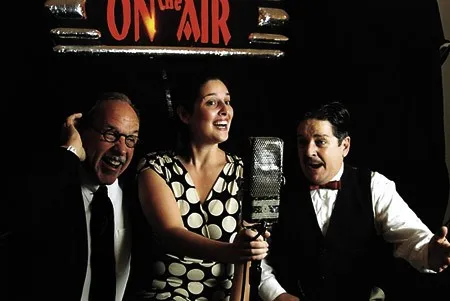
Feeling Christmasy yet? PURE Theatre is here to help get you in the mood with a stage version of It’s a Wonderful Life, the Jimmy Stewart-Frank Capra classic about a good man who fails to understand how his life has positively impacted the people around him. But this stage version is quite different from the movie, and not for the obvious reasons — it’s being performed as a 1940s-style radio drama, with actors playing multiple parts around microphone stands.
PURE co-founder Rodney Lee Rogers stars as George Bailey, a man at the end of his rope on Christmas Eve. He’s contemplating suicide when he meets Clarence Odbody (played by Paul Garbarini). Clarence introduces himself as an angel and shows George what the town of Bedford Falls would have been like if moping Mr. Bailey had never been born.
PURE’s big challenge with this play is to keep the audience engaged when they know what’s going to happen. Those unlucky enough not to have seen the classic 1946 movie have probably caught one of its many rip-offs or homages, from Back to the Future Part II to The Family Man. PURE’s main asset is their cast — or rather, the lack of a big one. Between them, five actors play approximately 50 characters and add live sound effects in what aims to be a hectic, humorous frenzy of activity, just like in the golden days of radio.
Susan Kattwinkel, who appeared in the Village Playhouse’s Twilight Zone adaptation, co-stars as the love of George’s life, Mary Bailey, along with several other roles. Another Playhouse regular, Nat Jones, most notably takes on the role of George’s nemesis Henry Potter. Jan Gilbert (Violet and other roles) is another familiar face on the local theater scene; this spring she appeared in The Producers at Charleston Stage, another live version of a well-known film.
By presenting a play with a familiar title, PURE and the other theaters mentioned above are following Broadway’s lead. Common sense dictates that audiences are more likely to go to shows with recognizable elements than ones that are new and unknown. Regional theater has no hope of competing with New York production values, but it still needs to draw in crowds. Why not use movie titles to draw in an increasingly film-literate public? The Village Playhouse’s adaptation of A Christmas Story was a solid reminder that the tactic can work; it was so popular in 2007 that the Playhouse remounted it in 2008.
But there’s more to It’s a Wonderful Life than its household name. It’s surprising how many memorable characters are packed into the story: absentminded Uncle Billy; Bert the Cop; Ernie the cabbie; and George’s petal-pushing daughter, Zuzu.
Adapter Joe Landry also penned Reefer Madness and Hollywood Babylon, both hits with Charleston audiences at other venues. He retains that the warm and fuzzy theme of the film, and that same feeling drives this compellingly character-driven narrative. Mark Landis directs this PURE production.
As usual, PURE will be running different initiatives to encourage people to come to the shows. On Dec. 3, the V-Tones will perform. “Student rush” tickets are available — if there are any left — for students on the night of each show. The matinee performance will have a BYOB (Bring Your Own Baby) nursery for parents who want to see the play or just take a break for an hour and a half.
A second look at Moutoussamy-Ashe’s Daufuskie Island photos
by Nick Smith November 25, 2009

Hold onto a concert stub long enough and it will become a collector’s item, an artifact, a souvenir of an irretrievable time. An old 10-cent comic book can sell for thousands if it’s preserved long enough. Hold on a few decades and your faded, hastily taken holiday snaps can transform into important historical documents. That picture you took of Auntie Joan flashing her knickers at the Christmas party might end up in an art museum one day.
Daufuskie Island has changed over the past 25 years. Tourism has swamped the sea islands and real estate development has gobbled up much of its countryside. In the late ’70s, Daufuskie was still waking up from its reverie of isolation and Gullah tradition. Jeanne Moutoussamy-Ashe, a photojournalist and fine art photographer, documented that period in unembellished black and white. Over a four-year period she shot broken-down buildings, ferry crossings, religious ceremonies, and folk in their homes. She compiled them in a book called Daufuskie Island: A Photographic Essay. Now an anniversary edition has been released, with a touring exhibition to accompany the expanded publication.
At the Gibbes, the show is split into three parts: people, work, and tradition. Sweep your eyes along the walls and it’s like watching a documentary, gradually unspooling the life of the islanders. All ages are covered, from childhood (“Mary Fields Elementary School at Recess”) through marriage (“Saying ‘I Do’”) to death (“Lavinia ‘Blossum’ Robinson’s Funeral”). The images aren’t always perfectly composed, and some of them are so dark that it’s hard to make out important details. But Moutoussamy-Ashe always seems to catch her subjects in honest, uncontrived moments.
In “A young man reflects on his day as he goes home,” the subject is in the foreground, dressed in a pinstripe suit with the apparent weight of the world on his shoulders. Similarly, “Riding in a car with no windows” shows a tired woman whose long day is written on her wrinkled face.
Some of these exhibits are little more than snapshots, with little to recommend them beyond their age and irrevocable subject matter; since the photos were taken, the older people have passed away and several of the properties have been sold off. Moutoussamy-Ashe’s greatest accomplishment was to show the islanders’ quirks and everyday traits: a bride in slippers, a woman cleaning crab on her porch, families with their dynamite ’70s fashions, Blossum before her death. These glimpses of humanity make this exhibition far more than just a document of a lost era.
Before Balloon Boy, there was Louis De Rougemont
by Nick Smith November 25, 2009
At 11:29 a.m. on Oct. 15, amateur scientist Richard Heene of Ft. Collins, Colo., called 911, worried that his son Falcon had snuck onto an experimental balloon right before takeoff. He said that the boy was missing and presumed to be floating 7,000 feet in the air.
The authorities acted swiftly. Denver International Airport was temporarily shut down, planes were diverted, and helicopters tracked the balloon for 60 miles. The media covered it as fervently as if it was the flying saucer it resembled. At 1:35 p.m. the balloon landed in Keenesburg, Colo. The boy was not inside. Had he fallen or had the balloon been unoccupied the whole time?
The nation breathed a collective sigh of relief a few hours later when Falcon was found hiding in the garage. His parents were overjoyed — but for what reason? Could the whole thing have been a hoax? Within days Falcon had admitted as much on national television; he even vomited when pumped for more information. Heene was a publicity hound, prepared to do anything to gain attention. This time, though, his stunt backfired. Viewers who’d spent half a day worrying about his son felt duped.
Heene wasn’t the first public figure to fall from grace. A century ago, Louis De Rougemont returned from a 30-year-long sea voyage with tales of distant islands, monstrous beasts, and rides on the backs of sea turtles. As in Heene’s case, the populace lapped up his well-told tales, which were serialized in British newspapers. He was honored by Queen Victoria. When his BS was finally debunked, he quickly fell from favor, despised by the same public that had held him in high esteem, his fabulous tale-telling abilities ignored. Like Heene, Rougemont hungered for exposure, and as a result, the seaman eventually rebranded himself as the world’s greatest liar.
In the Village Playhouse’s Shipwrecked, College of Charleston theater professor Evan Parry plays the yarn-spinning Rougemont as he sets sail on a pearl-fishing expedition with a pirate captain.
Shipwrecked is written by Donald Margulies, who won a Pulitzer Prize for his play Dinner with Friends. Commissioned by the Theatre for Young Audiences, Margulies decided not to try to compete with the spectacle of modern movies or video games. Instead he decided to take a step back, tying in Rougemont’s biography with his own fascination with the Victorian style of staged storytelling.
This stripped-down, family-friendly version of Rougemont’s life is packed with adventure, wonderment, and scenarios intended to stimulate the audience’s imagination, not dull it. Give them everything on a plate and they’re passive. Get them to see Rougemont’s world with their mind’s eye and something fantastic happens. A giant octopus imagined by a child will be far more spectacular than one built by a regional theater company.
Parry will be accompanied by Katherine Chaney and Addison Dent, both senior theater majors at Charleston County’s School of the Arts. They play 30-40 characters between them, with myriad costumes in trunks and on hooks around the stage. There’s shadow puppetry and live sound effects, all created before the audience’s eyes.
“It’s a jumping off point,” says director Keely Enright, “to introduce contemporary audiences to the storytelling theater of the end of the 19th and early 20th centuries.”
According to Keely, this is more than a seafarer’s big fish tale. It expresses some profound views on veracity. “Shipwrecked looks at storytelling for its own sake,” she explains, “saying that you don’t need to pick every nit to find out the truth.”
As with PURE’s latest It’s A Wonderful Life: A Live Radio Play, the Playhouse is using a few actors to convey a huge cast. Enright describes Shipwrecked as a radio play if radio had existed in the 1890s. “The actors are having a great time, but they’ve been working their fannies off with all the props and wigs,” she says, “while maintaining the integrity of their characters.” The director thinks she’s either brave or foolish to put the show on at this time for an audience used to Christmas fare. “I really love this play, and it didn’t seem to fit any other time in our season. So we’re taking a risk and counter-programming it for the holidays.”
Shipwrecked is more accessible for families than A Christmas Story, the Playhouse’s previous holiday show; there are no stocking-legged lamps here. “Margulies creates what it’s like to be a sailor for the first time in the Victorian era,” says Enright. “It’s very exciting, swashbuckling fun.”
If you’re not expecting grand sets or special effects, then chances are you’ll find something to like in this seaborne saga, whether you believe it or not.

Mt. Pleasant video game developer hopes Trinity Wars is a blast
by Nick Smith November 25, 2009
I’ve been asked to do some very strange things in my time, but doing voice-over work for TnT Gaming rates high on the bizarre-o-meter. I’m recording lines for a character in the video game Trinity Wars called Dominus Equestrius, who says things like, “I will not stand idle while all of House Equestrius refuses to give aid to our elven brethren.” I journey across the battlefields of a fantastical land inspired by European, Asian, African, and Middle Eastern mythology. It’s an Xbox 360 game that blends role-playing narrative with hack and slash combat.
These days, the line between video games and movies is becoming increasingly thin. They both have actors, sound effects, sweeping orchestral music, digital animation, and blockbuster opening weekends. The big difference is you don’t need to be on a studio lot to make games. Writer/producer Travon Santerre is based in Mt. Pleasant, and I’m recording my lines with my own microphones at home.
“I get a lot of blank stares from other people that make games when I tell them where I live,” he says. “I’m out here all by myself.” His team is spread across the country, with the closest living in upstate South Carolina. According to Santerre, there are a lot of developers in North Carolina and Georgia, but to his knowledge he’s the only one in South Carolina.
The core of the team is made up of four friends who went to high school in California before going their separate ways. When Santerre heard that Xbox Live was starting a category for indie games, he got the band back together. “We have a way to get our ideas directly in front of people all over the world,” he says, noting that 16 million subscribers pay $10 month for Xbox Live. “They’re thirsting for a game that’s different from the mainstream.”
Although Santerre has been making amateur games since his teens, Trinity Wars is his first pro venture. Other game makers with professional experience have joined him to complete the project, passing their contributions back and forth electronically. Deciding to start small, they released Trinity Wars Prologue: Spine of the World in February ’09. The game betrayed its low-budget origins, but the animation was slick, the gameplay effective, and the arena rich and complex. Positive feedback focused on the extended period of time it took to play the game — a definite plus — and the entertaining storyline.
“The reviewers said, ‘Wow! This has more creativity and innovation than a lot of big budget games,” Santerre recalls. It obviously wasn’t a million dollar project, but it had potential. This convinced the team that they should go ahead and make a full game, Trinity Wars Episode One. The adventure includes heroes, magic, elves, princesses, and plenty of swordplay.
TnT Gaming shows there are more potential avenues of production here than just making wings for airplanes. A big-name game can earn half a billion dollars in its first week of release. But to get to that point takes faith and a lot of hard work, for little or no pay.
“We’re just trying to make back what we put in,” says Santerre, who will sell his game for $5 per download. “We’re not trying to make a million bucks. We want to expose people to a good game.”
Like the other local actors involved, I’m contributing my time to this project for free. I’m doing it mainly to support Santerre’s endeavor but also in a vain attempt to impress my nine-year-old, a veteran gamer. My wife is harder to impress, especially since the day she came home to find me “getting into character” using her favorite dish cloth as a barbarian thong. But I can handle her disdain in my quest to see myself digitized, aiding my elven brethren in the name of House Equestrius.
Ryan Nelson Replaced
by Nick Smith November 25, 2009

Local TV host Ryan Nelson is enjoying her first holiday break in a long time. On Oct. 30, Nelson was replaced as host of Lowcountry Live, the cozy daytime talk show on Channel 4, WCIV.
Suzanne Teagle, general manager of WCIV, says the move was a financial decision, not a personal one. “It’s a diversion of resources,” Teagle says. “It makes more sense to use an anchorwoman to host the show.” Erin Colgan, an anchor on Good Morning Charleston, has taken over from Nelson. She is joined by co-anchor Evan Kelly and meteorologist Dave Williams. Williams co-hosted Lowcountry Live with Nelson before the changeover.
“Erin’s first day was Nov. 19th,” Teagle says. “We’ve had good feedback, although some people are diehard Ryan fans.” The new hosts don’t signify any major format change for the show.
Nelson can currently be seen on Comcast’s C2 channel, but she won’t be doing as many high-profile public appearances as in previous years. She has no hard feelings about ABC’s decision. “I had a blast and got to meet lots of cool people,” she says. “But it’s kind of liberating to be off for the holidays for the first time in forever. I’m going to be poor but happy.”
THEATRE A Christmas Contract
by Nick Smith November 23, 2005

Reckless
Running weekends through Dec. 10, 2005
PURE Theatre
The Cigar Factory
701 East Bay Street
It’s tough for married couples to surprise each other with new Christmas gift ideas every year. What can a husband get a wife who won’t stop talking, blessed as she is with eternal optimism and high-flung holiday memories from childhood? Well, he can always get her a hit man, hired to put her out of hubby’s misery.
Trouble is, this contract’s for life, not just for Christmas. Tom’s wife Rachel is forced to flee from her home and family. In a preposterously easy fashion, she hooks up with nice guy Lloyd Bophtelophti and his wife, a deaf-mute paraplegic named Pooty. Rachel changes her name, lands a job at a human services agency, and gets the chance to reinvent herself, but the living ain’t easy for long. She gets stuck with a stuffed shirt colleague and finds that no one’s being completely honest with her.
The inhabitants of this surreal world all have secrets to hide and lies to tell, but the show doesn’t end in a traditional manner when their true characters are revealed. In a reflection of modern life, Reckless is ludicrous, fast-paced, full of fucked-up people all connected by six degrees of unlikely coincidence.
Director Greg Tavares, a member of the PURE ensemble and part of the three-headed improv beast The Have Nots!, keeps this tricky play ticking along. For the most part, the channel-flipping pace stays lively and there’s a good balance between dark farce and serious character development. Myriad scene changes slow things down a tad, but Eric Doucette and Eric Kingrea keep the audience entertained as a pair of go-getting elves. With jolly aplomb they shift furniture around to create mini-sets, ingeniously designed by Julia Levy.
PURE’s artistic director and cofounder Sharon Graci dominates this show — as Rachel, she’s rarely off the stage. In some ways, Rachel resembles her dearly wished-for Christmas present: she’s as curious and excited as a puppy, bouncing back from her misadventures with a vulnerable naivete that only grates on occasion (one character, sick of her burbling, tells her to “shut the fuck up!”). Graci misses no opportunity to create memorable moments, as her character is progressively traumatized, before her redemption in a touching final scene.
There are plenty of chances for other cast members to shine. R. W. Smith is believably solid as do-gooder Lloyd, with some funny facial expressions conveying his emotions when he has no lines to say. Ann Elizabeth “Biz” Lyon astounds with her portrayal of six different therapists, switching from one identity to another with a chameleon’s confidence, funny or tender as the occasion demands. Likewise, Patrick Sharbaugh portrays a genial office boss, a sweaty game show host, and three other roles with energetic commitment.
Lisa Moraschi Shattuck brings depth to the part of Pooty despite a couple of out-of-place smiles. Jessica Chase is very entertaining as the no-nonsense working witch Trish Hammers. PURE co-founder Rodney Lee Rogers also has more than one role, tucked up in an elf-sized bed as Tom at the beginning and returning as a college kid towards the end.
Rogers, Graci, and Smith help to accentuate the play’s symmetry and its other delights. With its fairy tale quality, Reckless has plenty of surprises for the audience, but for all the nightmarish dashes of darkness, there’s also a hell of a lot of humor and powerful, poignant moments, too.
This production has plenty of room for Tavares to make his manic improv mark while still coming across as tight and carefully considered. Check out Reckless for its purposefully scattershot narrative, its fearless cast, its colorful imagery, or simply as an antidote to the multitude of Scrooges humbugging their way across the state.
FEATURE Art on the Edge
by Nick Smith November 22, 2006
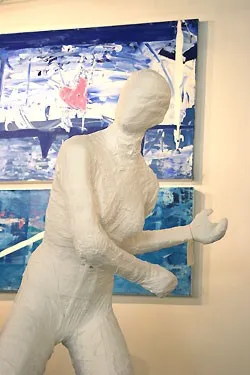
I’m amazed by the lengths some people will go to get to an art reception. A couple of weeks ago, Roswell Eldridge was willing to drive down from the tiny town of Rensselaerville, N.Y. to attend the dedication of Studio Open’s Audubon Room. His passion for the naturalist’s work is shared by the studio’s owner, Sherry Browne, who’s currently displaying prints taken from 19th-century wildlife artist John James Audubon’s octavos. But distance wasn’t the only obstacle Eldridge faced on his way to see the show.
On a busy Myrtle Beach bypass, he flipped his car into a drainage ditch and found himself upside down with his head underwater. He unbuckled his seatbelt and managed to scoot out the rear window, but one of his dogs was missing. The unlucky hound was eventually found 30 feet down the road; it had been thrown eight feet up in the air and was stuck in a tree.
Still, the art lover and his aerobatic animal got back on the road and Eldridge made it to the reception, where he contributed prints that have been meticulously scanned from privately-owned Audubon volumes. In a time when plates are being ripped from 1850s sets and sold individually on eBay, Eldridge is matching his self-preservation with another kind, upholding Audubon’s witty text as well as his famous bird art.
When the sun hits Browne’s studio at the right angle, it’s filled with shimmering color. She’s made good use of her space on Folly Beach’s West Hudson Avenue, with two contemporary artists sharing the main gallery area. Nance Lee Sneddon’s crimson, fawn, copper, and brown floral paintings occupy one wall, complementing Zernie Smith’s brighter paintings and sculptures. Smith gives ancient art styles a progressive edge, mythologizing his own life by incorporating personal experiences into Mayan mazes or Egyptian objects.
Downtown, the John M. Dunnan Gallery has also been rejiggered recently, with seats in the middle of the space and an area at the window for Dunnan to work in; a half-finished canvas sits on an easel, begging for attention with its bright yellow flourishes. The contemporary painter and sculptor has recently opened an ’80s-to-present retrospective which includes several pieces that have never been shown before. There are cascades of blue in his mixed-media work, and two examples of his oil paintings are also on display. The white slashes painted diagonally or vertically over some of his work hint at the more frenzied, involved pieces he’s creating at the moment.
Also on show are some of Dunnan’s lifesized white figures in lively poses. Their movement’s further suggested by the pale footprints all over the floor. Pity poor gallery manager Josh James, who sometimes gets the creeps when he locks up at night. More worryingly, he’ll sometime return the next morning to find that one of the statues has moved — zoinks!
The exhibition gives a mere hint of Dunnan’s body of work — there’s a lot more to his output than soothing abstracts and creepy mummies. His faceless nude drawings, echoes of Matisse’s dancing figures, cavort in a smaller back room to the unique rhythm of a looping Andy Warhol documentary. The retrospective might not be comprehensive but it suggests an urge to experiment — one that’s paying off in the works in progress on Dunnan’s easel.
VISUAL ARTS: Redux
by Nick Smith November 21, 2007
New Media: Vol. 1
Redux Contemporary Art Center
On view through Jan. 6, 2008
Fifth Anniversary Art Auction
Charleston Art Institute
24 N. Market St.
www.reduxstudios.org
Redux’s latest show is like nothing else in town.
It’s a departure from the typical, art-on-the-wall exhibition. It presents work by young Southeastern artists from institutions like Georgia Tech, the University of Florida, and Yale University School of Art. The art encompasses videos and digital prints — not necessarily the kind of work collectors will snatch up to display in their living rooms.
Hell, who’s got room for a talking ATM in their pad?
New Media is ambitious in other ways, too. It’s part of an experiment in cross-fertilization between the nonprofit Redux Contemporary Art Center and the College of Charleston, which held a conference on New Media Arts and visual/computational thinking at the Physicians Auditorium last weekend. The partnership certainly helps validate the out-there art of Redux, a young upstart of a gallery that celebrates its fifth birthday on Nov. 30.
Five years for any nonprofit is a true milestone. It’s a particularly significant one for Redux, which was founded by a couple of CofC Studio Art students in order to meet demand for a progressive art in the heart of Charleston. Seth Curcio, executive director of Redux, believes the “raw, young energy” of founders Bob Snead and Seth Gadsden, and their successors, has helped to sustain the center.
“But it’s been intelligently maintained, too,” Curcio says. “We serve a singular niche. We’re an open-door hub for artists who have inspired our longevity.”
Many artists who’ve rented space at Redux are contributing to this year’s annual contemporary art auction, which has been tied in with the anniversary. It will raise money to launch a new batch of programs for 2008: public exhibitions, artists-in-residence, lectures, film screenings, and outreach programs.
The auction will take place at the recently refurbished Charleston Art Institute, above the Noisy Oyster restaurant. Like Redux, it’s a place that stretches the notion of what art means. Programs cover the culinary arts as well as web design and interactive media, interior design, and commercial photography.
An off-location event will enable Redux to pack more people in and continue its mission to link with other organizations in the community. Moreover, it’s good to see two potential competitors working together. Although the classes they run are very different (the Art Institute has degree-level programs), they each target a young customer base, and the Art Auction is a good way for each organization to access the other’s.
Redux will need plenty of space just for the art — over 50 artists are contributing, including Snead and Gadsden, hyper-realist Robert Lange, DIY art proponent Tattfoo Tan, the multi-discipline Jonathan Brilliant, and more traditional artists, like Mclean Stith and Sandy Logan. The work of Lange, Stith, and Logan is familiar to French Quarter viewers, and they’ll help bridge the small but notable gap between the hip college crowd and more conventionally minded art enthusiasts.
This isn’t the first time Redux has ventured beyond St. Philip Street, though. 2006’s benign Invasion exhibition drew new artists and collectors to the Mary Martin Gallery on Broad Street. It won’t be the last, either. A “Redux Day” parade is planned for the future, along with other visible, socially relevant events.
“With the public behind you, you have a much better chance of continuing,” Curcio says. “We want to be activating the community. As we continue to grow and get more ambitious with bigger events and crazier things, we’re steering what we’re doing so that it’s community driven and more socially minded.”
A good example of this is the free component to Redux’s programs and events, promoting inclusion and shunning old fashioned art world elitism.
“We’re lowering the hierarchy of an art institution,” says Curcio, referring to Redux’s status as a contemporary gallery. “We’re democratic but still maintain a high standard.”
Submissions for their national calls for entries have grown over the past few years, but there’s no intention to stem the onrush by making the center an invitation only space.
“We want to be more open than that.”
Since Redux’s continued existence isn’t dependent on selling the work it shows, it’s able to display video art, interactive installations, and other work that challenges the notion of what art should be. By encouraging participation from its renters and the local community, it’s become stronger than ever.
Joe Johnson opens the church doors and finds no people
by Nick Smith November 18, 2009
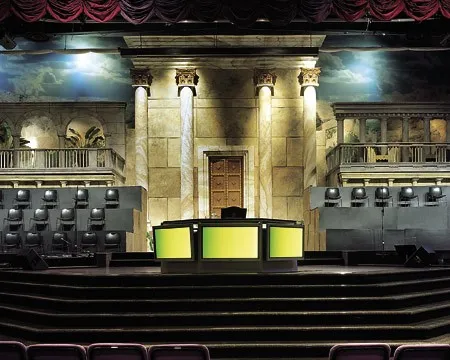
Megachurches are the cathedrals of tomorrow, malls where the masses shop for God, singing along to carefully orchestrated rock hymnals filled with heavily amplified messages, leaving the congregation spiritually electrified by light shows. Who wouldn’t be moved by a multimedia sermon complete with video-projected thunderbolts and live satellite broadcasts from God’s chosen representatives on earth?
Strip away the sound and fury, the biblical texts, and the thousands of worshippers, and you’re left with the technology that makes it all happen: computers, keyboards, projectors, and soundboards, all spewing their electronic guts like a convict in a confessional. Photographer Joe Johnson chooses to document them in Mega Churches, a photographic exhibition that is bright and sometimes beautiful but ultimately soulless.
Johnson has an MFA in Photography from the Massachusetts College of Art in Boston. He’s an assistant professor of art at the University of Missouri. Mega Churches is his first solo show in the Southeast. In previous exhibitions, Johnson has shown his taste for photographing landscapes (Local Weather, Kansas) and buildings (City Pictures). One notable past project took him to an abandoned old theater in Pittsfield, Mass. He photographed backdrops, murals, rows of seats, and the ropes and pulleys that controlled the curtains — an antiquated precursor to his current study.
To call a megachurch big would be like calling Taylor Swift overexposed — a massive understatement. It’s hard to imagine the scale of these places without entering one and walking through the study rooms, food courts, foyers, and auditoriums. To count as a megachurch, a house of worship has to have a minimum of 2,000 faithful attending weekend services. But Johnson elects not to show those people, so there’s rarely a sense of scale in his work. Only his shots of seats and pulpits lend real grandeur to his locations. “Seating, Raleigh NC” and “Seating, Temperance MI” are carefully composed. “Plasma Pulpit 2, Munster IN” is spectacular, with giant green screens in the center and Greco-Roman doors and columns in the background.
By displaying the mechanics of faith, Johnson invites us to marvel at the lengths ministers go to commune with God and wonder whether all the bells and whistles distract from true spirituality. Since God is omnipresent, maybe we’re supposed to “see” Him on the stages and control booths of these churches. They may be quiet, but they’re not dull; the artist chooses colorful images — “Bolt, Fort Wayne IN” has a blue and red-lit camera in the foreground with fake lightning behind. Some of the angles are so tight that they become abstract pattern studies: “Lobby, Fort Wayne IN” homes in on a carpet or wallpaper pattern. In “Amp Cover, Wilson NC,” a wire and a small power socket cover are the only sign of technology — everything else is covered with bright red carpeting. Other shots are pointless, such as “Tissue Box, St. Louis MO,” in which a box of Kleenex sits on a seat arm. Is it waiting for weeping parishioners or snotty ones? We’ll never know.
Although this exhibition is devoid of human subjects, it has plenty of warm hues and pleasing arrangements. Many of the pieces are split into thirds, including “Neon Dove, Monroe OH” with a dove sign at the top, a clock in the middle, and a Yamaha keyboard at the bottom. Johnson has a good eye for detail and theatrical elements. But his approach to the subject matter isn’t powerful enough to carry an entire show.
It’s hard to believe that this is in the same gallery that brought us Caleb Weintraub’s cabbage-patch punks in Pop Goes the Apocalypse, the kinky Geigeresque blown glass lingerie of Boris Shpeizman, or the street-smart art of Sheepman, and Sean StarWars. Mega Churches is so tame that it could go in any gallery in town.
There are some bright spots in the exhibition, but no crackling edge, no inspiration, and no sharp point. We’re not saying that every Redux show has to shock or carry an obvious message, but this is a contemporary art center that needs to present new ideas, not a languid photo essay.
Eye Level’s Debutante Show aims for quantity over quality
by Nick Smith November 18, 2009

Mike Elder’s Eye Level Art galleries have been busy this year, hosting movie screenings, dance parties, and fashion shows. It would be easy for the art itself to get lost in the heady spin generated by all of these social events, which, by the way, help pay the hefty rent on Elder’s Spring Street and Heriot Street locations. So it was refreshing to see the focus back on artists for The Debutante Show, a showcase of 18 young artists at Eye Level’s 103 Gallery on Spring Street. (Of the 100 or so works on display for the one-off show, a third will be moved to ELA’s warehouse gallery where viewings will be by appointment only.)
Guest curator/painter Anson Cyr has aimed for quantity, not quality with this exhibition. The idea here is to show the sheer breadth of the artists’ works, rather than selecting a few of their best pieces. Although most of the contributors are unknown, they already have a body of material to show. The results are understandably variable, but there are several good pieces that make this exhibition worthwhile.
Either by accident or design, the theme of “old and new” runs through the show. Amanda Downey paints modern, illustrative images on elevator schematics, surrounding mutant cats with a cradle of numbers and grids. As with many of her fellow participants, Downey’s ideas are stronger than her art. “Soft Corn” shows a scaled-down, curvy car parked on a scantily clad girl, a comment on the way sex is used to sell automobiles. In “Trippin or Not,” a car is melded with a sea creature, with marine fins instead of chrome ones. But the art seems rushed in places, as if Downey was dashing her ideas down on paper before she lost the spark.
Laurel Black also has a penchant for natural subjects. Some of her animal art would be snapped up at SEWE. She also shows that she can handle portraits (there’s a full color, breezy painting of a girl) and still lifes (“Teaset,” oil on wood). Labanna Bly, daughter of artists West and Mary Edna Fraser, provides a fragile-looking installation called “Interactive Alter.” She’s linked a bizarre selection of ancient and modern objects to make a Dia de los Muertos-type shrine. She’s used a Transformers helmet as the basis for a mirror-browed skull, wired to an amplifier. Dusty test tubes are racked above, and shells are lined up on the floor. The effect is a dark, mysterious perversion of commonplace technology.
Although the definition of “debutantes” refers to young women, there are plenty of guys represented here as well. Matt Bowers is one of the best known artists involved; he’s been a staple of the underground scene for years. However, his “Modern Artifacts” series is different from anything we’ve seen from him before. He connects manufactured items with natural ones, and his assemblage and found objects include “Serial Port and Preserved Pine Specimen” and “Intact USB Drive and Fly.” The art isn’t beautiful, but it is thought-provoking.
The old-versus-new motif recurs in Nate Phelps’ circuitry-like abstract paintings, Shelley Smith’s use of wallpaper designs and newspaper ads in her work, and Trever Webster’s dripping black abstracts on packed backgrounds. Also of note are Conrad Guevara’s sculptures made of yarn, batting, and wood; Tess Thomas’ homeless plaster and acrylic mannequins, surrounded by beer cans, with one hobo gagged with duct tape; and Timothy Pakron’s fleshy “Bondage” (oil on canvas), inspired by gay S&M ads on Craigslist.
The new kids — many of them fresh out of college — aren’t ready to take over for the old guard yet, but their art is imbued with an imaginative, playful energy, making this a successful introduction to their work. After all, the whole point of a debutante ball is to make a memorable first impression.
Local artists struggle to cover their costs
by Nick Smith November 18, 2009
In our money-minded culture, the cost of artwork can be more newsworthy than the art itself. This month a batch of Impressionist and modern art was auctioned at Sotheby’s New York for $180 million. A Picasso and a Kandinsky reportedly went for $10 million each, while Salvador Dali’s “Girafe en Feu” sold for almost $2 million, a new high for the surrealist. A bidding war flared over a skinny Giacometti bronze. It was bought for over $19 million — that’s $11 million more than the minimum asking price.
While the press gleefully listed these prices, they rarely named or described the actual pieces — a pity, because some of them are remarkable (Dali’s painting features a burning giraffe and a lady with psychoanalytical drawers in her drawers).
The Sotheby’s auction reflects a renewed interest in art as an alternate method of investment after a year of caution on the part of collectors. Aside from that, do the high prices make the art better now that it’s more valuable? If so, where does that leave artists in Charleston who are trying to cater to a much smaller, more frugal market?
“You have to consider all markets and set prices accordingly,” says Josh James, artistic manager and owner of Beyond the Gallery. He represents contemporary artists across the country, and he thinks that serious collectors are aware of different price levels. They won’t pay $40,000 for a painting in New York while another by the same artist is selling for $20,000 here. But he also notes that “everything’s case by case” — what seems priceless to one buyer is a so-so smudge to another.
Karen Ann Myers has a different view. Her recent solo show at Scoop Studios, I’m a Girl, introduced her as a fully fledged artist to the local community. “Yes, my prices were too low here,” she says, “but nobody knows who I am.” While she was an established artist living in Michigan and Boston, she was able to charge a sizable amount for her work. Here she’s an unknown quantity, selling intricate art for three or four figures.
Before her show opened, Myers spent a long time thinking, planning, and consulting friends and colleagues about pricing. “I looked at artists who were equally established and had equal presence,” she says. “I based it on size, style, how much my time was worth, all of that.” There are a lot of overheads for a painter — more than most people realize. Many artists have to pay for management, dealers, photographers, website fees, studio rent, materials, and a gallery commission of up to 50 percent. To put these expenses in perspective, Myers says that she spent $10,000 on paint last year.
“The starving artist mentality is real,” says local painter Nathan Durfee, “even if you’re selling work.” Before he made the bold decision to become a full-time artist, Durfee earned $35,000 a year in an office. To make that much now, he has to consistently create and sell paintings each month. “It’s a trade-off,” he says. “I’m doing what I love, and my work ends up in people’s homes. It’s worth a lot more to someone else than if it’s sitting in my closet.”
Of course, there’s a lot more to art than money. It’s almost impossible to put a price on the aesthetic and cultural value of the art around us. But in base terms, artists need to pay for their materials.
“Younger artists, despite their talents, may compromise their price just to create more work,” says James. “They just want to afford the materials to create more artwork.” At the moment, they rely on a few serious collectors who are prepared to pay fair prices to support their favorite artists.
It’s time more buyers stepped up to do the same. Who knows, we could have the next burgeoning Kandinsky or Dali in our midst, ready to set giraffes — and the art world — aflame.
Theatre 99 robbed
by Nick Smith November 17, 2009
Theatre 99, home of The Have Nots! was robbed twice last week. On the first occasion, over $2,000 in cash was taken from the register. A few days later, the thief returned to take all of the performers’ paychecks. Police found bare footprints on the roof, and they’ve now discerned that the culprit climbed up and got in that way. Although new locks and alarms have been fitted and the checks can be covered, the theater is still down $2,000. The Have Nots! are urging people to go to their shows to support them and make up the shortfall.
VISUAL ARTS Must-See Scrolls
by Nick Smith November 16, 2005

The Scrolls
On view through Nov. 28, 2005
City Gallery at Waterfront Park
34 Prioleau St.
Constructions by Gena Grant
On view through Dec. 2, 2005
City Gallery at the Dock Street Theatre
133 Church St.
Talk about your open-ended questions. Charleston printmaker Mary Walker sent materials to artists and studios with the loosest possible theme — “Why?” — and got a powerful response. In each region that Walker approached, the works on paper were connected as a scroll. Many of these scrolls have a common thread: the horrors of war, the death of U.S. troops overseas, human rights and wrongs.
The cohesion in the show — on view at the City Gallery at Waterfront Park through next weekend — is particularly remarkable because the work comes from several different parts of the U.S., including Savannah, Columbia, and Chicago, as well as Italy and Iraq. The styles and quality vary, with woodcuts and photos nestling next to lithographs and poems. A few of the submissions, like Scott Brooks’ “Liberty Takes a Holiday,” are not new. Others were created specially for the project. But the artists all answer Walker’s question with great passion.
Some of the most heartfelt pieces come not from a major city but from McClellanville, S.C. “Embrace,” a woodcut by John McWilliams, shows a shark circling a drowning figure in a stormy sea, aptly capturing the swirling turmoil of the waves and the panic felt by the swimmer.
Artists from D.C. take a more obvious, politicized route. In Mark Planisek’s “The Truth,” a hand-painted collage, Bush has a devil’s tongue, Cheney has a dollar sign on his forehead, and Rumsfeld’s a vampire. Andrea Schamau’s “Eyes Wide Open” is a photographic record of a traveling exhibition using thousands of tagged combat boots, each pair representing a soldier killed in Iraq. Then there’s Brooks’ “Liberty Takes a Holiday,” a classically-inspired oil painting depicting a crucified Lady Liberty. These works don’t seek to explain “why?”, exactly, but they’re determined to get viewers thinking for themselves.
Often, the more symbolic, less literal responses are the most powerful. Several of the artworks are from Iraq, where contemporary artists got excited about the project and sent back a scroll each, rather than one collaborative effort. These range from the abstract, huddled forms of Jaafar Khadar, rushed as if done in a battle lull, to an unpretentious effort from Asaad Al Saghir that resembles something the Children of the Corn might draw after watching Apocalypse Now. Best of all is Al Airubai’s work with sepia ink and sand, producing beautiful dark brown hieroglyphs.
For those who missed the Iraqi exhibition at Folly Beach’s Studio Open earlier this year, there’s a second chance to see some of those pieces on the second floor of the City Gallery. Although the show’s not a distinct part of the Scrolls project, the contributing artists from Iraq are represented. With more room to breathe than in Studio Open, the paintings have a strong impact and show a mix of experimental styles. There are dashes of Mondrian, Picasso, and Miro, a sample of the way Western art techniques have seeped into the Middle East and inspired artists there.
The Waterfront Park gallery’s little sister at the Dock Street Theatre is also exhibiting weird and wistful work. Gena Grant is a Mt. Pleasant-based artist who uses reeds and deconstructed baskets to make some unusual sculptures. She calls several of them “spires,” as they rise from a solid base on the floor and taper to a point. Smaller pieces are displayed on pedestals, and they capture the swirls and textures of woven baskets.
The best thing about this show is its diversity. Grant has twisted the reeds into shapes that look unique, although they still retain a degree of their natural form. The sculptures take on different personalities, wild or stiff. One might resemble an old lady, complete with white hair trailing to the floor. In another example, leaning fronds acquire the movement of a dancer. Grant also uses pizza boxes as canvasses for a couple of her drawings, giving a harvest sun an Aboriginal spiral. The unraveled baskets and rescued boxes make this art a cool instance of recycling.
GET THE PICTURE The Writing on the Wall
by Nick Smith November 15, 2006
There’s only one thing better than a new record store, and that’s an old one revamped and reopened, with live music acts and subversive art on the walls. 52.5 Records has only been occupying its new location at 561 King St. for four weeks, but it’s already played host to a bunch of bands and has become a temporary haven for local graffiti art.
“Graffiti” describes any kind of words or drawings on a wall. If someone doesn’t want it on that wall, it’s an act of defacement. Scrawl it on a canvas and it’s bona fide art. As HBO’s Rome viewers know, graffiti’s been around since ancient times, ranging from crude scribbling — such as political slogans insulting opponents — to ornate images. Since then, graffiti’s standing has improved about as much as that of mudslinging politicians. But a recent reappraisal of the form, helped along by increasingly ornate work by celebrated underground artists like Banksy, has helped to make graffiti respectable while it retains its antiestablishment cred.
Thanks to the City of Charleston’s recent crackdown on sniping, the artists in 52.5’s Graffiti show must be on its Most Wanted list. Public Enemy No. 1 is Proton, whose recurring Mario Bros motif has been sighted all over town. In one piece on display, Proton gives the plumbers opposing hues — Luigi almost grayscale, Mario more colorful — to create an attention-grabbing picture full of carefully balanced contrasts. Using the simple pop culture symbol as an insignia as well as a subject, Proton has included another strong piece where Mario goes solo, his green-skinned form standing out from a stark black background.
In their gusto to nab the art perps, the cops probably also have an APB out for Ishmael, whose favorite icon, Charlie Chaplin, makes a shady cameo here. There’s also one of Ishmael’s simian skulls leering across another contribution.
Alongside photographic evidence of his large-scale exterior work, Egroe provides variations on his tag for this exhibition — even one that’s “Blureeee.” Leder gives the metallic silver lettering of his own signature a multidimensional effect, stripping away a black background to reveal more letters underneath. John Pundt includes his own trademark creature (which looks like the bastard son of a demonic Pac Man) and juxtaposes angelic images with a pile of skulls.
Last time Pundt was keeping such talented company, he was part of the Hot Pressed Poster Fest at Redux. Now the Contemporary Art Center is focusing on a solo show by Young Kim; as if to show that they’re just as good at exhibiting condiments as the Halsey, Redux has covered its own floor with salt portraits (executive director Seth Curcio swears that any similarities to the Halsey’s Labyrinth is purely coincidental). Using a process similar to screen printing, Kim portrays people of all ages looking up from the floor, with a bowl placed below each one. Each bowl contains a different ingredient essential to human existence, such as wheat or oil.
Like artist Motoi Yamamoto’s Labyrinth installation at the Addlestone Library (which is part of the Halsey’s current 10-artist, five-site show Force of Nature), Kim’s work at Redux is sophisticated, dainty, and precariously placed. One wrong shuffle from a visitor and his portraits are prone to crumble. Luckily, that complements the theme of mortality that the artist is exploring, and tiny animal tracks and drops of water have given the salty subjects some extra character.
For years, Redux has proved that live music and progressive art are a good mix. With plans for another graffiti-themed show in the near future, 52.5 is following that up with its paintings juxtaposed with T-shirts and movie posters. It proves once again that the atmosphere of a venue has a great sway over how art’s received.
THEATRE Family Affair
by Nick Smith November 15, 2006
Killing Chickens
PURE Theatre Co.
Nov 16-18, 24, 25, 30, Dec 1, 2, 2006
PURE Theatre at the Cigar Factory
701 East Bay St.

It’s rare to see a PURE show where the characters aren’t completely screwed up. They’re all poster people for the proposed benefits of therapy, wading waist-deep in anguish or trying to get over a traumatic event. In these fascinating productions, contented relationships are as rare as big musical numbers and the set designers take pride in their humdrum arenas.
Killing Chickens, written by PURE cofounder Rodney Lee Rogers, is based in a world where Food Lion, Chick-fil-A, and late-night TV coexist with guns, cancer, and chemo. In this environment (“a small town in South Carolina”), there shouldn’t be much room for fantasy, but there is — along with compelling drama, subtle character development, and plenty of humor.
Rogers gives himself the funniest lines as Cliff. Without hogging the limelight, he swaggers around, flipping his cellphone like a gunslinger from High Noon. Scenes from the Gary Cooper classic are projected onto the set before Chickens, and there are various nods to Hollywood conventions throughout the show.
Cliff needs therapy. The death of his mom has hit him hard. His dad, Poppa Bob, seems to be one drumstick short of a bucket. As Cliff struggles to wrest power from Poppa while maintaining his façade as the devil-may-care member of his family, the strain is beginning to show. Rogers effortlessly brings all of these elements to the fore, making the audience laugh, and care about what’s happening, more than any other actor on the stage.
Cliff’s wife, Heather (Rogers’ real-world wife and the other half of PURE, Sharon Graci), is also in need of some lengthy bouts of counseling. She’s separated from her husband, has a kid to raise and a mortgage to cover. Like Cliff, she’s stuck in her gender-oriented role: She’s the practical one, the caring peacemaker and talker. Rogers is a smart enough writer to acknowledge this while including some authentic dips into her psyche; unhappily, she blames herself for Cliff’s shortcomings.
The action livens up when Cliff and Heather’s young daughter Ashley is on stage. In an energetic yet dialogue-heavy scene, Sullivan Graci-Hamilton delights the audience and overcomes the ambiguities of her character. Like her mother Sharon Graci, Sullivan is able to focus a lot of energy into a small amount of stage time, and she’s all the more memorable for it.
Poppa Bob has the most prominent part in Chickens, and he’s way beyond therapy — in fact, he’s prime stock for the funny farm. Most of the time, though, he comes across as a guy past his prime, missing his lost loved ones, going through the motions at his poultry processing job. In the tough role of Bob, Randy Neale gives a performance that’s almost painful in its intimacy. Thanks to some peculiar blocking by Chicago-based director Brian Golden, some of Neale’s choicest moments are unseen or barely heard when he turns his back on the audience or delivers lines upstage, giving a sense that we’re merely flies on the wall bugging a family conference. While such acting’s more appropriate for movie close-ups, Neale still creates several satisfying instants throughout the play and reacts to plot developments in a realistic fashion.
Some of Neale’s best scenes are with Ryan Ahlert, who plays Cliff’s hypochondriac brother Phil. Like their dad, Phil doesn’t hold much with talking about his feelings, although, ironically, he spends a lot of time on the couch. Ahlert takes a while to flesh out his strange relationship with his family; early on, his performance seems uneven, switching from loneliness to boredom to fuck-you grins without giving the audience a chance to get to know him first.
With plenty to say about loneliness, bereavement, the societal roles people play, and the pressures that result, Rogers has created a worthwhile piece of theatre that embraces its dramatic clichés rather than ignoring them, holding its own against past PURE offerings by Neil LaBute, Martin McDonagh and others. Rogers’ characters may need psychiatric help, but that makes their hard lives and poor choices compulsive to follow — the hallmark of any great drama.
VISUAL ARTS REVIEW: Nathan Durfee
by Nick Smith November 14, 2007
Celebrations of Stems and Clouds
Modernisme
On view through Nov. 21, 2007
21 Magnolia Road
There’s an autumn-colored part of West Ashley inhabited by corpulent, mottled ladies, men with rosy cheeks and hollow eyes, daydreaming child-like adults and animals that look more intelligent than their owners.
No, it’s not Bohicket Village. It’s Nathan Durfee’s superlative exhibition at Modernisme.
As well as introducing dozens of new creations by the figurative painter, Celebrations of Stems and Clouds also charts the development of his immaculate reality from initial idea through complex, large-scale oils — and it’s a joy to visit his wonderland of soul-searching or gravity-defying subjects.
Durfee’s a man in touch with his inner child, that playful part of himself with a knife-sharp sense of humor and a vivid imagination — the kind that stems from our formative years, only to be clouded by the everyday mundanity of adulthood.
Growing up in the small town of Bethel, Vt., Durfee had plenty of time to explore his active imagination.
“I never lived in a city-esque environment,” he says.
Consequently, he didn’t have all of his activities laid out for him. He had to amuse himself instead.
“That had a huge influence on my creativity,” he says. “When I played knights, dragons, or superheroes, I had to imagine them and create the characters.”
An amiable parade of pudgy-faced characters appear in Durfee’s show. Some, like “A Princess Dreams,” refer directly to children at play. A girl holds up a scaled-down horse with a rider that she’s breathed life into through the sheer force of her imagination. Others depict dogs or adults equally eager to have fun. In “Captain Nudinak Anu,” a nude male bather wears a paper hat and rides a rubber duck dinghy.
Next time he goes solo, I’d like to see Durfee experimenting with different backgrounds in his oil paintings. His deep blues are great, but their affect is diminished when aligned in a row together. Durfee’s such a creative artist that I’m sure he’ll try more palettes as he progresses — and he should be confident enough with his skilled work to push things further. I look forward to more of his reality-defying creative leaps in the future.
Bravely, the artist has put his accordion-style notebooks up for sale. They’re the train-of-thought journals that help get his inventive juices flowing. Sometimes, they spark full-fledged paintings.
“They give people an intimate view of what’s going on in my head,” he says.
Loath to part with them, he’s put a $5,000 price tag on each. The contents are a heady mixture of rushed, cartoonish sketches and perfectly drawn portraits.
So why is he parting with them at all?
“I rarely go back to the books for material,” he explains. “They’re more of an exercise for me. There are 50 to 100 painting ideas in each sketchbook.”
Durfee’s ink and acrylic work is the next step after his notebooks. They’re clean, simple caricatures, using just one or two bright colors, with a line of cheeky humor. A pig looks longingly up at a pink zeppelin in “Phil’s Crush.” A well-endowed man uses his manhood to vault through “Bobby’s Blessed.” In “Midnight Serenade,” a stilted robot sings the boogie electric.
Also in the show: reasonably priced oil paintings that pack the basic elements of Durfee’s work — pleasantly freaky characters bouncing through colorful, cloud-specked landscapes — onto small frames. Similar in size to his ink and acrylic pieces, these retain the simplicity of his drawings but hint at the greater fantasy world shown in his more typical 2-inch by 4-inch work.
Composition–wise, there’s a lack of depth in some of his paintings that helps to echo a Punch & Judy ethic.
“I’ve taken influences from old puppet dioramas,” he says.
Durfee’s was the last show at Modernisme. It closed after Nov. 21, 2007.
VISUAL ARTS REVIEW: John Hull & Barbara Duval: Works
by Nick Smith November 14, 2007

John Hull & Barbara Duval: Works
Halsey Institute of Contemporary Art
Simons Center for the Arts, College of Charleston
54 St. Philip St.
www.halsey.cofc.edu
Once a year, students at the College of Charleston’s School of the Arts get to examine the work of their professors — a couple of them, at least — when faculty members exhibit at the Halsey Institute. This time around it’s the work of Barbara Duval (who teaches printmaking, painting, and drawing) and John Hull (SOTA’s new chair and professor of painting) that’s on display.
Duval came to the college over 25 years ago. Her art is assured and mesmerizing. Her key piece is an untitled oil on canvas (84 inches by 60 inches), with broad red brushstrokes flaming into the sky and six figures running towards it or dancing around it. These mysterious, silhouetted figures reappear throughout the room, in monotypes (“MWH2”) resembling shadowy illustrations or etchings with chine-collé that have a photographic feel.
For example, her “RAF WP.2” resembles a faded snapshot. In “N,” Duval creates an effective perspective with a few simple, humanoid shapes. In “QPP,” similar running figures are less prominent, almost blending into pink vertical and horizontal lines. Only Duval knows whether her figures are ancient savages rushing toward a forest of red-lit reeds or a bunch of bums at Burning Man. All of her work, though, has a sense of twilight mystery and spark-like movement — the kind of motion that’s strangely lacking in Hull’s paintings.
Hull has been given the second floor of the Halsey to show his work, which includes examples of his realist series, Divertimento. Climb the gallery’s staircase and at first sight, the space looks alive with color and spectacle. Although they’re works in progress, the Divertimento pieces shine with bright, sunny yellows. They’re derived from detailed drawings Hull made at the Roberts Bros. Circus years ago. All the trappings of the Big Top are there, but the subjects look static.
The bulk of Hull’s work is from a series called Pictures from Sonny’s Place, recording everyday life in a Wyoming junkyard. Hull displays an incredible grasp of composition, using it in ingenious ways to create depth. Junk is heaped on the left and right sides of “One Way” with a yellow bulldozer shoving the viewer’s eye to the center of the image. “Twilight” reverses the technique with undergrowth to the fore and hills in the background. From a distance, the best paintings are like double-wide windows on a lucid trash-strewn world.
Despite the wrecked cars and garbage included in Hulls’ paintings, there’s plenty of tidy symmetry, too. In “Conversation in Junk Yard,” a monkey stands on a flatbed full of tires, mirroring a boy chatting with his dad. The dad is concurrently balanced with an older man, ignoring the ape. Hull’s spot-on with the deft facial mannerisms of his junk family, his composition, and his atmospheric lighting.
Since all of these elements are perfectly wrought, it’s bizarre that Hull’s human and animal subjects are all so stiff. There’s little sense of movement, even though each character obviously has a feeling and function. Even the monkey looks like something out of a taxidermist’s wet dream. Presumably Hull’s made a conscience decision to embalm his characters instead of creating the impression that they’re on the move. The resulting paintings are more staid than they could have been.
Visitors to the Halsey exhibition would be well advised to take a look at the other art on display in the Simons Center. New Works includes a variety of promising photographs, paintings, and a smattering of sculptures by students. There are expressive portraits by Lainey Harrison and Emily Lyles, a trippy blue and yellow jellyfish tableau by Andrew Smith marrying street art with traditional painting, and a dramatic representation of an artist at her easel who obviously doesn’t want to be painted.
There’s a lot to be learned from Hull and Duval’s masterful artworks, but the students can’t be beat for sheer exuberance.
Righchus rides hard
by Nick Smith November 11, 2009
The 20th century is strewn with pop-culture milestones, but music videos have a particular knack for searing themselves into the brains of our collective consciousness. There’s something about the combination of brash imagery, loud tunes, and fast-editing that makes them almost hypnotic. Whether Run-DMC are walking this way, Public Enemy are fighting the power, or Britney Spears is giving a womanizer a kick in the cojones, all good videos pack a punch.
Filmmaker Blake Engel has his own theory about their popularity. “They’re about immediacy, amazing you nonstop for three minutes,” he says. “As opposed to a more quiet film like No Country for Old Men, Spike Jonze’s ‘Weapon of Choice’ has Christopher Walken flying around a room. You don’t have to explain it. You’re just showing amazing things. You can get away with anything in music videos.”
You can even get away with working on a low budget if the tune is good and the filmmaking is inventive enough. Ten years ago, Spike Jonze shot the video for Fatboy Slim’s “Praise You” as if it was a performance by an incompetent community dance group captured on a camcorder. It took 10 minutes to film and cost $800 (mostly spent on catering). Yet it garnered countless plays and three MTV VMAs. Since then, lo-fi videos have become an accepted quirk on national TV.
But as digital video technology gets less expensive, cheap shots don’t have to look grungy. Directors are able to make their projects look better for less, if they can find a way to make them look amazing. Blake and his brother Taylor did just that for a video for local hip-hop artist Righchus’ song, “Ridin’.” The 2008 video was made for the infinitesimal sum of $42.
Despite the bargain-basement budget, “Ridin’” was slick and imaginative enough to gain praise via websites like BET.com and Writer’s Block Media, building a reputation that helped pave Taylor’s way to Los Angeles. But the ride wasn’t all smooth. The brothers planned the shoot carefully, but there were plenty of problems to overcome on the road to a finished product.
Neighborhood Moviemakers
Blake and Taylor Engel grew up in a sleepy corner of West Ashley. While other kids went out and played basketball, the brothers walked around the neighborhood with a video camera, making strange little movies.
“We would make versions of films we liked starring us, friends, and family members,” says Blake. “It was something to do, I guess.” Thus Batman and Robin fought crime in their backyard and The Mask made merry in their kitchen.
A decade later, the boys had moved on to original shorts; 2006’s “Mourner’s Kaddish” was a black-and-white documentary about their great uncle Joe, a Holocaust survivor. In this extended interview, Joe told his story and recalled events that he had never shared before. Although there were too many camera moves, the sound was rough, and the editing was abrupt, the film still had a professional look, and no amount of impatient camerawork could distract from Joe’s stark story.
Their next big project was 2008’s “Magic Man,” a short about a washed-up magician who plans a grand illusion to restore his reputation and his self-worth. With a poised performance by John R. Sexton, this production showed a growing maturity in the Engels’ work. It proved that they could tell a dramatic story without resorting to jump cuts and fancy camerawork.
By this time, the Engels had started a production company called Movable Type Pictures. This was made up of a group of filmmakers who, as Taylor puts it, “didn’t know each other at all.” Their disparate interests and specialties were combined for the drama. By the end of the shoot, they were encouraging each other to pursue their interests; for example, crew member Josh Bishop was interested in Steadicam work (“floating” a camera on a body harness). So an ETV cameraman was invited to come and train him for a day. “Over time he’s become really good,” says Taylor. “Everyone’s gotten better.”
We Want Our MTV
As Movable Type considered the different kinds of film they could make, they realized that music videos would be a perfect way to show what they could do. “We want to bring back creative music videos,” Taylor says, “where the idea comes first, not the money.”
At the time he shot “Ridin’,” Taylor was a penniless college student. Since he was studying film at the University of South Carolina in Columbia, he had access to equipment. He and his brother also had ideas for images and narrative structures that they wanted to achieve “sort of on the cheap.” But they needed a good act to go with them.
Taylor had been friends with music producer Max Berry since the age of five, and they both went to USC. “When I was a sophomore, he was my roommate,” says Taylor. “I could hear him making music through our wall.”
Berry works with rapper Matt Bostick, aka Righchus. The duo were putting together strong tracks for an album and were ready to promote one of their tunes with a video. They had no idea how much work it would be.
The Engels assembled their usual team and found a large warehouse location that they could use for free because two of the crew knew the owner. There were a few old pianos in the space, so they became key props. The team created a map of their soundstage, figuring out where the performers had to be. They wanted to shoot the whole video in one continuous take, which meant careful rehearsal, positioning, and lighting of the action as the camera rotated.
The more preparation a filmmaker does, the smoother the shoot will go. So the seven crew members met once a week for two months prior to filming. They aimed to film everything in two days, even though they weren’t sure whether that would give them enough time to set up the lights, practice the sequences, and film various versions of the video. It wasn’t easy to gain access to equipment either; in exchange for the weekend loan, the team filmed two Public Service Announcements for USC’s Media Arts Department. It’s an indication of their positive attitude that they saw this extra labor as an opportunity — they used the PSAs to test angles and lighting conditions that would be used to greater effect in “Ridin’.”
The company went from having no lights to having too many. The only way to control them all was to hook them up to a switchboard, time the video, and flip them off and on at the right time.
There are some things that aren’t so easy to prepare for. When the time finally came to shoot, the first day was spent setting up. They got ready to roll, flipped a switch, and lost power throughout the warehouse. “We couldn’t figure out why,” says Taylor. Eventually he learned that the main breaker had blown. The day was a bust; luckily, a generator was borrowed for day two.
The next problem: Righchus had to get from one part of the set to another — and not be seen doing it. Remember the video is one constant shot. This became even more of a challenge when the filmmakers evoked a slow motion effect. The song was sped up one and a half times with Righchus gamely lip-syncing and three dancers moving at double speed. As the camera moved away from him, Righchus would run across the set to appear in the next angle, making it seem as if he was in several places at once. When the video was played back in time to the regular track, everything took on a dreamlike quality.
Josh Bishop’s Steadicam training served him well for the video’s swooping, non-stop shot. Choreographing the lights and performances was tricky — it took 15 or 16 tries to get it right. But the video was brought in on time. More importantly, it looked great even though it had that next-to-nothing budget of $42.
A $60 gorilla mask was cleaned up and returned to a party supply store after filming. Likewise, a $200 external hard drive went back to big box retailer once footage was transferred to a desktop computer. Even the catering was free — the choreographer’s mom cooked for everybody. The only expense was gaffer’s tape, which could not be rolled back up and returned, although the Engels probably considered it.
“We could use more money,” says Taylor. “It’s tough trying to make videos for nothing. But we don’t want to make million-dollar things. My number one concern is that people are spending their free time making the videos. I want them to be proud of what they did, and showcase their work.”
A Righchus Duo
Charleston hip-hop duo Righchus and Max Berry have a lot in common with the Engels: Both pairs are trying to make original content with limited resources and connections.
After they met at the Charleston County School of the Arts, Righchus and Berry would rap battle each other. Later, they began recording music together and tried to get studio time in town. But because their sound straddled the line between rock and hip-hop, they found venues and studios hard to book.
“A lot of bars downtown like cover bands more,” Berry explains. “The black clubs like hardcore rap.”
So they started trying alternative events like Kulture Klash, an art and music show at the Eye Level Art warehouse, and a charity event at
Infuzions in Mt. Pleasant.
“The craziest thing is, it’s so difficult to find a venue,” says Righchus. “There’s nothing in Charleston that encompasses our original style of music.” Despite this, Righchus says they’ve played over 40 shows in the past year across South Carolina, culminating with a recent support slot at the Music Farm with ’90s superstar rapper Warren G.
Righchus adds, “We had to get our own shows and build our own studio from the ground up. We worked hard to get what we wanted, and it makes it feel better because we earned it.”
That may sound like typical hip-hop braggadocio, but Righchus is something different. His first album Chaos Theory melds alt-rock, synth sounds, orchestral samples, and rap. It’s a good first effort for a homegrown, self-taught producer like Berry. Most importantly, the tracks don’t rely on clichéd references to cars, guns, bitches, and bullion.
“Charleston is in the top 10 cities in the nation,” Righchus says. “Our hip-hop should reflect that. There is a lot of gangsta rap here, showing the wrong image. It shouldn’t be glorified. Music is about the expression of art, love, and creativity. We shouldn’t be afraid to get out of our boundaries and rap about betrayal, love, passion, and motivation and try to set a new standard for hip-hop in the city.”
Now a journalism major at USC, Righchus grew up in North Charleston. His team-up with the rock-influenced Max Berry helped him break away from the usual stereotypes of rap. “Nothing about me is gangsta,” he says. “I’ve never sold drugs, and I’ve never shot anybody, although I’ve been shot at. I want to sound like who I am. Every single experience on Chaos Theory has happened or is about to happen.”
While Righchus raps about the real world, “Ridin’” took him into a more fantastical world. As the video opens, Righchus stands on a dark stage. Lights start to come on, illuminating the side of his face, then his shoulders, then his back. Three dancers appear, running to their spots behind them guided by three shafts of light. The camera pans to a group of people relaxing in a room, then on to Berry at another keyboard, then back to Righchus. With sweeping, confident movements, the camerawork defies the usual video formula of not holding a shot for more than two seconds.
“We’re very proud that we pulled that video off all in one shot,” says Berry. “People like that fact.”
Bloggers liked a lot of other things too, describing the film as “epic,” (Jaques Morel), “real dope” (2dopeboyz) and “like none other that you’ve seen on BET” (Kevin Nottingham).
Flushed with success, Movable Type planned another, more ambitious video that evolved into the even more impressive “Go Hard,” shot at a car wash for $300 (mostly spent on catering). In this fantastical, cinematic short, Righchus has the shit kicked out of him as he raps before transforming into wisps of smoke, leaving his attackers befuddled by his empty hoodie. Super power or Jedi mind trick? We’ll find out in the next video, which promises to continue the storyline.
In the meantime, Blake is concluding his college studies, and Taylor has moved to LA, where he’s interning for Anonymous Content and One Tree Hill at Warner Brothers. He’s just picked up his first professional assignment there for streetwear icon FUBU. But when he gets the chance, he’ll make more music videos.
“I’m not in it for money, but to make something really cool,” Taylor says. “I don’t have the answer to what to do yet. Maybe something will spawn on the internet.”
With the impressive “Ridin’” and “Go Hard” videos doing the rounds and creating a buzz, maybe something already has.
Unlike Big Bird’s ‘hood, Avenue Q is a very dirty place
by Nick Smith November 11, 2009
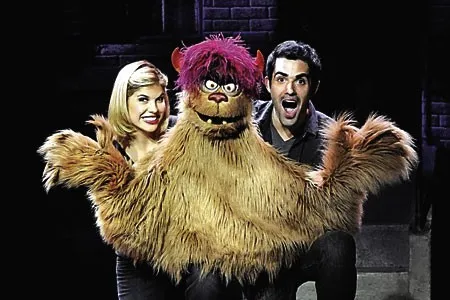
My gran doesn’t trust a soul in New York. She’s heard too many horror stories about muggings and hold-ups. When she visits Manhattan, she keeps her bag clutched tight to her bosom, eyes flitting from side to side watching out for pickpockets. The only time she puts her bag down is when she’s seated for a Broadway show.
The last production she saw was the Tony Award-winning Avenue Q, which she thought would be a harmless comedy about a bunch of lovable puppets trying to make ends meet in the real world. What she got was an uproariously adult take on TV puppet shows — think Sesame Street with sex and drugs, all brought to you by a certain four-letter word.
Granny Smith knew the show was full of surprises, but she didn’t bargain for songs like “I’m Not Wearing Underwear Today” and “You Can Be Loud as the Hell You Want (When You’re Makin’ Love).” She definitely didn’t expect one of the puppets to come up to her and start rifling through her purse. But after a brief senior freak-out, she realized that it was all part of the wild, woolly musical.
The seating arrangements in the Performing Arts Center don’t really allow for such participation, but audiences will still feel like they’re part of the action as they follow the adventures of Princeton, a young, naïve puppet who ends up on Avenue Q and meets a host of hairy characters who all have thwarted ambitions and distant dreams. These include Kate Monster, a cute but lonely kindergarten teaching assistant; an odd couple of roommates named Nicky and Rod; and shut-in Trekkie Monster, whose signature song is “The Internet Is for Porn.”
Ingeniously, Avenue Q creators elected not to hide the puppeteers, so we see one or two people behind each monster. “I think that’s why it won three Tonys,” says Jason Heymann, one of the talents behind Trekkie Monster (he also handles Nicky, Bear, and other characters). “There are much deeper emotions with the actors there to carry out what the puppets can’t. As an actor, you find yourself relating to the other actors even though they have a furry thing on the end of their arm.”
Aster Hall sponsors a fundraiser to save the Center for Photography
by Nick Smith November 11, 2009
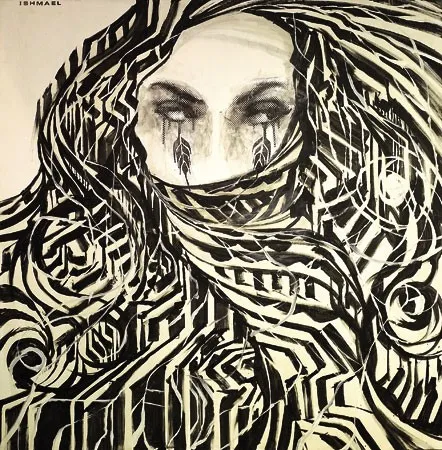
When Stacy Pearsall took on ownership of the Charleston Center for Photography this year, she knew it was more than just another job. The two-time National Press Photographers Association Military Photographer of the Year Award-winner saw a need in the community for youth programs, outreach classes, and art therapy for disabled veterans.
“My reason for taking it over wasn’t to make hoards of money,” says Pearsall. “Any profit is turned back into the community. We have free exhibits for young photographers. Whatever the Center doesn’t cover is paid from my own pocket.”
Pearsall’s concern for the community meant that local photographers and businesses rallied around her in September when she announced that the CCforP was struggling financially. Without additional contributions from its customers, the seven-year-old Center would be forced to close.
The day he heard the news, Sean Ferneau started speaking to Pearsall about what could be done. “She’s trying to do something new,” Ferneau, the gallery director of Aster Hall on King Street, says. “She’s trying to appeal to a broad base of artists without many resources, making her time and equipment readily available to them.”
Recognizing a kindred spirit, Ferneau began to plan a benefit show at his gallery.
Aster Hall opened six months ago, shortly after Pearsall took over the CCforP. It’s owned by jewelry designer Angela Hall. Ferneau has 10 years’ experience in the fine arts world, and he’s gathered an impressive roster of contemporary artists, including photographer Timothy Pakron, abstract painter Benjamin Hollingsworth, and multimedia artist Alex Leopold. For the benefit show dubbed The Project, these regulars will be joined by a pair of artists with a graffiti background, Ishmael and Desism.
“Several of my artists use non-traditional media like iron, fire, and spray paint,” says Ferneau. “I’ve been purposeful in choosing artists who are young, working in contemporary media with a contemporary historical construct in mind.”
That history can’t be escaped without mentioning the street or graffiti art movements. The gallery director says, “Street art is always a protest, and I’m interested in artists who protest in general. So what are they protesting about here? A young owner having trouble with her business due to economic forces beyond her control.”
Ferneau says that graffiti artists are “the artists most apt to fight for what is ethical. They are most inclined to fight against prevailing conditions brought on by the state.”
Ishmael and Desism will collaborate on a site-specific, semi-permanent mural in the gallery courtyard. They will also bring work to sell at Aster Hall. Ishmael’s art will be all-new, and this will be Desism’s first time exhibiting in Charleston.
Over the years, Ishmael has been formalizing his work and experimenting with new art techniques. His work is familiar to those who’ve caught it at Eye Level Art or the City Gallery at Waterfront Park’s group show Contemporary Charleston 2009: Revelation of Process. His work combines street art, movie references, and illustrative painting. He’s at his best when he has lots of room to express himself, which bodes well for the courtyard mural at Aster Hall.
Charlotte-based Desism grew up in the Bronx and was part of the golden age of graffiti art in the 1980s. He was also an early proponent of the branding, merchandising, and art sales that are now common in his medium. His work sometimes has a soft, hazy quality that’s perfect for landscapes and natural subjects (cobwebs, tree branches). Juxtaposed with tags and modern cultural images, this aerosol art reads like the dreams of a Pop Tart-fueled child.
A portion of the proceeds from this event will go to the Charleston Center for Photography to help it in these difficult economic times.
VISUAL ARTS Trunk Show
by Nick Smith November 9, 2005

Sawaguzo!
Redux Contemporary Art Center
136 St. Philip St.
Welcome to Pao Pao Land! Many strange creatures reside in this colorful world. You’ll see a patchwork elephant, a sea creature peppered with portholes, and a unicorn trotting through a field where the flowers grow upside down. You can also get your picture taken with Mribo, a tall tentacled being with big ears and a fabric fish tail who dominates the landscape.
So far so cute, but the Brooklyn-based creators of Pao Pao Land, Aya Kakeda and Fumiha Tanaka, have added an extra visual layer for older visitors to their Redux show. Aya’s work is exemplified by her silkscreen storybooks, for kids who are too old or smart to put up with Barney’s bullshit. Fumiha produces slightly cartoonish characters that float inches above the ground, symbolizing the innocence and uncertainty of pubescence.
Collaborating as “Pao Pao” — phonetic Japanese for the trumpeting sound an elephant makes — the Savannah College of Art and Design alumni deftly merge their styles in an installation that will appeal to anyone sickened by adorable Disney confections, exploring themes of lust, loss, sorrow, and, er, menstruation.
This isn’t a kid’s dream playground where everything is bliss. Reality seeps through, adding unexpected elements to the weird world. A checkered creature vomits on a yellow submarine, a basking seal has petals on his privates, and Mribo smokes a cigarette. The boys and girls depicted in Pao Pao Land have the oversized heads and wide-eyed visages of manga characters, yet they’re also sad and lonely-looking.
This is primarily due to the hues that the artists have used. Working with stencils, fabric, pressed flowers, and latex wall paint from Lowe’s, Aya and Fumi keep the colors muted and insipid, as if the walls have been stained by Mribo’s cigarette fumes. The inhabitants of this drab fantasy look grubby or unshaven, adding to the seedy effect.
Pao Pao Land is the centerpiece of Sawaguzo!, the Halloween marathon of Far Eastern arts at Redux. While it’s the most intriguing visual component, there’s a subtler, more proficient installation in an adjacent space. Miwa Koizumi makes garbage look gorgeous, turning plastic bottles into otherworldly underwater shapes. Suspended jellyfish swing in an air conditioned current; sea anemones glow with lighting from below.
On the walls are photographs of more delicate sculptures, some of them betraying their origins with expiration dates stamped on their frilly bodies. Miwa, who fostered an interest in trash while living in New York, also provided music and food art for the opening night of the show. She describes these “taste experiences,” offered in small paper cups, as a food performance where the objects disappear, enabling the viewer to digest the art. It beats lugging large artworks around, too.
Although executive director Kevin Hanley has organized several shows at Redux this year, this is the first that he’s initiated. His previous exhibitions were already set when he became director. Unfortunately, this will also be his last. He submitted his resignation to the board of directors a month ago, citing creative differences with the board as his reason for resigning, but plans to remain in the position until a replacement has been selected. His ties with the music world through his promotional company, Chord and Pedal, have led to some fruitful events at Redux, exemplified by the live components of Sawaguzo! itself. Just as he’s brought more music to the art center, it will be fitting if he does the reverse when he moves on, introducing visual arts to new venues.
With luck, whoever takes over as director will take their lead from Hanley’s enthusiasm and energy. The current show at Redux provides a good benchmark, balancing accessible Japanimated chintz with some diligently crafted artworks.
VISUAL ARTS This Is Our Youth
by Nick Smith November 8, 2006
Now!
On view through Jan. 14, 2006
Gibbes Museum of Art

Not everyone knows where the Gibbes Museum of Art is or what it’s for. It’s not just tourists who sometimes mistake it for the Charleston Museum or even the Gaillard Auditorium. To some locals, it’s an institution that’s been around seemingly forever, stuffy and immutable.
Those who’ve managed to find the Gibbes (it straddles the corner of Meeting and Queen streets) will know that’s not true. While there are some older, fixed exhibits that help to give the museum its character, there’s also been a constant attempt to include fresh shows. Big hitters like Jonathan Green and Red Grooms have been accompanied by less-hyped, intriguing selections of photography and painting, with a smattering of sculpture thrown in.
Even if the Gibbes’ hidebound rep is unjust, new Executive Director Todd Smith wants to shake it off anyway. And he’s doing it not with a whimper but a bang in a show as abrasive as its one-syllable title: Now!
This five-artist onslaught has engendered a wide range of responses, from enchanted to nauseated. A modest group of photos by Jeff Whetstone are hardly sick-making, with their black-and-white shots of the great outdoors; the artist is interested in man’s interaction with nature, using hunters as his slightly dopy-looking subjects. “John Marc, Turkey Hunter” is a neatly composed diptych showing Marc with and without his hunting gear. There’s a deer’s-point-of-view shot of a blind in “deerhunter” and a similarly voyeuristic view of a “Sleeping Hunter.” In the latter, a man dozes in long grass — but is he nature’s friend, foe or prey? With a detached style that’s only self-conscious when it accentuates the trash left in the wild, Whetstone isn’t telling.
Sarah Bednarek’s sculptures are also hard to pin down. It’s easy to ignore her abstract macramé Timothy Leary, a comment more on the myth of the ’60s guru than the man’s physical appearance. A representation of Goldie Hawn is more straightforward and raises a smile — it’s a wig on a stick. Bednarek’s centerwork is “Communards,” reveling in the idea of hippiedom even as the artist reflects on its subsequent dilution and commercialization. It depicts a group of small female forms standing next to a bundle of sticks, an afghan blanket, and a hollow baby.
Bednarek’s use of macramé makes “Communards” a memorable look at a period that, to the 26-year-old artist, must seem as distant as a dusty museum piece. Christopher Miner looks back as well, but in a more personal manner, recording and musing on his family history. Like an embarrassing child, his video work is tucked in a corner of the gallery — and quite rightly so. “The Best Decision Ever Made,” a naïve examination of banality, death, and depression, comes across as a badly shot, overlong video blog.
Fortunately, Now! is eclectic enough to include perkier pieces, including “Color Recordings.” This is one of those series where the process is as important as the outcome, not least for the artist. Kathryn Refi examines her environment by recording each moment of seven days with a camera, then recreating all the colors of those surroundings in large-scale abstract oil paintings.
Black, pink, blue, and white colors blur into each other in a chaotic queue, showing a progression from pre-dawn darkness to pale moonlight. Each day of the week is different, and judging by the examples here, none were exceptionally vivid.
Demetrius Oliver uses his own body as his canvas, and his work will be the most remembered from this show. His digital C-prints include details of his face and hand; on a couple of occasions he holds modern, manufactured objects in his mouth. By objectifying himself he accentuates the way that he feels when he’s judged solely on his appearance. Like the other artists in this show, his wily high concepts prove there’s far more to him than meets the eye.
Marriage Woes
by Nick Smith November 7, 2007
When Sen. John McCain visited the College of Charleston for a one-hour stump speech on Oct. 3, he clarified his support for how Gen. David Petraeus is conducting the war in Iraq, the present legal drinking age, and Bush’s child health insurance veto. Here for the school’s Bully Pulpit Series on Presidential Communications, McCain came across as down-to-earth and earnest. But there’s one thing that makes this noted straight-talking politician sound the same as most of his rivals; during his visit, he reiterated his stance on the importance of preserving the unique status of marriage between a man and a woman. Almost all the candidates in both major parties are dead set against gay couples tying the knot.
When it comes to the positions of GOP candidates on same-sex marriage, they’re all totally against it, except for former U.S. Sen. Fred Thompson, who has come up with a policy that would technically allow state governments to pass legislation granting same-sex marriage. However, he also wants to stop the courts from legalizing same-sex marriage. Meanwhile, Rudy Giuliani has never been in favor of gay marriage — although he once lived with a gay couple — but he has in the past endorsed civil unions. Mitt Romney, on the other hand, once supported a Massachusetts constitutional amendment in favor of civil unions while he was the governor of that state, but since then, he’s stated that he opposes both same-sex marriage and civil unions.
As for the Democrats, that party’s presidential hopefuls were recently asked their positions on same-same marriage during a presidential forum on gay issues broadcast on the LGBT channel Logo. Republican candidates declined the opportunity to participate in a separate Logo-sponsored forum.
While the Democratic hopefuls by and large support equal rights for gays and lesbians —all of the candidates are in favor of lifting the military ban on gays, and all but one of them wholeheartedly support same-sex adoption — they oppose same-sex marriage.
During the forum, Hillary Clinton stated her position on same-sex marriage, attempting to put a pro-gay spin on a negative answer. “I prefer to think of it as being very positive about civil unions,” she said.
Barack Obama also spoke in favor of civil unions. As he saw it, his job as president would be to “make sure that the legal rights that have consequences on a day-to-day basis for loving same-sex couples all across the country … are recognized and enforced.”
John Edwards touched on the religious connotations of marriage, but apologized for previously stating that his faith fueled his opposition to same-sex marriage. And while he proclaimed that his “campaign for the presidency is about equality across the board,” he added, perhaps for the sake of clarity, “I do not support same-sex marriage.”
These are apparently the personal positions of the hopefuls, but they’re also an attempt to avoid the kind of situation John Kerry found himself in during his 2004 presidential campaign. Kerry opposed same-sex marriage but also opposed a proposed constitutional amendment to ban it, leading to confusion about his position on the whole issue.
Long-shot Dems Dennis Kucinich and Mike Gravel are the only hopefuls who support same-sex marriage. During the Logo forum, Gravel suggested that his peers were “playing it safe” on the subject. “Marriage is a commitment between two human beings in love,” he commented. “And if there’s anything we need in this world, it’s more love.”
Family man
by Nick Smith November 7, 2007
Justin Truman • Age: 20s • Charleston • Just came out
EDITOR’S NOTE, 2025: Because the person in this 2007 story potentially faces retaliatory consequences in a current job, the Charleston City Paper has removed the person’s name from the story, per a publication policy vetted in 2022 with a national newspaper ethics organization. Removing names from stories is an extremely rare occurrence, but so are the times we live in. The person’s name has been changed to a pseudonym.
Justin Truman is the new head of We Are Family (WAF), a youth organization that offers support and advice for 16 to 23-year-olds coming to terms with LGBT issues. Although he says that this interview represents his “first public outing,” he came to the realization that he was gay during his freshman year at the College of Charleston. While studying there, he became involved with the Gay Straight Alliance and the Alliance for Full Acceptance. He now works at the college full time and is a member of a group of young gay and bisexual men called The Mpowerment Project, part of Lowcountry AIDS Services.
How did your family react when you came out to them?
The whole family always has been and always will be 100 percent supportive. I wouldn’t be in the position I am now without such a strong foundation. My parents are able to sympathize; they have friends who’ve gone through the same process. They’re no strangers to the gay world. There are some battles that I have to fight alone, internally and externally, such as psychologically dealing with being gay in this culture. No one can understand that except if they’ve gone through it themselves. But my parents guide me where I need to go. They’re my role models with a direct impact on my current success, and they’re open to all my friends. Some people don’t have that ability to go to a family’s house. But my mother’s universally maternal; she proverbially adopts everybody.
What’s it like being a gay young man in Charleston?
Superficially, Charleston seems to be becoming more liberal. But there’s still a conservative, reactionary undertone harkening back to old ways. I’m not sure if people are ideologically opposed to LGBTs. It’s more of a “don’t ask, don’t tell” situation. It can be a struggle for these people to come to understand the depth of feelings that can be had for a same-sex person.
Has anything bad ever happened to you based on your sexual orientation?
There are so many little slights that occur on personal levels. I’ve had a couple of things said to me in college, people obviously voicing their opinions… They use words like “faggot” or “queer.” It made me internalize my feelings. There are some gay men — I would say a good part of them — who are angry at circumstances. They’re frustrated at their inability to crawl into everyone’s mind to make them see that one’s definition of masculinity and femininity is more subjective than you might imagine.
Why did you become the head of We Are Family?
I was determined to come out and be an active part of the development of some of these youths. We tell them it’s okay to be gay, it’s not as big a deal as they might think. Now We Are Family’s a vital part of the scene here. Safespace is our focal point, where a few youths meet. We’re a close-knit group, and it’s a comfortable first meeting place for people questioning their sexuality.
Can We Are Family really make a difference?
I have seen changes when people start coming out. They’re able to live without a shroud of secrecy. It’s easier for them to deal with any psychological issues or emotional hurt. We’ve made a difference between life and death, because suicide rates among LGBT folks are some of the highest in the nation. Couple those statistics with the prevalence of prejudice and hate in an area such as the South and you’ve got a recipe for disaster. So it helps these kids to talk it through and be validated by others.— Nick Smith
Walk the Line
by Nick Smith November 7, 2007

Eric Buss • High Cotton • Age: 22 • Charleston • 7 years out
Eric Buss is a line cook at High Cotton. He grew up in Beaufort, attending Battery Creek High School. He’s been studying part-time at the Culinary Institute at Trident Technical College since 2003, working towards being a chef. He counts himself lucky not just for landing a “real fun” job at High Cotton, but also for the acceptance he’s found at home and in Charleston.
What was it like to come out of the closet in your mid-teens?
I pretty much knew I was gay back in fourth or fifth grade. I was always comfortable with it. My mom thought it was a phase I was going through because she’s a good Christian woman and whatnot. It took her a while to realize that it’s not something you choose. I came out in high school in Beaufort County when I was 15 because I was tired of living a lie. I told my immediate family first, then my friends. I figured it would show me what good friends they were. Everybody didn’t really care, and nobody turned their backs on me except for a few people. I had one friend who said if I was gay she’d never talk to me again. When I finally told her, she said, “Why didn’t you tell me about this before? I don’t care. I love you just the same.” I thought, “You could have said that in the first place instead of keeping me worried for four years.”
Was there any kind of support for you as a gay teen?
Where I grew up there wasn’t a gay scene at all. I was pretty much alone. Moving to Charleston opened my eyes to the whole gay scene. It’s nice to know there are people feeling the same way. It’s great just to be out and to be comfortable around others.
Any negative experiences?
There’s been a little bit of name-calling. People talk behind your back. But they can’t tell I’m gay by looking at me. At work, people knew me for me and then found out I was gay. In New York you can be as gay as you possibly want, and you don’t have to watch your back unless you’re really feminine and everyone can easily tell you’re gay. One of my friends here was beaten up. That’s one time in four years that someone I know was jumped for being gay. I have another, a 42-year-old friend whose parents still don’t talk about it. They know he’s gay, but it’s never brought up. His dad walks out of the room when he visits, and his mom won’t bring it up. My mom sees that it’s not any of her business. I also have a couple of friends in D.C. who came out, but their parents threw it off in the beginning. When they realized being gay isn’t a choice, they came around. The first few years didn’t go so smoothly for them, though. Not everyone is as lucky as me.
What can be done to improve gay-straight communication in Charleston?
Straights think that if a gay guy goes up to him, “He’s going to like me.” This town is opening their eyes to the truth. In the future I’d like to see people getting more knowledge, not casting judgment before they know what they’re talking about. Gay people can help them out too by sitting down and talking with them. I’ve sat down and talked to my manager about me being gay. I was impressed that he would sit down with me and ask questions instead of writing me off. That sort of attitude could open people’s eyes a bit more to the whole gay scene. — Nick Smith
Clearly Fabulous
by Nick Smith November 7, 2007

Charles/Ava • Drag Entertainer • Age: 24 • Charleston
It’s Friday night at Pantheon, the central hub of gay nightlife on Ann Street. Come midnight, the lights dim, the techno music stops thumping, and the audience cheers as Ava Clear appears, resplendent in a bright, feathered headdress, and revealing gown. Ava has been one of Pantheon’s regular drag performers for just over a year, and she loves what she does.
Ava’s all about the outfits. By day she’s Charles, a mild-mannered student at a major metropolitan college. By night she transforms into a super queen, gracing Pantheon or Patrick’s Pub with her presence.
It wasn’t always thus. “I was not a public speaker,” she says. “I was a shy person. When I look at pictures of myself from a year and a half ago, I can see how much I’ve improved.” Charles’ straight colleagues would tease him, joking that all gays were drag queens. He vowed never to do drag or dress up — until a friend convinced him to try it.
“He kept wanting to put me in an outfit,” Ava recalls. “So one night he spent three hours putting makeup on me, doing my hair, an outfit. In all that time I did not get to look in a mirror at all.” Once his friend was done, Charles looked in a mirror and thought, “Damn I look good.” Ava Clear was born. The friend present at the birth — veteran performer Crystal Clear — is now affectionately referred to as Ava’s drag mama.
Right after that, Ava performed at a Patrick’s Pub benefit show, the perfect place for a first-timer to try out an act. That led to talent competitions and a spot as one of Patrick’s drag entertainers. After a couple of months there, Ava became a Rising Star at Pantheon. The Rising Stars are a second string squad of performers who back up the main cast, learning the ropes as they go.
“The first couple of nights I was shaking backstage,” says Ava. She had every right to be nervous — Pantheon’s a big place, with a 5,000-square-foot dance floor, cabarets, and smaller dance floors. But now she looks forward to each show as a full cast member. “I throw on makeup, run out onstage. My confidence level has gone up so much,” she adds. “That spills over into everyday life.”
Ava suggests that would-be drag entertainers try Patrick’s on a Friday night. Once a month, newbies can test their skills in a kind of open mic for lip-synching divas. “That’s great for locals who want to get involved,” she says. “They might get paid a little bit. They might just get a tip.”
Ava plans to take her stunning outfits to more cities around the Southeast. “I’d like to start getting year-round, full-time work in North Carolina, Atlanta, Savannah, Columbia,” she says. There are plenty of opportunities, it seems, for Charles to unleash his alter ego. “Some people don’t recognize me at all when I change,” Ava says. “It’s fun to make that complete transformation.” — Nick Smith
Work v./Work n. is a junk-filled catalog of life
by Nick Smith November 4, 2009
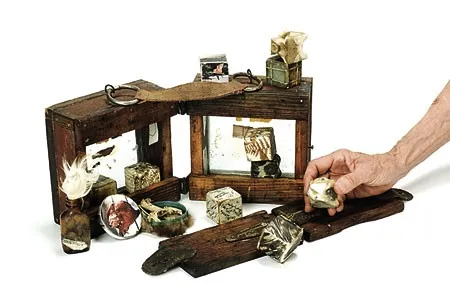
An old, bony hand opens a small cabinet. Inside is a tiny book. Inside that, lists are glued to the pages. It’s a history of art with Aldwyth’s name scrawled in a margin, a belated addition to the antique overview. Aldwyth is also the possessor of the hand, the maker of the cabinet, the one who glued in those lists and added her name. She’s made herself a part of history by reconstructing and reconfiguring it to fit her own needs and interests.
Aldwyth’s hand may show signs of age, but her eyes do not. The tireless 73-year-old wakes up extremely early every morning and gets to work. “She really gets down to business,” says Mark Sloan, director and senior Curator at the Halsey Institute. “And she reads voraciously as well. I’m envious of someone having the time to read so much.”
If time is on Aldwyth’s side, it’s the time to do what she wants instead of what she thinks other people want to see. “Slip Slidin’ Away,” a new collage exhibited in her inventive, eclectic solo show at the Halsey, is a good example of this. It has a gray border made up of numerical representations of each year of her life. Gusting Philip Guston heads send wind from each corner of the canvas. In the center, a large cloud is packed with people and objects that Aldwyth likes, such as artists, buildings, Dada, and more Guston images.
“The work changed from what I don’t like to what I do,” Aldwyth told me. Why spend months or even years collating pictures that made her feel bad? Instead, “Slip Slidin’” is a celebration of past and present joys, with her house floating over them in a bubble.
A joyous energy and quirky humor runs through lots of Aldwyth’s collages, placing incongruous images in unexpected places. Her sources are myriad, from early 19th century encyclopedias (“The World According to Zell”) to photographs of eyes (“Casablanca”). In the latter, these eyes drip down onto a checked circle. Each check contains an image — people, paintings, landscapes, diagrams. The border of each check is made up of tinier eyes. From afar it’s like a sponge, soaking up centuries of art history.
Some of the composite clippings are so small that a magnifying glass is required to see them properly. “Casablanca (colorized version)” has a border packed with miniscule copies of book jackets, details from classical art, photographs, and illustrations. These surround a veined white orb that floats in space, with more images hooked to a brain. Aldwyth’s influences and interests crackle from her mind as if they’re too much for her to contain. She’s compelled to let them out onto a canvas in visual form.
Before she got heavily into collage, Aldwyth specialized in assemblage, using found objects to create new three dimensional art. Some of these strange, dilapidated artworks are obviously different pieces of furniture stuck together. Others are like mechanical devices for thoughts or emotions.
“We Regret to Inform You” visualizes the pain of rejection, with nails and rusty shards of metal piercing an old trunk full of “personal debris.” For “This is Not a Gun” the artist has taken an item that looks like a garden hose attachment. She’s put it in a wooden case and set that on a plinth full of billiard-chalk holders. By appropriating common objects and reinterpreting them in works like “The Birds Bath,” Aldwyth refers to the Readymades of Marcel Duchamp; anything can be regarded as art if it’s placed in the right context.
Aldwyth has spent years putting these works of art together, and she’s packed a lifetime’s experience into Work v./Work n. It’s a chance to see the world through her eyes, where every piece of old junk has a prescribed resonance and purpose. It symbolizes the catalog of life that everyone creates mentally as they accumulate stuff through the years. Aldwyth hasn’t just transcribed that catalog; she’s gone one further by explaining and commenting on it as well, giving meaning to her odds and ends and giving old, bony subjects a new life and purpose.
Turning public places into exhibition spaces
by Nick Smith November 4, 2009

I’m a dyed-in-the-wool window shopper. When I’m walking down King Street, I like to take a peek at the merchandise, nose pressed against the glass like an Edwardian urchin. But recently I’ve had less to ogle. Many stores are closed thanks to pricey leases, the struggling economy, and cheapskates like me who spend too much time looking and not enough time spending.
While opportunities for retailers have dwindled, another part of the community has stepped in to give King Street a visual boost. WALK Gallery is an organization that was created to put art in vacant storefronts. WALK’s all-volunteer staff develops group shows that give unrepresented contemporary artists an exhibition space.
The concept isn’t new. In London, gallerists and curators have long since realized that they don’t have to fight for space when there are so many empty properties that can be used. More recently, New York artists have tarted up some of the dingier parts of Brooklyn with work that varies from kitsch to caustic.
Many other cities have tried this approach or are starting to appreciate its potential; San Francisco began a similar initiative in September. In the Holy City, WALK (walkgallery.org) began as the idea of Plum Elements owner Andrea Schenck and Rena Lasch.
“It came out of an initial meeting that happened when Jonathan Oakman (director of business services for the City of Charleston) came on board,” says Schenck. “We were talking about things that could be done for King Street, and it seemed like a no-brainer.” Schenck’s gallery is packed with artwork, and she was aware that “people wanted exposure for their work.”
Schenck previously lived in Cincinnati, which for a time had a main retail street with unoccupied storefronts. “They had murals that students painted,” she says. “It’s not rocket science that if you have something of interest in a window, it encourages people to stop, look, and continue walking down the street.”
She has a point. If you’re from out of town and you see empty storefronts down the street, what’s to stop you turning around and going in the opposite area?
The success of WALK is hard to quantify. According to Schenck, some artists have sold work. Graphic designer Christina Bailey has a different way of measuring its effectiveness. “For the first exhibition, we created rack cards and put them in the Visitor Center and hotels. I saw people walking around the streets with the materials.”
Bailey admits WALK’s infrastructure isn’t fully in place. The all-volunteer staff needs to get better at organizing their time together, since many of them have day jobs. For now, they’re holding meetings at Baked on East Bay every Thursday at 9 a.m. They have to make it easier for art buyers to contact the artists and involve more stores. They also need to find out how effective their project really is. But the concept’s solid — people looking for art might fall in love with a space and lease it, and shoppers don’t find themselves lost in a depressing sea of empty storefronts.
But why stop there? Why not bring these storefront works to our parks? The cities of North Charleston and Mt. Pleasant have both hosted successful contemporary sculpture shows in public spaces at Riverfront Park and Westlake in I’On, respectively. The art stays up for a year or two, so the cost of remounting is considerably less than places with more frequent exhibitions. These shows have also brought added attention to these areas during quieter periods of the year, and they’ve given artists a much-needed opportunity to show their work.
Marion Square has a couple of permanent sculptures, but little else. If the city can display Christmas trees ornamented with empty egg cartons and paper plates, why not show work by art pros another time of the year? The art-packed storefronts prove that there are talented local artists looking for exhibition space. All it takes is for a willing official to step up, test out a few modest spots, and bring some serious art to our parks.
Treeligion is a heartfelt, innovative look at religion
by Nick Smith November 4, 2009
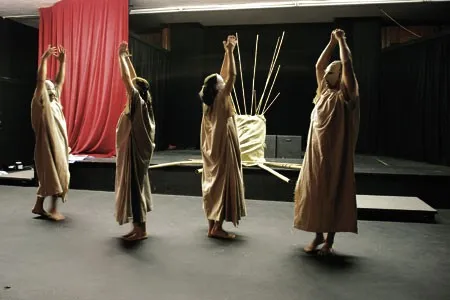
War. Misogyny. Ruthlessness. Conservative attitudes. History hasn’t been kind to the Ottoman dynasty, the realm that in its 16th Century heyday extended from southeastern Europe all the way to Asia and North Africa. But the empire deserves more credit than it gets.
There was only one way the Ottomans could rule over so many different races and religions. They tolerated them. The sultans who ruled the empire realized there was no profit in persecuting potential taxpayers. Pragmatism and capitalism overrode religious intolerance.
Deuce Theatre’s Treeligion takes a similarly evenhanded, expansive look at belief systems, blending many different religions into what one cast member calls a “soup of thought.” But don’t expect to be spoon-fed. This is an experimental play that uses dance, movement, recorded soundbites, sign language, stage combat, and snatches of song to convey the sheer variety of beliefs in the world. The play has a structure, but creators Michael Catangay and Andrea Studley have left plenty of room for interpretation as well — just like any hefty religious text.
The show’s main set piece is a tree with bamboo sticks for branches and masks hanging from a burlap-wrapped trunk, with black boxes stacked behind it. Like the tree, the boxes have more than one use (including a seat and a sacrificial altar). The opening scene, “Chaos,” besets the audience with strange music, sounds, and radio news clips. The five performers enter in robes with their faces concealed under brown cloths, repeating some of the clips. As the figures line up, they create a great visual moment that is both alien and eerily familiar; they are part monk, part druid, part exotic polytheistic cult.
The cultists recount myths of a great flood and the creation of the world from different cultures, including the Congo, China, Guatemala, and Native America. These myths are punctuated by body movements and hand gestures, led by the Tree Spirit (Arlene Lagos). Some are familiar — God surveys the world and finds that it is good. Others are obscure and intriguing — there’s a lot of begatting and one poor deity gets gelded, his genitalia strewn across the land.
After the tales of survival and rebirth come the show’s most contemporary element. The performers switch to modern times, walking around the auditorium, quoting responses from a previous audience survey. The replies are lucid, thought-provoking, and a great way for Deuce to connect with the audience. The quotes are interspersed with prayers, rituals, and stories, always raising questions to ponder: Is religion a necessary evil because people need guidance? Or is a divine good? Is it a form of mind control invented by man to cow the masses, or is it a perfect interpretation of a holy text? If so, which one is right? What if they’re all wrong?
Participation is an important part of the show, making it something to be experienced, not passively watched. While it’s harder to follow a play if you’re unexpectedly in it, there are enough regular theatrical moments to help make sense of everything. At 45 minutes, the play moves quickly, and the ending is abrupt. The audience can’t tell that it’s over.
Sometimes scary, occasionally humorous, and always entertaining, Treeligion definitely warrants more development. There are a few things to fix. The fight sequence needs to be tightened up a lot. There’s a brief glimpse of face makeup that is hard to see in the dark. However, all the performances are energetic and impressively choreographed.
Treeligion won’t conquer as much new ground as the Ottoman Empire, but it embraces more beliefs, and it deserves all the credit it can get.
For painter Brian Rutenberg, the waiting isn’t the hardest part
by Nick Smith November 4, 2009

Patience really is a virtue.
Gifted abstract painter Brian Rutenberg still remembers the first time one of his paintings was shown at the Gibbes back in 1985. He was a 20-year-old College of Charleston student contributing to a group show, dreaming of his first solo exhibition in the museum. It’s taken 24 years, but here he is, filling the Main Gallery with 14 paintings and four works on paper.
In those intervening years, Rutenberg’s wait has been enlivened with industry. After receiving a BFA here in 1987, he earned an MFA at New York’s School of Visual Arts. He’s been nibbling at the Big Apple ever since, with dozens of exhibitions in New York City including shows at the School of Visual Arts, Bill Bace Gallery, and a solo debut at the Cavin-Morris Gallery, which put him on the art world map.
Since then, Rutenberg’s work has been placed in 16 museums and public collections. His long list of awards is enough to make any struggling artist sick; it includes a Fulbright scholarship, a New York Foundation for the Arts fellowship, a Marie Walsh Sharpe Art Foundation grant, and a Basil H. Alkazzi Award. Not bad for a kid from Myrtle Beach.
“My imagination was formed in the Lowcountry,” he told us earlier this year. “Being born in a coastal South Carolina town, I had the pleasure of growing up around water … Water affects light and color in subtle but alluring ways.”
Rutenberg paints landscapes, woodlands, shining rivers, and dark shadows. But his work is not about the Lowcountry, only inspired by it. “I think it is more about the idea of ecstasy,” he said, “not a euphoric emotion coming from looking, but that moment of heightened awareness that pushes us beyond the brushstrokes into a state of shared consciousness between artist and viewer.”
All the work in the Gibbes’ powerful new Tidesong show is abstract, so it can be interpreted in many ways. From a distance, some of the pieces look like brightly colored atlases, each state denoted with a different hue. Close up, layers of paint up to two and a half inches thick give the larger paintings a geological feeling of substance and weight, like overlapping tectonic plates. One tremor and it looks like those plates will shift, revealing another tier under that, and another beneath.
These are Rutenberg’s representations of the layers in nature at a tiny detailed level, like the strata in the bark of a tree or the veins in a leaf. He doesn’t gloss over the flawed beauty you’ll find outdoors; he revels in it, depicting it with thick brushstrokes, drips, lumps, and scrapes.
Tidesong provides a good demonstration of why Rutenberg has built up such a following. It’s full of color and vibrancy, attention to detail and a willingness to experiment. The most dramatic large-scale paintings like “Blue Point” (48″ x 158″) defy gravity with their heavy layers.
“Pavillion” is one of the most complex pieces on display, with many intersecting lines (often resembling tree trunks), watery reflections, and lighter colors to suggest sunshine tentatively penetrating the landscape. Rutenberg alternates thick and thinner layers to create dense shadow and pale light, and balances either side of the canvas with shady foliage.
In “The Fading” series, he shows a similar grasp of form and value, sending a honeyed ethereal light into a dark, moody abstract world. This series is the most emotive in the show because of the strong contrast between pessimistic shadow and positive luminescence.
Rutenberg doesn’t always achieve his goal of making a conscious connection with the viewer. By choosing to leave the technical aspects of his work visible, he encourages us to admire them rather than losing ourselves in a picture. But he certainly evokes strong moods, from tranquility to hopefulness. Fans of his work will have to wait a while longer for him to figure out how to create the sense of higher awareness he’s aiming for. All they need is a little patience.
VISUAL ARTS Rave Party
by Nick Smith November 2, 2005

Cooperation of Pleasures: The Paintings of Julie Evans and Barbara Takenaga
Halsey Institute of Contemporary Art
Simons Center for the Arts
54 St. Philip St
1. A new name: In an effort to distance itself from stuffy, passive art galleries, the Halsey Gallery has changed its name to the Halsey Institute of Contemporary Art. The new, progressive name is reflected in a sparse show; the space dares to bare, with more wall space left blank than usual.
2. The poster art: If you’ve seen the flyers for this show, then you’ve had a tiny glimpse of its abstract world. From a distance, the flyer looks as if someone’s dripped luminescent liquefied Jello on a piece of paper. Up close, patterns emerge and the two pictures complement each other with their detailed circular shapes.
3. New York style: The exhibit, Cooperation of Pleasures, brings two New York artists to Charleston, and with them a taste of the present state of abstract expressionism in the Big Apple. Barbara Takenaga makes imaginative, colorful spacescapes using forms that twist and fold with trance dance determination. Julie Evans constantly experiments with Indian painting materials, including the miniature triple hairbrush. Then she uses her own perspective to add an accessible American twist.
4. It’s worth the trip: Concurrently systematic and organic, Takenaga’s paintings aren’t as symmetrical as they first appear. The trails of spheres and stars build a tunnel effect, but the end of the tunnel is raised so that the viewer’s attention is drawn upward and outward. If this gives you vertigo then the painter’s happy — she wants to create a sense of movement and stretched space.
5. At 70 by 60 inches, Takenaga’s “Little Egypt” is one of the most impressive paintings in the show. Golden planetoids collide with subatomic shapes, melding inner and outer space.
6. New colors: Inspired by her journeys through India, Evans has brought mineral pigments back with her that we aren’t used to seeing here. Muddy gouache flows over bright acrylics, creating dark greens, stark reds (“Red River Extract 1”) and vivid pinks (“Desert Saris”).
7. Big ideas: With her love of Indian miniature paintings, it’s no surprise that Evans’ canvasses are small. But there’s a lot going on in those little landscapes, with rippling water, shadowy buildings, and lots of bindi — the traditional jewelry worn by Indian women, particularly on their foreheads. Evans has a wealth of ideas to explore, from the meditative effects of mandala forms to the muck in the Ganges River.
8. Nostalgia: Every 10 years or so, the Spirograph comes back into fashion as a fun kids’ drawing tool. Evans picked up a cheap one on a trip to India and started creating simple, delicate designs with the toy. To make it less like a school art project, she used handmade paper, added bindis and outlined the spirals with gouache. The most successful, “Spiros and Bindis,” are the more complex pieces, with circles and colors complementing each other on a white background.
9. Evans’ “Pahari Landscape” has a circular focus, overlapping blue waves and a curtain-like border, creating an appealing proscenium effect.
10. The guest curator of this show is New York bigwig (and CofC grad) Brian Rutenberg, who will be contributing work to this week’s abstract show at the Eva Carter Gallery. He’s passionate about his chosen genre, describing Cooperation as an indication of what’s being looked at seriously in New York, with art that “bursts with luminosity and unpredictability.”
THEATRE The Glam Life
by Nick Smith November 2, 2005
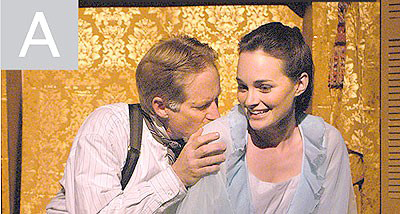
A Little Night Music
The Village Playhouse
Brookgreen Town Center
730 Coleman Blvd., Mt. Pleasant
Ingmar Bergman’s movies have proved a great source of inspiration for musicians and movie folk, from Woody Allen and Wes Craven to Bill and Ted. Bergman’s Smiles of a Summer Night, a story of high-strung family relationships set in Sweden, seems well-suited to a Stephen Sondheim musical. After all, the composer has a penchant for dark themes that complement Bergman’s melancholy mood pieces. But A Little Night Music is something different — a romantic comedy with a light-hearted tone, bawdy subplots, and a droll Greek chorus of singing bon vivants.
Sondheim’s exquisite score is written mostly in 3/4 time, giving it a gentle yet insistent rhythm. The story touches all the bedroom farce bases with an amused tip of its hat to the genre — there’s an elder man enthralled by his innocent teenaged wife and a more experienced woman, a chaste young man tempted by a forbidden relationship, a cuckold, a sagacious maternal figure, and a cheeky maid. The characters know that they’re being silly but carry on anyway, slaves to their desires.
Bill Schlitt plays Fredrick, a well-to-do lawyer whose intentions aren’t always honorable. His rekindled interest in old flame Desiree (Keely Enright) enrages her lover, Count Carl-Magnus Malcolm (Dusty Bryant), a strutting soldier with the facial expression of a bulldog chewing a wasp. Carl-Magnus is married to Charlotte (Cat Cook), who attempts to teach Desiree a lesson by seducing Fredrick. Charlotte’s best pal is none other than Anne (Laura Ball), Fredrick’s wife. Round and round they go in a fractured waltz of wooing, taking turns to delight and spite one another.
The mood and pace are set by the playful banter and lyrics, and also by a charming performance from Bill Schlitt. Sporting a Max von Sydow beard, he’s world-weary enough to make Fredrick believable but retains a wide-eyed air of naiveté for those moments when life throws him a curveball. This is a guy who loses one love, finds another, and is almost killed in one day — and we care about him when it happens. Getting the audience to empathize with a cheating Swedish lawyer is quite a feat.
As his confidante and soulmate Desiree, Keely Enright tackles her first musical theatre role with enthusiasm, an appropriate response to a character who’s happily associated with chaos. Her take on “Send in the Clowns,” one of Sondheim’s best known songs, is restrained, so it doesn’t get sappy. “Clowns” is followed by the underrated “The Miller’s Son,” performed by Lora Jacobs, who makes a perfect Petra and carries a fun subplot with ease.
Laura Ball cannily handles the complexities of a character who isn’t as naive as she first appears. Anne von Kolnitz as Madame Armfeldt and Johanna Schlitt (Bill’s daughter) as Frederika also make the most of their roles. Unfortunately, they can’t always be heard, and they’re not the only ones. Five musicians add to the sumptuous atmosphere, but drown out several lines — Kolnitz’ solo, “Liaisons,” is particularly difficult to make out. Early in the production, she tells Fredericka to practice her piano playing “with the soft pedal” — advice the musicians would do well to heed.
Bill and Johanna Schlitt were both in Into the Woods, the previous co-production between The Village Repertory Co. and The Company Company, of which Bill is producing director. His wife Maida Libkin directs this show and creates some fine stage pictures. They’re putting it on because they love Sondheim’s work, and it shows in a feast of beautiful music, assured performances, and clever set design. While Into the Woods sometimes seemed overambitious for the Playhouse, A Little Night Music fits just right. For non-Mt P. residents, the humor, songs, and setting all make this show worth going the extra mile.
THEATRE Dead Calm
by Nick Smith November 1, 2006
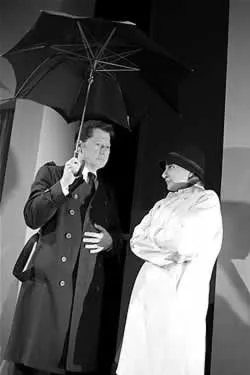
Rebecca
The Footlight Players
Nov. 2-5, 2006
Footlight Players Theatre
File Rebecca under “what the hell were they thinking?” Presumably, this stilted, creakingly slow show is intended as an homage to ’40s theatre. This is the Footlight Players’ 75th anniversary, after all, and, as with the rest of this season, they’ve picked Rebecca from their back catalog (they originally staged it in 1945).
Rebecca is a deliriously atmospheric story by Daphne du Maurier, writer of The Birds and Don’t Look Now. It’s set in Manderley, a sprawling Gothic house that amalgamates two real homes from the British author’s past. With a carefully building mood of menace and destructive passion, it should be an effective audience grabber, perfect for these dark autumn nights. Under the direction of Kyle Mims, it’s a sleep aid, instead. Rebecca‘s so slow, the Community Theatre Police should ticket it for not making the minimum speed limit.
A major pace-killer for this production is the blocking. Instead of moving fluidly from one part of the stage to another in a dramatic approximation of real life, the actors stand still, then cross the stage, then freeze again. It’s like watching a game of musical statues, except there’s no music and we’re not invited to join in. Moreover, whether they’re left frozen in the shadows or lit directly from above, the actors are often hard to see. There’s a fine line between creepy lighting and abject gloom, and Rebecca crosses it often. In the lead roles, Don Brandenburg and Christina Rhodes do some good, subtle work, but what’s the point when their facial expressions are lost in the dark?
Rhodes plays Mrs. de Winter, the Girl with No First Name who falls in love with Maxim (Brandenburg), the gentlemanly owner of Manderley. Tragedy drips from the walls, and the sadness is embodied in weird housekeeper Mrs. Danvers (Kain Cameron), who hates the new Mrs. de Winter for replacing Maxim’s first wife, Rebecca. At a glacial pace, the new bride discovers that Rebecca was her opposite — unashamedly beautiful, gregarious, and wild. But was her death an accident, a suicide, or a cold-blooded murder?
It’s unfortunate that even when we learn the answer, the play drags on for what feels like much longer than its two-hour running time, leaving the audience with no choice but to concentrate on the inadequacies of the actors. The British accents are fine, although the jolly Mrs. Van Hopper (played by Laura Hunt) is hard to understand; the Brief Encounter-style stiff upper lips are also acceptable. But the lips aren’t the only things that are stiff. Although David Moon gives the most animated performance in the play as bad boy Jack Favell, even his arms are tucked tight against his body half the time. In less spectacular roles, Josh Keller and M.D. Monroe Jr. both need to loosen up considerably.
Apart from Moon, everyone in Rebecca is reserved. Nobody gets really excited, even when they’re angry or confessing their sins to another character. This might have worked in the Hitchcock movie version, where the camera could get up close and catch the intensity in the actors’ eyes; here, the lack of palpable passion leaves the audience hanging, desperate for some drama.
As a time capsule sample of post-war, pre-Method theatre, Rebecca is a curiosity. It shows how far stagecraft has come in the past 60 years. Yet the director seems to have forgotten that audiences have changed since then — we’re savvier about theatrical conventions and mystery clichés.
For a top-notch production about a household struggling to escape the bonds of a charismatic dead character, viewers are better referred to Six Feet Under on DVD. In the meantime, to make Rebecca a relevant piece of theatre again, the actors here should break free from their restrictive blocking, follow their instincts, and do justice to du Maurier.
Painters, Interrupted
by Nick Smith November 1, 2006
Apart from the crappy food, the dingy rooms, and interminable lectures, the worst part of school for me was trying to get work done with someone watching over my shoulder. It was bad enough when my classmates were trying to sneak a peek at my muddled answers; if a teacher looked at my half-cocked compositions, I froze. There’s nothing that cramps your style like a snarky adult chuckling at your sums.
Some of the keener kids didn’t mind at all. They thrived on the attention and they always finished before I did. If they’d been highly skilled artists as well, then they’d have been perfect for Saturday’s Painting in the Park, where the public can watch painters create images from scratch, peer over their shoulders, and even chat with them if they dare.
This may not seem conducive to great painting, but event organizers for the CFADA (Charleston Fine Art Dealers Association) know different. The results will be auctioned that night, the oil still slick on the canvas, with proceeds from the auction going to eight local public schools.
This will be the third visual art-related auction in just over a week — the Charleston Art Auction and Through the Kaleidoscope both happened last Friday. Kaleidoscope, a ribbon event which included live and silent auctions, raised funds for the Hollings Cancer Center, while, like Painting in the Park, the Charleston Art Auction benefited art education in schools. So is there anything that sets the CFADA event apart for tapped-out bidders?
Park has one unique selling point — the chance to watch a painting coming together before your eyes, then getting a chance to own it. Plus some big hitters from local galleries are involved. CFADA has 14 members and typically invites two artists from each gallery to take part. With the event getting bigger every year, some participants were turned down for this one. That leaves 23 painters all lined up in Washington Park, no doubt jockeying for position to paint the prettiest tree or vista.
“I’ll be in the park every day of the week before Saturday,” jokes Kevin LePrince, who’ll be joining in the off-the-cuff, plein air activity. He doesn’t mind people chatting with him as he works; his biggest bugbear is weather-related. “The wind can be pretty bad in Charleston. It blows my supplies around, and sometimes it knocks my paintings over. There’s lots of debris. You can usually find a leaf or two stuck in my work — that’s part of the allure.”
LePrince is great at capturing that purply blue that can saturate the sky on fall afternoons, and his work should complement that of Karen Larson Turner, whose mauve-hued, large-scale art brightens the interiors of The Sanctuary on Kiawah.
Some of the attending artists seem better suited to the event than others. Odds-on favorite for completing a tasty piece of work is Gary Grier, who’s adept at rapidly creating highly detailed portraits on modest-sized canvasses. John Carroll Doyle, leading light of the local art scene, can tease beauty from the simplest of subjects. I’m not sure how the meticulous Scott Burdick will fare in this three-hour sprint, but he has plenty of plein air experience, and his upcoming Exotic Visions of India show at the Sylvan Gallery proves that he can find rich images anywhere.
Painting in the Park is part of CFADA’s three-day Art Annual this weekend (see Calendar page 34), all designed to benefit Charleston County High School Art Programs. If you get the chance to attend, leave your leaf blower at home and be sure to give the artists some serious breathing space.
VISUAL ARTS PREVIEW: Incantations in Thread
by Nick Smith October 31, 2007
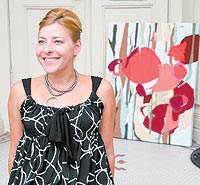
Incantations in Thread
Corrigan Gallery
On view through Nov. 30, 2007
It’s been called the Garden Spot of America, because of its fertile soil, plethora of farms, rhubarb festival, and quilts.
Lots and lots of quilts.
“I can’t remember ever not seeing them,” says Karin Olah, speaking of Lancaster County, Pa., where she grew up. “It’s how people decorated their homes. Quilts are a big part of the culture there.”
A strong Amish presence in Lancaster County (the Harrison Ford movie Witness was filmed there) has imbued the artist with a strong fascination with the culture’s “geometric, simple, yet rich tonal quilts.” As a child, Olah loved the puzzle-piece shapes she saw in each quilt. She found the individual squares beautiful.
“I loved it when they joined up to make a complete image,” she says. “The way things fit into a grid.”
While majoring in fiber art at the Maryland Institute College of Art, she was able to experiment with the conceptual and utilitarian uses of fabric. She dyed, printed, built, and spun fabrics. Eight years after graduating, her passion hasn’t faded.
Since moving to Charleston in 2003, Olah has made a name for herself as a mixed-media artist, drawing inspiration from the streets and marshes she sees while commuting to the Eva Carter Gallery, where she is director.
For the past two years, her work has been chosen for the Charleston Farmers Market poster, and her paint-and-fabric abstracts have cropped up at the City Gallery at Waterfront Park, Redux Contemporary Art Center, 53 Cannon, Church Studio, and Brookgreen Gardens, to name a few. Incantations in Thread is her second solo show at Corrigan Gallery, which represents her work.
“There are a lot of new colors in this show,” Olah says. “Blues, khaki, straw. I’m incorporating them into my old vocabulary.”
Some of the new works balance blue with Olah’s trademark reds; others stand alone, complementing her past palettes.
“I’m also using new, heavier fabrics, thicker linens, cotton. And as a final touch, I’m drawing with thread, looping it around on top of my paintings in a long, linear way. You only see it when you get up close. It’s elegant.”
Elegance aptly describes Olah’s art. Instead of sewing pieces of cloth together, she glues them, adding graphite and acrylics to her collages. Not all of her images leave an impression on the viewer, but none are slapdash either. They’re all carefully defined, professionally wrought pieces — a natural expression of an artist who admires the geometric elegance of the Amish.
The show’s title derives from recurring shades and shapes found in Olah’s Incantations, a series that connotes a kind of mesmeric music.
“First Incantation” looks like an orchestra tuning up, with abstracted red-faced figures preparing to play. Olah uses fabric, thread, gouache, acrylic, and graphite on canvas to create the anxiety of anticipation leading up to a performance. In this piece, there’s also a greater sense of depth than Olah’s previous work, with clusters of shapes and vertically-striped curtains in the background.
Suggestions of music are subtly woven throughout the series. “Second Incantation” is like the sound of improvised jazz, with mellow brownish colors escaping from what could be blank manuscript paper. “Third Incantation” harmonizes sad, lonely singular notes with a cosmic spiral of seeds, or perhaps they are planets, echoing each other with their shapes. There are more echoes in “Sixth Incantation,” with blue reflections and faint shadows dwarfing dark green leafy curls of color.
By creating so many different moods — plaintive to playful to passionate — Olah successfully uses her incantations to conjure the pitch and fall of voices. But while the labor involved in quilt-making recalls a powerful historical context, which itself informs Olah’s mixed-media non-representational works of art, the question remains: Isn’t fabric something her granny should be sewing?
“A lot of people think of fiber artists as being grandma-like,” she replies. “But it’s a very cool material to work with. It touches you every day. Working in textiles is something that — physically and metaphorically — I’ve always been wrapped up in, warmed by, and felt the weight of. I hope my work has that same enchanting hold on the viewer.”
Olah’s opening reception is part of the Ninth Annual Charleston Fine Art weekend, which is produced by the Charleston Fine Art Dealers’ Association. The weekend also includes a Painting in the Park event at Washington Park on the morning of Nov. 3 and a Charleston Art Auction that evening. Proceeds from ticket sales and from the sales of paintings from the park will go to Charleston County Schools art programs.
Darkwater investigates the paranormal, but don’t call them ghostbusters
by Nick Smith October 29, 2008
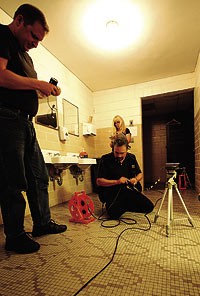
The Summerville Armory on North Hickory Street isn’t your typical haunted building. It has no gargoyles or cracked attic windows, no foreboding oak doors or cobwebbed eaves. It’s just a large brick structure that’s home to a National Guard unit when they’re not stationed in Afghanistan.
The Armory exterior may be dull as dirt, but the inside is a different story. At night, the building burgeons with unexplained events: bizarre sounds, doors that creak open by themselves, inanimate objects that shift from one side of a room to another when no one is looking. Even members of the National Guard Detachment — no pussies among them — admit a boo or two. According to facility manager James Boyd SFC (who asked that the unit remain anonymous for this article), “This place is haunted as heck.”
The strange goings-on have been attributed to a soldier who allegedly committed suicide in the late ’80s after his wife left him. Question is, are the phenomena due to the soldier’s tortured soul, or just the shifting of 50-year-old timbers?
It’s the job of Darkwater Paranormal Investigations to find out, or at least look for evidence of “anything that defies the laws of physics or nature.” That precludes bugs and dust motes that look like glowing sprites, sudden bursts of energy from fluorescent lights, or wind-rattled metal doors.
“If I can’t touch it, see it, or taste it, I don’t believe it,” says Darkwater founder Alkinoos “Ike” Katsilianos, a no-nonsense tough guy with close-cropped hair who’s been in the military since 1990. “But if I can’t debunk it, it makes me think there might be something out there.”
The Darkwater team has a healthy roster of skeptics, although each member still holds out hope for an encounter with the unknown. “I’d love to be tapped on the shoulder by a ghost and have a conversation with it,” says Bruce Orr, the group’s technical expert with 20 years experience in law enforcement. He doesn’t know what he’d really do if it happened. “I’m like the bomb dog,” he grins. “If you see me running, you’d better get outta here.”
At 8:30 p.m., Darkwater rumbles into the armory with soldierly precision. Two black trucks are parked outside the building, and video cameras, microphones, and cables are efficiently unpacked and set up.
Helping out is Chris Gordon, who works in the tech world for Cummins Turbo Technologies during the day. Like Katsilianos and Orr, he’d rather analyze than speculate. “Some people believe ghosts effect the energy around them to move things,” he says as he wields an electromagnetic pulse (EMP) reader. He’s yet to experience anything like that. He recalls a trip that Darkwater and the recently deceased Summerville Paranormal Group made to Strawberry Chapel in Moncks Corner. “Bruce found a cold spot, chest high,” he says. “I kept walking through it saying, I can’t feel it. I wanna feel it.”
The possibility of a spooky encounter spurs the investigators on even when the work becomes, as Katsilianos puts it, “boring as hell.”
However, Katsilianos says, “As soon as you see something that shouldn’t be there, you’re hooked. It’s like catching the big fish. You’ll be fishing ever since.”
The video cameras are trained on reputed haunt spots inside the Armory. The shower room has a strange damp patch on the ceiling; flaked paint hangs down in the shape of an inverted crown. The doors of the toilet cubicles supposedly open of their own accord in the middle of the night. And objects reputedly move halfway across a low-ceilinged office, untouched by human hands.
Once the cameras are hooked up to a monitor and all manmade electrical energy sources have been identified with the EMP, the team waits half an hour for everything to settle. By 10:30 p.m. they’re ready to begin their investigation in earnest.
The team decides to place dog tags on a hook in the shower — something their “guest of honor” would relate to. Orr scoffs at the TV show Ghost Hunters, in which a specter from the 1700s was once expected to recognize a flashlight. “If you’re from that time, you won’t know what a flashlight is,” he reasons.
And just as a paranormal entity might respond to objects it can relate to, the same might go for feelings. Orr reckons he can empathize with the soldier, so he sits in the shower and invites the ghost for a chat.
On the monitor, the shower room looks eerie. The team is using a near infrared setting on their cameras because of the small rooms; the infrared makes the shower tiles gleam, and Orr’s dark clothes look white. He sits in a corner, scratching his neatly trimmed beard and calling for the dead soldier.
Orr isn’t the only one talking. There’s a surprising amount of chat, considering that the team are hoping to record sound in the building. They’re waiting for a “magic time” when paranormal events are most likely to occur; some experts place it at 3 a.m., while Katsilianos prefers midnight. The investigation will wrap at 12:30 a.m. After all, the researchers have day jobs to go to and some of them have to get up early in the morning.
Bruce, back from the shower room, appreciates the thrill factor of a task like this. “There’s definitely a superhero mentality,” he says. “You’re conquering your fears and doing something above the norm.”
Linda Doty, a new member of the team, is brave enough to sit on one of the toilets in the bathroom, where the doors are supposed to creak open by themselves. Nothing visits her apart from a scuttling roach or two.
“There’s no scary music like on TV,” she says back in the main section of the armory.
Katsilianos passes his “magic time” without a creepy visitation, satisfied that he’s finished this stage of his job: gathering video, audio, and other data from the alleged haunted site. He does take one spook with him — a little figurine that he brings to sites so he’ll always take at least one ghost home.
When Katsilianos reviews the material for evidence of “intelligent entities” he hears a groaning that he can’t quite identify. Without a doubt Katsilianos will first discount any rational explanations for the sound before seeking otherworldly ones. “I’m a logic person,” he says. “I never really believed in ghosts. I’m just interested in stuff I don’t know about.”
With so much skepticism, the team is ripe for haunting. But they ain’t ‘fraid of no ghost. In fact, they’d be offended if you called them ghostbusters.
“I rate ghosts with unicorns and elves,” says Orr. “They’re mythical creatures.”
Orr hopes that in 50-75 years time, the technology will be developed to accurately trace paranormal activity. Right now it’s regarded as a pseudoscience, but reality shows and an enduring public interest have made the field hotter than ever. Meanwhile, Darkwater has enough “haunted” sites in the Lowcountry to keep the group busy in this life, and maybe the next one too.
Deuce Theatre touches on the touchy subject of religion
by Nick Smith October 28, 2009

To some people, hell is rush hour on I-526 with the radio stuck on WEZL. To others, it’s a fiery pit populated by big sinners and little horned demons. But where does this latter notion come from? The modern Christian perception of hell is the equivalent to Islam’s Jahannam or the Jewish Gehenna. In Greek mythology, Tartarus was a fetid pit of torment. By Roman times, it was surrounded by a ring of fire. For the ancient Egyptians, that ring was a lake for sinners to skinny dip in.
Hell’s not the only example of a religious trope that has been passed down from one civilization to another. From the tree of life to the Great Flood to the idea of a singular, Zoroastrian supreme being, there are plenty of elements that the world’s fatally bickering faiths can actually agree on.
Andrea Studley and Michael Catangay, co-founders and artistic directors of Deuce Theatre, like to raise hell themselves. When they arrived here from New Jersey, they brought The Emperor is Naked? It was a rabble-rousing political allegory with Ancient Greek trappings about a docile populace led by a warmongering ruler.
The show ran several times in different locations, most recently downtown during this year’s Piccolo Spoleto arts festival. Studley admits that “a certain group of people went to see Emperor,” i.e. those of more liberal political beliefs, but Piccolo draws audiences from all over the country. So when they took surveys at the end of each show, they got a good variety of responses.
The surveys asked for opinions on faith. These comments would form the basis of a new experimental ensemble play, Treeligion. To get some juicy material, Deuce asked fundamental questions like: Do you consider yourself religious or not? What does religion mean to you? Why does it exist, and does one religion have it right?
“The responses ran the gamut,” says Studley, “from very religious to thinking it’s a complete sham. Some people thought that religion exists because we fear death or want to explain the unexplained. A lot considered themselves spiritual rather than religious.”
Treeligion takes these varying answers, collates them with texts from different religions, and looks for a common thread. “We’re not writing any original text for this show,” Catangay says. “It’s a collage of myths, folklore, and direct quotes from the audience surveys.”
Recently, Studley has been studying the subject of religion alongside a friend. “In our research, we were surprised to find out how many religious stories have so many similarities,” she says. “Michael and I both have a Christian background, that’s what we learned first. It has its own origins, but there are parallels with Greek myths.”
The collage approach is a good way for Deuce to comment on religious issues without taking sides — or being run out of town. Studley and Catangay feel that the hot topic is a natural progression from their Bush-baiting prior production.
“The feedback after Emperor was pretty gracious,” Catangay says. “Even though our message was obvious, we weren’t coming down on the guy so much. We were trying to open up some sort of discussion.”
One particular point of focus in Emperor was the role of media. “We gave different perspectives on controlling the masses through the media,” Studley says. “There were some things that everyone in the audience could completely agree with or relate to.”
Similarly, the pair hope to keep Treeligion broad enough to include something for everyone. “People will interpret it very differently,” says Studley. “They’ll feel differently about it. They don’t know the histories or understand the parallels between these religions. It doesn’t mean they aren’t true. It means that everything has common roots.”
Studley’s research has opened her eyes to these roots. “We don’t sit here and profess to know everything,” she says. “We’re educating each other. We want to provoke a discussion. We’ll be offering talkbacks after every show.”
Judging by the passionate responses to their initial questions, the talkbacks could get heated. Humor helped Deuce to handle the touchy subject of politics, but Treeligion will be a more serious affair. Nevertheless, the show’s creators promise the play will feature theatricality, innovation, and the use of audience participation that make up their heavenly Deuce flavor.
One warning though: If you attend one of these chats and are asked to fill out a survey, be careful what you write — it might just fuel Deuce’s next performance.
Phillip Hyman’s new show is a flashback to pop culture’s past
by Nick Smith October 28, 2009

The Mill is a North Charleston bar that’s decorated with retro chic, from the old phone booth at the back to the ’60s-era atomic symbols to the chrome-edge tables in the diner-style eating area. In theory, it’s the perfect place to host an art show inspired by the iconic mid-20th century. But it’s still a bar, and some of the art struggles to stand out from the many dark corners and Halloween trimmings.
Although this isn’t the perfect space, many of the exhibits are striking and memorable. Visitors are greeted by a life-sized, life-like plywood cutout of game show hostess Vanna White, her skin the color of an Orion slave girl on Star Trek. Vanna’s cropped up in past Hyman shows, but she looks at home here with her rigid pose and her ghoulish grin (we said it was lifelike).
The cutout is by Phillip Hyman, who also curated the show, Retro. He has used other classic TV shows as inspiration before — he once based a whole series on The Outer Limits. There are a few homages here too, including a slinky portrait of Diana Rigg from The Avengers (“Girl with Gun”). Movies are acknowledged with a larger painting of the creature from the Black Lagoon. Like much of the Retro art, this one is painted with aerosols with the top layer thinned to make it look like light is coming through. Hyman has also made his spray spit in places to suggest suspended algae in the background.
Two pieces stand out from Hyman’s crop. One is “Let’s Go for a Ride,” a portrait of a woman with remarkable purple hair, sunglasses, and matching lipstick. The other is “58 Bel Air,” a close-up of a car’s bumper, perhaps the one that the purple girl took off in. Both artworks show an experienced eye for details, color, and composition.
Hyman has something of a noir partner in Connie O’Donald, an artist who likes to use simple monochrome shapes that are almost like blown-up negative photos. The face of Lee Van Cleef — most famous as Angel Eyes in The Good, The Bad, and The Ugly — is broken down into the simplest of lines and shadows, testing the old theory that we can recognize familiar images even when we catch fractured glimpses of them. Like Hyman, O’Donald coordinates colors to add balance to a female portrait in “Exotic Lava.” This time a starkly depicted, nearly nude girl leans over, breasts dangling, dressed only in pink striped stockings the same shade as her lips. She looks at us with an aloof expression.
We could only find one contribution from Christina Rodino, but it’s a good one. It shows the head and shoulders of an elfin girl with a squirrel draped on her shoulders like a mink wrap. There’s mild surprise in her blue eyes, and she’s pouting, probably because her squirrel is alive and looking for something to nibble. Rodino’s work is reminiscent of Stella Im Hultberg or Lori Earley, but with a rougher, hastier edge.
Chuck Keppler brings us more tormented actresses, including a woman lying on a Rigoletto script, her eyes tight shut. His enlarged Associated Press photos (gel transfer and acrylic paint on wood panel) highlight the raw printing process of newspapers. Their dots and flaws give their subjects a mysterious, dark-shrouded look. Keppler takes a punk approach to art, combining matter-of-fact text with symbolic images. It’s not for everyone, but it adds a dramatically lo-fi element to this show.
Mike Lane draws the short straw as far as his exhibiting space goes. He’s stuck in a poorly lit alcove between The Mill’s two main doors, and a few of his paintings are obscured behind a fake cobweb. But judging by the brutally brooding look of some of his work, maybe he likes it that way.
“Nelsons Colors” is a hanging sculpture/painting with a morbid fascination for anatomy. There are eyes, a small pair of legs, and diagrams of arms with their muscles and bones showing. Behind the canvas are pieces of interlinking bone-like wood. Deep down, Lane seems to be saying, we’re all part of nature and as liable to dissection as a hapless plant.
“Ohio State” has abstract bands of writing across it. These signatures or graffiti tags are snared together so they look like lines of barbed wire. An untitled 2009 piece is filled with checks on a brick wall, wrought in angry red and black colors. Organic-looking material is stuck onto the canvas and one eye peers out from the volatile scene.
“Chaos” is a strong example of Lane’s energetic art. It shows a bridge or black sails with red threads continually crossing each other. A bright red border contains the structure, which is reminiscent of ’70s string art. That puts Lane 10 years out of synch with the other artists, but as we mentioned, he probably wants to be left alone to do his own bad boy thing.
His best, most traditional work is “Family,” which uses a multiple photo frame. Instead of just putting photographs in it, Lane has included sketches, scribbles, one completely black shape, old black and white photographs that look photocopied, and one naked doodle girl. By taking a traditional method of displaying our loved ones and twisting it to his own ends, Lane reminds us that almost anything can be adapted into a canvas by an artist with imagination.
The occasional dark area is a common hazard for Hyman, who shows art in bars, stores, and alternate spaces throughout Charleston. It’s still a great way to expose new audiences to art and make it more accessible to everyone. While Retro could do with a few more lights thrown on the art, it serves its intended purpose, drawing attention to spaces that aren’t traditionally known as art venues even though new art goes up in them each month.
THEATRE REVIEW That’s So Raven
by Nick Smith October 25, 2006

Nevermore! Edgar Allan Poe, the Final Mystery
Charleston Stage Company
Running Oct. 25-Nov. 4, 2006
$10-25
Dock Street Theatre
Charleston Stage productions are the blockbusters of local theatre. Their lighting costs alone outstrip some of the littler locals’ total budgets. Like big Hollywood movies, they’re high on audience-grabbing concept and cool special effects but often low on fully-fleshed characters with credible relationships.
Nevermore! has been busting blocks across the nation for 12 years now with its lively slices of Edgar Allan Poe tales. Writer/director Julian Wiles — the producing director of Charleston Stage Co. — has to be commended for creating such a robust export fueled by his passion for Poe-ana. With light-handed allusions to Poe’s tour of duty at Fort Moultrie and a gleeful sense of the macabre, it’s a fitting Halloween show for local audiences.
Inspired by true events, Nevermore! uses Poe’s final days as its starting point. Poe was the 19th-century literary equivalent of Jim Morrison, with a string of hits (his poetry was endlessly bootlegged) and a career marred by gambling and drinking. People magazine would have been ecstatic when Poe disappeared a week before his demise, pitching up in Baltimore in a feverish state, never to return to lucidity. But even after his death, his work continued to grow in popularity, as if his vivid characters had lives of their own.
Like some theatrical version of M. Dupin, the detective hero of “The Murders in the Rue Morgue,” Wiles investigates the mystery and fills in the gaps with his own flights of fancy. Legend has it that Poe took a ship to New York City during his mystery week, so Wiles places him on a storm-tossed vessel where there’s little hope of escape from the author’s lurid nightmares.
There isn’t room in a two-hour play to do justice to all of Poe’s celebrated yarns; some, like Rue Morgue and Hop-Frog, have to settle for a couple of mentions. Others are celebrated in full-blown set pieces: a Masque of the Red Death with bad juggling and a horrific ending; a Pit and the Pendulum with a swinging blade and noisy denouement. Poe’s work lends itself to such operatic trimmings, but there are other things that make him a great read — an encroaching, fatalist atmosphere, a logical build-up to a fantastic climax — that aren’t quite captured here. Nevermore! seems more focused on his concepts than the complex feelings that his work can evoke.
The show’s more successful in its Charleston references, showing us a young Poe on Sullivan’s Island with his great lost love, Annabel Lee. Preston Hogue plays a suitably arrogant yet likeable lad in enormous blue pants, courting Annabel Lee with heartfelt poetry that threads through the play. An older Annabel (Mallory Good) recounts these early days, sharing the stage with her younger self (Kathryn Romaine) in an effective narrative device. Of the two Annabels, Romaine comes off best with natural inflections and a casual charm that helps to hook the audience.
By the time he’s a grown man, Poe’s depicted by Benjamin Larvie and engaged in some serious sipping. As he staggers down the raked stage he switches from maudlin to obnoxious, randy to reasonable with credible transitions. He rattles through “The Raven” on the assumption that the audience will know it, and some key words are lost in his drunken mumbling, but Larvie still manages to carry the bulk of the show, as his character stumbles from one vignette to another, stuck in a self-created nightmare.
His associates on this hellish journey are Captain Nimrod, boisterously performed by Burton Tedesco, and Antarctic explorer Jeremiah Reynolds. Actor John Edwards gives Reynolds some extra dimensions and creates an interesting figure in a handful of carefully chosen moments that don’t detract from the main action.
Many of the actors play multiple roles, including Romaine and Hogue. Not all of the acting is at the leads’ level, but Sheridan Essman and Zack Knudsen come across particularly well, with Knudsen’s Viscount adding depth to the “Red Death” scene.
Only one sequence really fails to deliver the goods — a Tell-Tale Heart homage is overlong, with “funny” characters who generally aren’t. There’s little difference between two shouting policemen, and all of the inhabitants of this story seem caricatured.
A thumping heartbeat sound effect helps pep things up, as do Laura Manning Turner’s moody musical cues. The lighting also helps to build a feeling of dread wonder, using yellow, stark red, and more purple than a Prince concert. A crafty set makes good use of the proscenium, with some of the cast appearing from behind and beneath the set in ingenious ways. There are plenty of tricks to keep the audience watching, and the plot follows a traditional, symmetrical structure.
Everything is exaggerated in this production — the pants, the props, the acting, and the sound design. Sneak some popcorn into the cheap seats, take some friends, pretend you’re at the multiplex, and you won’t be disappointed.
ART The Last Sculpture Show
by Nick Smith October 25, 2006
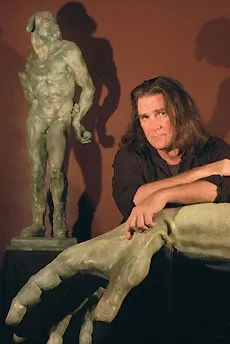
Anyone got a spare room fit for an artist? Just a few simple requirements: sheet rock walls, no windows, a big slop sink, and no noisy neighbors.
Many visual artists in Charleston do work out of their homes, either through choice or expediency. But not everyone wants to flip their house into a studio, and for sculptors, the kitchen rarely cuts the mustard as an alternative work space; for one thing, they could end up with pluff mud in their pancakes.
Installation artist Paul Hitopoulos once felt fortunate to have access to a vacant house where he could test a piece before it was exhibited. “I don’t work with an easel or traditional sculpture,” he says. “I had 40 gallons of pluff mud to go to Kansas City, Missouri, and I wouldn’t have been able to test the piece if I didn’t have that space.” Unfortunately, the arrangement was temporary. “I make money renovating houses, which is cool, but it’s detrimental to be renovating a place and simultaneously destroying it with what I do.”
Right now Hitopoulos is taking a hiatus while keeping an eye on the real estate market. To cover studio rent, he’ll be relying on his sales as an artist, “which means I can pretty much afford nothing.”
The myth-treated yet recognizably figurative sculptures of Tom Durham put him in a more traditional working realm. Yet he’s also struggled to find an affordable place to work here — so much so that he’s heading off to Philly instead.
“It’s not that I dislike Charleston, I love it,” Durham told me, “but I gotta make a living. I couldn’t afford the 1,500 square feet I need, which is going for $2,000-3,000.” Annoyingly, Durham found the ideal raw space sitting unused on King Street, but the owners were unwilling to rent. “They’re waiting for a big sale, and I know those places have been empty for over a year,” he says.
Even if the real estate bubble pops completely and prices come down, the net result probably won’t help artists all that much; Hitopoulos is mindful of the last time New York prices hit a ceiling and started to fall — he reckons that at best, art studio renters there shelled out a couple of hundred dollars less than before.
Right now, the solutions to this problem are narrow. Pay up, get out, or move back in with your mom. After 11 and a half years of contented renting, Durham’s lease agreement is up with Jupiter Realty, the latest owners of the Cigar Factory on East Bay Street. “They have to gut the building, so they’re moving everyone out,” he explains, “but they gave me over a year’s notice, and I can probably still rent on a month-to-month basis until I’m ready to leave.” Durham will be holding a farewell Open House tomorrow night (Thurs. Oct. 26) at 5 p.m., his final exhibition before he leaves town.
Despite his disappointment with the cost of studio space here, Durham is optimistic about his move. “It does open up a lot of opportunity,” he says, “and brings me closer to the market that I have.” He also welcomes new inspirations for his work, feeling that a forced move out of the city can be good for some artists: “Not everyone wants a picture of Charleston in their Charleston home.”
Personally, I’ll miss sneaking peeks into Durham’s studio when I’m in the Cigar Factory, which has benefited greatly from the presence of his eclectic work. Likewise, there are plenty of empty spaces and warehouses in town that could handle the needs of artists like Durham and Hitopoulos. If they’re not made welcome here, then there are other, more accommodating cities that will be happy to oblige.
VISUAL ARTS REVIEW: In the Dark
by Nick Smith October 24, 2007
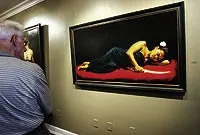
Robert Lange Studios
On view through Oct. 31, 2007
Sean Clancy lives in a small two-bedroom apartment on 125th and Broadway, on the edge of Harlem. There are a few brushes and paints scattered around, but he keeps his home pretty tidy.
He has to. He’s a big guy and there’s little room to spare.
Such commitment to precision and clarity are what inspired Clancy’s latest show at Robert Lange Studios. It’s called In the Dark and it’s a breathtaking series of realist oil paintings, featuring magnificent heroes and tragic heroines.
These works are teeming with inner life.
“He’s such a romantic,” Robert Lange says. “There’s an epic feel to his show. When we scheduled it eight months ago, we wanted to be surrounded by the work. We’ve never had such a big show in our main gallery.”
RLS is long and narrow, so visitors have no choice but to get up close to Clancy’s figures — the largest is 53 by 84 inches. With images of that scale close to their noses, viewers feel they’re part of the action.
In the case of “In His Sleep,” that action could almost be a scene from 300. It’s a riff on a dream sequence from The Iliad, where a general en route to aid the Trojans is murdered in his sleep before seeing the battlefield.
Using the literary scene as a starting point, Clancy has created an idyllic moment of his own. The general stands before a death-dark background, his outstretched hand holding a white rose, a cry for peace amidst the slaughter. In profile, he harkens back to classical Greek art and his muscular, bare-armed form gives the painting a Homer-erotic edge.
Clancy often paints dark backdrops and uses poems, stories, or mythological concepts as inspiration. “The Cherry Orchard” and “Fearless Knight” are both loosely based on The Faerie Queene, Edmund Spenser’s myth-draped self-help guide for wannabe warriors. The shiny steel armor of the “Fearless Knight” stands out against a black background; the angle of his sword helps to break the painting up into pleasing diagonal shapes.
Both knights are on red carpets, adding a regal note but also reminding the viewer of the blood spilled in their chivalric wake. Deep, dark reds are used through much of In the Dark — a knife stands out against it (“Slumbering Cynthia”), bodies lie on it (“Self Portrait,” “The Fairest Rose”), and in a sly wink to David’s “The Death of Marat,” an arm drapes from a bathtub, spilling red wine in “Dreamer of Love.” The sanguine liquid seeps across a white tiled floor, messing up the pristine bathroom.
The sumptuous colors, subjects, and chiaroscuro give the series an overall feel that’s somewhere between mid-Gothic, Renaissance, and Baroque art.
But there’s a precision here that owes more to Caravaggio than Goya. Like Clancy’s apartment, his paintings are neat and studiously arranged; as soon as he starts a painting, he knows how it’s going to turn out.
“I try to be precise and make it look as real as possible,” Clancy says.
Nevertheless there’s a contrast between his Old Master oils and Robert Lange’s glossy hyperrealism, which means there’s room for both in the gallery. Perhaps Clancy’s drawn to his source stories by their reassuringly dependable structure. He wants to explore looser techniques in the future, mixing that up with a couple of commissions (there are assured examples of his portraiture in this exhibition). Next summer he’ll be ready for another show in an as-yet undecided venue — maybe one closer to home.
Until now he’s avoided the postmodern-loving whirlwind of the New York art world. Judging by this show, however, he’s certainly got the chops to survive there.
James Franco and the Black Label Bike Club
by Nick Smith October 24, 2007
Stop By. Watch Films.
This weekend the Savannah College of Art and Design cranks up its annual film festival. In recent years the event has been growing in size and status; 2007’s eight-day affair is one of the most star-studded.
Guests include Michael Douglas and Catherine Zeta-Jones, highly respected filmmakers Milos Forman and John Sayles, Spider-Man heartthrob James Franco (touting his self-helmed movie Good Time Max) and Rush Hour director Brett Ratner.
The festival is geared toward independent and pioneering films like The Kite Runner, The Diving Bell & the Butterfly, and Reservation Road. There are categories for dramatic features, documentaries, shorts, animation, and student films, all competing for awards.
One of the festival’s best presentations will be at the Lucas Theatre (a sexier version of the Sottile), where Kodak hopes to convert a few videophiles with “Stop By. Shoot Film.” It’s a free event where registered attendees can spend two hours shooting a scene on 16mm, supervised by a top-notch cinematographer.
“Shoot Film” might not convince everyone to start using celluloid, but it’s a great opportunity to find out how tough it is to get some decent footage in the can — fostering a greater appreciation of films in the process.
For more details about the guests, films, workshops, and panels, visit www.scad.edu/filmfest. —Nick Smith
Smart Package
What better way for Redux Contemporary Art Center to celebrate its fifth anniversary than with — wait for it — Swedish animation?
On Nov. 8 at 6 p.m., a showcase of Nordic shorts, music videos, and artist films will be shown under the title of Daydream Nation.
While the center’s real anniversary celebrations kick off at the end of November, its growth as a well-rounded gallery of contemporary media is neatly symbolized by the screenings. Daydream Nation is presented by Package Deals, a Brooklyn-based organization with the smart idea of presenting films from around the world in country-by-country bundles.
Redux is also screening B.I.K.E., a documentary that looks behind the scenes at the Black Label Bike Club, which struggles against consumer culture and rival underground bicycle clubs in its bid for two-wheeled supremacy.
It might sound like a spoof, but the club is a 15-year-old international organization deadly earnest in its belief that one day soon, cars will be extinct and bicycles will reign supreme (as modes of transport, at least). The film was directed by Anthony Howard.
Mauritius offers a rare glimpse into the sexy world of stamps
by Nick Smith October 21, 2009
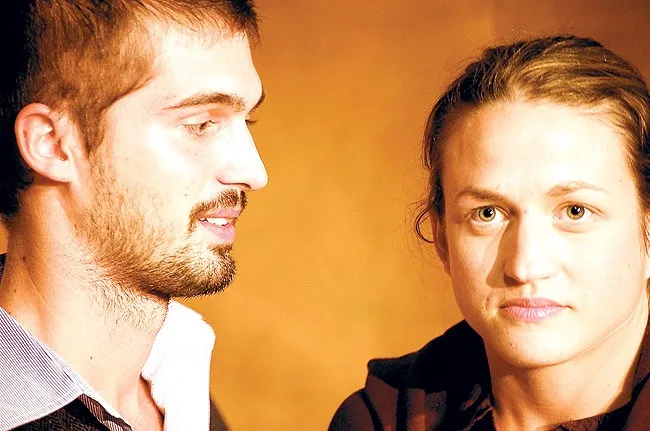
Prepare to be amazed by the dazzling, dangerous world of stamp collecting.
No, don’t stop reading. It’s really interesting, honest. Just ask Keely Enright, producing artistic director of the Village Playhouse.
“Mauritius sounded really deadly dull when we thought about it on the first take,” says Enright, who is also starring in the play. “But we were also intrigued because the subject matter seemed so benign. How could [playwright Theresa Rebeck] make a sexy thriller out of it?”
The initially innocuous story of two sisters inheriting a stamp collection takes a sinister turn when some rare stamps are taken to a store for evaluation. When Philip the store owner (played by Nat Jones) learns that they may have unpostmarked, misprinted, ultra-rare African stamps, he makes a major play for them — as do two other collectors, Dennis (William Haden) and Sterling (Dave Reinwald).
The sisters have their own squabble to settle. Jackie (Katie Huard) finds the stamps, but her elder half-sibling Mary (Enright) lays claim to them since they belonged to her grandfather. A series of mysteries pile up in a show that’s not so much a “whodunit” as a “whose is it?” The audience has to figure out who the stamps belong to, as well as their provenance and authenticity, and who the con artists are and what the con is.
This isn’t the first Rebeck play that Enright has had her eye on producing. A couple of years back she wanted to stage the one-woman Bad Dates, but dropped the idea when it was coincidentally selected by Charleston Stage. Mauritius provides a second chance for the company to revel in Rebeck’s funny, female-centered writing. “She’s a fantastic writer,” says Dave Reinwald, who is also the Playhouse’s managing director. “Mauritius has been fun to do and challenging. We’ve never done anything similar to this.”
“It’s really fascinating how it unfolds,” says Enright. “It has this Maltese Falcon feeling.” Along with talented director Paul Whitty, Enright is trying to honor the “vintage vibe” of the play — picture a female Humphrey Bogart cracking modern quips with a sprinkling of salty words — while keeping its present-day setting.
The New Yorker called Rebeck’s tale of grieving and grifting “David Mamet for girls” with particular reference to American Buffalo, Mamet’s tale of a valuable coin that brings out people’s greed. Rebeck’s work shares the same attention to cadence, unscrupulousness, and colorful language (not surprisingly, this one is recommended for ages 14 and up).
“I adore Mamet, what he does on the page and what happens on the stage,” says Enright, who has produced a few of his plays. “But I know some people who won’t even come in the door if they know we’re doing his work.” Mauritius is something different, she believes, because of its female perspective.
The stamp angle also sets this show apart from the rest of Enright’s oeuvre. “The biggest takeaway for us as actors,” she says, “is that we’ve become fascinated with the beauty and history of stamps and what they represent.” None of the cast had a philatelic background, and they couldn’t find a stamp store in town either. Wardrobe and prop mistress Julie Ziff had to go to New York to find the necessary trappings.
Enright says, “You will come away with a new understanding and appreciation for their world.”
Stamp fan or not, there are themes in the play that will resonate with anyone in the audience. The characters all have different needs and desires, but Jackie and Mary embody the play’s central questions. Where do you choose to live, the past or the present? Is your personal history more important than the here and now, the requirements of the moment? What’s more important — a family heirloom or cash in the bank?
Mauritius merges family feuds, dodgy deals, and collecting mania to tell an entertaining story. Rebeck is a playwright whose work stands or falls on the quality of the cast, and the Playhouse’s regular actors have already proven themselves capable of making a script sound fresh. The subject matter is a tougher sell, so it remains to be seen whether they can get their audience stuck on stamps.
Footlight prepares for a showdown between Richard Nixon and David Frost
by Nick Smith October 21, 2009

Some people achieve greatness. Others get to kiss the hem of great men. I saw an awful lot of hem-kissing when I shot a series of videos with Sir David Frost in the late ’90s in Scotland. Everybody wanted to be seen with him, get their picture taken beside him, drink a toast to him.
I gave him a 9 a.m. call time for our shoot. He said that “only when the Sultan of Brunei calls me do I get out of bed before 9.” Unless I had an extra $20,000 in my pocket, he wasn’t going to turn up until noon. He knew the power and value of his name.
Frost hasn’t always had such pull. In the ’60s he was best known in Britain as a satirist. He presented That Was the Week That Was, an all-singing, all-joking progenitor to The Daily Show with Jon Stewart. By the ’70s he was the nation’s favorite talk show host, a paean of hard-hitting chat. But he was a mere blip on the American cultural radar until 1977, when he grilled Richard Nixon on U.S. TV about Watergate.
To the former president, Frost was a milquetoast who posed no threat. Nixon had been pardoned by President Ford, and he’d never apologized for the mistakes he’d made. But Frost was ready to bite. He realized what an on-air confession could do for his career. So he gnawed at Nixon’s insecurities, teasing out an admission of fallibility if not one of guilt. It was Frost’s finest hour, the moment when he achieved greatness, now further lionized on stage and screen by writer Peter Morgan (The Queen, The Last King of Scotland).
Director Robbie Thomas was only 12 when Nixon died in 1994. Half his cast hadn’t even been born when the original interviews were broadcast. But this play is more than just a historical document. “It’s still very relevant today,” says Thomas, who sees parallels between Nixon’s follies and the “gray areas” of George W. Bush’s policies. “Nobody really knows if Bush abused the power he had as president.” That uncertainty sparked a renewed interest in Nixon’s attempted cover-up of the Watergate burglary.
“Peter Morgan released his play at the exact right moment,” Thomas says. “We’re questioning our leaders and the government. Up till Nixon people didn’t do that. He was untouchable, almost a demigod.”
To play this fallen idol, Thomas chose Mark Landis. The College of Charleston theater professor was not cast for his Nixon impression. “A lot of people did great impersonations, but that was not what I wanted. Mark has created his own character. He’s taken certain mannerisms from Nixon, he’s got it physically in the body, and he’s got some of the same speech patterns. But it’s really the essence he’s captured.” The same was said of Frank Langella in the movie version of Frost/Nixon — he didn’t look or sound like the ex-prez, but he was so emotionally authentic that it didn’t matter.
For the Footlights production, another CofC theater prof has been cast as Nixon’s foil: Jamie Smithson. Thomas recalls watching Smithson pull off the part of Richard III in the college’s Shakespeare Project. “There he was, this tall, gangly guy who does mainly comedic work, giving an incredible performance.” When Landis and Smithson auditioned together for Frost/Nixon, Thomas knew “this was a bout for the ages.”
The two leads are backed up by E. Karl Bunch, Boogie Dabney, Rob Maniscalco, Randy Risher, Christian Self, Noah Smith, Palmer Stowe, and Emily and Josh Wilhoit. Since this is a character-led play, Richard Heffner’s sets will be minimal so as not to detract from the performances.
There may be a slight distraction on Halloween night. The theater will offer discounted tickets to audience members who come dressed in ’70s garb or as their favorite politician. (At last, a chance to dust off those Sarah Palin glasses!)
Frost/Nixon is a neatly written look at the power of the media and the price of underestimating an opponent. Thomas concludes, “There are bits of theater magic. The narrator can talk to the audience one second then walk into a scene and take us with him.”
As for Sir David, he filmed his scenes with me like the media veteran he was, then left the set two hours early to party with some local dignitaries. He’d fought his big battle 20 years earlier, slain the dragon, reaped the rewards. And he has the late, ungrateful Richard Nixon to thank for it all.
The Halsey unveils Aldwyth’s cabinet full of curiosities
by Nick Smith October 21, 2009

If you’ve been downtown recently, you’ll have noticed some big, unblinking eyes watching you from posters and stickers. If you’re on the Halsey Institute’s mailing list, you’ve probably received an e-mail that promises you’ll see “an eyeful,” with a Benday-dotted orb attached. The searing image recurs in the work of the Hilton Head-based Aldwyth, an artist who will be the first to exhibit in the Halsey’s brand new gallery space. Ironically, this artist, whose watchful eyes seem to follow us nearly everywhere we go, has been toiling for years out of sight of the art world.
Aldwyth lives and works in a small, 800-square-foot octagonal house on a salt marsh, where she creates collage and fastidious assemblage (sculptures made from a combination of found objects). The little house symbolizes her humility, her obscurity, and her fascination with the miniature illustrations and tiny printed words that make up catalogues, résumés, and encyclopedias.
Aldwyth’s house is filled with 20 years’ worth of intensely personal, rarely exhibited artwork. When Halsey Director and Senior Curator Mark Sloan first visited her there in the mid-’90s, he was intrigued. “I thought, ‘Someone’s going to see this and scoop her up,’” he says. “Lo and behold, no one was doing it, so I decided to do it myself.”
Aldwyth’s art subsequently appeared at the Halsey in 1999’s The Right to Assemble, alongside five other assemblage artists. By the time her art appeared in another prominent group show, 2006’s Penumbra, she had gone on to produce some incredible collages.
Sloan draws a direct comparison between the artist and the Halsey Institute. They’ve both been plugging away, doing great things for a long time with little national attention or acclaim. “No one’s heard of us,” he says. “We’re two underdogs coming out together, joining forces.” It’s true that the epic, colorful nature of Aldwyth’s collages are sufficiently dramatic for the grand opening of a new gallery space. But the art also looks aged and otherworldly, in direct contrast with the Halsey’s contemporary, clean white walls and ceilings bristling with bright lights.
The art’s early 20th century feel is partly due to the materials Aldwyth uses. A lot of her collages are on Japanese Okawara paper that looks creased and well-perused, like the pages of a much-loved hundred-year-old book. There are also a lot of brown and gray colors that blend with her cut-out monochrome photos of eyes. Many of her earlier assemblage pieces are cabinets of curiosities, with drawers full of messages and detritus that beg to be rummaged through. The artist sees these objects as something you could sit in an armchair with, pick up and look through — an antiquated multimedia alternative to a book. But they’re too delicate to stand the strain of hundreds of well-meaning curiosity seekers. The temptation to touch and examine is so great — especially for school parties — that a video has been commissioned.
John Reynolds’ 30-minute film will give viewers a chance to see what’s in those cabinets when all the doors are opened and the contents are removed. This tour de fourrage will be accompanied by original music by Bill Carson.
Since Aldwyth’s 26-piece cigar box encyclopedia can’t be opened by visitors either, Sloan is exhibiting each box with the lid already up, accompanied by a reproduction of the top and bottom of the box. The encyclopedia will be the biggest hit of the show for children, as each letter of the alphabet is illustrated with found objects — “A” includes severed doll arms and scrapbook simulacra of Adam, an airplane, and an A-bomb mushroom cloud.
Beyond the fun and ingenuity that this show promises, there’s a sense of the unexpected that suits the Halsey’s new rooms perfectly. The Cato Building has corridors, large and small rooms, nooks and crannies; turn a corner and you’ll find more amazing assemblage. The experience may be overwhelming at times, but viewers will definitely be surprised by what they see. That’s a good indication for the future of this bold new gallery space.
FILM Balls to the Wal
by Nick Smith October 19, 2005
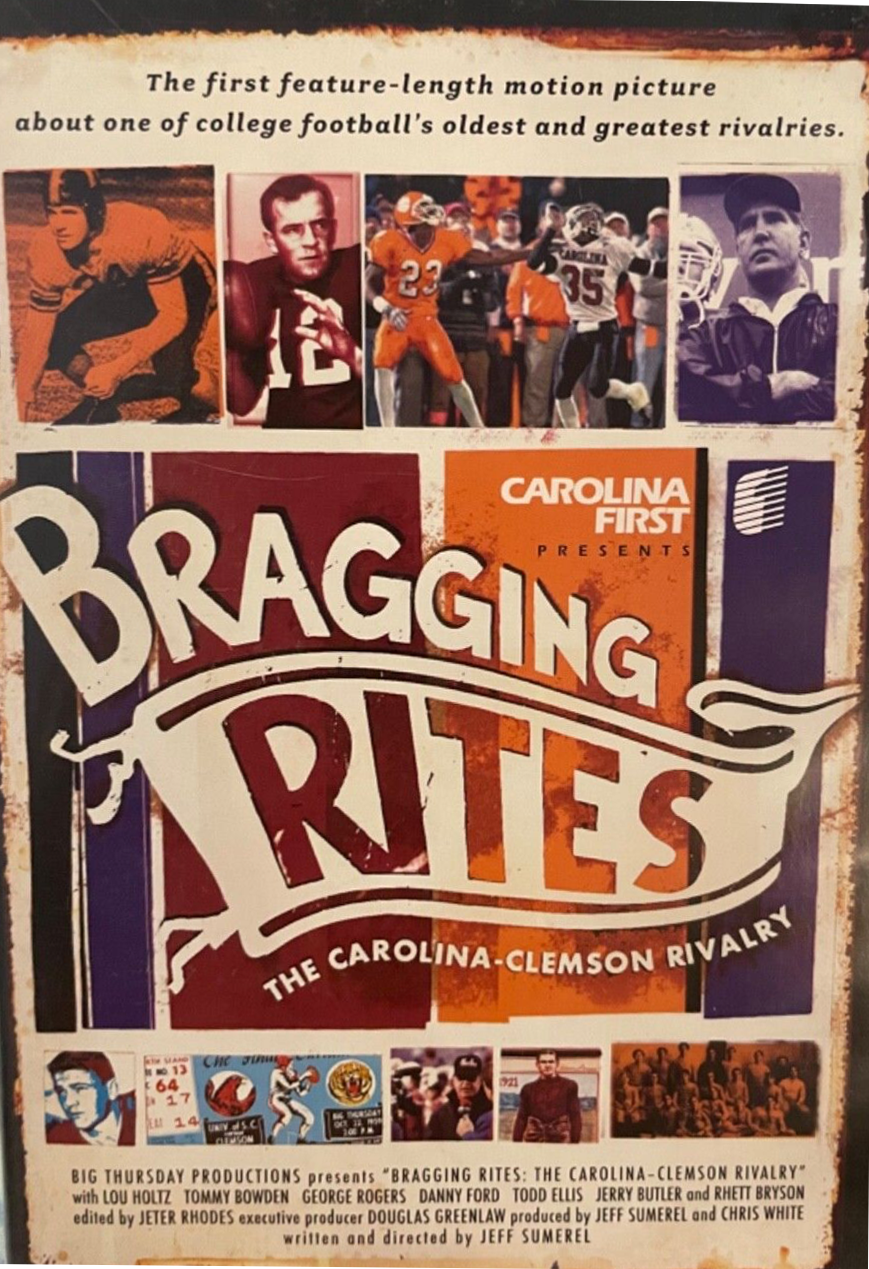
“Get out of the way! My sister just ate a shawl!” It might not be the most sensible line ever uttered in a film, but it’s fitting for the climax of a five-minute short shot in an attic and scored by a flamenco guitarist. To some viewers, The Shawl is a weird and wonderful example of Southern storytelling. To others, it’s just stupid.
But like it or not, Shawl director Jeff Sumerel is an inspiration to many. Under the banner of his company Spontaneous Productions, he’s created no-budget flicks that prove filmmakers can work virtually anywhere, tackling any subject. He’s the video-age version of a traveling troubadour, amazing audiences with his tales of diving mules and circus peanuts.
Sumerel took a step in a more unusual direction (for him) when he joined 83,000 fans at Clemson University’s Memorial Stadium for the 2002 Clemson-USC football game. Some of them came just to watch some high-class sportsmanship; others came to support their team and claim bragging rights from rival fans.
It was the 100th annual showdown between the two college teams, the apex of a rivalry that’s intensified over the decades to become an ingrained part of S.C. culture and has achieved national notoriety. The outcome was by no means certain. The previous year, Clemson’s Tigers had suffered a stinging 20-15 defeat to the Gamecocks. Yet 2002 marked a bad streak for the Gamecocks, with four straight losses, including a 23-0 humilation against Arkansas.
Sumerel was there to capture the tense atmosphere for his feature film Bragging Rites. The final result, first released on DVD and VHS in 2003, was compelling enough that three years later the documentary has been snapped up in a deal with Southeastern Wal-Mart stores — a groundbreaking achievement for a small independent producer.
“We spent a year and a half negotiating with Wal-Mart,” says Sumerel, “but we got our way in there. It’s an indication of the company understanding how popular the rivalry is.” After initial deals with BI-LO and individual mom-and-pop stores, Sumerel went through a college goods supplier in Ohio to get to the big box boys.
“The film was good and well-received,” says Columbia-based co-producer Chris White, “and we saw that DVD-related sports items were about to explode. We worked through a nightmare of red tape with The Computer Group, a big huge company that buys media product for Wal-Mart. They act as a kind of broker for everything from big Hollywood movies to the kind you find in the $5 bin. They called us and said that the S.C. stores wanted it, and fast. We shipped the product up to Ohio and within a week it was in all the stores.”
As small fries in a big retail supply pond, Sumerel and White are right in seeing the deal as a coup. “It’s so hard to get on the shelf,” says White, a full-on Gamecocks fan, “so I’m proud this film has done what it’s done. It’s cool that the thing that broke through for us is a movie. It’s our artistic statement — what we wanted to put up there, not edited by someone else.”
“People with no interest in football found it entertaining,” says Sumerel, “with the historical aspect and the relationships between players and fans. The supporters have the same seats every year, passed down from father to son. It was the rivalry that intrigued me; I wasn’t a fan of either team.”
For Sumerel, it’s the quality of the film, as well as the subject matter, that has fueled its success.
“We decided that the project deserved to be treated as a major motion picture, with a substantial amount of money spent on packaging and distribution. We used what we’d learned over 20 years of filmmaking — to think about the long term, planning everything out ahead of time.” After test screenings at both colleges, Bragging Rites was launched with statewide screenings in 2003.
“We’re still interested in the movie because it’s about the state, the culture, and the people, not just a football game,” says White, who also sees the feature as the ultimate research tool. “We were working on a screenplay for a regular feature, centering around one football game. We still want to do that, and when we pitch the story to people, we know what we’re talking about thanks to Bragging Rites.”
White’s enthusiasm for the screenwriting process received a boost recently when he and Sumerel met with Brian Frankish, executive producer on Field of Dreams and associate producer of Stuart Little.
“We’ve focused on writing lately,” says White, “because there’s a lot less overhead when we’re writing a screenplay. But we’ve also found that people in L.A. and New York are less on their guard with writers than with producers or directors. We asked Frankish, ‘Why are you meeting with us? Don’t you have bigger fish to fry?’ and he told us, ‘I’d have no job without screenwriters. There are no good ideas here in L.A., only copies of ideas. I’d be a fool not to listen to you.’”
White acknowledges that not everyone in Hollywood’s as receptive as Frankish, “but our legal rep thinks the same way. S.C.’s going to make its mark on the world of film, not by having tax incentives to bring Hollywood films here but by having the best stories to tell. I’m tired of the Film Commission concentrating on building up locations and resources like grips and gaffers. I want people to be getting story ideas from us, not just our labor. There are great storytellers here.”
The seminal football game featured in Bragging Rites ended badly for the Gamecocks, with the Tigers winning 27-20. Worse was a brawl between the teams at the end of the game. “It was a major disappointment, as my team lost both the game and their sense of sportsmanship,” says Chris White. “2002 will go down as an aberration in the history of the rivalry — one not worth remembering for either team.” Yet it will be remembered thanks to the DVD project, which White and Sumerel developed along the lines of a business venture as much as a tribute to the teams.
The film’s success with Wal-Mart is a result of hard work and negotiation rather than a new willingness by retail giants to work with indie filmmakers. The box pushers know that a product aimed at fans will sell a certain number of units, and the filmmakers’ smartest move was gauging the upturn in the athletic market. But by creating commercially-minded documentaries alongside quirky scripts and shorts like The Shawl, Jeff Sumerel’s going one step further, using his creative talents to build a fan base of his own.
VISUAL ARTS Island Art
by Nick Smith October 19, 2005
The Gallery at Freshfields
265 Gardeners Circle, Johns Island
768-8788
The Wells Gallery at The Sanctuary
1 Sanctuary Beach Dr., Kiawah Island
576-1290
Not so long ago, the portion of semi-wild barrier island landscape at the entrance to Kiawah and Seabrook Islands was green and unspoiled. Now the ironically titled Freshfields Village has paved over that parcel of land with parking lots and faux ’40s-era retail stores and a fancy new Piggly Wiggly.
One of the few rays of light on this built-up horizon is provided by Rob Hicklin, who established the Charleston Renaissance Gallery downtown more than 30 years ago, focusing on 19th- and early 20th-century artists.
“Rob wanted a space to show work by living artists,” says Kate Lindsay, director of Hicklin’s new Gallery at Freshfields Village. “It took over a year of planning to put together our paintings, 3-D pieces, and photographs.”
Until Freshfields Village is completed, visitors may have difficulty finding the contemporary gallery, which opened a couple of months ago. It’s tucked away beside Indigo Books at 265 Gardeners Circle (not #130, the mailing address on the brochure) but its treasures make the hunt worthwhile. With the slogan “Fine Art of the American South,” its artists include Terry DeLapp, Dan Ostermiller, William Dunlapp, and basket maker Carole Hetzel. Dunlapp’s “Late Night, Heavy Water” is a golden-hour delight, and the space is graced with sculptures from Ostermiller, such as a coy elephant labeled “Stage Fright.” Its pose was inspired by the nervous posture of the sculptor’s daughter, on stage in fifth grade.
“We’re hoping to have outdoor sculptures throughout the village,” says Lindsay. Some of them were in place for an inaugural Jazz Art Walk on October 7, which had Carolina Clay Gallery chipping in and Ann Caldwell performing on the village green. As we approach November, business should pick up for the gallery, as more stores open and locals become increasingly aware of the facilities. “It’s been busy, though,” the director hastens to add, “with residents interested in contemporary art, and those who want to support local artists.”
Not all the artists are local. California resident DeLapp’s “Fort Sumter” (acrylic on canvas) features the simple but recognizable landmark, capturing the heat of a Charleston summer with subtle tones. “When he visited the city, he found the light and water so compelling,” Lindsay says. “That’s what our artists share, wherever they’re from — the things they find compelling here.”
Freshfields offers Rob Hicklin a bold chance to experiment in a place that seems lighter and roomier than the Renaissance Gallery downtown. In a back room there’s a plasma screen where viewers can search the galleries’ complete catalog; like the Dunlapp work, the screen has been popular with visitors, and whatever’s successful will be repeated downtown. The cool space shows off the majority of the artworks to their best advantage; Philip Moulthrop’s wood work and Linda Fantuzzo’s panels are the least impressive, but they’re in such good company that a little rearrangement would easily put them in a better light.
Hume Killian also feels a little hemmed in downtown, so last spring he jumped at the chance to try a gallery in the Sanctuary Hotel on Kiawah. The place isn’t as elitist as some island residents might like to suggest — the hotel welcomes visitors, diners, and shoppers. But don’t expect any hunchbacked bell ringers at this Sanctuary. It’s a large-scale hotel with an exterior resembling a high school and interior murals that are obscured by staircases and doorways. That’s a shame, because Karen Larson Turner’s 28-x-22-foot vistas give the walls a great sense of scope and beauty.
As artists continue to seek new spaces to display their work, it’s becoming increasingly common for hotels to incorporate art into their décor; the Renaissance Arts Hotel in New Orleans is (or at least was) one of the most prominent, with a Gallery Project on its first floor. To give the Kiawah hotel its due, its murals and other original art pieces succeed in making the place look and feel unique.
The Wells Gallery at The Sanctuary is in a shopping arcade, next to a clothes store. It’s the result of a four-year relationship with the hotel’s designers, after Killian approached them with suggestions for original paintings and sculptures. Killian already has his hands full with The Wells and Smith Killian galleries downtown, and he admits that he’s spreading himself thin with his latest venture. “But the traffic we get here’s so much more regular than downtown,” he says. “A lot more of our customers are collectors who will make impulse buys, although some people are still scared of art.”
Maybe it’s the brash colors of Betty Anglin Smith’s work that scares them. Her multi-layered marshscapes are easier on the eye from a distance, and that’s not always possible in this space. Among a range of landscape paintings from local artists, Smith’s scorching work can’t fail to stand out. Wladimir de Terlikowski is the gallery’s only deceased artist; his 1929 “Sacre Coeur,” complete with white background, is also prominent in the crowd of Charleston buildings represented here.
Just as Freshfields has its plasma screen, Killian shows buyers his catalog on a computer monitor.
“I enjoy the fluidity of things coming here and going downtown,” says the owner. But it seems unlikely that some pieces, such as Smith’s “The Sanctuary” or Kim English’s tranquil figurative work, will pop up in the original Wells anytime soon, so the new gallery’s a must-see for any discerning island hopper. Go see the picturesque landscape paintings on display there — at the current rate of construction in the area, they’ll soon become the only record of some of its most beautiful natural environments.
THEATRE The Clone Wars
by Nick Smith October 19, 2005
A Number
Oct. 21-29, 2005
PURE Theatre
The Cigar Factory, 701 East Bay St.
723-4444
With the birth of Dolly the sheep in 1996, Britain’s Roslyn Institute was transformed from a worthy research center into a marvelous high-tech sideshow. There, Scottish scientists were busy playing God. (Their choice of animal wasn’t so surprising; Scotsmen have spent centuries cultivating an, er, intimate knowledge of their bleating buddies.) Now that we knew that scientists were capable of replicating sentient life, we wondered what other tricks were up their sleeve. For a while, anything seemed possible. Yet nine years later, Dolly is dead and the future seems further away than ever.
So where does that leave PURE Theatre’s A Number? The piece concerns a dissembling dad and his cloned offspring, who all have different personalities. As such, it explores similar themes to the Schwarzenegger-by-numbers flick The Sixth Day and Ira Levin’s The Boys From Brazil. The play is already less shocking than in 2002, when it was first performed by Michael Gambon and Daniel “James Blond” Craig. Fortunately, the fun here isn’t derived from the concepts so much as the way they’re presented.
Playwright Caryl Churchill flaunts her Brechtian influences with a simple, episodic one-hour show. The first four scenes contrast one son — the gentle, bewildered Bernard 2 — with a proto-Bernard, neglected as a child and aggressive as an adult.
Churchill seeks to subvert the fantastic trappings of A Number. She’s aware that the genre is renowned for starting a story with an ugly lump of exposition, so she obliges. Salter (Mark Landis) confesses that he had a facsimile made of his son after a car crash. The son has just learned that he has a number of photocopied siblings, and he’s in shock. The dialogue is believably disjointed, and Salter seems sincere as he attempts to help his son deal with the news.
In the next scene Churchill dumps the expositional lump — Salter has been telling porkies, and his real son isn’t happy about it. The audience is disoriented by the appearance of Bernard 1 (all the Bernards are played by the same actor, PURE repertory member David Mandell) and spends the scene sifting through the misinformation they’ve been given. Bernard 1 has violent tendencies, but possesses enough self-control to sit with his dad and discuss family matters.
Here’s where Churchill earns her writer’s fee, because A Number doesn’t rely on cloning for all its dramatic possibilities. Instead, it explores the foibles of fucked-up families, nature versus nurture, alcoholism, and the mourning process. It hinges on Cain and Abel-sized sibling rivalry, while Salter’s paternal responsibilities are examined and found wanting. Genetic tampering has given him a second chance after failing his original son. He gets to play daddy all over again, learning from his mistakes in a mirror of the evolutionary process.
As the dad, CofC professor of theatre Landis’ earlier, more comedic scenes are his strongest. He plays a foil to Mandel, who meets the challenge of playing the same guy three different ways. One grumble: in the final scene, his Michael Black character (the third clone) is a little too blithe, oblivious to some of the darker matters that Salter discusses with him.
A Number‘s matter-of-fact treatment of cloning will probably prove shocking only to fans of organized religion, who should fasten their bible belts and settle in for a bumpy, provocative ride. Otherwise, at $15 a ticket, the short running time, lack of set, minimal lighting, and ambiguous atmosphere may leave some audience members feeling shortchanged. But the free parking will help make it much easier to pay up for this quick fix of smart, stimulating theatre.
THEATRE The Office
by Nick Smith October 18, 2006
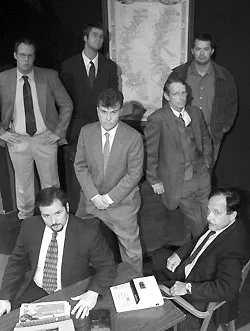
Glengarry Glen Ross
Village Playhouse and Repertory Co.
Running through Oct. 29, 2006
$20, $18/seniors and students
Village Playhouse
730 Coleman Blvd., 856-1579
Throw a stone in Charleston and chances are you’ll hit someone studying real estate. It sounds like the perfect job — flexible hours and high commissions, helping people find their dream homes. But not everyone ends up working for Prudential. There are some rapscallions out there who’d sell a piece of dirt to a dead dog if they thought they could make a buck off it, hard-talking white-collar weasels who’ve been trained to get their customers to sign on the line that is dotted, no matter what.
Playwright David Mamet worked with such rats, long ago in a different life. Since even Pulitzer Prize-winning writers turn what they know into dramatic material, Mamet used his experiences as fodder for one of his best-known plays, Glengarry Glen Ross.
Taut and terrifying in its misanthropy, this 90-minute all-male tale needs to be performed at a fast pace to make it effective. Most of the time the Village Rep players maintain that pace. Blink and you’ll miss some of the finest put-downs ever spat on stage, delivered by Playhouse regulars Michael Easler and Rob Duren. You’ll miss some of the subtler nervous tics of George Aaronow, perfectly played by Thomas Burke Heath. You might even miss a wonderfully tough, well-acted moment from Daniel Lesesne, hinting that there’s more to the actor than the cop roles he’s been typecast in recently.
The play only loses its rhythm a couple of times, most noticeably when Chris Sheets (as rube James Lingk) ambles into the Chicago real estate office where Act Two is set. Sheets can do gormless, henpecked, and vulnerable, but his interaction with sales shark Ricky Roma isn’t quite as agonizing as it should be.
In the brass-balled role of Roma, Rob Duren dominates the stage in the same way that his character dominates the sales contest the agents are so desperate to win. He’s on top and he knows it, as smooth as his silk shirt and tie. He flashes his pearly white teeth and cons the audience into liking him, only to reinforce what a scoundrel he is at the end; he’s out to get half of a colleague’s earnings, and he mercilessly chews out office manager John Williamson. As the lambasted “company man,” Williamson, Robbie Thomas gives a highly theatrical performance that is occasionally at odds with his fellow actors’ naturalism; at one point he looks straight at the audience and looks like he’s going to shrug and wink to boot. In other moments he’s the ideal foil for Duren’s glitz.
While Thomas’ acting sporadically jars and Duren’s is big and brash but just right for the Playhouse proscenium, it’s Nat Jones who really stands out in this production. While he doesn’t capture all the nuances of Shelly “The Machine” Levene, he puts on a mesmerizing show, whether he’s sitting at a table whining or sitting at a desk crowing. Levene is Mamet’s complex crowning glory in this play, an agent who’s been working hard for decades and has now hit a slump. The real pleasure and delicious horror of watching Glengarry is in witnessing the dismantling of The Machine, piece by petty piece.
Director and set designer Keely Enright has captured an ’80s vibe without laying it on too thick, using music, red and blue lighting, and the kind of beige-brown décor that people actually thought was a good idea 20 years ago. Julie Ziff, who always creates effective costumes on a meager budget, follows Enright’s lead and maintains the period feel but leaves the pastel jackets and neon socks at home. It’s also great to see a sturdy set in a Charleston theatre where actors can slam doors without making the walls wobble.
If the ending of Glengarry seems abrupt and leaves you wanting more, you can blame — or thank — the playwright. But for an energetic hour and a half, the Playhouse proves that it can handle anything — comedy, farce, powerful drama — and satisfy its audience in a production that’s required viewing for anyone considering real estate school. Or a career in acting, for that matter.
GET THE PICTURE Fashion-Forward
by Nick Smith October 18, 2006

There are some things a critic’s never supposed to say to an artist. “Which way up is this supposed to go?” is one example, or, “How long did it take you to paint this? Five minutes?”
I found myself having to bite my tongue recently when Georgia-based artist Michael Lachowski showed me some of the photographs from his new King Street exhibition. They were well composed, with rich colors and a strong contemporary resonance. But they also looked like fashion photography. To point this out to an elitist out-of-town artist would have been asking for trouble, so with visions of Lachowski brandishing a pallet knife at me, I kept silent.
Fortunately, Lachowski’s far from snobby. He rides a bicycle, supports the pedal-pushing Charleston Moves organization, and has the kind of laid back, self-effacing attitude that sits well with Charlestonians. “A couple of years ago I entered a fashion competition in Surface magazine,” he told me, and I breathed a sigh of relief. “Since then, I’ve added fashion to my portfolio and combined it with my art. It helps fashion magazine readers and 20-year-oldish people to connect with my work.”
Lachowski’s model of choice, Atom (a.k.a. Adam Burdett), portrays various well-known local figures in CHAD: Charleston Historical Art, Dude, a solo show opening this week that’s sponsored by urban design firm Keane & Co. Dressed in crisp 21st-century duds, Atom poses on historical sites as notables like William Rhett, Francis Marion, Joe Riley, and others. While the artist aims to maintain a “fidelity to the personages and the facts of history,” visitors to the show at 310 King St. will see the Swamp Fox sunbathing on Marion Square, the Mayor jogging past the Pineapple Fountain, and the pirate-bashing Colonel Rhett gripping a toy plastic sword.
Lachowski’s wry humor is also evident in his series of expressive drawings for CHAD. The edges of the state flag are scribbled ripples; the Hunley is represented by a nutty professor’s design sketch. They make a purposefully messy contrast to the precise representation of the photographs.
The artist will soon know whether CHAD is a hit. He’ll be holding a panel discussion at the offices of sponsor Keane & Co on Thurs. Oct. 26, inviting comments on a “visitor’s guide to the future of Charleston” from the audience.
Unlike some artists from beyond who drop a show in our laps for a few weeks and then disappear, Lachowski seems to have a genuine affection for Chucktown. CHAD has taken him several months to put together, as evidenced by a 50-inch-long montage of photos that show how King Street has changed recently — in the time it took him to record the whole street, old buildings were transformed and sidewalks dug up. For a man who believes in “living in the moment,” Lachowski manages to make the most staid aspects of our local history seem (dare I say it?) fashionable.
News from Charleston’s Art Community
by Nick Smith October 17, 2007
The Further Adventures of Kevin E. Taylor
Charleston gets a heavy mention in this month’s Juxtapoz, the San Francisco-based progressive art and culture magazine. The references crop up in a profile of Kevin E. Taylor, who moved to SF a couple of years ago. Since skipping town he’s been building up his reputation as an avant garde artist in shows at San Francisco’s The Shooting Gallery, Red Ink Studios, and Space Gallery.
The profile is written by no less than Shepard Fairey, another Holy City transplant who has known Taylor since he was a teenaged skate punk. It turns out Fairey is more eloquent than most of Juxtapoz’s regular writers, as he describes his initial meeting with Taylor, building an analogy between skateboarding and art. He also addresses Taylor’s subsequent obscurity: the reason no one’s heard of him, he says, is because the poor sap was living in Charleston.
By wising up and moving out West, Taylor has started to turn heads — so much so that his one-man show of recent work, Rise To Power, Fall from Grace was chosen as the inaugural exhibition for The Shooting Gallery’s new space, Gallery Three in San Francisco. Next up for the 35-year-old artist: a group show called Deep Pop at the Kenneth Chapman Gallery in New Rochelle, N.Y., and Animalitia, a solo exhibition at Anno Domini in San Jose, Calif. —Nick Smith
Oh Yes… There Will Be Workshops
The South Carolina Writers Workshop is a big deal these days, with a 17-year history, chapters throughout the state, and pretty much every type of writing represented by its members, from poetry to novels and non-fiction.
This is the time of year when all the workshoppers converge at the Hilton Myrtle Beach Resort on Oct. 26-28 for their annual Writers Conference. Agents, editors, teachers, and readers all get together to celebrate writing in S.C. Writers can have their work critiqued or attend group workshops. There are also open mic sessions, literary contests, poetry readings, booksignings, and expert panels.
One of this year’s new aspects is not for the faint of heart: slush fest sessions, interactive workshops among editors, agents, and writers where work is projected on a screen to be analyzed in front of the group.
Attendance fees range from $50 for a pre-conference Friday afternoon workshop to $389 for a complete package, including meals, a 20-minute critique of your work, and a year’s membership. You can register and find out more about the event at the Writer’s Workshop website, www.myscww.org —Nick Smith
THEATRE REVIEW: tick, tick… BOOM!
by Nick Smith October 17, 2007
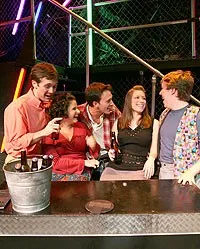
Charleston Stage Company
Oct. 17-27, 2007
American Theater
446 King St.
$30, $26/seniors, $10/students
(843) 577-7183
tick, tick… BOOM! has been billed as a departure for Charleston Stage, with a more intimate setting, adult language, and contemporary music. But it’s not all that different from previous shows. Unless you’re horribly offended by the f-word, there’s nothing objectionable — or remarkable — to be found in this short, entertaining modern-day musical from the creator of Rent.
The story centers around Jon, a promising composer living in a black-walled apartment on the West Side of Soho. It’s 1990 and Jon is a confirmed member of the Boomer Junior generation, gazing at his navel, concerned with turning 30.
His girlfriend Susan is there to help him through his quarter-life crisis. He’s also bucked up by his roommate, Mike, who’s making a name for himself on Madison Avenue.
Jon prepares for a workshop production of his futuristic musical Superbia, which he hopes will take him to the next level: a Broadway show. Karessa, his star actress, takes a shine to him causing friction between Jon and Susan. When Susan announces that she’s moving out of New York, Jon has to make a decision — stick with the music or get a proper job.
Sam Weber is good in the tricky role of Jon, narrating the show as well as interacting with the other characters. The hero’s emotions are mostly expressed through the songs, which Weber performs with gusto. Jon’s self-obsessed, amped-up persona won’t be for everyone, but Weber keeps him sympathetic throughout. With his hands in his pockets and a lean, hungry look, Weber resembles a singing, dancing version of Breckin Meyer’s John from the Garfield movies.
The other four actors play multiple roles with great dexterity. Nicole Nicastro is the sympathetic Susan who makes the most of an underdeveloped role. She also choreographs the show, adding important visual touches to numbers like “30/90,” where Jon and Mike’s friendship is shown through the way they mock-punch and pinch each other. Charlie Retzlaff helps build up the sense of a teeming city in several different parts.
On the night we saw the show, the cast dealt professionally with a few minor sound glitches. Nicastro overcame problems with her microphone by belting out some of her lines. Although Patrick Tierney (Mike) didn’t have the same hindrances, his singing wasn’t as strong, making his key song, “Real Life,” a chore to sit through. Acting-wise, he came across as confident and very likeable.
Autumn Seavey (Karessa) has one of the few solos, “Come to Your Senses,” and she makes it one of the show’s most memorable songs. That’s followed by another slow number, “Why,” sang by Weber. Both help to strengthen the final part of BOOM!, ensuring that it doesn’t end with a whimper.
While Jon finally solves his crisis, there was no happy ending for writer Jonathan Larson. Although his musical Rent was a triumph, with numerous awards, box office success, and a movie adaptation, Larson missed it all. He died suddenly from an aneurysm a month before the show opened. He was only 35.
This adds much-needed poignancy to the day-seizing, free-living themes in tick, tick… BOOM! It’s also evident that this autobiographical show has been put together posthumously, using a one-man production, musical numbers, and segments of a cabaret to create a tribute to Larson’s talent. As a result there isn’t much of a story to propel the show, and Jon is too self-involved to make this a great character study. But BOOM! isn’t the first musical with a paltry plot, and the transitions from one scene to another are well handled.
If you like Rent but aren’t expecting full-blown spectacle, you’ll be in heaven watching this show.
GET THE PICTURE: The Itchy & Scratchy Show
by Nick Smith October 11, 2006
Whenever I get the chance, every couple of days when I need to shore up the trivial crap that rattles around my brain and collect my thoughts, I make a To Do list. It helps me to prioritize. Filter. Not procrastinate.
Of course it doesn’t really help with any of those things — I just waste more time making the list — but there’s something minutely satisfying about crossing off a deed once it’s done.
One of today’s to-dos was a visit to Redux Contemporary Art Center, where a new two-hander covers biomechanical sculpture ranging from delicate glass to ugly sprouts of medical tubing. Boris Shpeizman creates ornate yet skimpy glass costumes that show off his artistic skill with the medium and take the piss out of fashion modeling at the same time, contrasting titivation with titillation. A video projected on one wall of Gallery No. 2 shows models wearing the see-through sculptures, walking in synch with the hiss and clomp of an installation next door. The effect is creepy and strangely itchy.
In three years of covering visual arts for the CP, I’ve seen shows that have made me yawn, blush, giggle, and groan. Rarely does a contemporary show make me feel dirty, and none have ever made me itch. Malena Burgmann’s Gift and the Baggage of Body, in Redux Gallery No. 1, does both.
The earthworms suspended over an air pump have something to do with it. So does the dead cat, parts of its skull showing through its parchment skin and flakes of God-knows-what underneath it. Then again, it could be due to a nearby collection of moldy-looking paintings with mouths full of crooked teeth and hog hair.
Using dead things in art is nothing new. Everybody remembers Londoner Damien Hirst’s infamous 1992 conceptual-art installation “The Physical Impossibility of Death in the Mind of Someone Living” at the Saatchi Gallery — a 13-foot tiger shark suspended in formaldehyde. More recently, Sabrina Brewer used taxidermy at Redux to re-create a “Fiji mermaid,” displayed during 2005’s Piccolo Spoleto. But Brewer tamed that beastie by giving it a cryptozoological pedigree and caging it in a freakshow context. Bergmann doesn’t give us any such let-out. She’s purposefully playing with dead things, confronting mortality, and trying to deal with the death of her stepmother.
Bergmann shares her grief, or at least her fascination with the “journey from present to past,” using the EKG print of her stepmom’s last minutes on earth, spooling past medical supplies and wheelchair parts. She comes across as not so much a sick puppy as a curious, mechanically inclined child poking at transience with a stick.
With “To Do List,” she catalogs essential needs (drink, sit) with darker corporeal ones (suck, drain wound). Her list is hooked up to a wasp’s nest by tubes, and teeth dangle from the canvas on wire strands. With her quietly eerie work, Bergmann reminds us that life is short and we shouldn’t waste our time on vain pursuits — like making To Do lists.
FILM REVIEW Fascist Filmmaking
by Nick Smith October 11, 2006
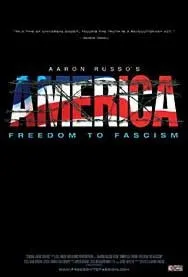
America: Freedom to Fascism
South Windermere Cinema
94 Folly Road
Oct 17-19, 2011
$6
766-7336
What does an audience expect from a movie? Not all of them have to be feature length. The movie industry was built around silent one-reelers, generally 10 minutes long. Does a movie have to tell a story? Not really; impressionistic documentaries get by on mood and visuals, not narrative. It doesn’t even have to have a central concept or character — a number of anthology movies, telling multiple stories bound only by a loose theme.
A movie can mean many different things, but surely it has to have the illusion of movement. After all, the word is short for “moving picture.” Yet Derek Jarman’s Blue is a memorable example of a feature that held one static image. It made the grade as a piece of visual art and a movie too.
Aaron Russo’s two hour documentary America: Freedom to Fascism, currently striking fear into the hearts of theatergoers nationwide, should be a movie — it has a main character (Russo himself), an informative point of view (Russo’s), and even a beginning, middle, and end (written by Russo). But it doesn’t feel like a real movie.
America focuses on the lack of a written law that requires us to pay income tax. As Russo develops this idea, interviewing lawyers, politicians, and authors who can’t find that law, he also examines the Federal Reserve. He learns from his eager interviewees that the 16th Amendment was never ratified by Congress, and that the IRS can be heavy-handed when it collects its debts.
From there, Russo decides that income tax is an instrument of totalitarianism. A small cartel of bankers control the government and media, we’re living in a police state, the Iraq War is an attempt by the Federal Reserve and the Bank of England to control oil interests, and within a few years we could all be implanted with electronic chips to track our spending and our lives.
America touches on a lot of hot topics, including the effects globalization has had on our nation’s labor force, the weakening value of the dollar, the Real ID Act (standardizing federally approved IDs), and the erosion of civil liberties after 9/11. But that’s all it does — touch on them. Russo tries to pack so much into his opus that he comes across as a guy on a soapbox, running off on tangents. One minute we’re shown a list of Bush’s latest Executive Orders; the next an IRS raid is reenacted with a photo and a couple of handheld video shots.
America‘s producer, director, editor, and star Russo’s a smart, witty guy with a decades-long track record. As he tells the audience on more than one occasion, he’s an award-winning film producer (his most notable credit is 1983’s hit comedy Trading Places). At his best, he uses every conceivable cinematic trick to engage the audience — stirring slo-mo shots of the American flag, snappy soundbites, a conspiratorial tone (“we’d discovered a government secret!”), and some investigative-style scenes where he roves with a camera crew. It’s as if he’s seen how powerful and effective well-made documentaries can be and has taken a little from each of them. Unfortunately, the rest of America is in a very messy state.
Apart from its wayward focus, Russo’s lack of an objective producer or distributor is the real problem here. There’s no one to channel his enthusiasm, or edit out personal opinions that don’t really add anything to the debate. “Most politicians will sell their souls for a dollar,” he tells us. Gee, really? Wiser heads might also have restrained Russo’s heavy hand as he juxtaposed his ideas with shots of gangsters and the Soviet flag.
There have been some great semi-professional video documentaries doing the rounds recently, but few of them collect the thoughts of one guy in such a muddled way as this. By creating and distributing his movie himself, Russo will get a lot of personal satisfaction out of the project, but it won’t have as much impact as it could have with a few executive orders of its own. As it stands, with a corner-cutting budget, heavy reliance on text, and myopically opinionated editing, it’s the filmic equivalent of the authoritarianism that Russo fears so much.
THEATRE The Wright Stuff
by Nick Smith October 11, 2006

Grace
PURE Theatre
Running through Oct 28, 2011
PURE Theatre at the Cigar Factory
701 East Bay St.
$20
723-4444
www.puretheatre.org
Religion isn’t just habit-forming, it can be downright addictive. One hit of an appropriate Bible passage can snare susceptible types for life. But those scriptures should come with a wealth warning. The Bible classes may be free, but it won’t be long before the collection plate gets waved under your nose, and a business deal based on faith alone is a hell of a risky one.
While a pious high is not to be sniffed at, the Monday morning comedown isn’t always pretty — and as the amazing Grace reveals, hymnal junkies who misplace their faith don’t take well to cold turkey.
Steve is a true believer, a “prayer warrior,” who lives in a heavenly apartment, all white drapes and cream leather furniture. He’s just scored a major hotel renovation deal with an unseen tycoon who has promised to wire him $18 million Swiss francs. Feeling a great rush when he realizes that his prayers have been answered, he shares his uncurbed enthusiasm with his wife, Sarah.
While Steve is out spinning a flimsy web of financial deals, Sarah’s left at home to befriend her mourning neighbor, Sam. This NASA programmer is a “thinker, not a believer” recovering from a car accident in which he lost his wife and his looks. Life goes on even after such an emotionally scarring event, and Sam must deal with visits from the exterminator, an extended stay in tech support hell, and ever-more-frequent visits from Sarah, who takes the commandment “love thy neighbor” further than most.
As Sam, Johnny Ali Heyward gives an incredible performance. This guy can make sitting at a laptop or hanging on the phone look fascinating, and when his character is placed in uncomfortable situations the effect is enthralling.
Never one to pick easy roles, Sharon Graci has some tough moments to pull off here. Sarah launches into a strangely self-absorbed story right after her neighbor has poured his heart out to her. Although subsequent events help justify the monologue, it’s still the weakest moment in the show. Still, Graci does what she can to make this transition seem less awkward.
R.W. Smith’s Steve is by turns blithe and bitter, and the actor handles humor and soul-searching with equal ease. Ross Magoulas plays the wry pest controller Karl, who is reminiscent of Clarence the angel from It’s A Wonderful Life, with his white uniform and the way he catalyses some events. But Grace is no Capra-esque feel-good piece.
But author Craig Wright does include some cinematic elements. He begins the play with the shocking end of the narrative, then rewinds the scene and starts from the beginning. There are cuts to black and fades to white, and the pace is tight thanks to an ingenious use of the single set. The actors occupy the same stage while living in their own apartments, helping to develop a running theme of the illusive distance between human beings.
Ex-hotel developer Wright’s best trick is to lead his characters down avenues of redemption, getting the audience’s hopes up only to dash them with a wrong turn that the protagonists choose to take. Director David Mandel picks up on enough of the play’s nuances to keep the audience engaged — and cautiously optimistic — right up until the final moments of the show.
It’s easy to get complacent about PURE’s constantly top-notch productions, but a renewed focus on acting and strong material has meant a tangible improvement in quality for this season. Grace is the best show we’ve seen from this ensemble in a long while, so now’s a great time to get hooked on a strong dose of uncut contemporary theatre.
FILM Green Days
by Nick Smith October 4, 2006
Charleston Documentary Film Festival
Oct. 5-8, 2006
Our world is crawling with parasites. They suck up oil and belch out carbon gases, wipe out ecosystems and destroy coral seas, turning Mighty Mother Earth into a little old lady on full-time oxygen support. The parasites continue to multiply, devouring resources with little consideration for the future. Now for the bad news: those parasites are us.
Thank goodness there’s reality TV to cheer us up. Why give a shit about environmental hot potatoes like handline fishing in Nova Scotia when we’re hooked on Dancing with the Stars? In fact, as 30 Days producer Morgan Spurlock recently posited, our supersized national diet of nonscripted shows might actually be good for the humble documentary, celebrated this weekend in a local festival with an ecological edge that substitutes global survival for Survivor. But just how much veracity can we handle in a half-week?
Heaps, according to Justin Nathanson, Executive Director of the city’s first festival devoted solely to the genre. The Charleston Documentary Film Festival’s frenetic four-day span will screen more than 40 films at three different locations: The Navy Yard at Noisette for a kick-off party, the American Theater for the bulk of the films, and Folly Beach for a grand finale.
Although Awendaw’s Sewee Center and Charleston County Public Library have found that there’s an audience for regular documentary screenings, Nathanson’s still taking a chance with the sheer number of films he’s screening. To help dispel the idea that environmental-issue movies are filled with tree-hugging preachiness, Nathanson has picked flicks with powerful visuals and some memorable characters; none of them beat viewers over the head with their message.
“There is no more powerful medium than film,” says Nathanson. “Once I plugged myself into the green scene it seemed like everyone was concerned with environmental and world issues, wanting to make a difference.”
Local independent producer Peter Wentworth approves of ChasDOC’s tight focus. “What’s exciting about this festival is that [Nathanson] has got a niche that really distinguishes it from the other regional festivals,” he says. “That, I think, is all important. There’s great benefits to carving out a unique niche that no one else is doing. He’s certainly got some very strong films for it.”
“I wasn’t prepared for all the work involved,” Nathanson says, “it’s been really challenging but very rewarding. It’s all about the audience experience and recapturing what I felt when I first saw the films.”
The docs that blew his mind include Sin Embargo, a look at Cuba’s incredible recycling efforts forced upon them by U.S. sanctions, and Chain. The film’s exploration of the increasing sameness of America, with chain stores swapping local color for box-shaped buildings, will strike a chord with anyone who’s ever had to drive through the city of Orangeburg. “It’s not the feelgood movie of the year,” admits Nathanson, “but it is a beautiful film to watch, a eulogy of our land and how it’s been homogenized.”
Other juicy-looking films include The Meatrix (an animated look at industrialized food production and farming), Journey to Planet Earth (succulently photographed offerings from PBS, with narration by Matt Damon), the Oscar-winning Man Who Planted Trees (more animation exploring man’s relationship with nature), and Varmints (pictured above, about the decline of the prairie dog in the American West).
Other selections, like Clearcut, show how passionate people can get over their environment, and a battle between “beenyeah” workers and “comeyeah” sophisticates should strike a chord with Charlestonians. The phenomenal success of March of the Penguins also proved that there was a hunger for docs set in exotic places. Here, Indian Rain Harvesting, Lost Jewel of the Atlantic, and Oil on Ice should deliver the goods.
Nathanson’s already intent on a second fest next year with a loose theme of social issues. He plans to make it bigger, with more international entries, but he’ll continue to encourage local production as well. “I want to inspire South Carolina to make more movies,” he says. “Filmmakers here don’t have resources to work with like in surrounding states – for some reason this state seems to be lagging a bit. I’d love to be a part of the bigger picture, get a really flourishing and prospering industry here.” That would be great for producers like Nathanson, and not such a bad thing for us ignorant parasites, either. –Nick Smith
THEATRE Half-Baked Ham
by Nick Smith October 4, 2006

Langston Hughes’s Little Ham
Art Forms & Theatre Concepts
Running through Oct. 10, 2006
Adults $20, Seniors & Students $15
Dock Street Theatre
135 Church St., 723-5399
It’s Harlem, 1936, with the Depression hammering businesses and ruthless gangster Louie “The Nail” Mahoney hitting them even harder. But that doesn’t stop the characters of Little Ham from dancing.
Art Forms and Theatre Concepts’ MOJA production opens with the cast dancing in a row in front of a black curtain, each defined by his costume and the way he moves. Although they all follow the same basic dance steps, they bring their own personalities to the pattern. There’s Hamlet “Ham” Hitchcock Jones (Antwan Crawford), sleeves and pants legs rolled up to make him look gawky; Jimmy (Warnell Berry Jr.), mincing around as befits his flamboyantly gay character; and a street cop (Patrick Dugan), beating time with his baton. Louie (Delvin L. Williams) struts past them all, inspecting his would-be victims. It’s a slick way to introduce the characters, and one of the few highlights of the first act.
Much of the action takes place in Lucille’s shoeshine place, where Ham works and dreams of finding his fortune and a “Sunday woman” to spend it on. Lucille’s husband Leroy enjoys giving Ham a hard time, but the young hero can’t really be blamed for not getting much work done — all of the characters visit the place to gossip or to gamble.
Louie wants some of Lucille’s action — and a share of every other business in town. He even wants to run a protection racket on Tiny Lee’s beauty parlor (another inventive set from designer Tripp Storm). Once Louie recruits Ham as a hoodlum-in-training, that creates a dilemma for the title character — he loves Tiny. But how can he help her if he’s riddled with holes by Louie’s growling associate, Rushmore?
This is a fairy-tale version of Harlem, and Ham’s got more than a touch of Cinderella about him, going from rags to riches at the wave of a crooked wand. He even gets to the ball — the Hello Club Ball, where he has choreographer Alisha Simmons to help him out, drawing on original 1930s dances to keep him in step. While the few fight scenes in Little Ham seem poorly staged and actors occasionally block each other from view, the dancing’s a strong point.
As Ham, Crawford is like Chris Rock with acting chops, handling the singing and comedy well. Lisa Robinson’s Tiny Lee matches his talents, and she’s only hampered by an overly restrictive costume. Warnell Berry Jr. does what he can with his contritely campy character, whose too-short solo hints at great talent. Similarly, Jimmy’s friend Sugar Lou Bird (Lea S. Anderson) does what she can with her role as the gangster’s moll with a heart of gold.
Not everyone in the cast can sing. Williams creates a memorably vain and menacing bad guy, but has particular trouble hitting his low notes. Larchmont (played by Zorba Breshers) and Clarence (Nicholas James) are also off-key, and Opal (Juanita B. Green) can’t be heard over the live five-piece band.
Compared to Gilliard’s previous musicals and despite the best efforts of the cast, the first act of Ham seems disappointingly flat, failing to fully engage the audience. The whole show feels under-rehearsed. A little extra work on the songs, sets, and storytelling would have helped immensely. The gospel-styled “Angels” wakes the audience up at the top of Act Two, which moves a lot faster and has stronger songs than the first half. It’s as if the cast realizes it has to boost its efforts and sing together to assist the weaker vocalists. Like their characters, they achieve goals in unison that they couldn’t hope to alone.
VISUAL ARTS Halsey Rising
by Nick Smith September 20, 2006
Despite its two floors of wide white spaces and inviting, broad glass doors, the Halsey Institute of Contemporary Art is like the reclusive great uncle in Charleston’s inbred family of local galleries. Tucked away in the College of Charleston’s Simons Center for the Arts, it’s been doing its best to get noticed recently, hosting weekly artists’ lectures, prepping an ambitious new show, and planning a move to a new, larger location.
The free lectures are a great way to get inside an artist’s head and derive some extra pleasure from their work. Over the past few weeks, three contributors to the Halsey’s current faculty exhibition — Erik Johnson, Yvette Dede, and Sharon Lacey — have each taken a spin around the gallery. Next up is Lynne Riding, who’ll be discussing the transition from her earlier, traditional work to the abstracted art she makes today.
Before the corpse of the Recent Works show is even cold, its successor is being warmed up. Force of Nature doesn’t officially start until Oct. 7, but this is no ordinary exhibition. Four years in the planning, it’s an environmentally-based, site-specific, multimedia miasma developed by Halsey Director and Senior Curator Mark Sloan and Nature co-curator Brad Thomas.
Ten progressive Japanese artists will participate in the show, which is spread over seven different Carolinian institutions, including UNC Charlotte and the Clemson Architecture Center in downtown Charleston. The two artists who’ll be based at the Halsey both have an intriguing way of combining past art forms with their contemporary sensibilities; Noriko Ambe carves paper pages to create “book sculptures” and creates installations that use the natural environment. Motoi Yamamoto is a salt artist, making intricate, maze-like patterns with the versatile condiment. (Habitual sneezers are urged to blow their noses before they enter the gallery.)
If you don’t fancy traveling to, say, Rock Hill to view Winthrop’s selection of mechanical “wind instruments” (by Rikuo Ueda) and art on copper disks (by Yumiko Yamazaki), don’t despair. All the installations and their construction are documented on a user-friendly preview website complete with a blog and a dedicated Flickr page, reinforcing the marriage of ancient techniques and modern forms of communication.
If the Halsey gang have their way, we should be able to sample Force of Nature‘s electronic leftovers when the gallery moves to the Marion and Wayland H. Cato Jr. Center for the Arts, due for completion next door to the Simons Center in 2008. A media room will include a computer with access to the Institute’s website, as well as any videos that accompany future exhibitions. A wealth of extra elbow room — twice the amount they have now, spread out over the new facility’s ground floor — will also accommodate a smaller, more intimate space with lower ceilings and hardwood floors, plus a library with supplementary literature.
Best of all, the curators hope to commission two artists to provide furniture and lighting for the rooms. If everything comes together as planned, this reclusive uncle may well become a favorite.
VISUAL ARTS The Power of Print
by Nick Smith September 13, 2006

Hot Pressed Poster Fest
On view through Sept. 15, 2006
Redux Contemporary Art Center
136 St Philip St., 722-0697
It’s a sweltering Saturday afternoon at Redux, where art spills out of the gallery’s door and into the parking lot, stacked in boxes or piled on tables. Colleen Terrell, a graphic designer, printmaker, and project coordinator of the Art Center’s Hot Pressed Poster Fest, cheerfully hogs the only available shade, cast by a small awning, as she watches over a vendor sale. Fellow artist Pete McDonough doesn’t complain. He soaks up the sun, explaining that he “doesn’t get out much.”
That could be why McDonough’s posters are wildly imaginative, evoking pulp magazine covers with their vivid colors and sci-fi themes. He’s one of the successful entrants in the national-call Poster Fest, alongside kindred artists like Sara Thomas, Allan Inman, and John Pundt.
The Fest does exactly what it set out to do: show a wide variety of art styles and concepts that exist in the genrefied limbo between commercial illustration and fine art. Many of the posters on display at Redux are advertising something, but they do it with disarming élan and a personal touch that you won’t find in a mass-run ad. These posters are often hand-cranked and limited in availability; some of them are the last, precious examples of a run.
All of the artists demonstrate a willingness to experiment within their own work that reflects the show’s overall variety. Thomas tends to use simple, brooding color schemes (a poster for Ted Leo and the Pharmacists sinks a black whale into a red sea), but a ’60s-style plug for Bluegrass at El Burrito tries something different, in blue and brownish grey.
Inman’s contributions are neck-deep in ideas, especially “Perpetual Propaganda,” with its complex concepts crowding round a simple TV set. Stephanie Nace uses glossy stock to give her bare-bones shapes more solidity, and Pundt skillfully toys with borders, fonts, and recurring images, merging late 19th-century advertising techniques and gangsta chic in a poster for Night Vizzion Promotions.
There’s a touch of 100-year-old carny culture in Standard Deluxe’s offerings as well, claiming that “the audience is part of the event.” Throw in a couple of strong men and revival tents and you’ve got yourself a circus billboard, but ads for Drive-By Truckers, down-home subjects like rusty water towers, and a penchant for military browns, greens, and muted yellows betray their contemporary origins.
Deluxe is one of three producers of graphic art invited to show work at the Fest and complement the competitive element. The Waverly, Ala.-based group touts the hand-pressed form with evangelical zeal.
Sean Star Wars’ zeal is mostly fueled by Mountain Dew, but it stems from a passion for printmaking. His grotesque yet playful images, inspired by ’40s and ’50s magazines, include grinning ice cream cones boozily melting, chain-smoking puppies, and sausage-fucking pigs. The Oxford, Miss., artist also makes clever use of text; an ape drinks from a bottle marked “evolve,” and clings to a second bottle that has part of its label obscured so it reads “love.”
The show’s third guest artist is the finest of the lot. Blake Basharian, from St. Louis, contributes the large-scale, meticulous “Gaze,” a collagraph print with gouache pen and gesso, which includes a broad sky, fine-lined whispers of clouds, and a half-covered corpse. His work helps to put across the broad scope of the print medium, and it doesn’t hurt that he’s an artist who refuses to be pigeonholed. “Oriental Rug” is a delicately contoured pattern on cast latex, while “Half Million Marks” is a perfectly segmented collagraph.
The Fest builds on an encouraging “prints as precious art” ethos recently encouraged by Ella Walton Richardson Fine Art Gallery (touting graphic work by masters such as Joan Miro).
“This show ties in with what we actually physically produce here,” says Redux Executive Director Seth Curcio, referring to the Art Center’s print studios and workshops. As such, this colorful exhibition is as much about participating as looking, using its inky images to urge visitors to find out more and get their own hands dirty.
THEATRE Playing Doctor
by Nick Smith September 13, 2006
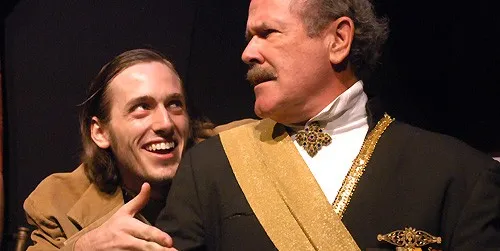
The Good Doctor
Village Repertory Co.
Running through Sept. 24, 2006
Adults $20, Students & Seniors $18
Village Playhouse
730 Coleman Blvd., Mt. Pleasant
856-1579
Life can be stressful for a playwright. Once a work is complete, producers, directors, and actors have a chance to interpret it as they see fit. Every new production has an even chance of becoming a polished gem or a dog’s dinner.
Neil Simon, creator of the Village Playhouse’s latest, would be pleased to know that they’ve scrubbed up The Good Doctor to make an appealing gewgaw; after all, he admitted that his 1973 comedy was little more than a string of sketches — a vaudeville show linked by a convivial narrator.
Simon brings his New Yorker sensibilities to the world of Russian literature, channeling the work of Anton Chekhov like a wild-eyed Coney Island medium. The narrator is Chekhov as a young humorist, fretting over the short stories that may become his legacy. Simon uses Chekhov’s character to share the trials of writing with the audience, from the agony of mental blocks to the ecstasy of finding an inspired idea.
The Good Doctor is a simple show, and the set and lighting are correspondingly modest, tailored to its 19th-century setting. The costumes impressively evoke Chekhovian society, from its ragged hawkers to its white-gloved higher echelons.
As emcee Chekhov, Brad Leon maintains an easygoing flow from one scene to the next. He deftly slips into other personae, sometimes before our eyes. He portrays a Great Seducer of Other Men’s Wives like a fey Regency England dandy, as silky smooth as his jaunty top hat. His overeager apprentice dentist character is imbued with the energy and high-pitched squeals of Elmo from Sesame Street.
Jake Hennessy contrasts this with a Topol-type voice in his role as a Sexton who’s reluctant to have his tooth pulled. Hennessy gives us a range of amusing characters and vocal impressions that help to differentiate between his characters. He plays a Jimmy Durante-styled lowlife and a couple of simpering subordinates, scraping his way around a set that sometimes seems too small for him.
There’s more contrast in the upper crust appearances of Steve Fordham, often acting as a straight man ignorant of the antics around him. But he excels in a silly scene at the show’s climax, heaving a mightily bandaged foot around as he unsuccessfully fends off a money-grubbing client with equally mighty buttocks.
With a lot of padding and grimacing, Maggie Jo Saylor gets the most laughs as the money-grubber. She’s joined in an earlier scene by Paulette Todd, who delivers the most distinctive characterizations through the play; high-school talent Ally Bing completes the cast, most notably appearing as a young governess and a phlegmatic actress.
As Chekhov points out to the audience, the misfortune of other people is a source of great amusement. The Good Doctor gives plenty of spins on such pain, physical and emotional, and it’s funny stuff. The show’s a good test of the actors’ comedic mettle, and they aren’t found wanting.
But it seems that, notwithstanding their modesty, Simon and Chekhov were aiming for something higher in the interpretation of their texts, aware that the best comedy is leavened with strong pathos. Director George Younts is celebrated for knowing exactly what he wants, and he gets it in this production. It’s a cheery play with a little bit of food for thought, but nothing that the audience can’t digest in a hurry. Through all the screaming and the slapstick, though, serious dramatic moments are not exploited to their full potential, and the actors don’t seize these opportunities to show how versatile they really are. Lonely or unfulfilled characters stay sketchy, and what should be an electrifying moment — an excerpt from Three Sisters — fails to create a buzz. That qualifies this Doctor as a first-aid fix of fun rather than a major operation.
THEATRE Lace Relations
by Nick Smith September 13, 2006
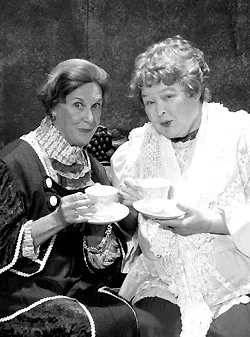
Arsenic and Old Lace
Footlight Players
Running through Sept. 23, 2006
Footlight Theatre
20 Queen St., 722-4487
Hello there! Come on in and have a cup of tea, won’t you dearie? I do so like having visitors. You see, I live here with my sister Martha and our nephew Teddy — don’t mind Teddy, he just thinks he’s President Roosevelt — and it helps to have a fresh body in here once in a while to liven up the place.
You’ve arrived in time for some splendid news. Those community theatre darlings, the Footlight Players, are staging our story to launch their 75th season. I find that “bully,” as Teddy would say, because although their production has some flaws, it still hits enough comedic notes to make it a worthwhile evening at the theatre.
My sister is reminding me to point out that we personally abhor anything to do with the theatre, and are very concerned that our nephew Mortimer is a dramatic critic. But the babyfaced Adam Miles plays him with such innocence and energy that he makes an imperfect character seem rather nice. Adam is a good actor with a strong voice that counterpoints his cherubic appearance. The sight of him kissing his fiancée Elaine still makes us giggle, though.
Mortimer’s much sweeter than Jonathan, the black sheep of the family. He fancies himself as some kind of criminal, affording playwright Joseph Kesselring with precious opportunities to make fun of gangsters and “old dark house” movie clichés. Jonathan is portrayed by another accomplished actor, Mike Ferrer, who’s saddled with some disappointing makeup. Mike manages to be menacing despite his panda eyes, giving some of the most natural reactions in the play. He’s obviously a Methodist.
Mortimer and Jonathan both discover our secret, and for some reason they make a big fuss about it. What’s wrong with burying a few bodies in the cellar, for Heaven’s sake? Before we know it, our house is as busy as Piccadilly Circus, with police coming in and out, cheerfully ignoring the cadavers we have hidden in the window seat. Mortimer’s attempts to keep us out of prison provide the play’s main farcical thrust, with ample opportunities for local actors to make solid appearances in supporting roles.
Best among these are Fred Hutter as Dr. Herman Einstein, who makes a great foil for Ferrer; Lawrence Thomas Taylor, perfect in a bit as one of our would-be victims — er, I mean lodgers; and Daniel Lesesne as a handsome young police officer. Arsenic uses a mix of set-in-their-ways Footlight veterans (like E. Karl Bunch and Hal H. Truesdale) and wide-eyed starlets (Christy Coleman and Erin Allison Mansour, frightfully awkward in her role as Elaine). Cornerstones of the cast are a likeable Nat Jones as Teddy, Samille Basler as Martha, and Jan Moore, in my role, as Abigail. Although it’s sometimes hard to distinguish between the voices of the two actresses, they imbue their caricatured parts with the right amount of dignity amidst the dottiness.
Director Bill Stewart uses this play to demonstrate what the Players are capable of: depicting colorful characters and equally brash and effective costumes in a long-winded farce, with jokes as fresh as our first kill. The atmospheric lighting doesn’t draw too much attention to itself, and the purple-patterned set (a replica of the set used in Footlight’s original 1942 production) successfully suggests our adorable three-story house.
The Players use the same set to present a ten minute “curtain warmer” called i am drinking the goddamn sun, a concise, narrative-led original comedy written by New Yorker Brian PJ Cronin that pokes fun at New York critics in a smart and well-written manner. Although I did not approve of its use of a certain four-letter word that is rarely heard in this theatre, I think that Mortimer would give it a killer review.
The Footlight Players dust off Mark Twain’s foray into theater
by Nick Smith August 30, 2010

In The Adventures of Tom Sawyer, Tom and his friends Huck and Joe go missing, presumed dead. They enjoy watching their own funeral before announcing that they’re still alive, to the delight of the local populace.
Twenty-one years after writing Tom Sawyer, Mark Twain expanded his grim gag into a stage play. This time, artist Jean-Francois Millet is the rapscallion who lives to witness his own funeral, faking his death to bump up the price of his paintings when he realizes that collectors will pay more for the work of a deceased genius.
Twain didn’t get the chance to see his one and only play, which went unstaged until it was dusted off and revised in 2007. But if he’d been able to watch the Footlights version and observed the audience, Tom Sawyer-like from the wings, he wouldn’t have been disappointed.
After a sporadically funny first act, the second half of the show kicks into high gear with outrageous characters, ridiculous foreign accents and farcical action.
Peter Galle plays Millet, who disguises himself as his twin sister to cash in on his newfound fame. Galle seems most comfortable when he’s in a wig and dress, flouncing across the stage in high heels and fending off male admirers. Lee Lewis is Chicago, an all-American prankster and Millet’s close friend. Lewis is a stable force in a crowd of deliberately over-the-top performances. Rob Maniscalco and Craig Trow play Dutchy and O’Shaughnessy, the latter behaving like a cross between a leprechaun and Brad Pitt in Snatch.
The villain of the piece, dirty art dealer Bastien Andre, is brought to life by Don Brandeburg in the zestiest, most playful portrayal we’ve seen from this local veteran. Actresses Laura Artesi, Lisa Benson, Susan Lovell, and Kelly McDavid also give very confident and enjoyable performances.
Special mention must go to Terry Davey as Leroux, an older character who shows his childish side when he prostrates himself before Millet, and to Sam Jackel in multiple roles, including a British nabob and an uproariously camp valet.
Technical director and set/lighting designer Richard Heffner excels with this show. He’s a true artist, putting more work into the sets than the play requires or deserves. In act one, Millet’s studio is as fully realized as possible on a small stage set, and at the beginning of act two, the dressing room earned a hearty round of applause.
The play has its weaknesses. Despite the involvement of gifted writer David Ives, it’s still very dated and simplistic. There are only two scenes. The asides to the audience are clunky, disrupting the flow of the story. Although the characters are fairly distinct, some of them spend long stretches of time with little to do except react to Millet’s shenanigans, and most of them come across as childish and unsympathetic. The opening act leaves the audience subdued until the arrival of Trow, who particularly appeals to younger patrons.
Director Greg Tavares, better known as a founder of The Have Nots!, successfully spices up the stale material by encouraging his actors to clown around. The gusto streamlines the creaky plot and juvenile jokes. This is no realist masterwork; instead it’s a fun and gaudy postmodern piece painted with broad, sure strokes.
Is He Dead? was a critical hit on Broadway. It’s impossible to tell whether it would have been as successful if it had been staged in Twain’s day. But now that he’s recognized as a long-lamented genius, the value of this lively play has definitely increased, even if it’s not always dead funny.
THEATRE OVERVIEW All Over the Map
by Nick Smith August 30, 2006
“We’re shaking things up this year,” says J.C. Conway, director of local company Theatre /verv/, and he’s not alone. Charleston’s board treaders are determined to try fresh tactics this year to snag larger audiences, ranging from new venues to more challenging productions. Those companies that aren’t taking a radical approach are going back to basics.
“We were very clear when we began what we were about,” says Village Playhouse cofounder and producing director Keely Enright. Since then, she feels that what she and her husband, cofounder and technical director Dave Reinwald, were trying to accomplish was lost. In their sixth season they aim to get back to their “initial passion” of taking classic literary 20th-century works and presenting them in an intimate space. “We wanted to take things that have been in larger theaters and make them smaller,” says Enright, emphasizing her desire to bring them down to an intimate level that would appeal to a TV-watching audience. “Characters sometimes seem whiny on a big stage and they can be hard to care about, but if they’re right here next to you, you do care.”
As Mt. Pleasant’s only repertory theatre company, the strip mall-based Playhouse has its own niche audience but is always trying to attract new blood from other parts of Charleston. “We’ve just signed a new three-year lease,” Enright says, “and it’s tremendously expensive — above $6,000 a month — but we’ve figured out how to keep ourselves afloat. Now we’re building up our membership base.”
In an attempt to appeal to a broad range of tastes as well as their own, Reinwald and Enright are mixing dependable comedies (Neil Simon, Alan Ayckbourn) with solid drama (David Mamet, Tennessee Williams). Also on the roster are the recent Tony-winning Urinetown: The Musical and the tender tearjerker She Loves Me.
Enright’s own penchant for slice-of-life drama and eras less well known to audiences is represented by the post-WWII drama The Subject Was Roses. “It may not be our big moneymaker,” she says, “but we want to show some things that people won’t ordinarily experience. Although they’re good moneymakers, you won’t see Steel Magnolias here and we won’t ever do Arsenic and Old Lace.”
Over at the Dock Street Theatre on Church Street, Charleston Stage’s founder and Producing Director Julian Wiles is also interested in putting on lesser-known shows alongside obvious crowd-pullers like Ragtime and The Best Christmas Pageant Ever. “You can’t just pick popular things if they’re not strong,” he says, explaining that although his productions have familiar stories and general appeal, he’s always looking for “unique, well-written plays.” The example he uses from last season, the hackneyed Baby, does not bode well for lovers of unique theatre at the Dock Street; this year’s Moonlight & Magnolias is a better indication of what Wiles is after.
Taking a humorous look at the rushed rewrite of the Gone with the Wind movie, Magnolias is a twist on that old theatrical standby, the backstage story. A small cast playing a variety of larger-than-life characters? Check. Plenty of scope for broad comedy? Check. Incompatible personalities trapped by desperate circumstances? Check. References to a classic slice of popular culture? Double-check. “People know something about [the backstory],” Wiles assumes, “but they don’t know that the screenplay was totally rewritten in five days.”
Another fairly new play, 2001 Obie winner The Syringa Tree, captivated Wiles when he saw it last year in Atlanta. So he’s bringing the production team to Charleston for a run in the new year, serving as the lynchpin of a season that aims at providing the goods for “sophisticated theatre audiences and the tourist market that comes in.”
Wiles should know those audiences pretty well — this is his 29th year as a theatre director in Charleston. He’s noticed some positive developments in the local theatrical community over the past seven to eight years, with the establishment of a few dedicated companies with a passion for the art form and the city.
“We now have an incredible range of things people can choose from, from cutting edge to musicals,” says Wiles of Charleston’s array of theatre companies. “The theatrical menu is bigger than it’s ever been. People don’t want to see the same thing all the time, just Broadway plays or just musicals; they want to sample different things.” Wiles admits that not every meal will be a gourmet one, but the tourist bumps help to sustain less palatable patches. “Every single production isn’t going to be brilliant, but there are 400 performances a year in Charleston and a huge number of people go.”
Rather than seeing the other theatres in town as mere morsels to his feast, Wiles has ganged up with them to form Theatre Charleston, the coalition formerly known as the League of Charleston Theatres. Partly that’s to help lure the tourists: “We want to make Charleston a theatre destination — people can come from out of town and see one or two shows in a weekend.”
Theatrecharleston.com provides schedule information and links for all five participating companies; actors can use it to find out about auditions and should eventually be able to add their resumes to the site. “We’re reaching out to the other theatres in town to join,” Wiles says.
That’s all dandy, but what does it mean for the rest of us? Wiles hopes that at some point, the site will provide discounts on tickets for individuals who join the league. In the long term, the best results might come from the increased communication and harmony the organization brings — local companies will stop grousing about each other and concentrate on producing great shows.
“Although Charleston Stage is huge, we don’t feel like we matter less or we have less to offer,” says Sharon Graci, cofounder of Pure Theatre on East Bay Street, on her company’s role in Theatre Charleston. Graci sees the league as a great opportunity to encourage audiences to be arts-inclined, tying in with her own desire to “attract, breed, and develop” challenging theatre. Whereas Enright and Wiles avoid quick-fire contemporary plays, Pure revels in them.
For its fourth season, Pure will present five Southeastern premieres, an American premiere (Pure International, directed by Bulgarian Alexander Morfov), and a couple of world premiere shows. The first of these will be Killing Chickens by the company’s cofounder, Rodney Lee Rogers. The other will be an as-yet unselected play to emerge from the company’s playwriting group, the Pure Lab. Both showcase new work developed by the theatre. Play development was one of the programs that Theatre Charleston members picked up on during an initial fact-finding mission to Chicago. “We want to emulate those company’s programs,” Graci says, “but still meet Pure’s needs. So we might go with two long one-act plays chosen from the work written by the seven writers we have in the lab.”
Graci describes this season as a mature one, as she and Rogers bring their company back to its Pure roots. Just like Enright, they feel confident and established enough to reaffirm what they set out to do. Since Pure was founded by actors and is geared towards them, they plan to get more technical support. That way, with more dedicated designers and stagehands, there’ll be less to distract the thesps from what they do best. Pure’s also moving the start times for all its shows from 8 p.m. to an earlier 7:30 p.m. kickoff, as well as introducing Sunday Brunch Matinée shows, with light nibbles at 1 p.m. and performances beginning at 2 p.m.
One unavoidable distraction that Pure must face is a move from their Cigar Factory space. “It’s pretty definite that the Factory will close to tenants in December,” Graci sighs. While the company explores some short-term options, it ultimately wants to find a place where they can expand their space over a 10-year period.
At least Pure has a home. The 10-year-old Art Forms and Theatre Concepts, Chucktown’s African-American company, finagles performance time in the Dock Street and Footlight Players Theatre. The equally venerable Actors’ Theatre of South Carolina, still waiting patiently for its new venue in the pending Folly Beach Fine Arts Center to become available, will team up with Footlight Players on the Dylan Thomas play A Child’s Christmas in Wales.
Pure isn’t the only group on the move, either. Charleston Stage is preparing to make an announcement on its own search for a space this month; its Dock Street Theatre home will close in June 2007 for a two-year makeover. “We’re staying in our present space completely for this season,” says Wiles. “We haven’t closed.” Meanwhile, doubtless motivated by occasionally disappointing audience numbers and a less-than-perfect rehearsal space for its shows in the downtown Dark Room, Theatre /verv/ is switching its shows to West Ashley’s Map Room. With its fresh-faced director and cast and a season of high-strung shows, /verv/ is geared towards younger crowds and hopes to find several in its new setting.
“We’re the first company in West Ashley, and I think we’ll benefit from that,” says J.C. Conway. Using the Village Playhouse as his niche market model, Conway has organized /verv/ around a core group of four actors — himself, Jan Gilbert, Beth Curley, and David Barr. “I’m by no means saying we’ll only do stuff with us,” assures Conway. “Our second show, Things You Shouldn’t Say Past Midnight, has a larger cast. But casting can be tough in this town.”
One way to encourage actors to join a production and stick with it to the bitter end of closing night is to pay them. Up until this year, only three companies threw their actors a bone — Charleston Stage, Pure, and Actors’ Theatre of South Carolina. Despite its tight budget, the Playhouse will join them in paying cast members this season for all but one production — She Loves Me, their latest coproduction with The Company Company (which doesn’t include players’ payouts in its remit).
There’s one institution on the peninsula where the actors pay the company instead of the other way round. “They pay us to get better,” says Mark Landis, director of Arms and the Man at College of Charleston’s School of the Arts. These student productions hold their own with Charleston’s professional fare, and this year SOTA’s trimming its number of Shakespeare plays down to one (King Lear) because of the amount of work involved in mounting a production.
“It’s to give our overworked technical department a break,” explains Joy Vandervort-Cobb, who will direct Wedding Band for SOTA in October. “When we’re doing all our shows, those people are torn, and we’re looking to lessen the load on the scene and costume shops. Not many people want to drop shows. It comes down to man hours, reality, and costs.”
SOTA is focusing on six shows this season, with ingredients that Vandervort-Cobb considers atypical. “I think we just went crazy,” she jokes. “We’re just going through a phase.”
While CofC cuts down on its bardwork, the Footlight Players are boosting its own number of productions in honor of its 75th season. The bulk’s made up of board-selected favorites from decades past, including Daphne du Maurier’s Rebecca and a community theatre staple, the Village Playhouse no-no Arsenic and Old Lace. 2006 will also see the introduction of a new offshoot season, “Salt & Battery,” in part to get younger audiences into the theatre. The experiment was first tried 50 years ago, when avant-garde shows ran concurrent with the regular stagings. The edgier productions will start at 10:30 p.m. on the same nights as three of the retrospective shows; for example, David Mamet’s Romance is set to parallel Inherit the Wind.
Apparently Charleston theatre works in cycles — every few years, the larger companies realize they’re getting staid and decide to shake things up a bit. They stage more challenging plays, then revert to more marketable stuff when the box office receipts disappoint them. Luckily for audiences, those companies seem to have short memories and the cycle is beginning all over again. — Nick Smith
ONES TO WATCH Daniel B. McSweeney
by Nick Smith August 30, 2006

It’s an unlikely story. An out-of-towner with little knowledge of Charleston’s slew of galleries sets up his own studio in an area that’s far from the tourist track. He pours his savings into converting a boarded-up building on Hagood Street into a progressive gallery and pottery studio complete with kiln. Against all odds, the venture survives the slow summer months and starts to thrive. However unlikely, the tale is true; the artist is contemporary sculptor Danny McSweeney, and he’s making a good go of running the Spark Studios and Gallery.
Now presenting Oddities, his second group show, the enterprising McSweeney still finds time to create his own work. A keen canoeist, he says that he’s “at the water a little bit too much” but once he knuckles down to work he gets totally involved in his pot-slinging.
McSweeney’s output straddles functional, marketable pottery and unique designs inspired by “characters, people, and emotions.” Recent forays into more abstract wall hangings suggest a new direction for the artist. “I’m working on a couple of things more in that direction,” he says, “much larger, more involved.”
As word of his shows spreads, more artists are approaching him with work to exhibit. Most recently, local artists Philip Hyman and Ted Pickering are contributing wall-mounted sculptures and paintings to Oddities. As if that’s not enough, the gallery owner teaches, too. Spark’s night classes are small – three nights a week, four students per group – but popular, and a new children’s course has just begun.
“I have a big variety of crowds coming into the studios,” says McSweeney, “including a lot of children from the neighborhood. Some of them haven’t ever been into a gallery before.” As a guy who plans on “staying here for a long time,” that ties in with one of the artist’s long-term aims – to attract and nurture viewers new to art. –Nick Smith
ONES TO WATCH Jarod Charzewski
by Nick Smith August 30, 2006
Amid the inevitable sea of idealistic, jaded, or downright inept lecturers that train our nation’s youth, a small percentage of effective educators occasionally bob to the surface. For the next three years, scores of students at the College of Charleston will be lucky enough to encounter one of those buoyant personalities as Jarod Charzewski becomes the Studio Art Department’s latest visiting artist.
Charzewski is an installation artist and sculptor with an MFA from the University of Manitoba, Canada. His past work includes Burning Bridges, which placed an arcade of large slanting door frames in a weedy field, and Tides, a multimedia installation that included video and kinetic sculpture, judiciously commenting on the replacement of historical property with new construction.
“Tides is a very research-based environmental project in three stages,” says Charzewski. He plans to continue developing the open-ended project, adapting it to the spaces he finds. “A lot of the work I’ve done in the past doesn’t really have to be in a formal gallery space, and when it is, it can surround any normal exhibits. It’s very subtle.” He’s only begun to explore Charleston, but he notes that the Aquarium might suit his environmentally-edged work perfectly.
The artist is eager to bring his fascination with technology and “unconventional art practices” into the classroom, using the reaction that occurs when Mentos are dropped into Diet Coke as an unlikely example. Charzewski’s unaware of any art projects that have used a mint-fueled geyser. To redress this, he’ll require students to create something to mount on top of the Coke bottles, then videotape the reactions or stream them on the net. “Contemporary art and sculpture can really encapsulate all kinds of things,” he says, and by the sounds of it, the same will apply to his classes. –Nick Smith
VISUAL ARTS All Together Now
by Nick Smith August 30, 2006
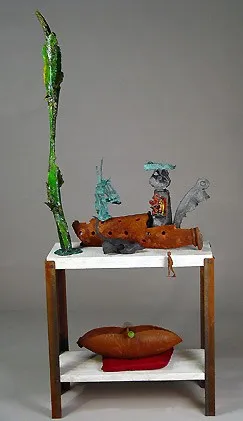
Recent Works: Yvette Dede,Erik Johnson, Sharon Lacey, and Lynne Riding
On view through Sept. 22
Halsey Institute of Contemporary Art 54 St. Philip St., 953-5680
About once a year, students at the College of Charleston’s Studio Art Department get a special treat. One or more of their teachers put their own work up for scrutiny at the Halsey, baring their best efforts for the students and public to view. The show has to work on two levels — one, as a platform for their talents and a validation of their teaching tools and methods; and two, as a satisfyingly kick-ass art exhibition that will lure the public into the gallery. After all, this exemplifies the best of the teachers’ current work at the pinnacle of their academic profession thus far, with the kind of quality that their students are working toward.
Recent Works adequately meets most of those requirements. The artists give a hint of what they’re capable of. It’s great for the students to be able to see and discuss this work. But as a show in a major art forum and the first that the Halsey’s presented for two months, this group show doesn’t kick much ass at all.
Perhaps it’s the subdued art styles of all four contributors that make this a muted affair. The most colorful, imaginative work comes from Erik Johnson, a CofC mainstay who works as a sculpture instructor and studio manager. He’s fond of taking his creative cue from his everyday environment, using sticks, old toys, and bits of furniture to give his work extra resonance. A good example is “See You When I Get Home,” an eclectic sculpture made of cast iron, aluminum, bronze, wood, fabric, steel, and enamel. A theme is suggested by a miniature male and female figure all set to travel somewhere, although the man might be slowed down by a dent where his heart should be. There’s also a rowboat on a cushion and a rusty, multi-holed vessel, all connoting a voyage.
Johnson melds manufactured and natural objects in unexpected ways, defying gravity as he balances old boots and tree branches against adjustable wrenches or giant, broken eating utensils. Johnson’s work is meticulously unpolished to give it a memorably naïve edge. In keeping with his teaching, it’s inclusive art; instead of showing viewers what they aren’t capable of yet, the artist suggests that they, too, could have a go at creating sculpture using objects that are familiar to them.
Lynne Riding, who teaches painting and drawing, also draws inspiration from found objects. While some might find a discarded piece of string easy to ignore, she extrapolates a grubby knot or loop to create oil on linen images.
Her series of abstracts leave a lot of room for interpretation. By supersizing some of her paintings she gives her subjects greater validity, but like an incredible shrinking woman it’s the small and insignificant that Riding is really fascinated with, from a broken piece of twine down to a microcosm of cracks and molecules. At least that’s what the vaguely spherical shapes in “Untitled” suggest, with unraveling lines counterpointing a large, pale egg.
Sharon Lacey has moved on from the cruciform series that filled the Dock Street Theatre’s City Gallery this spring. A couple of her better cross pieces are in the show, along with some ghostly figurative work. She uses the same nocturnal style and palette to paint more appealing work. In “Sacer,” a woman blends into the background, with suggestions of other figures on the right hand side of the canvas.
Lacey uses dirt colors for the background of “Soiled,” hemming a nude woman into the lower half of the painting. Her face is suggested by two dark, round eye sockets that give her a ghoulish appearance.
Yvette Dede’s major work in this exhibition is a mess of Western cultural “Objects Extraordinaire”: a baby doll, a football helmet, tools, and knickknacks. The objects are grouped by size — largest on the left hand side, smallest on the right, with the tiniest grouped in an attempt to suggest that the everyday things are exploding towards the viewer. Dede’s close attention to shadow and detail are admirable, yet like Recent Works as a whole, the overall impression is flat and mostly uninspiring. Maybe the show will work in the same way as Johnson’s sculptures, inviting students to create their own work without daunting them with anything breathtaking.
Gretchen Dzedzej’s destiny is to be a filmmaker, doggone it
by Nick Smith August 25, 2010
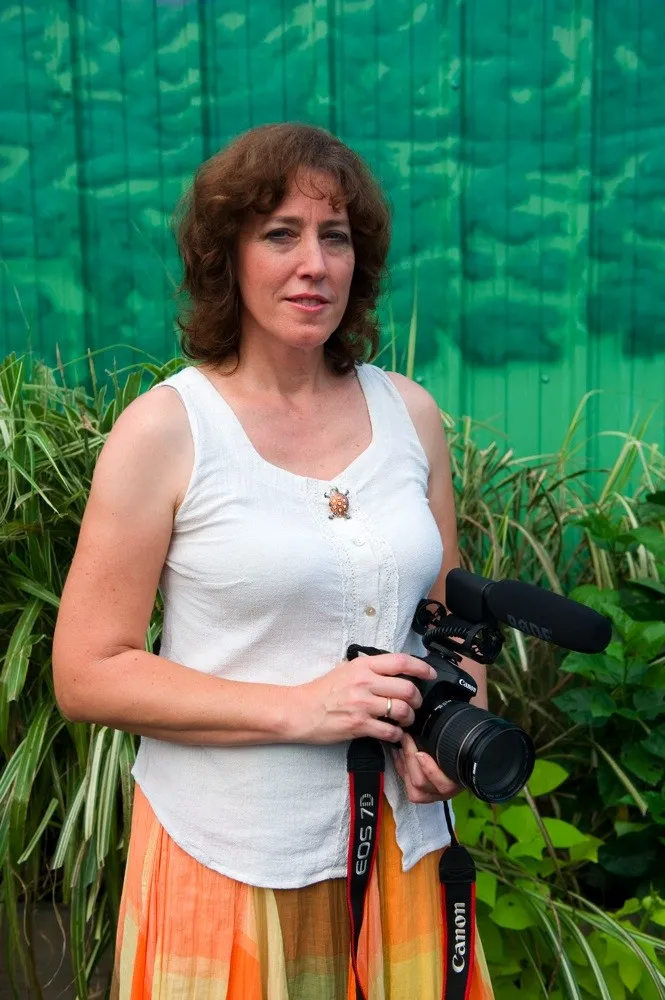
It seems like these days anyone with a camcorder can call themselves a filmmaker. Technology has become so manageable and affordable that a novice can shoot some pretty-looking footage on their camera or phone. But there’s more to films than making them look good. A successful movie requires months of preparation. A director needs good social skills to get along with their crew. The actors have to be believable, and the editing must be tight. Then the whole thing has to be marketed and sold to help pay for the next one.
So calling yourself a filmmaker is one thing. Making a film that will stand the test of time is another. At the moment, James Island resident Gretchen Dzedzej (pronounced “Zedzay”) is working hard to make such a film, and she has all the skills to get it right. She’s a 49-year-old artist, photographer, videographer, and business owner who excels at motivating others to help her complete her projects — unless she’s dealing with her own flesh and blood.
Her first film, the 8-minute Lucky Strikes, was shot last October for the National Film Challenge. Entrants had three days to write, film, and edit a short. Fortunately Dzedzej and her friend Trisha Wallis had a good idea. Unfortunately, they didn’t know any professional actors who could work with them on such short notice.
“The bad thing is, I cast my son,” says Dzedzej. He got the lead of unemployed young man Mark Shapiro, who receives a box of matches. When he strikes a match he gets a wish — and wishes he hadn’t.
The fledgling filmmaker learned a valuable lesson. “A mother should never direct her son in a movie. Michael didn’t feel like acting, and by the end he was ready to kill one of us.”
Nevertheless, Dzedzej was still excited when the film was screened at the Terrace with other entrants. She’d made a movie while other competitors had thrown in the towel or run out of time. However, as the lights went down and Lucky Strikes began, she shrank back in her seat, mortified. “It’s a crappy movie, so I was embarrassed to show it. But the other actors were good, and I was encouraged because people liked it. They thought my son was funny, and it was a great little story.”
Dzedzej knew that if she could entertain an audience with a hastily shot short, then she could make a much bigger impact with a carefully developed project. This year she’s been working on her first feature film, with experienced actors this time, called My Doggone Destiny. She can explain the simple concept — a day when everything seems to go wrong — to a stranger, and they’ll instantly relate. Consequently, the writer/director is learning which ideas click with her potential audience.
When she’s not filming commercials and wedding videos to build up her reel, Dzedzej runs Renaissance Painting, a company that specializes in faux painting and murals. She’s also president of the Southeastern Filmmakers Charleston chapter, meeting every month to network and train with fellow filmies.
“I used to tell artists that the way you feel about art is how you look at life,” Dzedzej says. She’s begun to look at life as a videographer, noticing filmable scenes and images on the street. The difference between her and her peers is that she makes the extra effort to grab her camera and film those scenes. She’s just now beginning to call herself a filmmaker. “If I don’t,” she says, “I’ll never become one.”
With a growing crew, an increasing collection of equipment, and infectious enthusiasm, it looks like Dzedzej is becoming one already.
Attorney Mark Mixson branches out
by Nick Smith August 25, 2010
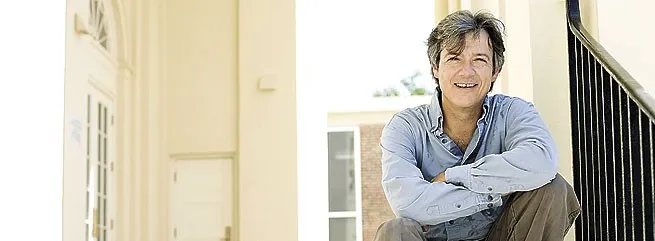
“Theater should be amazing,” says local stage actor and director Mark Mixson. “I like breathing life into something in a new way, to astonish, surprise, shock the audience.” Mixson genuinely cares about theater. He’s been involved for more than three decades, both here and in New York. So why isn’t his name familiar to everyone in the theatrical community?
The busy trial attorney doesn’t volunteer for any old project. He carefully chooses each play he gets involved with, making sure he’s perfect for a part or that he can do something unexpected as a director. That means he’ll work on two or three plays a year at the most.
When Mixson does get involved in local theater, he’s guaranteed to make an impression. You may remember him as the complex, sympathetic villain Salieri in the Footlight Players’ Amadeus or as the conniving movie producer Bobby Gould in David Mamet’s Speed-the-Plow at the Village Playhouse. As a director, he re-energized that old chestnut The Miracle Worker and purposefully unsettled this year’s Piccolo audiences with Discretion.
“The playwright [Terry Roueche] wanted people to be disturbed,” says Mixson. “Discretion worked for me when I felt it was properly making people uncomfortable. It was supposed to be profoundly disturbing at some level.” The story of marital trust and betrayal stood out in a sea of crowd-pleasers during the festival. It was an extreme example of Mixson’s desire to “take a play and make the audience see it in a different way.”
When he signs on for a show, Mixson blocks out a good deal of time and throws himself into it “with the hope that it’ll be great.” That greatness can come from unexpected places. The director saw The Miracle Worker as a judicious challenge and opportunity because the audience was complacent about the material.
“It was a large play, somewhat complex in its ideas, but everyone thought they knew it.” Although that made it easier for him to exceed expectations, Mixson got incredible performances from his cast and re-established himself as an auteur in a city with limited opportunities for directors.
“Charleston could be the place to do the things I want to do,” he says, “but I don’t know if it will support epic theater except during Spoleto. I don’t know if there’s a strong theater community here … not even a nascent one.”
After a successful stint running The Romanceworks company in the ’80s, Mixson moved to New York to make his way as a city defense attorney and senior counsel. He was able to fuel his passion for theater, soaking up Broadway shows and establishing an edgy company called Threshold. As his four children grew up, it became more financially shrewd for him to move back to S.C. and set up his own Mixson Law Firm in Hollywood, S.C. and Myrtle Beach. When he’s not being “very theatrical” in court, he’s having weekly meetings about the creation of a new theater company with significant funding here. All he needs is the right venue to stage his productions.
“I’m lusting after the Memminger Auditorium,” he says. “It’s dark. No one’s using it. I could put six plays on easily that would blow people’s minds, using regular people from the Footlights, PURE, and places like that. The shows wouldn’t be expensive, but they’d be awe-inspiring. Jaw-dropping.”
Wherever Mixson’s oeuvre ends up, it deserves to be seen and appreciated. This is a man who gives a damn about local theater, and it shows in everything he does.
Liz Vaughan finds a niche in time-based media
by Nick Smith August 25, 2010

Liz Vaughan likes to experiment. “I’m in a phase of learning a lot of new processes,” she says. She’s been developing her stop-motion animation skills for the past two years; a recent example, “Chimney Swifts,” was shown in Redux’s spring exhibition 1 x 1. This film is only a few seconds long, but it reflects some of Vaughan’s alternative video and photography techniques — a simple subject with a strong sense of movement and a hint of nostalgia.
Vaughan’s photographs are mostly landscapes and still lifes. “People feel connected to my Southern landscape subjects,” says the artist. “They feel that because my work is interactive, it tells a loose story, and I’ve recently been using really neutral tones that give it an atmospheric quality.” As far as her stop motion is concerned, viewers respond to her playful, low-fi approach. “It’s not super high-tech,” she says. “Some people have said it’s poetic, although I wouldn’t use that description. I’d call it gritty.”
In Vaughan’s animated world, loose screws and jewelry are buried in flowers and delicate fauna, plant life sprouts from the palm of a hand, and a box sprouts wings, snatching thoughts from the sky before flying too close to the sun and plummeting back to a drawing board. By exploring the relationship between art and nature with the technical medium of animation, Vaughan makes films that look fresh and colorful.
“I’m attracted to a certain kind of aesthetic,” Vaughan explains, “the way I think and move and feel about things.” She can trace this back to an early interest in sculpture. While studying at the College of Charleston, she took a sculpture class with Jarod Charzewski and he boosted her confidence level. “He and my other professors had a huge influence on my education,” she says. With Charzewski’s encouragement, she developed her sculptural and stop-motion skills. But her animated art always fed off her first love, photography.
“As soon as I took my first photography class I knew that was my real passion,” she recalls. The passion had been building for a long time, though. “I blame it on my dad. I remember when I lived out in the middle of nowhere in Georgia, he and I would ride around in his truck and photograph old buildings and trees.” This is still how Vaughan interacts with her environment and chooses to express herself. “If you take the camera out of my hands and replace it with a tube of paint, I would be totally disoriented.”
In 2008, a year before she graduated with a degree in studio art, Vaughan started co-directing Blume, a series of multimedia art fundraisers at Pantheon. She also helped set up Outer Space in 2009, a venue that helped artists and musicians connect with the local community.
She’s presently hard at work co-planning the Receiver Time Based Media Festival. This event will incorporate animation, performance art, and Mac-based media. “There are galleries in San Francisco that are all time-based media. New York, too,” Vaughan says. “It’s important to stand your ground in the Southeast where stuff like this isn’t so prevalent.”
To help pay the bills, the photographer is working on temporary projects, like recording artifacts at the Avery Research Center and helping to build a Lowcountry Digital Library of regionally important documents. She’s grateful for the skilled work, but she doggedly continues to produce her multimedia art too.
Vaughan thinks that painting and printmaking would be a cop-out for her. “People respond more to object-based representational stuff, but it doesn’t scare me that my artwork is less sellable. When I feel more neglected, I only see it as something I feel more passionate about. I’m going to be that much more stubborn and stand behind my more contemporary work.”
Multitalented Brit lands on Charleston’s shores
by Nick Smith August 25, 2010
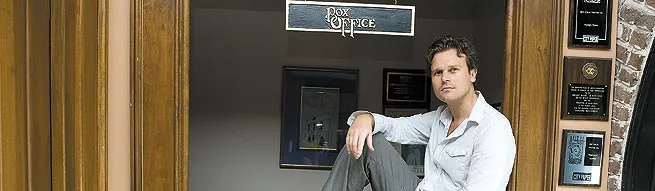
As the Titanic sinks to an icy grave, Rose Dewitt Bukater holds on to Jack Dawson for dear life. Jack is making the noblest of sacrifices, helping Rose to stay afloat while he dies of hypothermia. And it’s all happening in a bathtub.
This is the emotional climax of Titanic by Blind Faith Films, which won the Done in 60 Seconds competition organized by Empire movie magazine in 2008. It crams all the best elements of the film into one minute — with an old lady storyteller, a nude sketch, the “king of the world” line, and a wrecked ocean liner included.
The two men behind Blind Faith, Craig Trow and Nick Jesper, were amazed and annoyed by their sudden success. After spending years trying to get recognition as actors and filmmakers, this silly project garnered more than everything else combined. They also found that their next hit wasn’t as easy to pull off.
While they try to sell a number of TV pilots and short comedy scripts, the duo has a new problem to deal with: they’re 4,000 miles apart. But Trow sees his recent move from England to Charleston as an opportunity, not a hitch. At 29, the quick-witted Brit looks like a surfer dude but sounds like Hugh Grant. His wife April, who has family in the area, is an ophthalmic technician.
Since arriving six months ago, Trow has already gained employment as a model and actor. It’s no wonder he found work so quickly — he’s a drama school graduate and was a working actor in London for two years; Sean Connery’s agent even represented him for a time. He performed at the Globe Theatre and appeared on British TV. But the grinding, dehumanizing audition process left him feeling disillusioned with the industry. He’s more comfortable with his first love, comedy. He continues to develop scripts and projects with his Blind Faith friend.
“I spent two hours on the phone with him today,” says Trow. “You can do a lot more stuff over the internet these days.” He is able to watch rough cuts of his film projects as Jesper hones them. Otherwise he’s writing more scripts, including a 30-minute pilot called World Savers for the U.K. TV market. It’s another example of the goofy humor he displayed in his Titanic quickie.
“I love silly humor,” he says, citing Police Squad starring Leslie Nielson as an example of TV comedy that has survived the test of time. “It’s very visual, with silly gags rooted in some sort of reality.” That visual element is particularly important to a foreigner like Trow. “Soccer has been described as a universal language,” he says. “Laughter is of the same essence. In a Charlie Chaplin film there’s no language, but it works any place in the world.”
In Charleston, the center of the comedy world is Theatre 99. Trow has been taking improv classes with Greg Tavares, a founding member of The Have Nots! It’s the accepted way for comedians to introduce themselves to local audiences.
Trow is always hasty to express his gratitude for the opportunity to work in the States, thanks to his wife April. Everything changed for Trow when he met her. “I’d always been a Lone Ranger,” he says, “focused heavily on acting and performance. I went at life headstrong. Then I met somebody I was willing to share my life with, and I realized there was something else out there.” He sees his move as an opportunity, not a sacrifice, a chance to “adapt and do things I’m proud to do.”
Unfortunately, opportunities are few and far between for professional actors in Charleston. Trow knows that he may have to move to New York or Chicago to get more work. “America is a big country,” he says. “April’s willing to go wherever I need to go.”
So catch this promising young performer while you can — he’s acting in the Footlight Players’ Is He Dead?, which opens Aug. 27. He’ll tickle your funny bone, whatever language you speak.
Theatre Review: High drama in Osage County
by Nick Smith August 23, 2010

August: Osage County is a family drama set in a house where the shades are always drawn, the AC’s off, and the air is still. For years, poet/educator Beverly Weston and his wife Violet have stagnated, making no progress, retreating into states of delusion and bitterness.
The setting is a complete contrast to the Village Playhouse, launching its tenth season with this indelibly entertaining play. The Playhouse has been unwilling to stagnate. Married founders David Reinwald and Keely Enright have discovered their own way to escape from reality, putting on musicals, magical realist fables, and TV and film adaptations along with the classics. Unlike the Westons, they understand that surviving isn’t enough; progression is just as important.
Their version of Osage County never stands still. It’s full of smart dialogue, vivid characters, deep themes, and potent drama. But there’s more to this production than its Tony and Pulitzer-winning text. Lesser companies would have settled for the play’s reputation to fill seats. Enright and Reinwald go the extra mile, with strong casting and an ambitious set. As one local director recently put it, they slave over their productions. Nowhere has this been more evident than in this production, which has been in the works for six months.
O.C. isn’t so much complex as heavily populated. When Beverly goes missing, a deluge of family members rush to Violet’s side. There’s Ivy (played by Angela White), the daughter who’s stuck close to home and resents her absentee sisters, especially Barbara (Cristy Landis). Barbara has a tough exterior but struggles to cope with her husband Bill’s (David Reinwald) infidelity. Karen (Tracy Abeles), is so excited about her fiancé Steve (Robin Burke) that she’s out of sync with her sisters. Johnna the housekeeper (Sierra Garland) bustles in the background, a constant reminder of Violet’s precarious health.
Violet (Samille Basler) spends most of the play verbally dissecting her daughters, picking at their faults and being honest in truly brutal ways. She chases down an endless supply of pills with short drags on her long cigarettes, a matriarch with mouth cancer dispensing acid justice to anyone who breaks her arcane house rules. She is by turns playful as a child, wicked as a witch, and, first thing in the morning, as weird and incoherent as a David Lynch dwarf.
Basler seizes her opportunity to play this mercurial character. She is utterly riveting and believable. Landis is equally strong as Barbara, taking responsibility for the emotional chaos unfolding around her. The Westons have plenty of flaws for Violet to target: the males are dopey or unfaithful, Ivy is in love with a close relative, Barbara’s daughter Jean (Katherine Chaney Long) smokes dope, and Violet’s sister Mattie Fae (Mary Cimino) constantly knocks her son Little Charles (Josh Wilhoit). Because there are so many characters, the audience is kept on its toes as to who will get skewered or which revelation will be dealt with next.
Director Enright juggles all the subplots perfectly, and on the whole her casting choices are spot-on too. As in her previous play Dead Man’s Cellphone, Angela White flips a mousy character into a strong, well-rounded one. As the menfolk, Reinwald, Wilhoit, Nat Jones, Robin Burke, Tom Sterns, and Jeff Jordan all give their characters a solid authenticity in a handful of scenes. Chaney Long and Sierra Garland have shown greater range in past performances; here it’s as if Enright has told them to stay low-key. Only Cimino seems out of place, lacking the plausibility of her castmates.
Basler’s intense acting makes up for any shortcomings the show may have. Flaws and all, this is one of the best productions we’ve seen this year.
Steve Rosenberg and friends dip into their trove of early music instruments
by Nick Smith June 6, 2012
Rate this professor: He’s a feted recording artist, world-touring musician, recipient of France’s coveted Grande Prix de Disque, and chair of the music department at the College of Charleston. He’s the early music world’s equivalent of a rock star, and since he plays centuries-old melodies, his instrument of choice isn’t an electric guitar. Instead, it’s a favorite of schoolchildren everywhere. He’s Steve Rosenberg, known to medieval and Renaissance music fans as the “Pied Piper of the recorder world.”
For his June 10 Early Music performance, Rosenberg will be playing multiple instruments as part of the Brio quartet. Although the Spanish tunes on the playlist date back as far as the 1400s, Rosenberg insists that the show will be “a very accessible, varied, beautiful concert.”
Brio is a lively foursome of first-rate musicians: Rosenberg, percussionist Danny Mallon, string player Mary Anne Ballard, and vocalist José Lemos. Since getting together in 2002, they’ve toured extensively and made two CDs with Dorian Recordings called Romance and Sol y Luna. The group will gauge the reaction of the crowd as they select percussive and instrumental dances from their repertoire. “There’s so much in our CDs,” Rosenberg says. “We have many different programs. I’m looking forward to jamming into a whole big selection.”
Brio focuses on the secular music of the Sephardim, Jews of Medieval Spain. Over three centuries of core dances, romances, and rhythms from surrounding countries are incorporated into the mix. If there are any religious touches, they’re just in passing. “I don’t know who wrote them,” Rosenberg says. “Some were sung by historic communities. It’s hard to date them.”
Audiences will recognize some musical hints from operas and urban Arabic beats. “The Spanish sound reminds people of the origins of flamenco, and it’s influenced by a Middle East flavor,” Rosenberg says. “People who have no clue about its origins still find it wonderful.” That’s probably because Brio gives a tight, organic performance that the professor describes as “playing with friends.”
CofC alum Jose Lemos is a star in his own right. Originally from Brazil and Uruguay, he’s a counter-tenor opera singer who’ll be in Nice, France, the day before the concert, performing a Handel solo. He will fly in, rehearse with Brio, and, as Rosenberg puts it, “have a good time.”
Mary Anne Ballard plays viola da gamba and rebec (a bowed string instrument) with Brio. She’s an important figure in early revival circles, an arranger of early music and part of the Baltimore Consort, which Rosenberg guests with. They’ve known each other and worked together for more than two decades.
Danny Mallon bangs a mean caxixi, a percussion instrument that’s essentially a basket filled with seeds. He also plays a variety of percussion instruments, including the doumbek, darbuka, bodhran, riq, agogo bells, jingle bells, finger cymbals, shaker, and woodblock. The versatile musician’s in demand all over country, but he’s best known to Spoleto audiences for his “Drums through the Ages” shows. He’s also played with the College of Charleston Concert Choir and Madrigal Singers.
Despite the bewildering array of early instruments, Brio appeals to modern audiences thanks to a natural rhythmic sound — and they avoid the dry, stoic performance style of Dark Age lore. They won’t sell out and go electro either. “You can hear people play electric music and take many different approaches,” says Rosenberg, who also plays renaissance guitars. “We’ve heard people try to be Arabic. We know the idiom pretty well, but we don’t want to replicate the original sounds exactly. We have one foot in classical, one in folk. We make it what we can without putting artificiality into it, and it feels great.”
Chicago group keeps their comedy painfully honest
by Nick Smith May 30, 2012
The families that work together succeed together: the Von Trapps. The Kennedys. The Mansons. The same could be said about Chicago’s Elams, but they don’t focus on music, politics, or murder — improv comedy is their thing. The family — the three Elam siblings Erica, Brett, and Scott, plus Brett’s fiancée Jet Eveleth and Scott’s fiancée Lisa Burton — have taken the Chicago comedy world by storm, honoring the mirthful memory of Del Close at the iO Theater. “Our family’s close,” says Erica Elam, “but we don’t talk about things very much. We tell stories on stage we might never say to dad or mom, because it’s a different kind of bravery to tell one-on-one than it is in front of audience.” That’s the charm of Dinner with the Elams — they’ll do traditional improv sketches, but there’s added intimacy since they’re all related or engaged. “The best improv groups have a real sense of trust and support,” Erica says. “But we don’t just have a couple of years of history. There are decades of it between us.”
When the Elams take a suggestion from the audience to use in a sketch, it often inspires a true-life story. “It’s not unique, but the audience feels like they’re being let into our lives,” Erica explains. “There are built-in laughs because of our relationship.” And since the crowd is in on the joke, they share the performers’ reactions when surprises are revealed on stage. “In our first show,” Brett says, “we each had to share the story of how we lost our virginity.” The results were uncomfortable and hilariously funny. “We were honest about how we felt and what was going through our heads at the time. There was a real awkwardness when the fiancées had to stand up.” Erica didn’t know how her brothers lost their V-cards either, and they say her response was priceless.
While creating comic situations, the Elams bond with each other, too, and there are great moments to witness on stage. “Scott was embarrassed telling the story about when he crapped his pants,” Brett giggles. “And then Lisa looked Scott in eye and said, ‘I shit my pants too.’” You can’t get any more romantic than that.
Not all of the Elams’ anecdotes are frivolous. Youngest brother Scott had a severe speech impediment as a child. Most of the family couldn’t understand him, and in his first few years of school, he couldn’t communicate with his teachers. “It became a theme of one of our shows,” Erica says. “As we were exploring ideas we gradually realized how far our baby brother had come. Scott makes his living talking articulately with people. He speaks quickly and he’s a great improviser after struggling so much. It was a moving, beautiful show.”
Jet Eveleth is well known to local audiences as a member of The Reckoning, and her positive experiences with Theatre 99 led to the Elams’ current visit. “She’s naturally a great actor, and one of the best improvisers in Chicago,.” Erica gushes. But there’s another, more pressing reason for them to traipse to South Carolina: Their 15th annual holiday on Pawleys Island. “We go out on the beach and play improv games all day,” Brett says. As their Charleston gig ties in with their latest vacation, their parents and other family members from Nashville will be in the audience seeing them on stage for the first time. They might be in for a shock. Most importantly for the Elams, as Brett puts it, “they’ll hear some truthful stories.”

Wanderlust performer takes a faithless trip to the land of the faithful
by Nick Smith May 30, 2012
The city of Bethlehem is a stone-clad nexus of religion, attracting travelers from all over the world who seek salvation. The Holy Land Experience is an 11-year-old Orlando amusement park dedicated to the Passion of Christ, with actors dressed as biblical denizens, centurions, and apostles. At the end of every day, Jesus is crucified, complete with blood, special effects, and a stirring music score.
“It’s a full-on production,” says writer-performer Martin Dockery, who visited the park as research for his new one-man show, Holy Land Experience. “Going through it was my entire preparation. I got a sense of the real Bethlehem through this American facsimile.”
Dockery, who presented Wanderlust and The Bike Trip at previous Piccolo Fringes, was inspired to create his newest show by a Christmas carol, “O Come All Ye Faithful.” “I thought, wow, what if this song has been misinterpreted? What if it was really a tourist ad designed to draw people to Bethlehem?” he says. He vowed to himself that by the time next Christmas rolled around, he would go to Bethlehem just like the joyful and triumphant subjects of the song. But he wouldn’t describe himself as faithful.
“I’m not religious at all, although I was raised Catholic,” Dockery says. “Even if you don’t believe, it’s exciting to see what Bethlehem looks like.” He took his trip with no preconceived notions. “All I was aware of was how ignorant I am of everything going on there. My sense of the world comes from The New York Times. My whole sense of Bethlehem has come secondhand from people who have other agendas or don’t know anything more than me.”
Not surprisingly, Dockery met many pilgrims in the Holy Land. “They were from so many different kinds of religions, sects of Judaism and Christianity, all eager to talk about their faith. Everyone had some viewpoint.” Although religion is one of Dockery’s least favorite topics — he doesn’t have much patience for it — he was unable to escape it on his travels, and he even gained insight into the people he encountered, “what they were seeking and how they tried to reconcile whatever was disturbing them.”
Dockery’s personal experiences made his trip more relevant. He’d just had a terrible breakup with a girlfriend who he’d cheated on, and he was still dealing with the guilt of what he’d done to her. “How do you forgive yourself and beg forgiveness of others?” he asks. “I was reconciling the pain I’d caused this girl I love. And how could I create a relationship with the new girl and be honest with her?”
Despite the weighty themes of the show, there are just as many laughs in Holy Land as in Dockery’s past productions. It’s funny without mocking any of the pilgrims. The humor comes from a mixture of the events Dockery witnessed, the way believers were naturally at odds with each other, and his own neuroses. With no sets or music cues, he relies on his wits to keep the audience entertained. His mix of honest soul-searching, observational comedy, and gripping storytelling make his shows an epic experience. The young performer may not have found religion, but he’s gained devout followers nationwide.
Arts+Movies, Features
This was the year of cautious optimism for Spoleto
by Nick Smith June 16, 2010
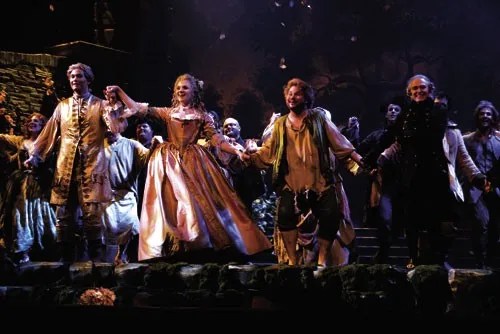
2010 will be remembered as the year when Spoleto played it safe, if it’s remembered at all. It had its milestones in the newly spruced-up Dock Street Theatre, and Geoff Nuttall proved himself worthy of his director for chamber music title after Charles Wadsworth passed him the baton last year. But there was nothing controversial, outrageous, or even risky — and those things should be part of every major arts festival’s remit. Without pushing the envelope, no one’s going to be curious about what’s inside.
We don’t blame General Director Nigel Redden for taking the safe route. Millions of dollars are at stake each year. Eighteen million dollars was spent on renovating the Dock Street, so there was no room for error there. And the city’s reputation as an arts destination is also at stake, with millions more in tourism dollars riding on that rep. Nevertheless, we don’t want to see Spoleto turn into a predictable grocery list of operas, one-man plays, and puppet shows.
Music and dance dominated this year’s program. Classical music was the backbone of the festival, with 11 Chamber Music concerts, a superlative orchestra, and a guaranteed level of excellence from the Westminster Choir. Dance was well represented, with Giselle, I Can See Myself in Your Pupil, Les Ballets Trockadero de Monte Carlo, Oyster, and Lucinda Childs’ Dance all celebrating the form in different ways. Other kinds of high art got shorter shrift, but audiences didn’t seem to mind. Although Spoleto’s budget was slightly higher than last year (up from $6.2 to $6.3 million), there was an unspoken understanding among audiences that times are hard — 2008 was expensive thanks to big productions like Monkey, and the organizers had to cut back a little. The question is, where does financial responsibility end and the festival’s mission to challenge audiences begin?
The quality of each production was strong enough to keep arts fans happy. Flora, the main operatic offering, had appealing characters, elements of familiar music, and a large-scale set. Giselle was a solid example of traditional ballet. Present Laughter, the Noël Coward play performed by Dublin’s Gate Theatre, hit all the right farcical notes. They were the kind of shows that tour groups could be wheeled into for a satisfying experience. The kind you could bring your granny to without fearing that one singer would fellate a dwarf (as in 2005’s Mabou Mines DollHouse) or batter her ears with weird cadences (2007’s Faustus). There should be all-ages events in the festival, but all of the shows we saw were G-rated apart from This Is What Happens Next and Die Roten Punkte. If Spoleto is, as founder Gian Carlo Menotti intended, supposed to touch everyone, doesn’t that include people who want their minds broadened?
Visual arts are an understandably low priority for Spoleto. No one plunked down $40 to see JoAnn Verburg’s photography or Nick Cave’s Soundsuits. But art doesn’t exist just to make money. Menotti wanted his festival to immerse the entire community; Spoleto’s collaborations with the Gibbes Museum and the Halsey Institute offered access to people who couldn’t afford the high-dollar shows. Previous visitors still talk about installations like Places with a Pastand Evoking History, but these kinds of exhibitions have been variable and irregular. We would like to see some consistency from year to year so that visitors know a Spoleto event will take place at the same locations in 2011.
In other papers, visual arts didn’t get any play, but opera and music did. The New York Times covered Maestro Emmanuel Villaume’s resignation and the Dock Street reopening, and, rather arbitrarily, reviewed Philemon & Baucis. This has less to do with any increased status for the festival and more to do with the NYT‘s stabilized finances (they couldn’t afford to send any reporters here in 2009).
The Wall Street Journal reviewed three operas — Flora, Proserpina, and Philemon. Reviewer Hailey Wilson marveled at Heather Buck’s voice, found Flora “jolly,” and reckoned the Colla marionettes looked old-fashioned (they’re supposed to!). MSNBC.com blogged a frothy interview with the Ebony Hillbillies. Charlotte’s Creative Loafing critic Perry Tannenbaum found the Dock Street “comfy,” but said that some of the Present Laughter performers were hard to hear. Columbia’s alt-weekly Free Times gave the most accurate coverage — Flora was a “delightful trifle,” Lucinda Childs’ Dance felt like “a museum piece,” and Die Roten Punkte was “a poor man’s Hedwig and the Angry Inch.”
From an outsider’s point of view, the events cemented Charleston’s reputation as a staid historic destination, just as the organizers intended. Nostalgia’s a great draw when times are tough and the future’s uncertain. Back home, The Post and Courier perpetuated the trend of tagging Charleston as a tame, retro place to go. The daily newspaper approached the whole festival from a positive angle, finding most shows rather splendid. Judging by its coverage, this wasn’t the city to visit if you wanted your aesthetic sensibilities challenged.
If the programming didn’t take special mental effort, getting from venue to venue took the physical kind. Whether traveling by foot or car, locations peppered across the city meant that it was impossible to see every show. Since we’re known as the Holy City, the use of many different churches was suitable and necessary. Some of the venues were too far apart to facilitate travel between them all. We’d like to see more consideration of this matter in future festivals, as well as greater cooperation between Spoleto and Piccolo. A schedule from Piccolo earlier in the year would help with that.
Members of the Spoleto Festival USA Orchestra played enchanting music at St. Matthew’s Lutheran Church. Some concertgoers refused to attend, however, because they disliked the venue. “I can’t see anything,” complained one Spoleto regular. The Intermezzi were stirring and popular enough to warrant performances in other, secular venues.
The College of Charleston’s Sottile Theatre has been underutilized in recent years, so it was good to see it being used in 2010. In a recent interview, Redden said that his team was talking to CofC about improving the Sottile. That would be great, but the venue has proved itself capable of hosting big productions like Faustus and Monkey without any overhaul. If the college has been holding out for support from Redden, or either party is still miffed by Monkey‘s budget, they need to put audiences first and open the Sottile’s doors to more shows in 2011.
Spoletians weren’t always guaranteed good sound. Several concerts were marred by unbalanced mixes, high volume, or failing equipment. A couple of Wachovia Jazz events were particularly plagued by technical difficulties; even when Fabiana Cozza had her microphone fixed, some of her backing band’s instruments were louder than others. Most of these problems were unexpected and beyond the technicians’ control, but others could have been anticipated. Piccolo also had its share of problems, from crackling head mics in Mahalia: A Gospel Musical to a mid-scene blackout in Discretion. This wasn’t just at the beginning of the festival, either; the blackout happened near the end of Discretion‘s run. No matter how good the performers were, the clumsy technical errors gave visitors a bad impression of Charleston’s theater scene. More attention needs to be paid to this side of production if the festivals (particularly Piccolo) want to continue to be taken seriously.
Apart from tighter tech, the festivals need to check their mission statements before they gear up again. Menotti wanted the art of Spoleto USA to feel like the main course of a meal, not an after-dinner mint or a thin soup. To really satisfy our appetites, it needs consistency and spice. He wanted the festival to be an artistic celebration that would be unavoidable for the citizens of Charleston. Instead, we have tickets for a ballad opera ranging from a highly avoidable $100-$150 and a $30 finale on a West Ashley plantation. A premier performing arts festival also needs high-risk events to make it thrive and grow. Otherwise it will stagnate and be discounted as a snug bauble, a delightful trifle. Spoleto should have some surprises along with the comfortable familiarity of returning companies.
That isn’t to denigrate the hard work of everyone involved in this year’s festival, from Redden and his chums to the attendants at Middleton Place, who spent a week preparing for the finale and 12 hours making sure 3,000 people got in and out of the place without a scratch. Whether 2010’s programming is remembered or not, the staff and volunteers’ commitment to the arts should make an indelible impression on the city.
Funnily enough, the most controversial aspect of the festival wasn’t a show at all. It was the ugly, unimaginative poster by Maya Lin, which toyed with a road map of South Carolina. But if its aim was to get people talking, it certainly did that — weeks after its debut, people were still complaining about it. The debate didn’t hurt ticket sales, and it gave the press something to scribble about. Bless their hearts, some people liked it. It was the only time this year that Redden’s team trusted an artist to do something unorthodox and supported it until some people grew to love it. All they need to do is apply that sensibility to other aspects of the festival, as they have done in the past.
Spoleto 2010 Superlatives
by Nick Smith June 15, 2010
The sets have been struck, the dancers have flown home, the fireworks have fizzled. Spoleto’s done for another year. In the spirit of previous years’ “Most Boinkable Artist” awards, here are some categories to mark 2010’s hits and misses. No prizes are involved, but the performers below deserve all the bouquets and brickbats they get.
Cleverest Wordplay: Present Laughter
Noel Coward’s drawing room comedy was a success when it premiered in 1942. The Gate Theatre proved its staying power with their Spoleto version, which spanned the entire festival. Its lynchpin was Stephen Brennan’s performance as Garry Essendine, which was far subtler and more effective than Victor Garber’s portrayal in a recent Broadway revival. But even if Brennan hadn’t been so good, the dialogue would still have sparkled like fine champagne.
Runner up: Jack Tracey at the Sundown Poetry Series
On June 9, Isle of Palms poet Tracey read some self-penned work in the mobbed Dock Street Theatre Courtyard, regular venue for the Poetry Society’s Sundown readings. He respectfully asked that listeners did not applaud between poems. 40 minutes flew by with a cascade of witty, often snappy verses about maturity, relationships, and living in Charleston. This was clearly a man who loved to write, and one who deserves a large following.
Best Mascot: The dog in Flora
Considering that Flora, An Opera had so many comedic elements, it’s rather sad that the production’s biggest laugh came when the villainous Sir Thomas Testy took his dog for a mid-show walk. The fake canine was pulled across the stage like a small child’s toy, garnering a huge reaction.
Runner up: David Lee Nelson
We didn’t plan it this way, but the City Paper seemed to adopted CofC alumnus Nelson as its unofficial mascot — at least judging by the number of times he was name-dropped. The comedian even appeared on the cover of our final Spoleto issue. There was something about his Facebook-checking, soul baring show Status Update that captured the zeitgeist and made us want to give the recent divorcee a big hug.
Most adaptable space: Memminger Auditorium
Whether it was used for modern dance, a one-man play, or a freaky carnival, the Memminger delivered. From day to day it was transformed into a dance space flanked with lights (I Can See You in my Pupil), a sideshow with a man-sized catflap (Oyster) or a gig pit fit for a rock band (Die Roten Punkte). Hats off to the auditorium staff who made the changes so smoothly.
Best way to pass time between big shows: Intermezzi
I know that the Spoleto Festival USA Orchestra is chock full of virtuosi and can be relied upon to deliver the classical goods in any concert. But I wasn’t expecting the intimate Intermezzi series to be so engaging, like a zesty blast of music to wake people from the stupor brought on by noon heat and heavy lunches. On June 4, Andriana Chuchman and Tyler Duncan from Flora performed snippets of operas like Le Nozze di Figaro, The Pearl Fishers, and The Barber of Seville, engaging the audience with their playful acting and powerful singing. June 7 featured solos and duets that made contemporary classical concerts accessible to even the dowdiest of attendees.
Best place for stalking the stars: King Street
It was a joy to see performers walking down King and window shopping as if they were nothing special. Caroline Fermin (Gallim Dance) was as cute in real life as she was on stage, and two Ballet Trockadero dancers were also spotted, out of their tutus and in everyday clothes (even if they wore daisy dukes).
Runners up: Vickery’s Bar & Grill, Kudu
In Vickery’s, Otto and Astrid Rot mingled with their fans after their first Roten Punkte show. In the Kudu coffee house, solo performers David Lee Nelson and Patrick Combs (Man 1, Bank 0) compared notes and beverages.
Artifacts, Arts+Movies
Cotto thief strikes again
by Nick Smith June 14, 2010

Julio Cotto is a local artist who finds himself on the Blotter page almost as much as the arts section. He’s had artwork stolen from four different locations, most recently the City Gallery at Waterfront Park.
The artist contributed a series of paintings to this year’s Contemporary Charleston exhibition featuring women in animal headdresses. An accompanying sketch was stolen from the gallery early last week.
He describes it as a black, white, red, and gold portrait on a “regular size” piece of paper. The subject is wearing a koi fish headdress. Cotto does not have a copy of the sketch, only a partial tracing of the headgear.
Cotto says that all remaining sketches will now be displayed under plexiglass, but that doesn’t make him feel any less angry about the theft. “It makes me not want my stuff shown publicly, just in my studio or gallery. I put my time into it, and use it to make my living. I guess the gallery was counting on the good nature of people not to steal original artwork.”
Beautiful Music, Ugly Sound
by Nick Smith June 11, 2010

It was the perfect evening for a samba. The night was warm with the merest hint of a breeze whistling through the Spanish moss. Lights gave the College of Charleston’s Cistern Yard a colorful luster. Famed Brazilian singer Fabiana Cozza was ready to perform her first ever U.S. concert to a thronging crowd. She swished onstage, opened her mouth… and her mic failed.
The best tech is kind the audience doesn’t even notice. Most Spoleto shows have been smooth-sounding and efficiently lit. A huge amount of work goes on behind the scenes to make sure each concert is appealing to ear as well as the eye. But this year Spoleto has been plagued with uneven sound levels (the Ebony Hillbillies), overloud mixes that led some audience members to put their fingers in their ears (Lizz Wright at the Gaillard) and unintended moments of silence for Cozza.
This isn’t the best way for Michael Grofsorean to celebrate 30 years of directing the Jazz Series. He accepts responsibility for the hitches, but insists that they were due to circumstances beyond his control. “Electronics are wonderful until they don’t work,” he says. Fabiana Cozza’s first Wachovia Jazz concert on Friday June 4th proved his point more than any other show.
When Cozza realized her sound was out, she hurriedly took a handheld microphone. She couldn’t hear herself so she stopped singing again, talking to the audience while the backstage crew tweaked their levels. With the sound equalized and the cable freed up, Cozza was ready to start singing some five minutes after she’d stepped on stage.
The sound snafus arose after Cozza asked to use a wireless microphone, giving her more mobility as she swayed to her catchy music. Her sound was checked for two hours that afternoon without a hiccup. But that night, it fizzled out.
A leaner, meaner Spoleto gets to the point
by Nick Smith June 9, 2010
Downsizing isn’t always a bad thing, even for an arts festival. After losing money in 2008, Spoleto Festival USA is bouncing back with strong attendance levels and good word of mouth. The renovated Dock Street Theatre has been a successful lure, but, in general, the program has contained streamlined shows that forgo breathtaking spectacle and focus on good performance.
Out of the two plays offered by Spoleto, only one is a traditional stage production (Present Laughter). The other is a fast-paced one-man show with a quirky structure and a philosophical theme (This Is What Happens Next).
Other genres look just as undernourished. The only true opera on the program is Proserpina, revolving around a solo singer with a chorus to back her up toward the end. This is a festival on rationing.
These productions take just as much time and effort to put together as a traditional concert. The performers and/or musicians have to rehearse, sets usually have to be built, and the marketing machine has to be cranked into action no matter how big or small the product is. Still, an economy of scale is a factor that effects the whole festival. Whether by coincidence or design, there’s definitely a stripped-back feel this year.
But something interesting has happened as a result of these cutbacks. Instead of discussing cool sets or outlandish costumes, people are talking about the performances. Whether or not they appreciate the modern classical music of Wolfgang Rihm, they zero in on Heather Buck’s touching portrayal of Proserpina. For many, composer/conductor Neely Bruce is as much a star of ballad opera Flora as its flowery decor. And the actors of Laughter‘s Gate Theatre have not been upstaged by their costumes this year.
According to the festival’s General Director Nigel Redden, the budgets for 2009 and ’10 were significantly lower than ’06 and ’07. A gala at the Dock Street helped bring in some much-needed extra funds, and projected revenues and contributed support for this year are higher than 2009. “Ticket sales are … above all historical levels, and contributed income from individuals is strong,” he said in a memo to the Spoleto Festival USA Board of Directors — and that was way back in January. He also notes the challenges of the recession, state budget cuts, and dwindling corporate donations.
Spoleto has had leaner years before — 1993, 1994, and 2000 in particular. After an expensive Chinese opera production, low ticket sales, and a state budget cut of about $250,000 in 2008, the organization tightened its belt and waited for the economy to rebound. It’s still waiting. Right now, Redden and his team are cautious about spending their multimillion-dollar budget. Thankfully, they haven’t been as risk-averse with their programing.
An arts organization has two choices when it needs to boost revenue: stick with popular works that are guaranteed to fill seats or concentrate on the high quality of the performers and hope that patrons will take a chance, appreciate what they see and hear, and tell their friends. While there’s plenty of well-known or well-liked material this year — Mozart, Beethoven, the Gate Theatre, the Colla marionettes — real attention has been paid to quality. The Spoleto Festival Orchestra is better this year than in 2009 — and it was damn good then. The musicians have also been more versatile. I’ve seen Flora singers in Music in Time and Intermezzo concerts, increasing the audience’s appreciation of what they do and how hard they work. Conductor John Kennedy has pulled triple duty on Proserpina, Music in Time, and Intermezzo III. And members of the Westminster Choir have also been used in Flora and Proserpina.
It’s not unusual for the musicians to be used for more than one form of music; they’re not called a festival orchestra for nothing. But the sheer range of what they’re taking on indicates that they’re being stretched. They’re handling the pressure very well, and it’s helping Spoletians to become familiar with the leading players of the year.
Redden’s crew have made up for the lack of theater and opera with plenty of dance. The nostalgia of Flora is all well and good, but for the festival to have a future it needs to look forward, too. Gallim’s I Can See Myself in Your Pupil helped with that. It was a fresh, imaginative take on contemporary movement. The Gallim dancers did not conceal their art; they did not hide in the wings when they changed costumes or prepared for a sequence. They let the audience see their process as they unleashed their emotions. This was much more satisfying than the formal Lucinda Childs’ Dance, where a 1979 film was projected in front of present-day dancers making the same moves. The current work was too prim and repetitive, too reverent of its source material. The ’70s dancers were more fluid and seemed to be enjoying themselves a lot more. Worst of all, the live dancers’ feet were obscured by the bottom of the projector screen. People paid good money to see those feet! It was the only show where the nosebleeders had the best seats in the house.
Lucinda Childs was an example of the organizers selecting famous names (Childs the choreographer and that old Spoleto fave, composer Philip Glass) rather than considering the material fully and realizing its lack of connection with the audience. On the night I saw the show, several people walked out, and by the third act, patrons were talking amongst themselves about the dance or checking messages on their cellphones.
Unusual for a performing arts festival, there’s been no classical ballet yet. Les Ballets Trockadero de Monte Carlo certainly had the chops to do justice to Swan Lake and Paquita, but their comical take on the form doesn’t really count as bona fide ballet. Hopefully, the National Ballet of Georgia’s Giselle will redress that balance, if the dancers can survive until then (the male lead has had to be replaced twice due to injury).
Much of the dance has taken place in the Gaillard, and I’ve already griped about the shallow gradient of the auditorium. Practically every time I’ve gone there, I’ve heard attendees complaining that they can’t see properly because a big bonce is in front of them. The acoustics aren’t great either, meaning that if you really want to get the full impact of a performance, you have to sit near the front. Maybe Mayor Joe Riley heard our collective moans, because this week he announced a $142 million revamp of the building. This ambitious two-year project would kick off in 2012, adding offices, expanding banquet space, and improving the auditorium. The city would pay half of the costs, with the rest of the money coming from private donors.
It’s no coincidence that the announcement was made right in the middle of the festival. The Dock Street Theatre has shown how a renovated arts venue can attract audiences and improve Charleston’s profile, although it’s far too early to tell whether all the time and expense involved in such a project will pay off. The many out-of-towners who pay attention to Spoleto will now be aware that we’re improving the Gaillard, encouraging them to come and check it out in a few years’ time.
But the news is a big deal for locals too. There are roads to be fixed, drains to be improved, schools to be earthquake-proofed. Of course, the Gaillard money comes from a different pot, but the city still has other priorities.
For a long time, members of the local arts community have pushed for a multipurpose arts center that will be a resource for the creative cultural community and attract patrons. But the new Gaillard Center sounds more like a cleaned-up version of the old auditorium than a real response to those requests. By making the announcement during Spoleto, locals will have the memory of some entertaining shows fresh in their heads, and they’ll be more amenable to the decision. Never mind the folly of spending so much money on a building so close to the ocean in a city that’s had its fair share of hurricanes.
Another big announcement was made a few days beforehand. This one came from Emmanuel Villaume, the Christel DeHaan music director for opera and orchestra. With two other jobs and guest conductor gigs filling his calendar, he resigned from his nine-year Charleston post. His last concert as director was performed on June 6, ending with poignant encores of Le Nozze di Figaro and other popular works. After the show, he was in good spirits, probably due to the ecstatic send-off that the audience gave him. Globally recognized as a philharmonic orchestra maestro, Villaume has been a big draw for the festival since his first involvement in 1990. As the festival headhunters track down a replacement, the spruced-up Gaillard venue will be a useful (if expensive) bribe.
Piccolo Spoleto had no such earth-shattering announcements to make. It was too busy picking up the Spoleto Festival’s slack, providing avant-garde theater, a feast of visual arts, daily dance performances by different companies, events for disparate religions and ethnicities, and observational comedy. The offshoot festival, run by the city’s Office of Cultural Affairs, seems more relevant than its big sister this year, with less financial or artistic caution. Some of the Piccolo fare is low-budget, and it’s not all successful. But it does one thing very well that Spoleto can’t or won’t do: it builds relationships between artists, venue owners, and regular folk. It links local performers with ones “from off,” brings big shots to little venues, gives lesser-known local people and places a chance to impress visitors from across the country. This is how the Edinburgh Fringe Festival took off, and the way that Piccolo will succeed in the future is not by banking on headline stars but by supporting the little people.
There are two big productions still to come to Spoleto, Giselle and Oyster by the Israel-based Inbal Pinto & Avshalom Pollak Dance Company. To make the festival a real success, they need to be beautifully executed, cutting-edge, visually interesting performances. That’s a lot of pressure to put on a couple of dance shows. Giselle is more of a traditional ballet that we haven’t seen so far this year; Oyster is heavy on spectacle. Between them they hit the demographics the organizers are after: hardcore high-art lovers and people who need some fun with their floorcraft. Beyond that, the festival will end with another example of rationing: fiddle and banjo music rather than a grand classical offering. The Carolina Chocolate Drops will have to work extra hard to give Spoleto a satisfactory send-off. If they achieve that, the audience should appreciate them just as much as a big by-the-numbers orchestra.
Israeli performers dream while they’re awake
by Nick Smith June 8, 2010

Once upon a time, there was a dancer named Inbal Pinto. She lived in Israel, where she met Avshalom Pollack, a drama student. Together they did what they liked, combining their skills and their far-out dreams, fulfilling a wish to tell stories in different ways. The story they’re bringing to Spoleto is called Oyster, simply because it sounds right. It’s very skillful and completely different from any other show in the festival. This makes them happy.
Despite publicity to the contrary, Oysterhas almost nothing to do with Tim Burton’s poem “The Melancholy Death of Oyster Boy.” In a phone call from Tel Aviv, Pollack told us that he and Pinto had already originated the show when they came across Burton’s book in a London store. The word “oyster” jumped out and it really seemed to fit as a title. “It joined together mysteriously and continuously,” he explains, bemused by the references to Burton that seem to pop up in all of their PR. “It’s okay I guess, we like him. Our production can remind you of his worlds, with the visual kind of stuff and the costumes. But it’s different.”
This show shifts and changes too much to be defined by one short poem. Nevertheless the parallels are clear. As in Burton movies like Pee Wee’s Big Adventure and Edward Scissorhands, Oyster is about being different or flawed and trying to be perfect, having disabilities or restrictions but still trying to achieve great things. It has a dark, absurd style, outrageous set pieces, and costumes and makeup that project childlike innocence twisted out of shape. “If it reminds people [of those films] or they can see the story, that’s fine,” says Pollack. “But we have no master plan or specific plot that the audience will get.”
As far as he and Pinto are concerned, the more ambiguous their show is, the better. That includes the medium of expression as well as the story threads they’re weaving. Is it dance? Quirky contemporary movement? There’s a fine tightrope between universal appeal and ambiguity; Pollack and Pinto seem to be treading it very successfully.
“It’s a show that isn’t really difficult to connect with,” says Pollack. “It addresses a very wide variety of audiences — ones that know dance, theater, the circus — making the right connections between different kinds of people. Some people can find their whole lives in our pieces.”
When they created Oyster, Pinto and Pollack knew they wanted to incorporate a carnival sideshow element. So they watched Tod Browning’s 1932 movie Freakstogether, just to help them understand the subject. “I don’t think it was a specific inspiration,” says Pollack. “Watching the movie was part of the process. The sideshow ideas came from our internal world. I grew up in a family of actors; we both grew up backstage.”
They must have seen some mighty weird stuff, because Oyster‘s full of it: male dancers with no arms, living dolls, froglike ballerinas on leashes, a giant, and a human bell. According to Pollack, the sequence “explores how human beings, performers, are manipulated into doing things.” There’s intrinsic meaning behind the action, even if the plot is fathomless. “The elements are linked together,” says the director. “We have internal logic, a world we create on stage.”
Like dream logic?
“It is like dream logic almost,” Pollack agrees. “The great power of performing arts is that they’re like dreaming. They’re about going into the unknown, watching something that can be strong, surreal, nostalgic, a fantastic experience and an emotional one — it’s to dream while awake.”
That seems to be a big reason why Pinto and Pollack’s work has been popular for more than two decades. Their work is visually stunning escapism that isn’t difficult to connect with on an emotional level. “It’s not fast food for the brain,” Pollack insists. “There’s more in it, more layers. It’s like an onion that you can peel and get more information or metaphors or some kind of magic.” Another reason for their success could be their strange but catchy titles, which include “Shaker” and “Boobies.”
Israeli contemporary arts are enjoying a current resurgence in popularity, a young form in a young country with audiences that continue to grow. That has given Pinto and Pollack more artistic freedom. “We’re not really depending on [box office] or afraid to find the way to bring an audience,” Pollack says. “That enables us to bring new ideas. When an artist says ‘I need to bring this amount of audience,’ it turns into a different show. We concentrate on making our shows the best we can, not what works with an audience.”
However, the artists don’t ignore the concerns of the audiences, their tastes and their political proclivities. “We do what we do,” Pollack says. Not that we avoid politics — we examine the reasons for our lives, our hopes and despairs, maybe create our own politics.”
Ten years ago the performers toured China. In a Q&A, they heard audience members say they felt the show reflected their lives and the way the government controlled their existence. Pollack is careful not to make direct political comments in his work. “We put it inside and cover it with layers and layers of stuff,” he says. “They’re part of the material but not in your face — part of the action of a character, in a set, inside the music, sinking into your ears and heart, inviting you or shaking you into doing something, speaking to you.”
The messages are there for those who look, encapsulated in a tantalizing treatise on the value of freedom. The creators of Oyster are happy living their own fractured fairy tale, bringing their dreams and nightmares to life in Israeli, American, and European theaters. Not everyone will dream on the same wavelength as them, but audiences will be emotionally involved, even if their feelings are of disdain rather than joy. And behind the surprising images lie comments on social politics, artistic freedom, and the power of magic. Dream along with them and you might catch a few pearls of wisdom along the way.
BOOK REVIEWS
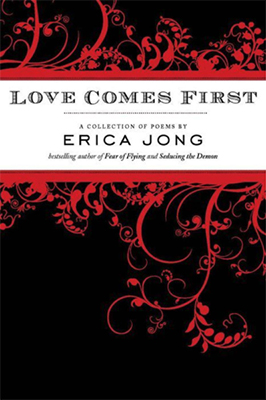
LOVE COMES FIRST. A Collection of Poems by Erica Jong.
Published by Tarcher/Penguin. 98 pages. $24.95.
Sex has been a tried and tested topic for poets since bards began, but Erica Jong caused a particular stir in the ‘70s with her candid approach to erotic material, mischievously using everyday objects as carnal metaphors.
Although poetry has always been her first love, she’s spent recent times writing bestselling novels and non-fiction. So it’s been 18 years since her last poetry book, Becoming Light. That’s a long time to wait for more verse from a writer who excels at the form. Expectations are understandably high for this collection but in this instance, followers of the acclaimed writer’s work will not be disappointed.
Jong has mellowed in the interim years, now taking a more subtle, pensive approach to her subjects. That’s not to say that her poems are dull; her thoughts are put across in a compact way that seems effortless. The poems are pithy and intelligent without becoming trite. Examinations of mourning and mortality and balanced with notions of hope and rebirth, along with verses about less weighty fare – figs, antique Venetian glass shards, a fax cover sheet.
To close, Jong devotes a third of the book to Aphrodite, the Greek goddess of love, exploring the aftershocks of the deity’s capricious decisions. But there’s nothing whimsical about Love Comes First, a heavenly book that deserves to be savored and reread.
 This is Nick Smith's Official Website
